
Ari Aster says that Eddington is about a data centre, something seldom discussed in reviews. So what does that mean, exactly? NB: The following contains spoilers for Eddington. In interview after interview, writer-director Ari Aster has said broadly the same thing, often with a faint smile on his face. Eddington, he says, “is about a ... Eddington | The meaning its angrier critics appeared to miss
Ari Aster says that Eddington is about a data centre, something seldom discussed in reviews. So what does that mean, exactly?
NB: The following contains spoilers for Eddington.
In interview after interview, writer-director Ari Aster has said broadly the same thing, often with a faint smile on his face. Eddington, he says, “is about a hyperscale data centre being built outside of a small town.”
That quote is straight from The Moynihan Report, but he’s repeated it almost verbatim elsewhere.
“It’s about an AI data centre being built just outside a town,” he told the Mixed Signals podcast.
“The film begins and ends on a hyperscale data center being built,” he told IndieWire. “And if you asked me what the film is about, I might just tell you that it’s about a data center being built.”
“The movie is about a data center being built,” he told Letterboxd. “It begins on one, and it ends on one. For me, that’s the heart of the film.”
There are many more instances like this, but you get the idea.
It might at first seem as though Aster’s being deliberately obtuse here. Yes, there’s talk of a data centre being built in the dusty lands outside the film’s title town. But it’s only briefly described for much of the movie, and certainly doesn’t appear to be the central focus.
Instead, Eddington is about the growing disconnection that occurs between an ensemble cast of characters, and the grim consequences that spiral out of what is essentially a stress-filled communication breakdown.
So what is Ari Aster on about?
Before we answer that question, it’s worth looking at what isn’t in Eddington.
The film begins in May 2020, right as the pandemic sends the world – and the fictional town of Eddington – into lockdown. But as Joaquin Phoenix’s white hatted Sheriff Joe Cross drives around his home turf, there’s no sign of sickness anywhere. Nor is there through the rest of the film; Eddington is about the powder keg of anxiety that was 2020, and which we’re still processing today, but not Covid-19 itself.
Similarly, Black Lives Matter protests have spread to the town, but there are barely any people of colour among the demonstrators – just white bread, mostly college-age kids spouting well-meaning talking points and slogans.
As drawn by Aster, Eddington is a place just south of world history. The mass sickness and tragic loss caused by Covid-19 occurs mostly in cities, hundreds of miles away. (Though right at the end, Cross has a cough that might imply that the disease may finally have reached the town’s borders…)
All of which means that the cast of Eddington experiences the outside world on their smartphones and laptops. There’s Cross’s sickly wife, Louise (Emma Stone), a would-be artist who spends much of her life in bed and eventually becomes mesmerised by the Pizzagate-esque teachings of cult leader Vernon (Austin Butler) introduced to her by her mother Dawn (Dierdre O’Connell).
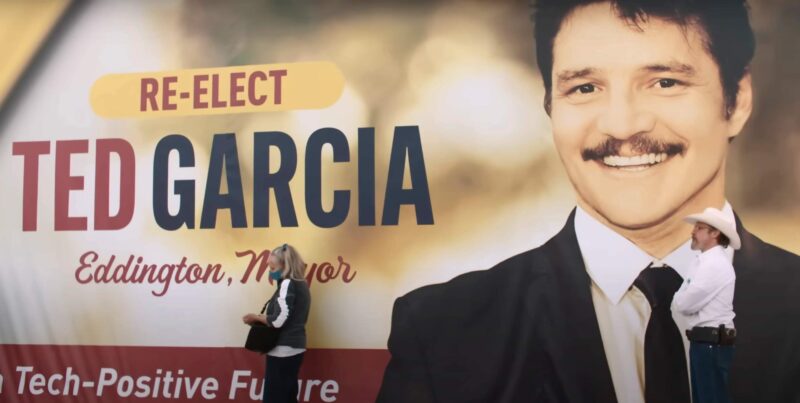
A seemingly easy-going soul at first, Joe eventually embarks on his own crusade. Outraged at being forced to wear a protective face covering, he decides to stage an impromptu mayoral campaign on an anti-mask ticket. The current mayor, Ted Garcia (Pedro Pascal) has clear centrist leanings, and dutifully wears his mask while out shopping. But Aster constantly teases at his insincerity – not least in his connections to big tech, with a deal quietly being hatched to build the aforementioned data centre outside Eddington. He talks up the job opportunities for the locals; the project’s detractors argue that it’ll suck up an already meagre water supply.
There are many other characters in Eddington, some depicted as on the left, others on the right, and some, like the young Brian (Cameron Mann), as opportunistic as the mayor. Desperate for a girlfriend, he starts spouting leftwing talking points in the hope of attracting Sarah (Amélie Hoeferle).
Eddington isn’t unlike Zach Cregger’s Weapons in this regard. It’s another anxiety-filled ensemble piece in which its emotionally tormented characters mostly clash and distrust one another rather than pull together. Both appear to feed into the sense that, since 2020, society has been turned on its head, and nothing is quite as it was.
In Eddington, Aster calls his fictional AI company SolidGoldMagikarp. It’s a reference to a kind of glitch that occurs in generative AI in which user inputs result in unexpected and weird outputs. The inhabitants of his small town certainly display some unexpected and weird behaviours of their own.
When Eddington emerged at Cannes earlier this year, reactions were polarised – even more so than for Aster’s wilfully strange 2023 psychodrama, Beau Is Afraid. Some critics were angry that Aster showed so much contempt for his leftist characters, whom he roundly depicts as buffoons. A piece in The New York Times described a Cannes afterparty in which attendees were yelling at each other over Eddington’s targets for derision. Nobody, it seemed, could quite agree whether it was more unfair to the right or left of the political aisle.
The film has received more than its share of positive reviews since, but there’s also a large number of critics who’ve been quite strident in their negative assessments.

“Eddington isn’t enlightening, focused or, frankly, thoughtful,” reads a review on Decider. “Not in the least. So what’s the point? I haven’t the foggiest.”
“It’s really too bad Ari Aster doesn’t have any ideas worth sharing,” said New York Times critic Manohla Dargis on The Last Thing I Saw podcast. “It’s biggest laughs are… pandemic-related, and then Black Lives Matter comes in, and it’s making fun of young white people and interrogating their whiteness. It’s cheap… I was really offended by it. And also the film is so dated. It’s not about power, it’s about individuals and how they’re reacting to these forces… Fuck you, Ari Aster.”
Aster has said that his film is polarising by design (“The film is deliberately provocative,” he said on the above-linked Moynihan Report), and so in that regard, it’s mission accomplished. A film that is about the dreadful things that occur when people are hived off into like-minded camps has itself prompted a similarly divisive reaction among some film journalists.
This is doubly ironic given what Aster said on the promotional trail: forget Covid, BLM and conspiracy theories. According to its own filmmaker, Eddington is about a data centre being built on the outskirts of a small town in New Mexico. To date, few mainstream critics have zeroed in on the data centre’s significance in their reviews.
Why, then, is that so significant? Because of something else we never see in Eddington, at least directly: the billionaires that have sold this technology to us in the first place. The smartphones and the social media apps on them indirectly lead to the events we see in Eddington – the organisation of fringe groups, the dissemination of fake news, the constant foment of fear and anger, the violence and the chaos.
And while the people of Eddington – and by extension, all of us – scream and point fingers at each other, arguing over who’s privileged and who isn’t, who has the right to speak and who doesn’t – the tech sector has only grown in power and wealth. Blessed (or perhaps cursed) with the benefit of hindsight, Aster sees AI, as represented by the data centre and the vast reserves of water and energy it needs to run, as the next phase in Big Tech’s consolidation of power.
In Aster’s reading, we are being controlled, manipulated, made sick by these firms and their products. The people of Eddington were too busy fighting to see the true enemy being built in their midst, and so the film ends with one leader gone, the other incapacitated, and the entire town essentially in the pockets of SolidGoldMagikarp.
There’s a disease in Eddington, Aster suggests, and it isn’t Covid-19. It’s technology.
Eddington is in UK cinemas now.