In the wake of Tom Noonan’s passing, a respectful tribute to his uncanny performance as Francis Dollarhyde in Michael Mann’s Manhunter. In terms of sheer eeriness, few screen villains can match Tom Noonan’s portrayal of the serial killer Francis Dollarhyde in 1986’s Manhunter. Based on a best-selling novel by Thomas Harris, it features stand-out turns ... In Manhunter, Tom Noonan created one of the great screen villains
In the wake of Tom Noonan’s passing, a respectful tribute to his uncanny performance as Francis Dollarhyde in Michael Mann’s Manhunter.
In terms of sheer eeriness, few screen villains can match Tom Noonan’s portrayal of the serial killer Francis Dollarhyde in 1986’s Manhunter.
Based on a best-selling novel by Thomas Harris, it features stand-out turns from William Petersen as a damaged, retired cop on the trail of yet another murderer, and Brian Cox as incarcerated maniac Hannibal Lecter (here mysteriously spelled Lecktor), and Michael Mann directs with a thrumming energy. Much of the film’s tension arises from his use of framing and suspense: a light switched on to reveal a blood-streaked crime scene; the long scenes of quiet punctuated by abrupt violence or its pounding synth-rock score.
Noonan, however, managed to project through all of that style through sheer magnetism. Unfeasibly tall, pale, eyes glinting, he brings a grimly fascinating dimension to Dollarhyde beyond what was written on the page. Just as Mann is obsessed with dualities – between one side of the law and the other, the two warring sides of one personality – so Noonan successfully depicts both the human being and the demon that exists in one body.
As Mann later put it in a tribute on Facebook, Noonan captured “the battered child become a killer adult – both alive in the same bottle.”
Right from Manhunter’s opening, we’re shown the brutality and sheer evil that Dollarhyde – dubbed the Tooth Fairy by the press, because he leaves teeth marks on his victims – is capable of. As Petersen’s Detective Will Graham puts it, he thinks nothing of massacring entire families to realise his sick fantasies. Subsequently, an effort to goad Dollarhyde into the open through an inflammatory newspaper story backfires, and the killer exacts his brutal revenge on sleazy reporter Freddie Lounds (a young Stephen Lang).
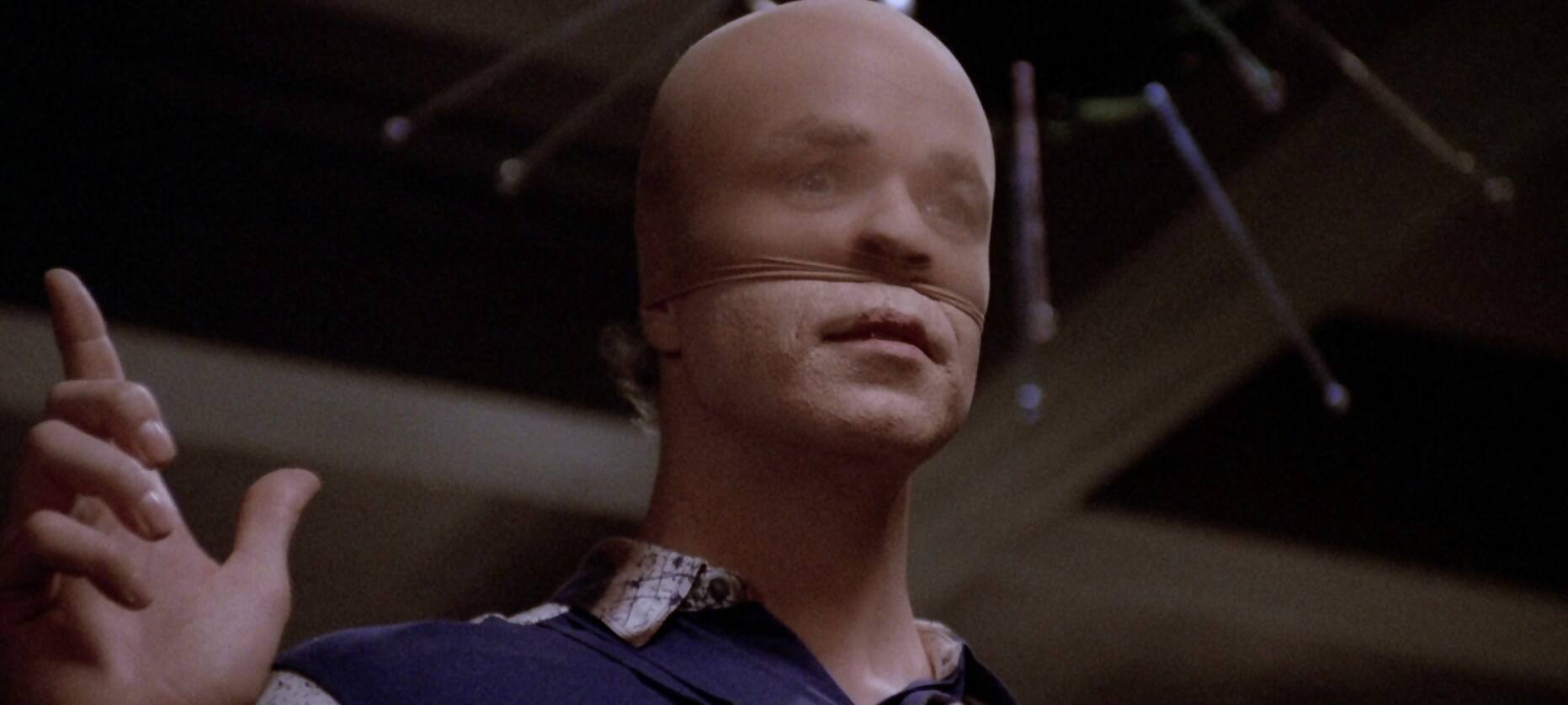
Noonan is utterly terrifying in this latter moment. His face partly obscured by a beige stocking, Dollarhyde proceeds to lecture Lounds on his obsessions and superiority, before forcing him to read a statement into a voice recorder. Noonan’s weird syntax and soft voice, so violently at odds with his formidable stature, make it easy to share in the victim’s terror. Indeed, Noonan’s performance is so disturbing that we don’t even need to see the facial torture that occurs afterwards; a cut to an exterior, and Lounds’ gargling cry, tells us all we need to know.
Later, Mann follows the structure of the novel, and shows Dollarhyde embarking on a brief relationship with a blind photo lab technician, Reba, played by Joan Allen. In lesser hands, these moments of romantic bliss might have seemed unearned, or even dull – why should we as an audience care about this sick creature and his dalliances? Instead, Noonan makes the relationship fascinating, even tragic: for a few moments, Dollarhyde gets to taste what it might be like to live as a normal human being – capable of love and being loved. But inevitably, the monster rears its head again, as depicted in the moment where, in the grip of a jealous rage, he tears the vinyl off his car’s dashboard, and the sound is uncannily like that of a roaring tiger.
“No. Not Francis. Francis is gone. Francis is gone forever.”
A failure in cinemas, Manhunter was only re-discovered later when director Jonathan Demme’s own Thomas Harris adaptation, Silence Of The Lambs, was released to Oscar-attracting acclaim in 1991. By this point, Noonan, whose acting life began in theatre, was well into a busy film career that would often see him cast as other villains, mostly because of his size and unusual demeanour. He memorably played Frankenstein’s sorry creation in Monster Squad (1987) and the psychopathic drug dealer Cain in RoboCop 2, whose brain and personality are rather foolishly injected into a heavily-armed robot.
Later, he played a murderer named Ripper (and himself) in the meta box office disappointment Last Action Hero (1993), the enigmatic tech expert Kelso in Michael Mann’s Heat (1995), while director Ti West harnessed his off-beat energy in 2009’s The House Of The Devil.
By then, the brilliance of both Manhunter and Noonan’s performance had been thrown into even greater relief. In 2002, director Brett Ratner (since disgraced over multiple claims of sexual misconduct) made Red Dragon – a second adaptation of the same Harris novel that formed the basis for Michael Mann’s thriller (the title was changed in 1986 due to fears that audiences would mistake it for a martial arts film).
Despite a huge budget and a cast full of respected actors, Red Dragon couldn’t begin to match Mann’s adaptation, and not just because Ratner is a journeyman where Mann is a genius. Everything that was subtle and alluded to in Manhunter was stated flat-out in Red Dragon. A brilliant actor though he is, Ralph Fiennes struggles to bring the same depth to his Dollarhyde; he comes across as flat and passive where Noonan constantly radiates an unpredictable energy. We’re never quite sure what Noonan’s killer do next; as a result, we simply can’t take our eyes off him.
Legend has it that Noonan remained in character for Manhunter’s shoot, insisting that the crew refer to him as Francis. It’s also said that he was kept away from much of the core cast, and that when William Petersen crashes through a window and comes face to face with Noonan in the final reel, the expression of shock on his face is genuine.
They’re fun little stories – the kinds of things film fans love to snack on and share. But beneath the facts lies one of the most chilling, fascinating villains you’ll find in any thriller – no mean feat, given that Brian Cox’s take on Hannibal the Cannibal can be found in the same movie, and arguably equals Anthony Hopkins’ showier, more famous performance as the same character five years later.
In his balance of humanity and monstrousness, Noonan’s turn as Dollarhyde ranks alongside Peter Lorre’s similarly magnetic performance as the killer Hans Beckert in Fritz Lang’s M (“Can’t! Must!”). He really is that good.
Noonan passed away on the 14th February 2026 at the age of 74. Like all artists, he leaves a lasting legacy of work; not least that unforgettable animal he created 40 years ago.
To quote Dollarhyde himself, “You owe me awe…”