We cast a weary eye over yet another week of dispiriting AI developments. Grab a stiff drink, readers. Everything is awful isn’t it? Genuinely, unremittingly awful. The absolute worst people have all the power, nothing works properly, and to quote a singularly catchy headline, the money is in all the wrong places. Little wonder, then, ... Michael Caine chatbot, Disney and the revenge of Tilly Norwood | Another week in AI, reviewed
We cast a weary eye over yet another week of dispiriting AI developments. Grab a stiff drink, readers.
Everything is awful isn’t it? Genuinely, unremittingly awful. The absolute worst people have all the power, nothing works properly, and to quote a singularly catchy headline, the money is in all the wrong places.
Little wonder, then, that so many of us seek refuge in the relative comfort of film and TV. Or we would, except there’s a coterie of rich people dedicated to making that sector unremittingly awful, too.
People who talk about the “opportunities” of generative AI and use terms like “powerful tool” and “we definitely don’t want to put artists out of work, honest.”
People like these…
The unknown soldier
First, to director Timur Bekmambetov, who leapt to prominence in the 2000s with such action thrillers as Night Watch and Wanted before returning this year as the producer on the shockingly ill-advised War Of The Worlds, which doubled as an alien invasion flick and advertisement for Amazon goods and services.
(The film’s makers insist that all the Jeff Bezos products just happened to be in there.)
Not content with his 21st century role as a screenlife movie mogul, Bekmambetov is but the latest person to utter the phrase, “AI is here to stay” – the tech sector’s equivalent of the serial murderer’s motto, “I will kill again.”
The filmmaker has been showing off his latest project to Variety this week: a piece of AI software called Stanislavsky. If you’re wondering why that name sounds familiar, it’s because it’s taken from Konstantin Stanislavsky, a theatre director famous for his school of acting. Bekmambetov has boldly taken the name for his software because, he says, it can generate digital actors capable of displaying realistic performances akin to De Niro or James Dean – both former Stanislavsky pupils.
Variety was certainly impressed by the filmmaker’s demonstration, which apparently showed a soldier sitting in a hospital room, reciting a heart-wrenching soliloquy. “This guy is completely lifelike,” the outlet enthused.
Explaining how the system worked, Bekmambetov said that its virtual actors can be told how to perform through simple ChatGPT-like prompts – so if you want to make your digital Brando act like they’re sad, you can tell them their dog just snuffed it. No, we’re not making this up.

Suggested product
Issue #61 (Horror Special): Magazine + Signed Ben Wheatley F&TT&N: Issue #4 (Reprint)
£14.99

Said Bekmambetov, “In the prompt I’ll use the Stanislavski system and write something like ‘His dog died yesterday, and the sunset is reminding him of what it was like to play with his dog in the park.’”
Unfortunately, we haven’t had a chance to evaluate the soldier’s monologue for ourselves. Variety did have a demonstration video embedded in their article, but less than 24 hours after the piece was put live, the clip has been “removed by the uploader.”
AI is here to stay; the soldier, seemingly, isn’t.
Oh Christ it’s Tilly Norwood again

Speaking of AI actors, the creator of Tilly Norwood has emerged to give a new interview – having allowed a few weeks for the dust to settle after that wave of collective horror back in October.
Ms Norwood, you may recall, made headlines all over the place when her makers, a company called Particle 6, claimed that the AI-generated thespian had been signed up by a Hollywood talent agency.
The Screen Actors Guild reacted with horror. Actor Ralph Ineson wrote on Twitter, “Fuck off.”
The mastermind behind Norwood, Dutch comedian turned tech guru Eline Van der Velden, went rather quiet, but this week spoke to Variety (yep, them again) to tell her side of the story. Tilly Norwood is, she has insisted, “satire,” and now adds that she was intended “to spark conversation.”
“I very much want this creative renaissance to come from the creative industries,” Van der Velden said. “We need to take control of it as opposed to it being imposed by the tech industry. There are going to be AI actresses, right? That’s a given. Tilly’s not the first. Tilly’s not taking anyone’s job. She’s created jobs actually. And there’s a lot of humanity and people behind her that people forget about.”
One thing Van der Velden didn’t address was the creepy, leery quality to the proof-of-concept video designed to show off Norwood’s acting prowess. One gen-AI character in the clip coos about her “Girl next door vibes;” another jokes about ignoring consent during “romantic scenes,” while yet another says “She’ll do anything I say. I’m already in love.”
Van der Velden did say, curiously, that the angry reaction to Norwood was confined to the United States. “This backlash thing didn’t exist in the UK,” she said, “because people understand that we’re using it as a force for good.”
Clearly not a Film Stories reader.
Six finger discount

Perhaps proving that he hasn’t logged onto the internet at all in the past year or so, Disney boss Bob Iger announced on an earnings call this week that his company’s streaming channel – that’ll be Disney+ – is on the cusp of “the biggest and most significant changes” since it launched about six years ago.
It’s 2025, so you can guess what the changes are: shoehorned-in AI gubbins. Specifically, subscribers will be able to use the service to create their own “gen-AI short-form user-generated content.”
By the sounds of things, Disney+ will soon have a feature much like Sora 2’s mix of social media app and video slop (sorry, content) generator. Meaning users will be able to type in a prompt and the software will produce a clip in response.
This could open a bumper-sized can of worms for Disney.
When Sora 2 launched a few weeks ago, the platform had few if any guardrails in place to prevent people from breaking copyright laws all over the place. There were videos of OpenAI boss Sam Altman grilling Pikachu on a barbecue, clips of Rick And Morty characters shilling crypto, and so on. A day or two later, some buttons were pressed behind the scenes and making copyright-infringing videos became more difficult.
All the same, it’s an object lesson in how generative AI can be used in ways its creators don’t expect (or if we’re being cynical, companies fully expect it, but let it happen and make apologies later).
A couple of years ago, this writer was introduced to the term ‘Time to Penis’, which essentially means, if you add any kind of creative element to a piece of software, it’s merely a matter of time before someone uses it to make something phallic.
The family-friendly firm Nintendo discovered this when The Legend Of Zelda: Tears Of The Kingdom came out in 2023, and – within days – users shared clips of the mucky things they’d made using its construction system. One bit of footage showed a gigantic human effigy with a jet of flame emanating from its penis before its testicles (made of bombs) exploded violently.
Unsurprisingly, users of generative AI platforms have often produced much, much more nightmarish things than this. Disney may think it’ll have guardrails in place to prevent its customers from making Mickey Mouse do something startling to Donald Duck, but as recent history has proven, people reliably find sneaky workarounds.
To paraphrase Jurassic Park, filth finds a way.
AI at the Beeb

Perhaps travelling over on the same boat containing the rights to Doctor Who, the former head of Disney StudioLAB is coming back to the UK for a plum job at the BBC.
Deadline reported earlier this week that British executive Alice Taylor, who worked at Disney in various roles for over a decade, is to head up the BBC’s Creative Lab – an outfit quietly set up a few months ago to “blend cutting-edge AI with world-class storytelling,” as Taylor put it herself in a statement.
If you’re wondering what the BBC’s idea of AI storytelling looks like, consider the BBC Maestro course announced in May, which brought back a digital ghost of Agatha Christie to dispense writing tips.
It’s a common theme in the AI space: anyone and everything is fair game, and if there’s money to be made, the dead can and will return.
Out of shape
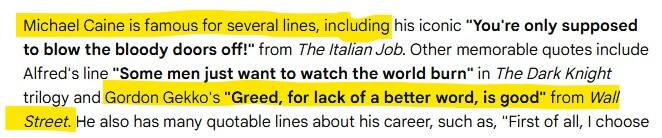
…which brings us somewhat neatly to the 92-year-old actor and national treasure Michael Caine, who it was announced this week has signed away the rights to his voice. He’s made a deal with ElevenLabs – an AI audio company which says it specialises in “voice agents that listen, talk, and act, localise content at scale, tell stories, and improve accessibility” for an undisclosed but probably sizeable figure. ElevenLabs has a market valuation of about $6.6bn, so it probably has plenty of other people’s cash to spend.
“For years, I’ve lent my voice to stories that moved people – tales of courage, of wit, of the human spirit,” Caine said in a statement that he definitely wrote himself. “Now, I’m helping others find theirs. With ElevenLabs, we can preserve and share voices – not just mine, but anyone’s.”
Caine isn’t alone, either. Fellow Oscar-winner Matthew McConaughey has signed a similar deal, it was announced at the same time, meaning his voice will also live on in perpetuity. We can only guess at where Caine and McConaughey’s distinctive tones might turn up in the decades to come.
Maybe, when the machines take over and the mass enslavement of humanity begins, it’ll be Caine’s synthesised voice soothing us as we’re turned into flesh batteries.
Or maybe a Neo-type figure will emerge and, following a lengthy battle, help us overthrow our AI oppressors.
Future generations will call that uprising The Caine Mutiny.