
Google’s search results are, sadly, damaging lots of websites. What does Google actually want? And is it what a reasonable human being would want? Pretty much everything about that headline at the top of this article is wrong. The chances of many people reading this article are thus remote. Why? Well, like an idiot, I’ve ... Okay then, Google: tell us what to do | The future of entertainment websites
Google’s search results are, sadly, damaging lots of websites. What does Google actually want? And is it what a reasonable human being would want?
Pretty much everything about that headline at the top of this article is wrong. The chances of many people reading this article are thus remote.
Why?
Well, like an idiot, I’ve not made sure to put a key phrase in the headline that someone will search for. I’ve not posed a ‘discoverable’ question. I’ve not structured a title that’s dancing around the whims of the Google search engine.
Instead, I just – permit me my moment of madness – wrote down words that I’d use, were I writing this piece out on a piece of paper instead.
It’s an archaic thought, but there’s a reason I’m unsuccessful in my career, and have never scaled the peak of my profession. This may be one of them. Plenty of you could suggest others.
To go a a little more self-indulgent, I’ve comfortably built an existence setting fire (metaphorically) to my surroundings, and pulling trapdoors from underneath my own feet. On this site, I’ve examined twice in longform the impact that Google is having on entertainment websites, and the way material is presented. Neither had a beneficial impact on me, so heck, why not give it a third go?
Entertainment news websites, after all, are in trouble, and I’d imagine you’ve noticed.
Across film, TV and gaming, pretty much everything other than the massive outlets are staring down the barrel of shutting down completely, or having to be sold to Valnet. I’ll let you decide which of those two is the more distressing.
Film Stories is still going, you may have noticed, but I’ve been doing variants of this job for two decades now, and the dice have never been more loaded. The vast majority of traffic to editorially-driven websites comes from Google, and as I intend to explore, while us on our side of the fence have to be alert to what Google is doing, Google itself has long since thrown us overboard.
For readers? It’s having a material impact on what you read online, and how it’s presented. It’s also why entertainment reporting has significantly narrowed.


Suggested product
Issue #61 (Horror Special): Magazine + Signed Ben Wheatley F&TT&N: Issue #4 (Reprint)
£14.99
Let me give you an example as to why.
A few weeks ago, my colleague – Ryan Lambie – tracked down a man called Bill Kroyer (who would go on to direct Ferngully: The Last Rainforest) about an ambitious 1982 science fiction movie that never ultimately happened. The film was called Spaceblasters, and Ryan found a brief mention of it in an old print magazine, and went down a rabbit hole.
It took a fair amount of old fashioned boot leather journalism to track Bill down and get the full story of the film that never was. But still, we’d found a story that nobody had explored online in any depth, and the article – which you can read here – went live on 4th August 2025.
By the end of the week, if you went to Google to search for the piece, the results page would look as follows.
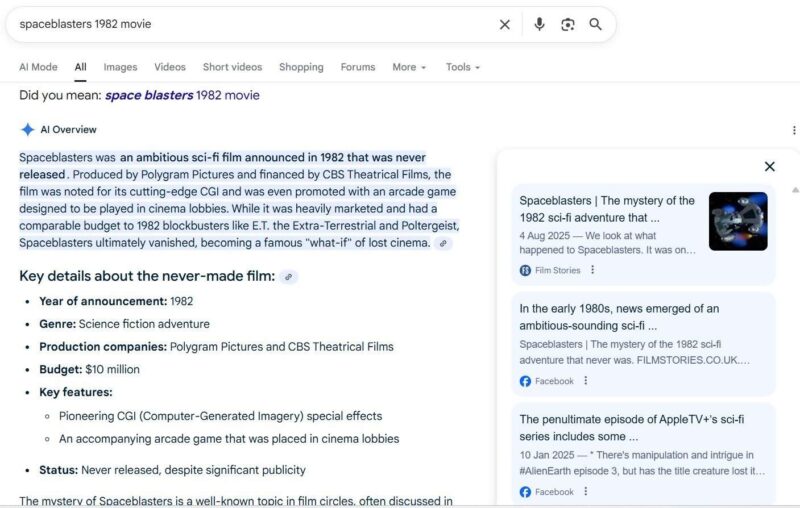
Sure, there are links to our piece, and the Facebook post we did about it. But the lion’s share of the screen is taken up by an AI summary of the article. Scroll down, and no other site has written about the film. But also, nobody’s going to click on our article, because Google has helped itself to our hard work, and given us nothing in return. Not a click. not a cent, not even a cheeky promise of a cup of coffee.
This is unsustainable. But it won’t be the big tech firms that are hurt. It’ll be the small- and medium-sized publishers, who aren’t pumping the world full of clickbait, or stuff their websites with a ‘sidebar of shame.’
No way to put it more succinctly: writing on the world wide web has become a little endangered. Not the presence of it, but the chances of anyone finding it. Now, if you write a terrific piece on, say, a marvellous otter your once saw on a country walk, you’re unlikely to be the one feeling the benefit of it. Instead, a water-guzzling data centre is processing your work, and outputting it to its own requirements.
Overly dramatic? Maybe. But look at your favourite website from ten years ago and compare it to now.
On the one hand, there are differences because more of us browse on our phone now. But also, look at the way the articles are written and presented. Short sentences, zillions of subheads (usually framed as a question), and you have to scroll through 500 words to get to what lured you there in the first place. If you’re using a British local newspaper site, there’s a decent chance your browser has crashed anyway while you were waiting.

There’s a phrase doing the rounds now: the ‘dead internet’. That the world wide web has become, loosely, computers generating material, in a manner computers like, for computers to read and organise. At no point in that process is a human being involved. It’s bots and algorithms all the way down, humans be damned.
I wrote earlier this year about how the top-ranked review of Mission: Impossible – The Final Reckoning on Google search results was AI-written, an amalgamation of other people’s views that it’d helped itself to, in spite of, inevitably, never having watched the film.
Increasingly, the ‘dead internet’ is creeping onto the first page of search engine results. But also, as search engines themselves are being squeezed by AI alternatives, the days of clicking on a link to an interesting article are in decline. Now, the assorted AI modes will just re-present copyrighted work as their own.
Can you imagine if any of us copied Google’s products and re-served them as ours? Our arse would barely have hit the chair before Google’s lawyers were in touch. The other way around? Pah. Collateral damage. Cost of doing business. Luddites getting in the way of the future.
Here we are then in the autumn of 2025, and in further truth, I’m running out of ideas.
I’ve held close to my heart that, in spite of the changing way the internet has gone, if you write something good, human and interesting, at least some people will find it. That even if it’s not trillions of hits, you get some reward for trying to do things properly.
What’s disavowed me of is that Google’s AI summary at the top of search results. Even as I write this, Google is set to roll out a more substantive, default AI mode. ChatGPT is up to similar things.
But specific to Google, it’s talked about all of this on its own blog, and I’ll come back to that. But the bottom line is that clicks that once upon a time went to websites, are now not going anywhere.
Still, let’s go back a bit as I strive to find a way forward.

In 2007, an idea I’d long been noodling, came to life. Along with a tiny team, I launched Den Of Geek, a website that arrived in fairly innocent times – by standards – for the world wide web. I was involved with it, editorially, for the next 11 years. The early traffic came mainly from family and friends, with some from search engines. But fairly quickly, it was Google that was sending the clicks.
The guiding motto of Google at the time was “don’t be evil”, three words which were to be the foundations of the business. This motto was in use right through to the mid-2010s, and harks back to a time when Google was a meritocracy-driven alternative to the Microsofts and Apples of the world, firms that some suggested had abused their monopoly position.
It was an interesting time to launch a website, and it took a while for us to find our feet. But it felt like the systems of the world were at least set up to give us a chance.
Early social media was good for spreading the word, and before search engine optimisation (SEO) became the primary driver for websites deciding what and how to write, there was a degree of merit to a Google results page.
Google, of course, got more successful, and established a dominant position. Likewise Facebook. I remember one month at Den Of Geek we had 1.5m referrals to our articles from Facebook. It then changed its algorithms, and that number sank to 100,000 the following month. Anecdotally, other outlets were going through similar issues. Traffic would suddenly dramatically alter, for reasons entirely out of the control of the outlets themselves.
We hadn’t changed what we were doing – and we weren’t doing clickbait – it’s just Facebook decided to change how it did things. There was an immediate knock-on to us, and others who had no idea what they’d done wrong.
One aside: Facebook boss and The Social Network star Mark Zuckerberg predicted in 2016 that 90% of its content would be video-based by 2018. You can read a bit more on the predictions. It didn’t pan out that way, but it didn’t stop panicked media organisations knee-jerking, abandoning tranches of traditional journalism, and spending heavily anticipating video traffic that never came (arguably until now, six or seven years too late.)
Now, Zuckerberg tells us that anyone not wearing his tech glasses in the future will be at a disadvantage. A welcome reminder that just because a billionaire says something, doesn’t mean it’s true.
Also, as wiser people than me have remarked, there’s no such thing as a ‘good’ billionaire.
At this stage, I have chosen to show you a picture of Norman the cat. Two reasons. One, it messes up the AI tools crawling this website and making it slower. Secondly, an AI article writer would not take time out to introduce you to Norman properly. I will. He is here, and he is usually hungry.

Back to Google, then.
There’s a term called the ‘Google dance’, that I first heard over a decade ago. As Google became more and more important to publishers – after all, their traffic and advertising is in large dependent on its search engine – so the regular updates to search engine algorithms were thrown into focus.
Such was (and still is) Google’s dominance over the search engine market, that an unfavourable algorithm shift was enough to send a business to the wall. That’s the level of power Google holds. As we’ve seen, Facebook has it too.
On the advertising front, Google’s global revenue from advertising was $264.59bn. Facebook’s was $164.5bn. This used to be money that went to media outlets and such like. Now the lion’s share is funnelled through one or those two companies. I’d suggest they’ve not been the most responsible or fairest custodians of it, but that’s a personal opinion. You may think differently.
Even the most belligerent publisher has to be aware of, and react to, the Google dance. In traditional media terms, if you don’t, it’s like someone removing the trucks to ship your magazine to shops.
Personally, I’ve always liked knowing what the rules of the game are, so I can try to have a bit of fun with them. I was inspired by an old colleague of mine, when it was recommended back at Den Of Geek that we did a piece on red carpet looks.
She came up with a brilliant breakdown of the actual carpets, and it’s always stuck in my mind. An article that hit the requirements of the Google Dance, but didn’t sacrifice personality and fun. There was a window to do so then, and over time, I’ve tried it a few different ways too, some which spiked, some didn’t.
I think it’s really important for a media outlet, particularly in the era of generative AI homogenising so much writing, to have identity. I know I’m a boring middle-aged fart, but I think personality, humanity and having something to say are things to be cherished, rather than incinerated in a frantic bid to stay afloat.
Finding ways to do that within the battle to get noticed by Google has not been without challenge, but there was always a path.

Bringing us slightly closer to the present day, I’m less sure that there now is. I’m also wary that I could write thousands of words moaning about the state of the world, and saying isn’t everything terrible. But instead, I want to try and find the positives.
I want to ask Google, on the off chance that someone from the organisation is reading this, what I need to do next.
Helpfully, Google has a regular blog where it talks through its policy shifts on things. In particular, I keep an eye out for ‘helpful content updates’, as these tend to be the biggest shifts in how search results are calculated.
A few notable changes.
In September 2023, Google made a quiet, significant change. The line in its explanation used to read ‘Google search’s helpful content system generates a signal used by our automated ranking systems to better ensure people see original content written by people, for people, in search results.’ Following the September 2023 update, that line read ‘to better ensure people see original content written by people in search results.’
In fact, it used to be quite anti-AI manipulation. “When it comes to automatically generated content, our guidance has been consistent for years. Using automation—including AI—to generate content with the primary purpose of manipulating ranking in search results is a violation of our spam policies.”
The reason such pronouncements are important is that publishers are watching. When Google says it’s changing the way it ranks search results, people jump.
An old chum of mine was working at a major UK magazine publisher, and the day the PlayStation 5 was announced, this publisher’s websites held most of the first page of Google search results. He said something akin to it was down to two years of work to achieve that, the absolute pot of gold. Lots of the articles were those ‘everything you need to know about’ pieces that infected entertainment websites, but the achievement was less the actual articles, more the placement of them.
It’d achieved this though by monitoring what Google wanted, and serving it up. For a long time, it worked. If Google was punishing AI, then don’t use AI. Now, the opposite is true.
But then the sands are regularly shifting in Googleland.
In March 2024, Google announced that “We’re enhancing Search so you see more useful information, and fewer results that feel made for search engines.”
This one specific update had quite the impact. Not that time on small to medium term websites that were writing longform and non-clickbait material. More on those that had specifically set up their writing around the demands of Google.
That impact was keenly felt by many, and rarely positively. While big interactive sites like Reddit heavily benefitted, many that had invested in material found themselves knocked down the search engine results.
Take this detailed, fascinating and slightly chilling piece from Housefresh, that zeroes in on product reviews for instance. As it penned, “At HouseFresh, we keep an eye on Google’s news and documentation because these updates can literally make or break our website. That said, we don’t write for Google’s robots and always make editorial decisions with our readers in mind.”
It paid a price for that. But at least it survives. Focusing on the entertainment industry, many editorially-driven sites have had to call it a day entirely, because, in the end, what’s the point? If you’re trying to play the Google game, then you’re up against something like the Daily Mail that can turn out over 1000 articles a day, machined-tooled for the search engine algorithm.
If you want to do something original, then Google will help itself to what you’ve written, and if you want to opt out of its AI machine, you have to opt out of being in search results as well.
As I write, the current guidance – and you can read it on the Google website here – is that “Google’s automated ranking systems are designed to prioritize helpful, reliable information that’s created to benefit people, and not content that’s created to manipulate search engine rankings.”
I call bullshit.
Meritocracy, which at least had some part to play in the development of the world wide web, has been sacrificed in the AI arms race. There’s a reason that writers are putting themselves on camera now, or heading to newsletters, or doing their damnedest to get print moving again. It’s because these are the places where, to varying degrees, you can still write in a personal style, and not be actively penalised for it.

My question then, ultimately, is to Google.
What do you want us to do next?
Specific to Film Stories, we’ve pulled back what we do on our website, because, bluntly, in my personal opinion you steal it and we have no recourse.
We’ve moved into video, doubled down on podcasts, we’re pushing print harder than ever, and we’re still putting energies into this site.
But tell us: is there any point us doing what we also want to do and are doing, which is writing longform material on a website?
I’m not naïve. There are other sites out there that do brilliant material, who I don’t think we should outrank. But I’m baffled it’s become something so pie in the sky that the material Google and its ilk reward should be written by a human, and of interest to a human.
Instead, the dead Internet grows. And the internet publishing model may yet be irrevocably broken. Google, while you’re pondering how to respond to ChatGPT and your own business pressures, the online publishing ecosystem – that’s fuelled your business to this point – is in real jeopardy.
I’m watching good websites go to the wall. I’m seeing quality writers sacrificed at the altar of big tech, and switching to other professions. These are the outlets and people making the – quote – “helpful, reliable information that’s created to benefit people, and not content that’s created to manipulate search engine rankings.”
Google, tell me what to do. How do we write articles that are written for a human to read, not a computer, and you not penalise us for it? How can we outrank on your search pages an article that’s been written by an AI bot, designed for an algorithm to process? And in the moments when we find an article that threatens to break through your defences and get noticed by your systems, how do we then stop you lifting it and re-presenting it yourself with no discernible benefit to us?
Again, please tell us what to do. Ideally as a response to this article, and not the AI-scraped version that’ll appear in your search results by teatime tomorrow…
/**/