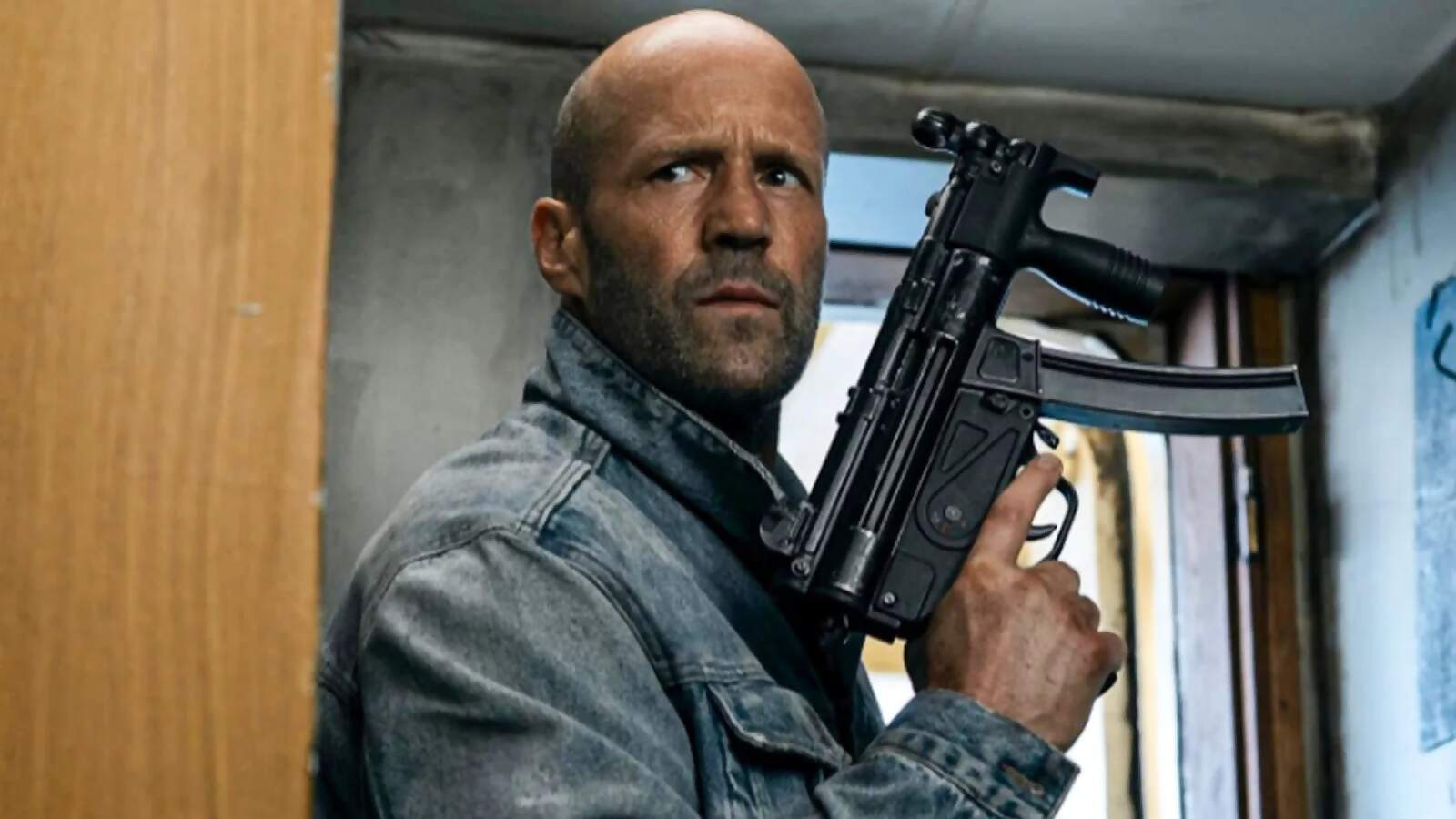
Sylvester Stallone, Scott Eastwood and more star in Mission Alarum, now on Prime Video. We ponder how such a cheap film got such a great cast. NB: The following contains mild spoilers for Mission Alarum. What would the political-economic concept of austerity look like when applied to an action movie? For the answer, look no ... The mysterious economy of Mission Alarum, starring Sylvester Stallone
Sylvester Stallone, Scott Eastwood and more star in Mission Alarum, now on Prime Video. We ponder how such a cheap film got such a great cast.
NB: The following contains mild spoilers for Mission Alarum.
What would the political-economic concept of austerity look like when applied to an action movie? For the answer, look no further than Mission Alarum, an action thriller that has just emerged on Prime Video in the UK. Also known simply as Alarum in most territories, it stars Scott Eastwood, Sylvester Stallone, Willa Fitzgerald and Mike Colter – an impressive cast for any genre film, we’re sure you’ll agree.
The film’s budget – said to be around $20m – appears to have gone on its stars’ salaries, because Mission Alarum is the opposite of that old critical chestnut, “the money’s all there on the screen.” Almost every shot has the feel of a production frantically stretching every penny for all it’s worth.
Now, before we go much further, it should be pointed out that this isn’t some cruel tear-down of a movie simply because it was made with meagre resources. Cinema history is filled with superb genre films that have made the most of their tiny budgets: Jeremy Saulnier’s Blue Ruin and Green Room, for example, were small, independently-made thrillers that still managed to make pulses quicken with their moments of violence and suspense. They’re cult classics for a reason.
The difference between those films and Mission Alarum is that they were written and conceived around the finances they had available. Blue Ruin had a tiny cast and a limited number of locations; Saulnier got a bit more money together to make his follow-up, Green Room, so he pulled together a larger, starrier cast (including Patrick Stewart!) but kept the location work largely restricted to a grimy rock club in some US backwater town.
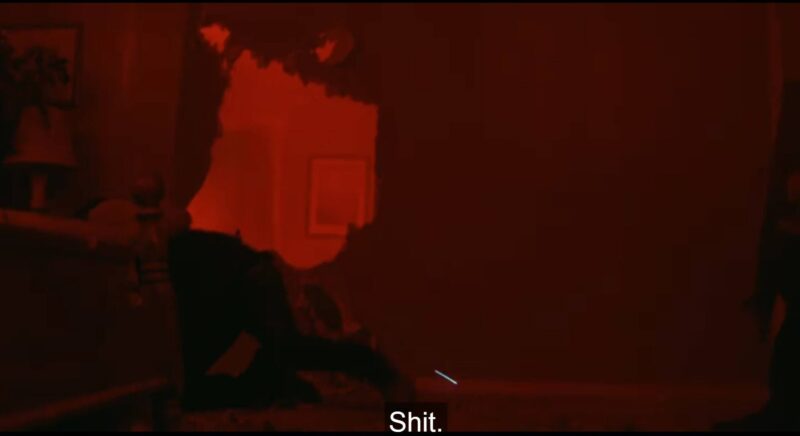
Mission Alarum, on the other hand, tries to pull off a thriller in the mode of Jason Bourne, John Wick or even Mission: Impossible – but with a budget that looks closer to an episode of TV’s Homes Under The Hammer. Hence why there’s a plane crash set-piece in which we don’t see the plane crash, and a building riddled with rocket propelled grenades which proceeds to glow with an eerie red light instead of catching fire.
We’re getting ahead of ourselves, though. A quick plot summary, for those interested: Scott Eastwood stars as Joe Travers, an agent working for some clandestine organisation connected to US intelligence. In an opening scene-setter, Travers is engaged in a pitched battle with agents from a rival group called Alarum – one of them being Willa Fitzgerald’s Lara. Theoretically, the two should be killing each other, but they wind up falling in love at first sight instead.
One Bond-eque title sequence later (with some surprisingly good music from composer Yagmur Kaplan), and we’ve moved on by five years. Joe and Lara are now married, permanently on the run from their former employers, and are currently staying in a remote hotel somewhere outside Gdansk, Poland. But then a plane crashes seemingly yards from their hotel, throwing their lives back into chaos. The pilots aboard the small aircraft, Joe soon recognises, were assassinated; their murderer was after that mainstay of modern thrillers, a USB stick containing vital data. Joe pockets the USB stick (we’ll leave it for you to find out where it was hidden…), which puts he and Lara in the crosshairs of assassin Orlin (Mike Colter) and Joe’s former agency colleague, Chester (Sylvester Stallone, carrying the casual air of an actor who’s not exactly doing a deep dive into the character he’s playing).
All of which leads to a series of low-octane action sequences, with the plot switching between Lara, punching and murdering Russian mercenaries at the hotel, while Joe offs bad guys in the woods and later the mean streets of Gdansk (which, thinking about it, feels strangely quiet for a city). The threadbare budget is in evidence from the start: there’s a close-quarters shoot-out in a hotel room where you can clearly see that everything pertaining to a gunshot is computer generated. A pair of bullet holes in a window. The little spurts of blood when Scott Eastwood smacks a goon in the face with his own shotgun. The muzzle flash and the faintly comical puff of smoke from the end of said shotgun. All plainly CGI.
Now, there isn’t necessarily anything wrong with the digital approach – the John Wick franchise used CGI muzzle flashes and the like as a cornerstone of its own style of in-your-face action. In fact, the set-pieces in those movies would have been far more dangerous – maybe prohibitively so – with traditional squibs and blank-firing weapons.
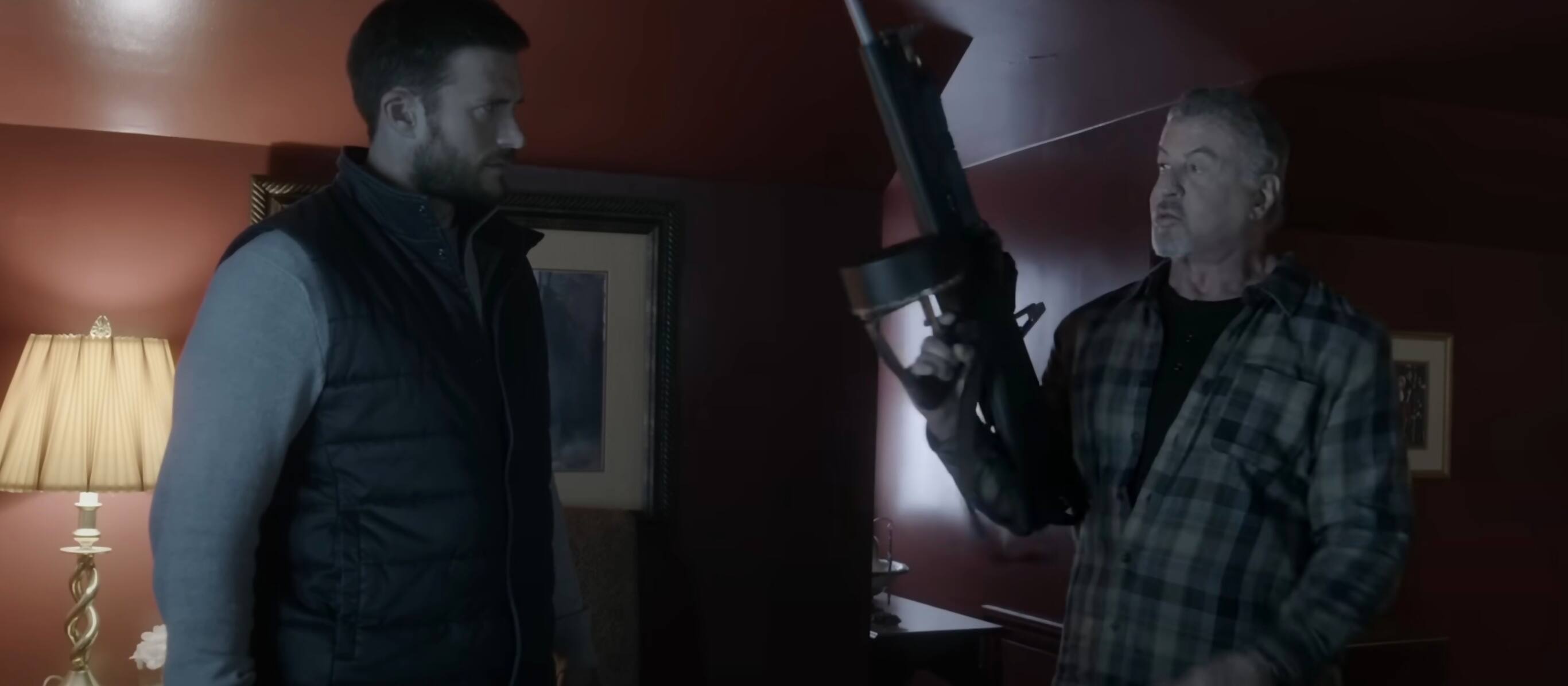
The problem with Mission Alarum’s CGI-enabled action is twofold. Number one: none of the effects looks remotely convincing. Number two: the guns the characters hold don’t look real. The gigantic AA-12 firearm Stallone is shown waving about, for example, looks like a soft air gun – which it possibly is. Worse, poor Stallone and Eastwood appear to have been asked to simulate their weapons’ recoil by jerking their arms in the air, meaning they look like a pair of kids playing finger guns down their local park.
In between the unconvincing action scenes, Mission Alarum is plain weird. There are repeated sequences where Joe’s desk jockey superiors talk about the plot while sitting around in what appears to be an abandoned school. They’re the kinds of conversations that actually make the film more confusing – a tangled mess of acronyms, talk of conspiracies and shadowy pasts hidden away in old filing cabinets.
Even moments of suspense are undone by some confused writing and staging. Joe discovers the crashed plane during a morning stroll with another hotel guest (Bridgette, played by Isis Valverde) and a pair of tour guides. Then the villainous Orlin turns up with a small army of identically-dressed goons, and (mild spoiler alert) summarily executes Bridgette mere inches away from where Joe’s standing. The reaction shot of Eastwood, wearing the expression of someone waiting for their order at a Starbucks, is truly something to behold.
It’s a wonder, really, how on earth such an impressive cast was convinced to star in such an undercooked souffle of a thriller. Stallone surely doesn’t need the money at this stage; Willa Fitzgerald, in such films as Strange Darling and Kathryn Bigelow’s upcoming A House Of Dynamite, ordinarily has a knack for choosing decent roles for herself. Mike Colter and Scott Eastwood are similarly far too good for all this nonsense. So what happened?

A possible clue might lie in producer Randall Emmett. A 2021 piece published by New York magazine depicted him as the grand master of something called the ”geezer teaser” – a cheaply-made genre piece that prominently features an ageing action star in its promotion, but whose contribution to the film itself is largely minimal. The first of these was 2003’s Out For A Kill, which nominally starred Steven Seagal and went straight to video.
Among Emmett’s other efforts as producer you’ll find 2008’s Righteous Kill, perhaps best remembered as the second (and infinitely worse) pairing of Al Pacino and Robert De Niro after Heat. Then there was a series of late-career Bruce Willis films, including Setup, Fortress and Vice, more Seagal (Submerged, Today You Die, Mercenary For Justice) and a few films featuring Stallone before the subject of this piece (Escape Plan 2: Hades, Backtrace, Escape Plan: The Extractors).
None of these are what you’d call classics. But across some 110 films and counting (we almost forgot to mention he produced Neil LaBute’s take on The Wicker Man), Emmett appears to have carved out a niche by making low-budget, not-great genre films that nevertheless turn a profit on streaming or disc. Mission Alarum is simply the latest of them – one that similarly drags together some recognisable names for a forgettable action adventure.
(There are also murky allegations levelled against Emmett, listed in the New York magazine piece and on Wikipedia, which we won’t get into here.)
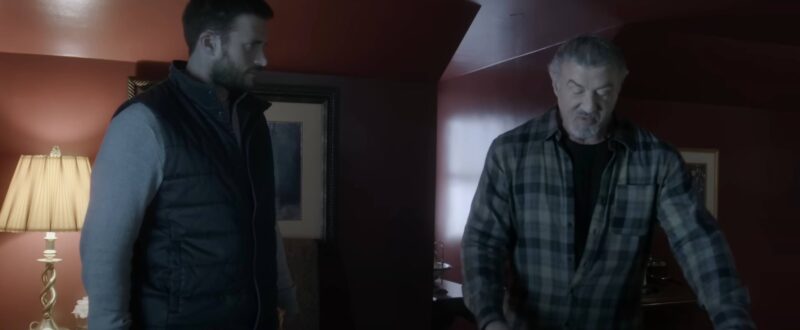
All of which explains why Stallone isn’t in Mission Alarum for very long, and why so much of the film feels as though it’s been shot around the other stars’ busy schedules. Aside from one or two scenes, Willa Fitzgerald and Scott Eastwood spend much of the plot in separate locations. In the scenes where Stallone does show up, he’s mostly indoors, talking to Scott Eastwood’s Joe or pretending to discharge his big gun.
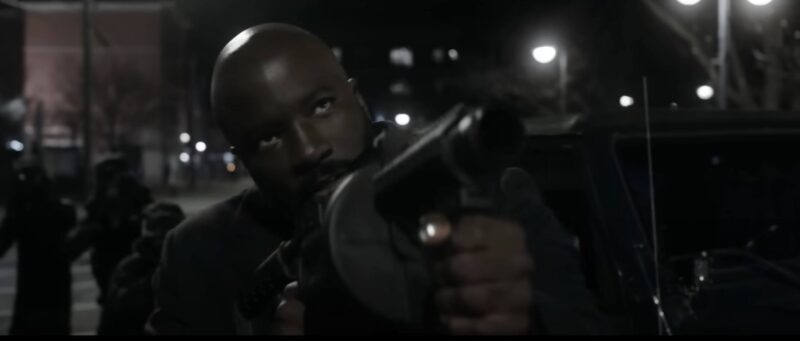
This brings us to perhaps the most jaw-dropping scene in the movie. Joe and Chester are holed up in a cardboard-looking hotel room when Orlin and his forces arrive. Orlin’s men open fire, causing CGI damage to the building. Then Orlin himself pulls out some sort of grenade launcher and begins firing it through the windows. The budget evidently couldn’t stretch to staging a real fire, so the production makes do with filling the sets with stage smoke and dotting red lights around the place, creating a warm, fiery glow. This wouldn’t look too convincing by itself, but the cinematography is so slapdash that we can actually see the lights behind Stallone and Eastwood in more than one shot.

It can’t be overly stressed just how unfinished the effects look in this whole sequence. The movie looks so unconvincing at this point that it almost tips over into the realm of surrealism – like Lars von Trier’s Dogville, where Nicole Kidman and her co-stars acted against a wilfully minimal backdrop that can barely be described as a set.
Mission Alarum ought to be taught in schools as a philosophical thought experiment, much like the Ship of Theseus or Trigger’s Broom. How much can be carved away from an action movie – whether it’s budget, quality sets and props, good taste or common sense – before it ceases to qualify as an action movie?
If nothing else, we should be grateful to Colter, Eastwood, Fitzgerald and Stallone for giving up their time to make something so boldly experimental – even if they didn’t necessarily intend to.
Mission Alarum is available now on Prime Video.
/**/