Psycho author Robert Bloch wrote a fascinating review of the tech thriller WarGames in 1983, calling it ‘outstanding’ but criticising its ‘amoral’ hero. The high-tech thriller WarGames was one of 1983’s biggest hits. Starring Matthew Broderick as a young computer whiz whose decision to hack into the US military’s defence systems almost triggers World War ... In 1983, the author of Psycho reviewed WarGames
Psycho author Robert Bloch wrote a fascinating review of the tech thriller WarGames in 1983, calling it ‘outstanding’ but criticising its ‘amoral’ hero.
The high-tech thriller WarGames was one of 1983’s biggest hits. Starring Matthew Broderick as a young computer whiz whose decision to hack into the US military’s defence systems almost triggers World War III, it was popular with both audiences and with critics. Roger Ebert praised it for its pace and plausible integration of then-new computer technology; it was, he said, “one of the best films so far this year.”
One lesser-known review from the period, meanwhile, came from the desk of Robert Bloch – best known as the author of Psycho. Published in 1959, that novel was, of course, famously adapted by Alfred Hitchcock the following year. Bloch was a prolific writer of horror, crime and numerous other genres, though, writing dozens of novels, short stories and screenplays over his long career.
In 1983, Bloch took the time to write a lengthy review of WarGames for the sci-fi film and TV magazine, Starlog. It’s a fascinating piece of writing, with Bloch placing director John Badham’s movie in the context of a post-WWII tradition of teen movies – from the biker gang movies of The 1950s (The Wild One, Rebel Without A Cause) to what he calls the ‘beach blanket’ films of the 1960s, which were typically comedies in which “dumbass oldsters are outwitted by clever youngsters,” as he puts it.
In Bloch’s reading, WarGames is a teen movie for a 1980s era of videogames and self-absorption – pointing to an “ugly aspect” in the film that “must be challenged and considered.”
Not that Bloch dislikes the film as a whole – far from it.
“Let me say, up front, that WarGames is an outstanding film,” he writes. “Its production values are impressive. Its script, direction, editing and cinematography are deft. The performances of Matthew Broderick as David and Ally Sheedy as Jennifer are outstanding.”
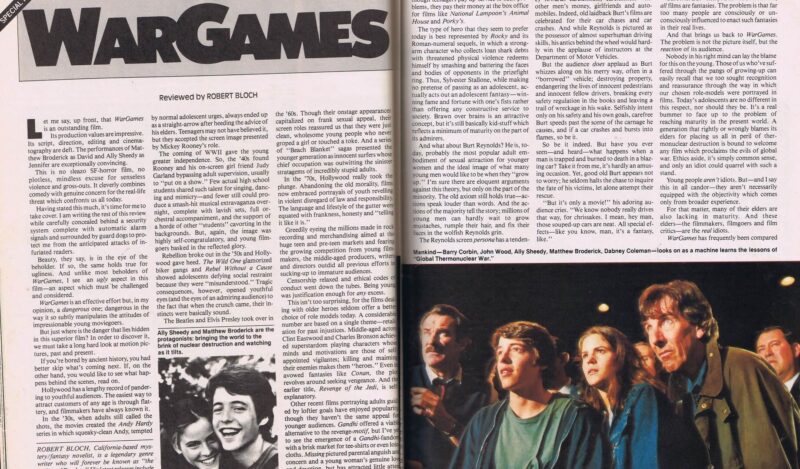
Bloch’s criticisms lie in the actions of its teen protagonists, particularly David, whom he describes as “immoral and amoral.” Other critics, he said, had poked holes in the plausibility of a kid being able to hack into a military computer network, when what they missed was the darkness lurking behind the fresh-faced hero.
Here, Bloch contrasts WarGames with another film about nuclear war: Stanley Kubrick’s classic Dr Strangelove. Where that film was an intentionally heightened black comedy, WarGames shoots for believability – which, for Bloch makes the depiction of its “pompous” and “clueless” adult characters all the more jarring.
“Only a few critics have objected to the film’s portrayal of adults as pompous jerks who react to the threat of disaster precisely like the kids,” Bloch wrote. “David’s parents… are good intentioned wimps who give him an expensive home computer as a toy… the sole major adult credited with intelligence [John Wood’s Dr Falken] is depicted as a weirdo who has succumbed to disillusionment with the whole human race.”
Podcast | Wayne’s World 2 (1993) and WarGames (1983)

Suggested product
Issue #61 (Horror Special): Magazine + Signed Ben Wheatley F&TT&N: Issue #4 (Reprint)
£14.99

Suggested product
Issue #60 Magazine Bundle (3x Covers: A Scanner Darkly Magazine + 1991 + Roger Deakins)
£14.99
David and Jennifer, on the other hand, are more bothered by their own plight than the fate of the human race, Bloch points out: “If you stop to think about it – as none of the critics seem to – Jennifer’s selfish hangup is as callous as Dr Strangelove’s disregard for the fate of humanity.”
Bloch reserves his harshest criticism for David himself – a computer whiz who (and we’re paraphrasing here) uses his powers to defraud a phone company, rip off videogame developer, change his school grades, and buy some return plane tickets to Paris. And all of this is before he hacks into the national security network and almost triggers nuclear Armageddon.
“I accept WarGames as an entertaining fantasy,” he writes. “But I cannot accept the unchallenged notion that there’s anything ‘heroic’ about a young man who devotes his skills to totally immoral and amoral ends; who seems to think that lying and cheating are merely part of a ‘game’ which all intelligent human beings must play in order to get a free ride through life at others’ expense.”
WarGames, Bloch suggests, is a product of a 1980s era of hyper-capitalism and the pursuit of self-interest – a period later summed up by Wall Street’s ‘Greed is good’ line and the bloody satire of RoboCop. “Critics unwittingly indicate just how far we have come in our total acceptance of the Me-First concept of life,” Bloch writes. “There is no love but self-love, and David and Jennifer are applauded for accepting it.”
Whether you agree with Bloch’s argument or not, it’s a superb piece of writing – and a unique perspective from one of horror’s most influential writers.