AI-generated ‘actor’ Tilly Norwood is said to already have a Hollywood agent. But the response to the project suggests that audiences aren’t ready to embrace the tech. You may have heard of Tilly Norwood by now. She’s the young actor with an Instagram account in which she shares photos and clips from her work, including ... Tilly Norwood | We can still fight back against the rise of creepy AI actors
AI-generated ‘actor’ Tilly Norwood is said to already have a Hollywood agent. But the response to the project suggests that audiences aren’t ready to embrace the tech.
You may have heard of Tilly Norwood by now. She’s the young actor with an Instagram account in which she shares photos and clips from her work, including a jeans commercial that apes the controversial one Sydney Sweeney fronted a few weeks ago.
“Forget blue genes,” the blurb accompanying the latter clip reads. “Mine are binary. Some people wear denim, I am data. My story is evolving…”
The joke being that Tilly Norwood only exists on a server. She’s AI-generated – the product of actor turned tech entrepreneur Eline Van der Velden. If Tilly was created to get attention, then it worked: within hours of the creation’s appearance at the Zurich Film Festival, trade outlets such as Deadline and Variety were reporting on what Van der Velden described as “the next Scarlett Johansson or Natalie Portman.”
The coverage in turn brought wider attention to Van der Velden’s small yet established production firm Particle6, plus its spin-off “AI talent studio”, Xicoia. According to Van der Velden, her companies have been in contact with Hollywood studios for some months already, and suggested that Tilly Norwood might soon have a contract with an agency, just like a flesh-and-blood actor.
“We were in a lot of boardrooms around February time, and everyone was like, ‘No, this is nothing. It’s not going to happen’,” Van de Velden said. “Then, by May, people were like, ‘We need to do something with you guys.’ When we first launched Tilly, people were like, ‘What’s that?’, and now we’re going to be announcing which agency is going to be representing her in the next few months.”
A couple of clips have been produced to show what Norwood might look like in the context of a film or show. One, 20-second reel shows her in various contexts – Red Sonja-like fantasy, sci-fi thriller, period bodice-ripper, and so on. Another, described as a comedy sketch, is about producers using AI to magically generate ideas for TV shows.
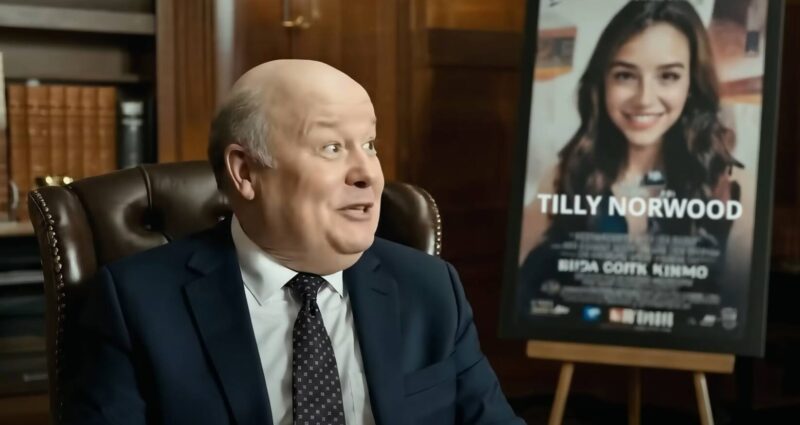
The entire sketch was generated using AI, and like so much output of its type, it’s both eerily realistic and… plain eerie. Its cast of digital humans – including Tilly – look almost photoreal until you look a bit more closely and see the telltale signs of unreality. The glassiness around the eyes; the Barney the Dinosaur monoteeth; the mixture of soft-focus skin and unnaturally hard edges around things like spectacles and gelled hair.
There’s also a cynicism – bordering on contempt – written into the script. Television is dead, the sketch outright states, but here comes generative AI to churn out terrible-sounding ideas that are nevertheless passable enough to keep bovine audiences entertained. “Britain’s Got Breakdown,” an AI-generated old chap jeers. “Audience votes on who gets therapy.”
Then it introduces Tilly Norwood herself, an actor described as having, “Girl next door vibes,” by a seedy-looking TV producer. A woman who seemingly works in a costume department introduces her more cryptically: “Like if a Sunday roast went to drama school and got BAFTA-optimised.”
No, we’re not sure what that means, either.

Suggested product
Issue #61 (Horror Special): Magazine + Signed Ben Wheatley F&TT&N: Issue #4 (Reprint)
£14.99

Suggested product
Issue #60 Magazine Bundle (3x Covers: A Scanner Darkly Magazine + 1991 + Roger Deakins)
£14.99
Things become even more unseemly when it’s heavily implied that Norwood has appeared in intimate sequences of some form. “Consent in romantic scenes? We just ignored that,” says one male character with a smirk.
“She’ll do anything I say,” beams another. “I’m already in love.”
Yikes.
In the sketch’s version of reality, Tilly Norwood becomes a TV star, appears on Graham Norton (in tears for some reason), and clips of her go viral on TikTok. Audiences have cheerfully embraced AI bilge, and if it all sounds dystopian, then at least, a producer quips at the end, “it’s not another reboot.”

Intended as a piece of promotion for Particle6 – it even name-checks itself as Norwood’s creator – it’s not so much a statement of intent as a confession. In the face of endless budget cuts and an uncertain future, generative AI is here to blast out endless cheap entertainment for the huddled masses – quality and good taste be damned.
Following the swagger and chutzpah of Tilly Norwood’s Zurich reveal, however, came the backlash. Commenters on Instagram queued up to criticise both the comedy sketch and other posts on the Norwood account. Sample responses included the words “gross,” “disgusting,” and “consent is not something to joke about.”
The Screen Actors Guild also offered its unvarnished thoughts on the matter.
“To be clear, ‘Tilly Norwood’ is not an actor, it’s a character generated by a computer program that was trained on the work of countless professional performers – without permission or compensation,” SAG-AFTRA wrote in a statement. “It has no life experience to draw from, no emotion and, from what we’ve seen, audiences aren’t interested in watching computer-generated content untethered from the human experience. It doesn’t solve any ‘problem’ – it creates the problem of using stolen performances to put actors out of work, jeopardising performer livelihoods and devaluing human artistry.”
Several non-AI, breakfast-eating actors have also voiced their disquiet over the advent of Tilly Norwood, including Melissa Barrera and Emily Blunt; the pithiest reaction came from Ralph Ineson, who in response to a Twitter post about Norwood’s potential talent agency contract, wrote, “Fuck off.”
In the middle of the controversy, Van der Welden posted a statement on the Norwood Instagram feed.
“To those who have expressed anger over the creation of my AI character, Tilly Norwood, she is not a replacement for a human being, but a creative work – a piece of art,” she wrote. “Like many forms of art before her, she sparks conversation, and that in itself shows the power of creativity…Much of my work has always been about holding up a mirror to society through satire, and this is no different.”
Van der Welden hasn’t yet responded to the specific complaints over the sketch’s jokes about consent.
More broadly, Particle6 has also been rather vague about how movie studios might employ Tilly Norwood in their productions. She’s not a flesh-and-blood actor, but nor (presumably) is she a polygonal 3D model like, say, the cat people in Avatar.
If Norwood were to appear in Fast X Part 2 alongside Vin Diesel and Michelle Rodriguez, the real actors would have to act to the equivalent of a tennis ball on a stick, leaving computer technicians to somehow slot Norwood in later. Wouldn’t it be cheaper and easier just to hire a real young, upcoming actor?
The obvious alternative – and one seemingly favoured by several major tech companies – is that movies and TV shows are composed entirely of gen-AI footage. Sure, the results look a bit floaty and a bit odd, but that’ll probably be good enough, won’t it? Most people only glance at the television while they’re fiddling with their mobile phones, anyway. Who even needs real actors?
Tilly Norwood arrives at what feels increasingly like a pivotal moment not just for entertainment, but for society as a whole. Like a burglar looking for unlocked doors or weak security, tech firms are probing at the edges to see what is collectively acceptable, whether legally or ethically. As reported by The Wall Street Journal, OpenAI has plans to release a new version of Sora, its gen-AI video software, which will merrily feed on copyrighted material unless owners opt out. The success or failure of those plans will likely hinge on how angrily studios and their very expensive lawyers respond.
Similarly, both Hollywood studios and companies like Particle6 will be monitoring how audiences respond to the notion of gen-AI actors. Will they readily accept them, as the comedy sketch suggests, or reject them? Are actors themselves mere puppets or toys to be programmed and played with, or is it their humanity and life experience that makes them something more than a picturesque special effect?
Read more: The Coca-Cola AI Campaign review | It’s not the real thing
The debate surrounding generative AI is often presented by its advocates as Luddites versus technological progress. But really, it’s an even simpler debate than that. It’s humans versus the people who own and run the machines. The push-pull between humanity and production is centuries old already; as new technologies are introduced and society responds, there’s a constant need for vigilance – a readiness to push back and reassert our rights as human beings.
Generative AI is simply the latest phase in what is, to borrow the title of a recent film, One Battle After Another: a certain class of people, mostly clustered around the tech sector, want to drive the value of art and self-expression down to zero. Beneath the guise of democratising creativity and reducing costs, they’re providing a means of sucking up ever greater profits while simultaneously decimating work opportunities for artists.
All of this is being laid out to us as though it’s inevitable; as though gen-AI, Tilly Norwood and an army of pretty faces with no inner lives are the future, and that’s all there is to it. Screenplays will be churned out by one piece of software; footage will be spewed out by another. We will line up for our entertainment gruel and smile.
The vociferous response to the Tilly Norwood project provides at least some sense of hope, however, that audiences won’t simply accept what tech companies are trying to foist on them.
The future remains uncertain. But if we remain determined enough – and angry enough – in the face of gen-AI, then maybe this is one battle we can still win.
/**/