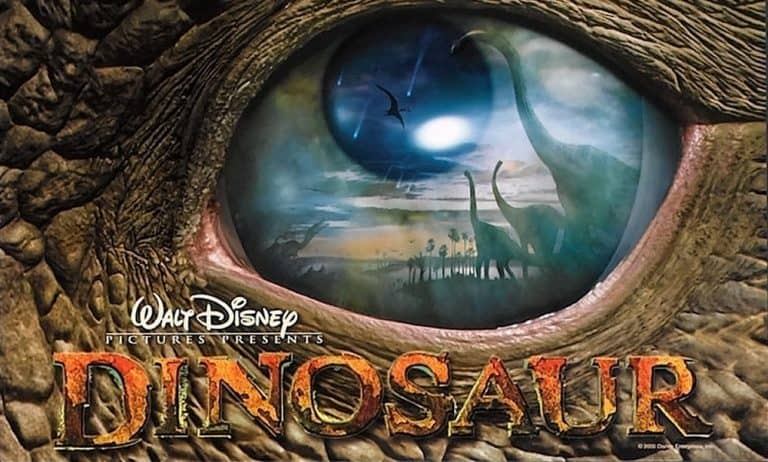
Disney’s Dinosaur, released in 2000, cost the studio over $100m to make. But the concept began life on the set of RoboCop, with storyboards by Paul Verhoeven. A notable outlier in Disney’s official roster of animated classics is Dinosaur, a film released in 2000 which combines live-action locations with CG renderings of a “fearfully great lizard” ... Disney’s Dinosaur, and how its origins go back to RoboCop
Disney’s Dinosaur, released in 2000, cost the studio over $100m to make. But the concept began life on the set of RoboCop, with storyboards by Paul Verhoeven.
A notable outlier in Disney’s official roster of animated classics is Dinosaur, a film released in 2000 which combines live-action locations with CG renderings of a “fearfully great lizard” cast. Now discussed mostly as a curio, it’s not so much that the film has been forgotten in the 26 years since it first opened in US, more that its story and characters have been forgotten. That’s not a great legacy.
And here I am now, to make things worse by skipping over the film itself and digging into the story of its origins. Because while the history of Dinosaur is fascinating, its prehistory is arguably more so.
In 1999, while Dinosaur was deep in production, Cinefantastique published a special double-sized issue to celebrate 100 years of stop motion. It’s the edition with Ray Harryhausen and one of his peerless Jason And The Argonauts skeletons on the cover. Inside the magazine is a great feature with Phil Tippett – the stop motion pioneer behind the Go-Motion effects in Dragonslayer and The Empire Strikes Back, and the man who put the tiger in ED-209’s tank.
Much of the magazine’s discussion with Tippett was given over to his work on Dinosaur back in the 80s, almost 15 years before the concept came to fruition. What’s revealed here is that Dinosaur started life in discussions on the set of RoboCop, where Tippett, producer Jon Davison and director Paul Verhoeven schemed together to create a stop motion-powered picture set in days and hours leading up to the Cretaceous–Paleogene extinction event.
This was pitched to Jeffrey Katzenberg, who was then heading up Disney’s movies. And the team set about developing something substantial to coax a full-on green light out of the studio.
According to the report, Verhoeven’s inspiration was George Stevens’ classic western Shane, wherein a lead character travels “from a devastated landscape into a promised land”.
The plan was to focus on a cast of silent, non-anthropomorphised dinosaurs, all of whom would be snuffed out in the film’s climax, as well as a small mammalian protagonist who would, thanks to their biology, survive into the new world.
Verhoeven and Davison recruited Walon Green – screenwriter of The Wild Bunch, Sorcerer and… um Solarbabies – to create their script.
Things changed a lot on the way to the Dinosaur we know and… well, we do still know it and that’s more than a lot of movies could say. Here at Film Stories, we’re rather prone to whimsical notions of What Might Have Been. It’s deep in our DNA. In that spirit then, we’d like to draw your attention to an original storyboard images by Paul Verhoeven himself…

Verhoeven storyboarded two sequences from the film to assist in calculating its budget. With a sad sense of near-inevitability, this is what knocked the director and Tippett off the project – the price tag came in at $45m and Jeffrey Katzenberg wouldn’t go above $25m at Disney.
Not the executive’s most egregious mistake, but perhaps a regrettable slip-up, not least when the final movie would ultimately cost the studio around $125m to simply make.