


In making Haunted Mansion, director Justin Simien wanted to apply a practical effects-driven approach – here’s how he pulled it off…
For only his third feature film as director, Justin Simien has taken on an ambitious family blockbuster. He himself was a child who loved Disney’s Haunted Mansion ride and horror movies, so he came to the project understanding that children often love to be scared. His admiration for the genre comes across in his second film, horror-comedy Bad Hair, which undoubtedly contributed to him getting the Haunted Mansion gig.
The film sees astrophysicist/paranormal expert/New Orleans tour guide Ben (LaKeith Stanfield) come to the aid of mother and son Gabbie (Rosario Dawson) and Travis (Chase Dillon) when they move into a mansion full of mischievous apparitions. It’s a fun film, but one that also commits to being creepy. That’s refreshing considering that in recent years there’s been a noticeable lack of child-friendly ‘gateway’ horror.
We sat down with Justin in London to discuss his vision for the film, getting the balance of horror and comedy right, and taking a practical effects-led approach to his ghosts.
A unique script
Simien’s introduction to the project came in the form of Katie Dippold’s script, and he talks a lot about her vision being truly unique. “Katie Dippold, who I’ve been a fan of as a screenwriter for a while, wrote this kind of miracle way into The Haunted Mansion that was both like reverent for the source material, but also was an original movie idea. It wasn’t a remake, it wasn’t a sequel, and I thought ‘Wow.’ One, I didn’t expect that script to come out of a studio development process, and two, I really want to protect this voice, and I want to protect what is on the page here. And so I began to pitch my vision for the movie,” he recalls.
That vision included embracing the culture of New Orleans, where the mansion is located, but also leaning into the horror elements in a way that would excite a young audience. “It involved embracing the culture of New Orleans and really rooting this movie in the authenticity of that place. And also involved not really pulling punches, you know, knowing that we obviously want kids to enjoy the movie, but I was a kid who loved horror movies, and I was a kid who rode The Haunted Mansion and was, you know, very scared of it, and on the other side of it found myself giggling and proud that I made it through. So I kept just saying those things and citing those principles, and all of a sudden, we’re on a set, shooting this thing!”
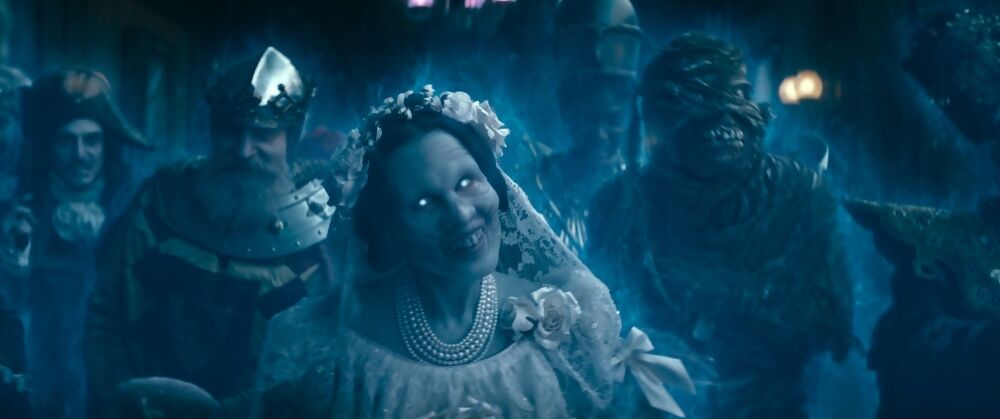
His intentions also included a practical effects-forward approach where possible. Firstly because “it’s just more fun.” But it also goes back to using the ride itself as inspiration, and keeping true to the source material. “That’s why it’s so magical. You see that you can see through them. You know that the ghosts are ethereal. You know that a trick is being played, but because they’re using that old school Pepper’s Ghost Trick, rather than just kind of putting a screen in front of you, you’re not quite sure how it’s being done,” the director explains.
It’s something you can see in the ghosts of Simien’s Haunted Mansion especially, as many of them are a hybrid between practical effects with an added dose of CGI. Justin expresses that he very much wants the audience to embrace the visual trickery going on in the movie. The ideal reaction would be “‘I know CGI is involved, but I’m not quite sure where the CGI starts and where the practical effect ends,'” he says.
“That to me creates a sense of like, ‘Wow, I’m really seeing something that’s unusual.’ And it makes you kind of trust that the movie is going to really take you on a fantastical journey. It sort of like kills the jadedness, I think just a little bit in audiences – particularly me! So that was kind of a mandate from the start. I really didn’t want people running around, you know, green screen sets and stuff. And it’s unavoidable to some degree, but wherever we could, practicality forward.”
A bigger production
Simien’s last two films, Dear White People and Bad Hair, were much smaller productions when compared to the scale and budget of Haunted Mansion. The director refers to the change as trading ‘one problem for the other.’
“On a smaller movie it’s, ‘Well, how do we even achieve an eighth of what we’re envisioning here? How do we achieve our ambition with no money and the location fell through? And is the actor showing up?’ and all of those things that sort of happen on the indie project. On a studio project, you know, there’s no problem achieving an ambition. That’s not the hard part. The hard part is sort of managing the multitudes of teams and people that need to be communicated that vision, defending that vision, explaining why we’re still doing it, or why not doing it anymore. There’s just a lot more people to communicate with and to kind of coordinate and get on the same page. But the actual fundamental job, at least for me, as director is actually the same. It’s ‘What is the story? What is the most effective way to tell this story to an audience with the resources that I have?’ And the resources might be huge, they might be small. But the answer to that question to me is fun either way.”

This isn’t the first Haunted Mansion film to exist. The Eddie Murphy-led 2003 incarnation was a flop both critically and financially, though it’s since found its audience. The movie’s cult status has led to other attempts to make a new Haunted Mansion, most famously with filmmaker Guillermo del Toro at the helm. It’s Simien’s movie with Dippold’s script, though, that made it in front of the cameras. When I ask him why he thinks his incarnation was the one that emerged successful he has an easy answer – “I think Katie Dippold’s take. It’s gotta be.”
“I didn’t get a chance to read, and kind of purposely didn’t want to delve into whatever the development history had been,” he continues. “But when I got the script for this, I very quickly understood Katie Dippold’s genius here, in that she told a grounded sort of story about new original characters so that a general audience can connect to them. But then they actually go on a very, like kind of fateful trip through the mansion, not unlike you do when you ride the ride itself. You yourself aren’t a part of this mansion, but you might join it, you might be the one more soul that joins, and you want to sort of figure out like, ‘How did these people get here, and what are they doing?’ And she kind of brought us through that experience. And I thought, at least I recognized on the page, that it was a winning formula and just wanted to protect that and do it justice.”
Balancing act
Tonally, Haunted Mansion has to strike a careful balance between its comedy and the entry-level spookiness of the haunting scenes. Simien’s worked on horror-comedies before with Bad Hair, but surely getting that balance right for a family-friendly Disney film is even harder?
“I think it’s harder to communicate. It’s not harder to actually do it,” Justin answers. “But you have to sort of calm everybody down while you’re doing it and sort of, you know, while you’re doing it, keep everybody calm, knowing we can always edit it out, or we can always pull back and we can always – ‘can everybody just chill out while we do this?’ – And then the testing phase is when you realise, at least in this – and you don’t always realise this. I certainly don’t – but in this case, I realised like I was actually right.
“Kids really wanted more, you know? Wanted to be scared, and they wanted adventure, and they didn’t want to sort of be gaslit into thinking the world was a happy rainbow sunshine place. And I was really, you know, excited to see audiences embrace that as we sort of took the movie out on some early test screenings and, you know, eventually did get the backing of the studio to really go there, not pull any punches.”
He adds that even the things Disney was hesitant about, that were initially cut from the film, were eventually returned intact. “Because we had kids telling us like, ‘No, we love it, we want more!'”
Another thing to balance here is adapting a fan-favourite ride while also putting his own individual stamp on the movie. It turns out that wasn’t one of Simien’s concerns. “It’s not hard to do that for me. I don’t know why. I love doing that. I grew up wanting to do that,” the director says. “I grew up really being attached to certain stories and pieces of IP that had yet to be movies, like I grew up on X-Men really heavy, and I sort of grew up during that dearth where there wasn’t Star Trek films, it was just the Star Trek shows. And I don’t know, I just always fell in love with these universes and thought about how I might imagine them.”
The stretching room
Being a child who loved the Haunted Mansion, he of course has a favourite part that made it into the movie – the stretching room. It’s a part of the ride filled with seemingly innocuous portraits. These quickly turn sinister as the room stretches upwards, revealing much more morbid aspects of the paintings along the way.
“There wasn’t a set piece built around it on the film when I came on board,” Simien reveals. “I’m very proud to say that there was this interesting kind of like, escape from the house sequence that I pitched to the studio, like ‘Let’s do this in the stretching room.’ The stretching room is so iconic, it needs its own cinematic kind of moment and presentation, and I’m really proud that we got to do that and that it seems to be working for audiences.”
I ask how you go about pulling something like the stretching room off on a film set, and he laughs. “Which part of it?” he grins, and so we whittle it down to the stretching itself (our conversation is, after all, limited to 15 minutes).
“It’s a mix of practical and digital. We actually built that set, and then at a certain point, you sort of just take a piece of the set like the gargoyles, and you’d sort of pull LaKeith, very high off of the ground. It’s basically, we shot that sequence literally as practically as possible. We couldn’t actually make the floor turn into quicksand and turn into a waterfall, of course. The crocodiles were also a little bit tricky. But every element of it, we just stripped it down shot by shot, and what of it we could do with real actual moving parts, that’s how we did it and then kind of filled in the blanks later.”
Promotion
It’s hard to ignore that this interview with Simien is occurring amidst the SAG-AFTRA and WGA strikes. The director is the only person here to promote the film, and I ask what that experience has been like. “I feel like I’m being pulled apart at the seams, if I’m being honest with you,” he says. “I’m a part of the labor movements that are happening right now. The DGA has made a deal, but the WGA hasn’t. I’m a writer. I’m not a writer on this film, but I am a part of that guild. I’m not a part of SAG, but I know what the actors are fighting for is so so important. And at the same time cast like this, you know, it’s harder for them to pop. This is a very diverse cast. It has some newcomers in it like Chase Dillon, who you’ve never seen before.
“And of course, it’s got Owen Wilson, and Danny DeVito, and Jamie Lee Curtis – some heavy hitters here. But I know that they were really proud of their work in the film and wanted to speak for it. So I’m happy that I can speak for it, but at the same time, you know, I wanted people to hear from them, and so I hope folks can see them in this movie. I think their work does speak for themselves, and hopefully one day when we get what’s right in the industry, they can speak for it too.”
Despite Dillon being arguably the least experienced member of the ensemble cast, he’s a really memorable part of the movie. It’s clear that Justin, too, is impressed with him. “I saw Chase Dillon for the first time in The Underground Railroad, Barry Jenkins, amazing miniseries. But Carmen Cuba, our casting director, we were talking about ‘Who should play the kid?’ and Chase Dillon was the first name out of her mouth, and I was like,” he pauses to gasp enthusiastically. “‘Oh my God, yes. Can we get Chase? What’s he doing? Is he still young? What does he look like?’ A lot of people were brought in for the character but to be honest with you, Chase was always, you know, our top choice.”
Another standout cast member is LaKeith Stanfield in the role of Ben, and Simien had a clear goal for what he wanted to do with the actor. “I’ve loved him for a long time, and I think it’s so rare to find an actor who can pull off that level of pathos, but also can be charming and be funny and bring you inside of a character that might have some edges to them. That’s something that he does in all of his roles., and I wanted so badly for people to understand him as a leading man figure. Because I saw that in him.”
As Simien mentions, there are a host of very well known actors among Haunted Mansion's cast, and working with them was a bit of a daunting prospect. “I was nervous more so because I didn’t know who was going to be a diva,” he explains. “I love working with actors. I love an ensemble cast, and there’s nothing worse than like a big name star type person that comes in and it’s not really about the work for them. I thankfully did not run into that situation with anybody here. Everybody here, and I mean, like, Jamie Lee Curtis is one of the biggest stars there is. Jared Leto’s a huge star. Danny DeVito. They were so generous, and so about the work and about the craft and about being in service to the story.”
The future
As our conversation comes to a close, this is normally where you would ask what someone’s up to next. Of course, the industry has come to a little bit of a standstill while the strikes are ongoing. The filmmaker does have a few things in the works, including a four part documentary called Hollywood Black that will take a look at black filmmakers and their contributions to cinema. However, some down time may also work in Simien’s favour.
“I’m excited to cook a little bit,” he says. “When I say cook, I mean, sort of – without a deadline or without any work imminent, frankly, because of the strike, which I very much support – just to kind of sit in my own office without anyone calling me, and just see what I’m going to come up with, you know, with some of that free time. So you know, we’ll see. We’ll see where that goes.”
With the ambitious Haunted Mansion marking Justin Simien’s third film in the director’s chair, we’re excited to see where things go, too.
Haunted Mansion is in cinemas on 11th August.
—
Thank you for visiting! If you’d like to support our attempts to make a non-clickbaity movie website:
Follow Film Stories on Twitter here, and on Facebook here.
Buy our Film Stories and Film Stories Junior print magazines here.
Become a Patron here.


