A salute to Memento, the time-bending thriller that put Christopher Nolan on the map. It appeared at the Venice Film Festival on the 5th September 2000. NB: The following contains mild spoilers for Memento. Christopher Nolan has gone on to make movies of ever-increasing scale and ambition, but the echoes of Memento, released 25 years ... Memento | Christopher Nolan’s breakthrough thriller made its debut 25 years ago today
A salute to Memento, the time-bending thriller that put Christopher Nolan on the map. It appeared at the Venice Film Festival on the 5th September 2000.
NB: The following contains mild spoilers for Memento.
Christopher Nolan has gone on to make movies of ever-increasing scale and ambition, but the echoes of Memento, released 25 years ago, can still be felt in his subsequent work. By now, audiences almost expect Nolan’s movies to play around with time or perspective in some way, whether it’s the nested realities of Inception or the varied chronologies in Dunkirk. Memento wasn’t Nolan’s first film – that was the ultra low-budget Following, shot on 16mm film for around £3000 – but it was the one that announced the filmmaker’s style and tone to a wider industry.
In retrospect, it’s striking just how assured Memento is as a piece of filmmaking. Nolan and his collaborators handle its interwoven chronology in a way that feels almost effortless; similarly, cinematographer Wally Pfister makes the story’s down-at-heel settings – all bare motel rooms and dingy bars – feel rich and captivating to look at. Guy Pearce’s Leonard Shelby also emerges, with the benefit of hindsight, as the prototypical Nolan protagonist: solitary, coolly intelligent, haunted by his past. There’s a clear line to be drawn from Leonard to Leonardo DiCaprio’s Cobb to Cillian Murphy’s incarnation of J Robert Oppenheimer.
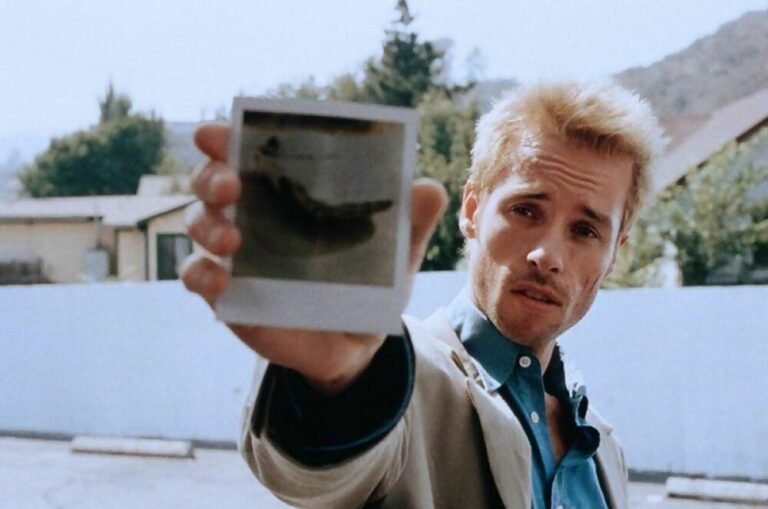
At heart, Memento is a straightforward thriller of the type we often saw in the 1990s. Leonard, left permanently brain damaged after two men broke into his home and murdered his wife, can no longer form new memories. The only thing that sticks in his head are glimpses of his old, happier life, vague recollections of an insurance investigation he once worked on, and the image of his wife’s death. Holed up in a dingy motel room, Leonard makes tracking down his wife’s killers his sole ambition; a task he achieves through the obsessive taking of notes and Polaroid photographs.
The attention-grabbing thing about Memento is its widely-celebrated non-linear storytelling, which begins at the end and works backwards to the beginning, with monochromatic digressions running forward in time, until the two threads ingeniously intertwine at the climax.

Following, itself a noir-inspired thriller, was also told out of sequence, but in Memento, it feels more intrinsic to the plot than a narrative conjuring trick. Memento’s disarray both reflects both Leonard’s mental state, and also allows us to truly understand the depths of his obsession in a way we couldn’t in a more conventional telling. As we begin to understand Leonard’s predicament, we might initially think we’re in straight revenge thriller territory; it’s as Nolan delves further into the past, unpicking the layers of his protagonist’s story, that we realise just how unreliable this narrator really is.
Pearce is superb in the central role – portraying Leonard as an enigmatic yet relatable lost soul. The actor effortlessly hints at the darkness lurking at the edges of his character while still making him worth rooting for. Carrie-Anne Moss and Joe Pantoliano – who’d both just worked together in The Matrix – are similarly terrific among the small yet capable cast, both playing classic noir characters who know far more than they let on.
Nolan would have been in his late 20s when he finished his Memento script – developed after conversations with his brother Jonathan. The strength of that screenplay was what essentially changed the course of Nolan’s career; rather than float around for years as a spec script, it was snapped up by Newmarket Films relatively quickly in the summer of 1997, and was in production by September 1999.
Brad Pitt was attached as the lead at one stage, which undoubtedly would have resulted in a much different film, with a higher budget and greater commercial expectations attached. Instead, Memento benefits from being so low-key; there’s an unmistakable melancholy that runs through the whole piece, from Pierce’s careworn performance to David Julyan’s murmuring score. There’s a tension and intrigue that keeps us leaning in as the narrative slides towards its climax, but the suppressed regret and self-loathing beneath Leonard’s determination sounds a downbeat final note. (Pantoliano’s performance, all panic and frustration, is extraordinary in these final moments.)

Memento made its debut on the 5th September 2000, and Nolan’s stature soared almost immediately. Despite initial fears that audiences wouldn’t follow its knotty mystery, it was a financial success relative to its $5m budget. And while the word-of-mouth surrounding the thriller grew on its cinema run in 2001, Nolan was already in production on his next film, Insomnia. Another thriller, it was a remake of the Norwegian film of the same name; rather than treat it as a gun-for-hire assignment, Nolan infused it with his own quietly bleak sensibility – aided by more of Wally Pfister’s exquisite camera work (just look at that opening aerial shot…).


Most reading this will know the movies that came next, because just about all of them have been critical or financial successes of one degree or another: the Batman films, interspersed with his thrillers The Prestige and Inception. The Kubrickian sci-fi of Interstellar; the dramatic heft of Dunkirk and Oppenheimer, and the head-scratching action of Tenet.
Tenet, in particular, serves as a striking contrast to Memento. Tenet is also a thriller that plays with the flow of time, with storytelling strands that run both forwards and backwards. But it’s set largely on yachts, in expensive parts of London and among super-rich, evil Russian oligarchs – a reflection, perhaps, of the fancier circles Nolan now moves in as one of the world’s most famous movie-makers. But Tenet also feels convoluted rather than necessarily complex, and overblown where Memento is understated.
As a series of action set-pieces, Tenet is a demonstration of Nolan as the consummate showman. In terms of character, story, and sheer economy, however, it’s Memento that emerges as one the filmmaker’s most effective pieces of work to date.
/**/