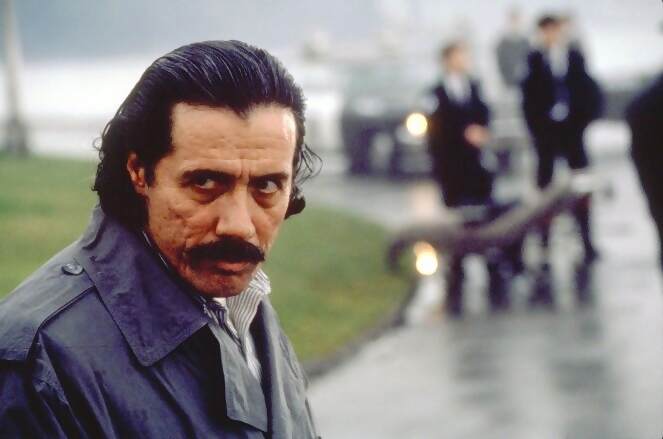
Now streaming on Prime Video in the UK, The Limbic Region is a highly watchable little thriller, with a committed performance from Edward James Olmos. Genre fans might know him as the enigmatic Gaff in Blade Runner (“You’ve done a man’s job, sir!”) or the quietly stoic William Adama in Ronald D Moore’s Battlestar Galactica. ... The Limbic Region | In 1996, Edward James Olmos starred in his own mini Zodiac
Now streaming on Prime Video in the UK, The Limbic Region is a highly watchable little thriller, with a committed performance from Edward James Olmos.
Genre fans might know him as the enigmatic Gaff in Blade Runner (“You’ve done a man’s job, sir!”) or the quietly stoic William Adama in Ronald D Moore’s Battlestar Galactica. Other movie-watchers might know him for his Oscar-nominated turn as real-life maths teacher Jamie Escalante in 1988’s Stand And Deliver.
One of Edward James Olmos’s less widely-discussed roles, however, was 1996’s The Limbic Region – a made-for-TV film so obscure that it doesn’t even have a Wikipedia entry. Now on Prime Video in the UK, it’s a singularly underrated crime thriller, held together by a mesmerisingly committed central performance from Olmos. Although low-budget and rough around the edges, it could almost be viewed as a dry run for David Fincher’s Zodiac, released in 2007.
It’s a noir detective thriller at heart, but with a far greater commitment to the literary genre’s gloom and cynicism than commonly seen in most movies (Fincher’s Seven being one notable exception). Olmos plays Jon Lucca, a San Francisco detective driven out of his wits by a case he could never solve. Twenty years earlier, a serial killer calling himself the Scorekeeper preyed on young couples parked up on quiet country roads; most were shot or stabbed. Having sent multiple taunting letters to the press, a guy claiming to be the culprit was cornered in a seedy peepshow joint and shot by the police – Lucca himself was badly injured in the crossfire.
In the present, Lucca’s now frail and left terminally ill from years of smoking and drinking. With seemingly weeks left to live, he meets up with Lloyd Warden (George Dzundza), a loner Lucca has long believed is the real Scorekeeper. Quiet and ordinary-seeming, Warden agrees to go on a drive with Lucca, where they revisit the scenes of earlier crimes and talk about the facts of each case. But is Lucca right to be suspicious of Warden, or has he spent years of his life obsessed with the wrong guy?
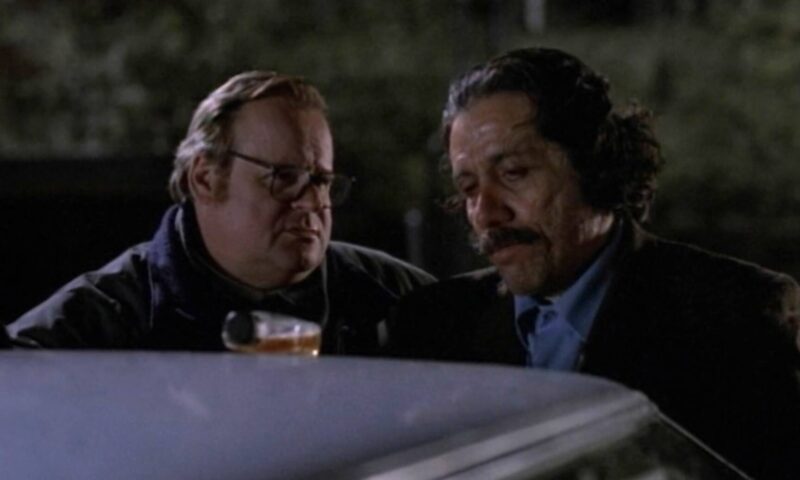
Screenwriters Todd Johnson and Patrick Ranahan dangle that question in front of us for The Limbic Region’s brisk duration, cutting between Lucca and Lloyd’s terse exchanges on the road and the investigation 20 years earlier. Here, we see an altogether different Lucca: smartly-dressed, incisive and determined to catch the killer. But we also see the souring effect his work commitments have on his relationship with his wife, Ann (Gwynyth Walsh) and their two daughters, aged four and five when the case begins. As the years roll on and the killer still hasn’t been apprehended, the fear that Lucca’s now teenage daughters could be a target only adds to the domestic tension.
The case itself is quite clearly modelled on the Zodiac – a real killer who killed five victims in late 1960s San Francisco. Like the Scorekeeper, the Zodiac murdered young couples on country roads, sent taunting letters to the police (many written in a cypher that amateur detectives are still trying to solve today), and was never apprehended. Interestingly, the film’s makers are at pains never to mention the Zodiac case itself; when Don McKay’s unnamed newspaper editor marvels at the audacity of a killer sending out letters, Lucca tersely points out that there was an earlier precedent – Jack the Ripper in 1888.
This is far from the first time the spectre of the Zodiac has haunted a movie. Scorpio, the hippie sociopath in Don Siegel’s 1971 seminal cop thriller Dirty Harry, was also based on the killer, right down to the letters and the attack on a school bus – something the Zodiac threatened to do but thankfully never carried out.
In its story of corrosive obsession, though, The Limbic Region has far in common with David Fincher’s above-mentioned 2007 movie, based on San Francisco Chronicle cartoonist Robert Graysmith’s own life-long intoxication with the Zodiac case. Like Lucca, Graysmith loses himself in the mystery to such a degree that it upends his life: he loses both his job and his family. In this regard, The Limbic Region is more about Lucca than the identity of the murderer; the film’s title comes from a brief conversation he has with a doctor, who explains that the limbic system is an ancient part of the brain that deals with impulse control. He talks about this in reference to a serial killer, but he could just as easily be talking about Lucca’s inability to control his drinking and smoking habits, not to mention his inability to stop obsessing over the Scorekeeper.
Lucca also has much in common with the similarly dogged Will Graham, protagonist of Thomas Harris’s novel Red Dragon and memorably played by William Petersen in Michael Mann’s 1986 adaptation, Manhunter. Like Lucca, Will Graham also goes on deep dives into the psyches of the killers he’s after, and also has a tendency to lash out at his colleagues.
The Lucca role certainly provides a showcase for Olmos’ range as an actor, as he shifts from smart professional to frustrated outsider to a broken, lonely husk. It’s a detailed performance, and in some places so vulnerable as to be almost difficult to watch; we can almost feel his sickness emanating through the screen.


The Limbic Region is, however, also a TV movie, and like many such features of its vintage, feels much older than it actually is. The pace can be pedestrian at times, the transitions between scenes too reliant on hard-boiled narration. It’s also weighed down by one of those jangly, piano-heavy scores that seemed to be standard issue for TV movies in the second half of the 20th century – the kind of soundtrack that belabours moments of emotion rather than quietly underlines them.

Certainly, The Limbic Region isn’t as precisely-made or moving as Citizen X, the 1995 made-for-TV thriller about the hunt for Soviet serial killer Andrei Chikatilo. But then, that was something of an outlier in 90s television; it was written and directed by Chris Gerolmo, screenwriter of the Oscar-winning Mississippi Burning, and starred Stephen Rea, Donald Sutherland and Max von Sydow – a casting coup for a period before it was common to see Hollywood stars make appearances in TV movies or shows..
The Limbic Region, on the other hand, was directed by Michael Pattinson, an Australian filmmaker whose early work included the soap opera Prisoner: Cell Block H, and later took in an episode of Millennium, starring Lance Henriksen, and 2000s cult sci-fi series, Farscape.
Pattinson’s work here is, in places, quite inspired, though: there’s a quite eerie use of lighting and POV shots to illustrate the killer’s perspective, and some of the sequences depicting the Scorekeeper’s crimes are truly unsettling. In fact, the whole film is far more harsh than most made-for-TV films of its vintage; the language is coarse, the scenes of intimacy are frank and unblinking. Sequences where Lucca clashes with his fellow cops in the precinct are shot at a remove with handheld cameras, giving them an urgent, documentary feel.
There’s also some subtle yet effective production design, such as the weirdly monochromatic decor in Lucca’s house; look closely, and even the pot plant in the background is grey rather than green. It’s the first sign of sickness in this domestic idyll, perhaps – a portent of the detective’s later isolation and loneliness.
The engine that drives The Limbic Region is, however, the strength of its acting. George Dzundza (a hard-working character actor who you might also recognise from Basic Instinct and Crimson Tide) is watchably ambiguous. Similarly, Roger Cross, as Lucca’s partner Brownlee, gets some of the film’s best lines – including a desperate plea for Lucca to put the past behind him, which ultimately falls on deaf ears.
Even in its rough-edged, more hackneyed moments, Edward James Olmos’ performance keeps things moving. By turns charismatic and crumbling, defiant and defeated, he breathes life into what could have been just another burnt-out detective archetype. The Limbic Region isn’t a lost classic, but neither does it deserve to vanish into the archives like some unsolved murder case.
The Limbic Region is streaming now on Prime Video in the UK.
/**/