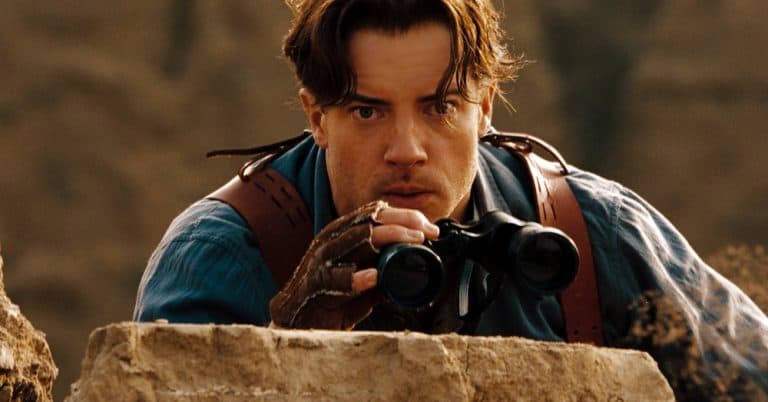
After The Mummy: Tomb Of The Dragon Emperor, there were plans for at least one more Mummy movie with Brendan Fraser – but it didn’t go to plan. Sitting through the pretty joyless, Dark Universe-branded reboot of The Mummy in 2017, most cinema-goers were probably sitting there thinking that this was not a very good ... The lost Brendan Fraser-headlined Mummy movie
After The Mummy: Tomb Of The Dragon Emperor, there were plans for at least one more Mummy movie with Brendan Fraser – but it didn’t go to plan.
Sitting through the pretty joyless, Dark Universe-branded reboot of The Mummy in 2017, most cinema-goers were probably sitting there thinking that this was not a very good film.
Appreciating the story of The Mummy has been told numerous times on the big screen, the attempt to gamble on a fresh reboot headlined by Tom Cruise may have looked good on paper. But for someone growing up on the blockbuster movies of the 80s and 90s, I felt I wasn’t alone in wondering: why didn’t they just get Brendan Fraser back?
Where had the fun gone? Why was Cruise – a very able actor, of course – struggling to headline a movie with anywhere near the level of charm that Fraser had managed?
Bluntly: just why.

The 1999 take on The Mummy (above) is a bit of a baggy beast, but it’s also bursting with entertainment, and huge amounts of fun. A chunk of the credit for that surely lies at the door of its leading man, and his rapport with the also-terrific Rachel Weisz. Fraser broke through as a movie star in the late 90s, headlining hits George Of The Jungle and Blast From The Past (both excellent). He’d also appeared in the acclaimed Gods And Monsters, and his star was on the rise at speed. The Mummy sent it into the stratosphere.
Fraser was effortlessly funny and won over audiences, so it was inevitable that he’d be signed up for the sequel to The Mummy. And while The Mummy Returns was – in this humble writer’s opinion – a much lesser film (kid sidekicks ahoy), it was an even bigger success at the box office.
Fraser’s career in the 2000s wasn’t quite the same, and he’s talked candidly about what happened in a much-shared GQ interview. It’s a piece that stopped me writing ‘where are they now’ articles back in my previous job, making me keenly aware that you never fully know somebody’s else’s story.
Still, in the aftermath of The Mummy Returns’ enormous success, there wasn’t an immediate overt drive for The Mummy 3. While it was assumed it was going to happen, director Stephen Sommers pursued Van Helsing instead. Scripts were put together, and Universal was trying to nudge a new Mummy adventure forward. But it wasn’t until the start of 2007 – six years after The Mummy Returns – that it was officially confirmed the a new movie was coming. Furthermore, Sommers wasn’t going to direct it, with the job instead going to Rob Cohen.
Fraser was signed up later that year, although Rachel Weisz – who was said to be unhappy with the script – declined the offer to return. It left John Hannah as the other returnee, with Maria Bello stepping in for Weisz. The working title was The Mummy 3: Curse Of The Dragon, but in the end the movie was set to be called The Mummy: Tomb Of The Dragon Emperor.
It was full steam ahead, and a release date of summer 2008 was marked on the calendar by Universal Pictures. What’s more, the studio didn’t want to have to hang around for The Mummy 4, and got to work making sure it wouldn’t have to. Key members of the cast, including newcomers Bello and Luke Ford, were signed up for multiple films, with Ford for one revealing that he had a three picture deal.
The signs, at first, were positive. Although reviews were hardly stellar – but then they hardly were for The Mummy Returns – Tomb Of The Dragon Emperor brought in just over $400m worldwide. That was slightly down on its predecessor, but still decent money.
Furthermore, the film had put in place a follow-up, that would have seen Antonio Banderas recruited to play the villain. The movie would have seen the O’Connells – led by Fraser – heading to South America for more mummy-battling. A working title was The Mummy: Rise Of The Aztec, and John Hannah was expected to return as well.
Rob Cohen was tapped to sit in the director’s chair again, and a screenplay was commissioned. 2010 was the earliest we could have seen it, but it soon became clear that it wasn’t to be. Still, work continued on the movie, with Rob Cohen then suggesting at one stage a 2011 release.
Meanwhile, Universal was experimenting. It had started digging back into its classic horror vaults and pressed ahead with 2010’s The Wolfman and 2014’s Dracula Untold. The Mummy 4 was to fall in between those movies, it seemed. Yet alongside all of this work, the Marvel Cinematic Universe was building elsewhere in Hollywood. And the grosses that the MCU movies were bringing in led to pretty much every studio in town looking for a cinematic universe of its own.
Thus, a few different factors ultimately brought The Mummy 4 to a shuddering stop.

First, there was no getting away from the non-plussed response from fans to The Mummy: Tomb Of The Dragon Emperor. It simply hadn’t had the impact of the previous two movies, and as such, there was hardly clamour for more. The Wolfman struggled, too, and the tease at the end of Dracula Untold failed to have people furiously heading to Google to try and find out when they could discover what’d happen next.
Secondly, the stakes for blockbuster cinema had been raised, and a $400m hit just didn’t cut it to the same degree anymore.
Thirdly, Universal knew it wanted a cinematic universe of interconnected films. It knew that The Mummy had been its best box office performer over the past two decades. It had to choose, ultimately, between The Mummy 4 and a reboot to launch what it was going to call the Dark Universe.
It did not choose wisely.
By 2012, it was announced that a writer had been hired – Jon Spaihts – to fashion a new take on The Mummy, one that would leave Brendan Fraser behind. With that announcement, the plan for Rise Of The Aztec was duly abandoned, and Antonio Banderas’ chances of doing battle with Fraser were over.
It’s a pity. Because across three films, of which I’d suggest just the one has been particularly good, Fraser has been a large part of the reason that even the weakest of them remains worth a watch. While we’ll never know what that 2010s incarnation of The Mummy 4 might have looked like, we can at least be content in the knowledge that a new take on the franchise, with Fraser, Rachel Weisz and John Hannah all returning, will come out in 2028.
We’re willing to bet it’ll be a lot more fun than that 2017 incarnation…
An earlier version of this article originally appeared on Film Stories in 2020.
.