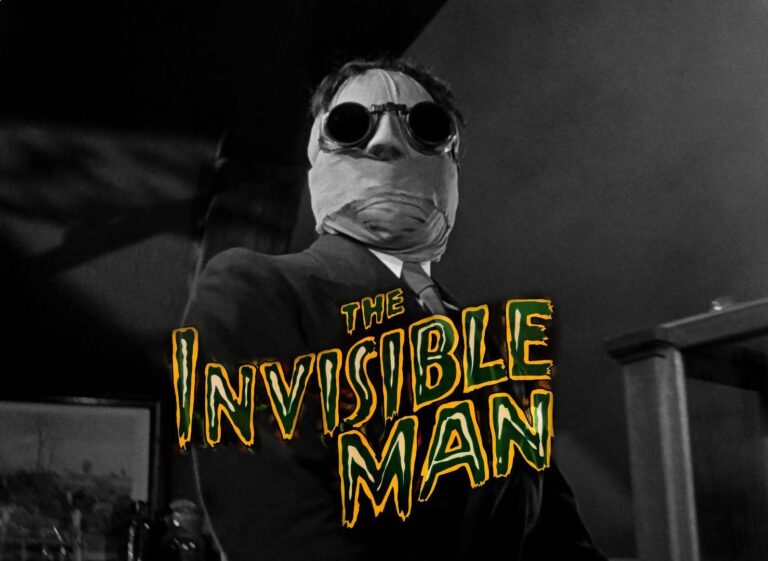
Claude Rains was terrific in 1933’s The Invisible Man – and his archetypal mad scientist was far more murderous than you might remember. Like the lofty forehead and bolts through the neck on Frankenstein’s monster, or the staring face of Bela Lugosi in Dracula, the title character in The Invisible Man has become part of ... The Invisible Man gave us one of the deadliest monsters of the 1930s
Claude Rains was terrific in 1933’s The Invisible Man – and his archetypal mad scientist was far more murderous than you might remember.
Like the lofty forehead and bolts through the neck on Frankenstein’s monster, or the staring face of Bela Lugosi in Dracula, the title character in The Invisible Man has become part of our collective pop cultural memory. The black hat and matching round goggles; the face wrapped up in bandages.
It’s an image that has been recycled, copied and parodied since James Whale’s film emerged in 1933, whether in direct sequels, later adaptations of HG Wells’s text (like the BBC’s 1984 series) or homages like Sam Raimi’s Darkman.
The character design, suggested by Wells’ 1897 novel, made The Invisible Man one of the most memorable of Universal’s monsters. Claude Rains’ physical performance – with his maniacal giggle and contemptuous voice – makes him a charismatic presence beyond the obvious visuals. But revisiting the horror thriller almost a century later, what’s striking is just how murderous the Invisible Man – aka Jack Griffin – really is.
Flipping seasons from the novel – it’s winter rather than summer – Whale and screenwriter RC Sherriff create a sense of unease from the off. Britain is blanketed with snow, and in the little village of Iping, the locals have packed into their local pub to enjoy a beer and keep warm. Amid the revelry, a shadowy figure walks through the Red Lion’s door in a bulky coat and clutching a suitcase. The bandages and false nose leave the punters wondering whether he’s a convict who’s injured himself during his prison escape.
All but demanding that the highly-strung landlady (Una O’Connor, delivering an entertaining if ear-splitting performance) give him a room to stay in, the mysterious character reveals himself to be a chemist whose experiment has gone awry. Dr Griffin has uncovered a formula for invisibility, but cannot reverse it; even more worryingly for everyone else, the serum also has the side effect of inducing madness.
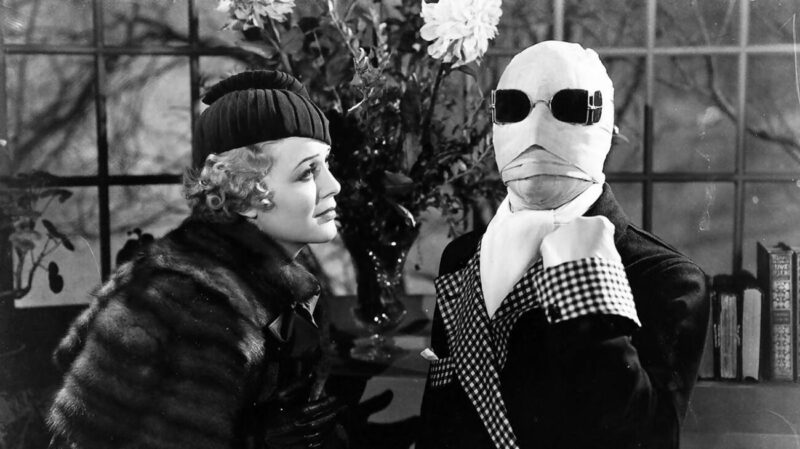
Holed up in one of the pub’s rooms, Griffin begins trying to find a means of reversing the invisibility process, but finds himself repeatedly interrupted by the staff (in truth, he’s so deranged that he probably never would have found a cure in any case). Flying into a rage, Griffin tears off his bandages and reveals his true form to the terrified locals – a sequence featuring some truly impressive analogue visual effects courtesy of John P Fulton.
Thereafter, Griffin embarks on what he describes himself as a ‘reign of terror’ – a murderous rampage that only escalates as the local police increase their efforts to catch him. We learn bits and pieces about Griffin’s previous life; how he was in love with Flora (Gloria Stuart), daughter of a respected scientist, and how he wanted to make his name as a wealthy chemist to make him worthy of her hand in marriage. He also has an old friend, Kemp (William Harrigan) who initially tries to help Griffin, but soon begins to backtrack when he realises the depths of his mania.
Those humanising slivers aside, Griffin remains an out-and-out monster. Other screen villains of the 1930s generally had some mitigating circumstances behind the chaos they caused. Frankenstein’s creation in Whale’s 1931 film was a frightened innocent; King Kong was merely an animal cruelly dragged out of his natural habitat; even Dracula fed to slake his hunger rather than purely for the sport of it (though enjoyment clearly came as part of the feeding process…).
The Invisible Man, on the other hand, is an outright murdering psychopath – and it’s possible that he might end up killing far more people in his film’s brief duration than those other characters listed above did in their respective movies. In one scene, Griffin sneaks back to the Red Lion to retrieve his notebooks and, as he leaves, takes the time to beat a police officer to death with a bench. The killing is entirely gratuitous; he could easily have taken the books and sneaked off without anyone being the wiser.
The crimes only escalate from there. Angered that Kemp gave away his location to the police, Griffin vows to murder his old friend the next day. Elaborate attempts to capture the Invisible Man backfire, and Griffin delivers on his promise – albeit in a way so unnecessarily protracted and cruel that it’s enough to give even jaded viewers a moment’s pause.
It keeps going: Griffin then breaks into a signal box, fiddles with the levers and causes an almighty train derailment. A locomotive and multiple carriages go careening off a mountainside, resulting in what we can only presume are dozens if not hundreds of deaths.
There’s an almost nihilistic charge to these moments – not least because Rains attacks the role with such hateful glee. Universal followed up The Invisible Man with sequels, but none of them managed to make the title character as dark as Rains did; perhaps one of the few related films to truly capture the same level of psychopathy was Paul Verhoeven’s interesting-but-flawed Hollow Man from 2000, though Kevin Bacon still couldn’t replicate the breadth of Rains’ grim charisma.
The Invisible Man’s blackly comic air may have been introduced to prevent the moments of horror from feeling too heavy; instead, the cocktail of humour and violence makes Whale’s film feel even more nightmarish. Compared to the magnitude of his crimes, the abrupt way in which Griffin’s antics are brought to an end could be seen as too abrupt; he certainly doesn’t die in the grip of terror as most of his victims do. (Griffin’s book counterpart dies more nastily, and he kills far fewer people than the screen version.)
But then, The Invisible Man’s final moments also sum up what makes it one of the most fascinating horror films of its era; like Frankenstein and King Kong, it asks us to see the humanity in its central character. But here, that sympathy is pushed past to its limit in a way that audiences might recognise from such later films as A Clockwork Orange or Michael Mann’s Manhunter, where the perspective shifts to the killer’s warped perspective.
As Griffin warns near the start of Whale’s mini-saga, “You’re crazy to know who I am, aren’t you? Alright! I’ll show you!”
Across 70 eye-popping minutes, the Invisible Man does exactly that.