Now 45, director Peter Hyams’ space western is a classic in its own right, but can also be enjoyed as an unofficial Alien spin-off. Showrunner Noah Hawley’s Alien: Earth managed to expand its franchise’s universe for TV, giving us glimpses of terrestrial cities and corporate island lairs that we didn’t get to see in the ... Outland is Alien with shotguns instead of aliens, which is why it’s an underrated classic
Now 45, director Peter Hyams’ space western is a classic in its own right, but can also be enjoyed as an unofficial Alien spin-off.
Showrunner Noah Hawley’s Alien: Earth managed to expand its franchise’s universe for TV, giving us glimpses of terrestrial cities and corporate island lairs that we didn’t get to see in the movies.
But like anything with Alien in the title, Hawley’s show had to deliver the acid-spitting goods at some point. He may have been interested in such themes as artificial life and the manipulative power of big tech, but Hawley would have been in deep trouble with fans and producers alike if a screeching Giger monster didn’t appear now and again.
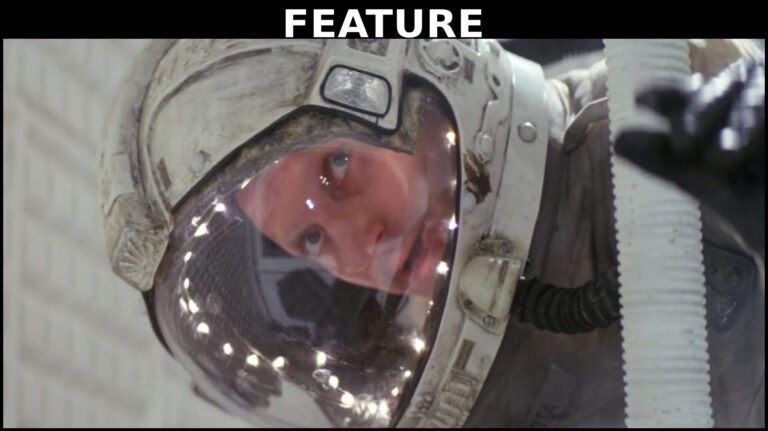
Released in 1981, writer-director Peter Hyams’ Outland very obviously stands on the shoulders of Ridley Scott’s Alien, sharing a glaringly similar retro-futuristic look, composer Jerry Goldsmith, and even the same model maker (the late Bill Pearson). But Outland is also, just as famously, a space western – essentially High Noon transferred to a mining community orbiting Jupiter.
In uniting these two influences, however, Hyams creates a corporate dystopia that could be imagined as an unofficial companion piece to Alien. While Ripley and her crew are off on LV-426 being screwed over by Weyland Yutani, another company, Con-Am 27, is busy manipulating its blue collar workers on Io, one of Jupiter’s moons.
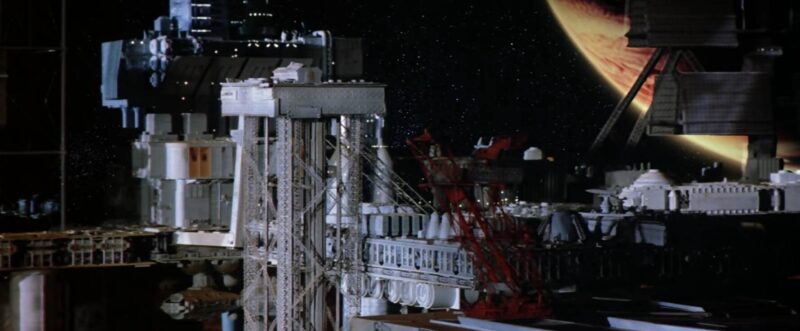
Sean Connery stars as Marshal William O’Niel, a space cop whose job is to maintain law and order across the assorted mining facilities scattered around the solar system. The bases are metallic and claustrophobic; we can almost smell the staleness of the recycled air. Worse, the base has begun to experience a string of violent incidents – miners screaming about spiders and sabotaging their own suits, or going berserk with guns and threatening to kill stricken sex workers.
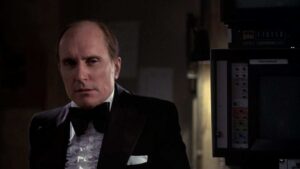
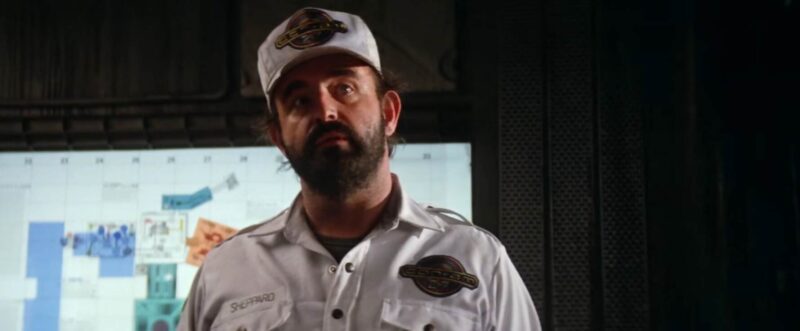
It’s little wonder, then, that just two weeks into his new post on Io, O’Niel’s wife decides to up and leave with their young son. O’Niel, isolated and depressed, then becomes fixated on working out what the connection is between all these corprses and the colony’s manager – a sleazy guy named Sheppard (Peter Boyle), who boasts about his workers’ boosted productivity while he messes around with a golf simulator in his office. (Interestingly, Giovanni Ribisi’s character in the first Avatar also practices his putting in at least one scene – golf being an easy shorthand for corporate douchebaggery.)
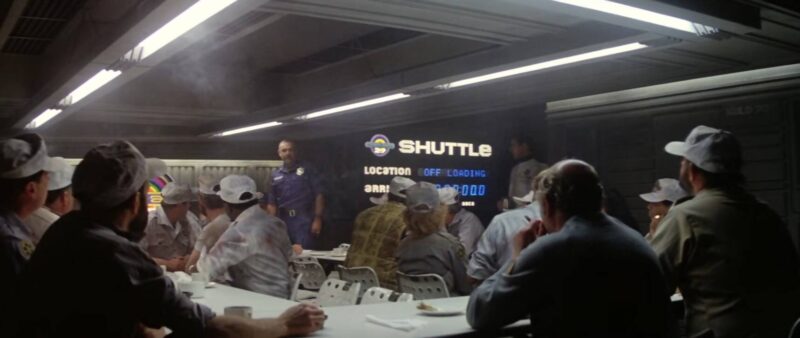
Although the Alien comparisons are inevitable, Hyams’ worldbuilding here is extraordinary. Together with production designer Philip Harrison, they create the illusion of a huge, grimy complex of living quarters, shower blocks, drinking dens and mess halls. The ceilings are low; Hyams, acting as cinematographer here as he often did (though Stephen Goldblatt is listed in the credits) lights his interiors from above or beneath, creating deep shadows and stark highlights.
It’s exactly the kind of utilitarian environment that a company interested more in profit than the comfort and well-being of its workers would create. The film’s look was a reference point for Duncan Jones’s Moon (Bill Pearson also worked on that film’s miniature effects). The mining colony seen in Bong Joon ho’s late capitalist satire Mickey 17 also feels remarkably like the one in Outland.
Moving through Hyams’ bleak interiors, Sean Connery provides one of his great post-Bond performances. It’s so watchable in its sad restraint that it’s a little surprising that his turn here isn’t mentioned in the same breath as his work in things like The Offence or The Untouchables. Perhaps if Outland had been shot as a traditional western (as Hyams initially envisioned) then it would have garnered more attention.
Although Hyams takes High Noon as his model, he makes changes to the plot that completely change its meaning. Where Gary Cooper’s Marshal Will Kane is threatened by the return of a vengeful outlaw he put in prison, the menace in Outland already exists within the community itself.
There’s something rotten at the core of the Io base, and the film’s intrigue lies not just in the conspiracy that O’Niel picks away at, but also the abundant opportunities for him to look the other way. In the opening act, O’Niel is distant and stoic, and clearly oblivious to how miserable his job is making his own family. Their departure serves as something of a wakeup call: as he watches the video left by his wife (effectively a sci-fi ‘Dear John’ letter), Connery subtly depicts the shift going inside his character’s head.
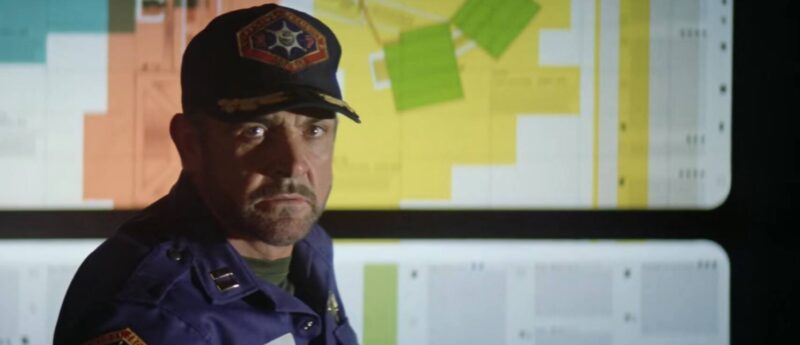
O’Niel has spent months, if not years moving from base to base, essentially working as another instrument of the faceless company which runs these mining operations. He may wear a blue uniform and carry a badge, but he begins to suspect that it’s essentially a fancy dress costume; for the most part, cops serve as glorified security guards, there to keep the peace while turning a blind eye to the company’s shadowier antics.
“The last Marshal before you kept things running pretty smooth,” O’Niel’s new deputy says. “That’s all they want. Things run smooth, they make their money.”
Unlike just about everyone else on the base, O’Niel decides to keep probing more deeply into the conspiracy – despite repeated threats from Sheppard, who has the whole base under his quiet control. And the more O’Niel probes, the more isolated he becomes; as in High Noon, no one in the community wants to help him – either swayed by the promises of fat bonuses, or simply afraid of reprisals, they either refuse to cooperate or, worse, try to foil his investigations.
The sole exception being Dr Lazarus, a salty medic brilliantly played by Frances Sternhagen. Just like O’Niel, she has her own arc which takes her from grouchy detachment to keen investigator. Far from the flat ‘love interest’ of some thrillers of this vintage, Dr Lazarus is O’Niel’s equal on multiple fronts – they’re both middle-aged, disillusioned and perhaps slightly haunted by the years of overlooking their paymasters’ criminality.
“I spend my days dispensing tranquilisers to the workers and certifying that the company prostitutes don’t have syphilis,” Lazarus says at one point. “I don’t know how to analyse a new molecule!”
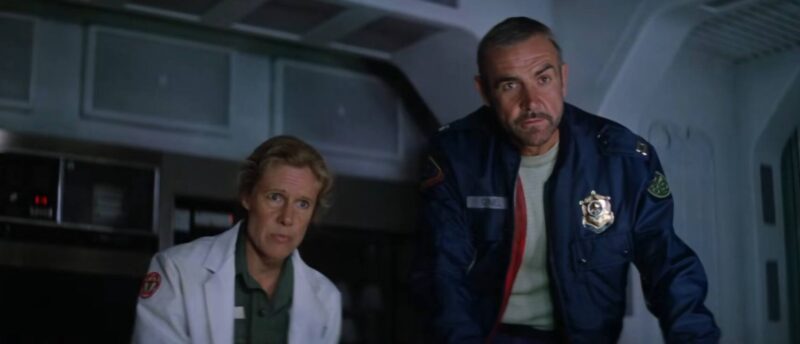
As in Alien, the subject of class runs right the way through Outland, though again Hyams gives it his own twist. We never see anyone from the company itself; they exist only as logos or as crackly voices on communications systems. They don’t even have to send in robot infiltrators, as Weyland Yutani does; they only need people like Sheppard and those in his orbit – other blue collar people, essentially, who’ve ascended to a position where they can now exploit their fellow workers on their company’s behalf. Just about everyone in Outland has been compromised in some way, either by narcotics or the promise of more money.
O’Niel and Dr Lazarus, flawed, ageing and broken as they are, opt to draw a line in the sand and do something about the rampant corruption. Their determination and respect for one another becomes almost moving; when assassins are drafted in, we genuinely fear for their safety. As exotic as Outland’s premise is (complete with shotguns that work in a vacuum, somehow), they feel like real people in a frightening situation.
Outland wasn’t a hit in 1981, and reviews were mixed. But time has been kind to it: Hyams’ practical sets, miniatures and in-camera effects still hold up. The low-key performances are roundly superb. And perhaps most of all, its story, about characters who live in a universe dominated by ruthless corporations who have no regard for laws or public safety, still rings true.