The subject of much fan speculation, the villainous Snoke could now be regarded as a symbol of the Star Wars sequel trilogy’s fundamental flaw. NB: The following contains spoilers for Star Wars: The Force Awakens, The Last Jedi and The Rise Of Skywalker. “There has been an awakening. Have you felt it…?” Spoken in ominous ... Star Wars: The Force Awakens | The mystery of Snoke, 10 years on
The subject of much fan speculation, the villainous Snoke could now be regarded as a symbol of the Star Wars sequel trilogy’s fundamental flaw.
NB: The following contains spoilers for Star Wars: The Force Awakens, The Last Jedi and The Rise Of Skywalker.
“There has been an awakening. Have you felt it…?”
Spoken in ominous baritone by Andy Serkis, those words opened the teaser trailer for The Force Awakens, first uploaded to YouTube in 2014.
It was a significant moment for the Star Wars franchise; the first glimpse of what it might look like without creator George Lucas at the helm, and the first clue as to how Lucasfilm would handle the franchise under the watchful gaze of its new owner, Disney.
Although audiences didn’t know it at the time, that early teaser also introduced the world to Supreme Leader Snoke: a shadowy villain whose presence loomed large over The Force Awakens’ story, much as Emperor Palpatine had in the second two films in the Original Trilogy.
Having been delayed for six months from its original May slot, The Force Awakens finally arrived in cinemas in December 2015. In terms of getting a new trilogy on its feet, it looked like a case of mission accomplished for director JJ Abrams. Like the filmmaker’s Star Trek films, The Force Awakens played on nostalgia and fan goodwill – introducing a new generation of characters while also finding supporting roles for the old.
There were valid criticisms that Episode VII’s plot and characters were essentially repurposed from the 1977 original, and that it leaned rather too hard on the series’ iconography rather than introduced new ideas of its own – something George Lucas himself grumpily pointed out.
The Force Awakens certainly looked pretty, though, and it undoubtedly laid the foundation for more movies to come. Which brings us to Snoke – the pale, scarred villain played by Serkis. Appearing on the galactic equivalent of a Zoom call for The Force Awakens’ entirety, Snoke was presented as the trilogy’s scheming puppetmaster.
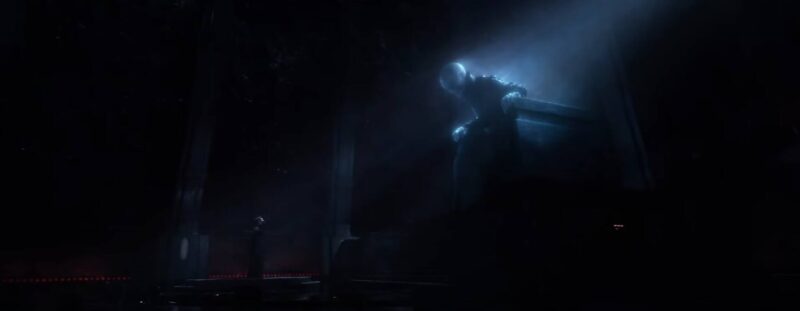
Years earlier, he’d turned Han Solo’s son Ben (Adam Driver) to the Dark Side, creating the Darth Vader-esque Kylo Ren. He was also the leader of the First Order and its vast military machine – the sequel trilogy’s equivalent of the Empire, which has its own planet-destroying super-weapon, the Starkiller base.
Snoke’s scars, wizened appearance and general aura of mystery provoked all sorts of fan speculation. That JJ Abrams was so fond of mystery boxes and secret identities only appeared to hasten the number of increasingly batty theories that emerged in the months after The Force Awakens’ release.


YouTube videos, website posts and message board threads were devoted to speculation over who or what Snoke might be. One popular suggestion was that he was secretly Darth Plagueis, a Sith Lord slain by his own apprentice, Palpatine. Another went that he was actually Palpatine himself.
Or, if you wanted some more outlandish possibilities, how about ‘Snoke is Mace Windu,’ or even ‘Snoke is Jar-Jar Binks’?
Serkis shot down some of those theories in interviews while teasingly hinting at other hidden dimensions to his villain. Having ruled out the idea that Snoke was a Sith Lord, Serkis told Entertainment Weekly in 2015 that the character is “extremely strong with the Dark Side of the Force,” and appeared to suggest that Snoke might have been motivated by revenge.
“…he is also a very vulnerable and wounded character,” Serkis said. “He has suffered and he has suffered injury. The way that his malevolence comes out is in reaction to that. His hatred of the Resistance is fueled by what’s happened to him personally.”
Movie-goers had to wait three years for The Last Jedi, writer-director Rian Johnson’s 2017 sequel. Perhaps here we’d learn more about Snoke and what prompted the ‘malevolence’ that Serkis hinted at.
Well, no. Not exactly.
Instead, Johnson had other ideas. His follow-up to The Force Awakens focused instead on the relationship between Rey (Daisy Ridley) and Kylo Ren, as well as the latter’s descent into ever greater villainy. Snoke was re-introduced as a gaunt figure in a gold dressing gown before being swiftly executed by a floating lightsaber.
Mark Hamill, who’d elsewhere been vocal in his dislike of how his character, Luke Skywalker, was presented in the film, was supportive of Johnson’s decision to kill the film’s elder villain so early.
“I was surprised everyone was so upset that they got rid of Snoke.” Hamill told Games Radar in 2017. “From Rian’s point of view, it was a big favorite for [Episode] 9 because he’s not important. It clears the deck to have the conflict between Kylo and Rey without him getting in the way and having to explain if he’s a clone or if he’s related to Palpatine.”
In writing The Last Jedi’s script, Johnson wasn’t necessarily riding roughshod over JJ Abrams’ best-laid franchise plans, however. By many accounts, the sequels were embarked on without any solid structure already in place.
Snoke could, therefore, be viewed as a symbol of the sequels trilogy’s one fundamental flaw.
Uber
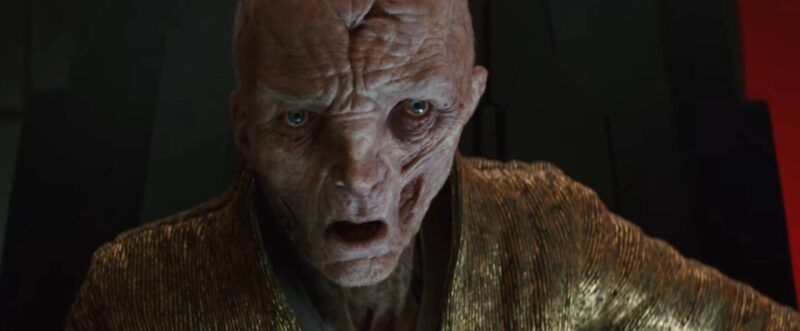
When Andy Serkis recorded those “There’s been an awakening…” lines in 2014, he had no idea what Snoke looked like. In fact, nobody did; for a part of the production, the villain was dubbed ‘Uber’ (meaning ‘supreme’, not a reference to the taxi app) and Abrams spent months settling on a look for the character; he’d initially resisted the idea of making him look like another old geezer, deeming the design to be too close to Palpatine.
But as proven by the making-of book,The Art Of The Force Awakens, the film’s creatives had a tendency to come up with some intriguing new ideas, only to abandon them in favour of ones that hewed more closely to existing Star Wars concepts. Exotic costume and ship designs were replaced by items that looked more like ones from the original trilogy. The neat-sounding story idea of a ‘Jedi Killer’ villain was dropped months before filming was set to begin.
So it was with Snoke; Abrams toyed with making the character younger and perhaps female, before finally settling on the Palpatine-ish look seen in the finished film – a decision made in October 2015, mere weeks before the movie premiered.
Looking back, it’s remarkable how little time Lucasfilm (or perhaps its overlords at Disney) allowed for The Force Awakens’ production. The script was finished in early 2014, while casting took place in the early months of that year; by the time cameras rolled in May, the central cast had only just been hired.
As originally planned, Abrams and his collaborators had just one year to get a hugely complex, effects-filled movie shot and pushed through post-production in time for its release slot in May 2015. Inevitably, the date was soon pushed back to December.
There’s a reason why Snoke is so shrouded in physical and metaphorical darkness in The Force Awakens, then: even the film’s makers were still figuring out who he was.
Shrouded

As self-defeating and illogical as it might sound, Lucasfilm seemingly began making the sequel trilogy without coming up with an overarching story. Daisy Ridley once said that Abrams had written drafts for episodes eight and nine, but Lucasfilm boss Kathleen Kennedy also said in more than one interview that the details for the sequels were still being worked on.
Serkis later said that, although he’d come up with various ideas about Snoke – partly to help him understand the character from an actor’s perspective – the villain’s backstory was still unclear as Johnson began working on The Last Jedi.
“The amount of Snoke theories that were going around, that I’m sure many of you were a part of, trying to work out who he was,” Serkis said at a fan expo in 2024. “It was a lot of smoke and mirrors, because it was still being evolved as we were making it.”
Johnson’s decision to kill Snoke off early in The Last Jedi also caught Serkis off-guard, the actor admitted to GQ magazine. That publication suggested there were “narrative disagreements” between Abrams and Johnson, and that this had somehow resulted in Snoke’s sudden exit.
“Let me just phrase it like this,” Serkis said. “When I went in to read The Last Jedi, [I spent] the first 30 pages thinking, ‘This is the most incredible character.’ Then I turned the page: ‘And then Snoke gets sliced in half.’ And I was gutted. Gutted.”
After The Last Jedi, there was a certain amount of turmoil behind the scenes when it came to the trilogy’s closing chapter – what became 2019’s The Rise Of Skywalker. Colin Trevorrow was to direct and co-write, but he left during pre-production due to ‘creative differences’. Months later, JJ Abrams was brought back in, and by the time cameras rolled, the production had even less time to get the film finished than they did on The Force Awakens.
Billed as the closer not just to the sequel trilogy but the Skywalker saga as a whole, Episode IX revealed that Emperor Palpatine (a somehow returning Ian McDiarmid) had been revived by a Sith cult on the planet Exogol, and that Snoke was little more than a genetically-engineered puppet designed to do Palpatine’s bidding.
Just to add to the air of a plane being built mid-flight, a revelation from The Last Jedi – that Rey was a ‘nobody’ was also amended in the Rise. Now, Rey was Palpatine’s granddaughter.
The Star Wars sequel trilogy therefore ended as it began: as a beautiful-looking muddle. The plot trajectories and shifting tones between the three episodes created the air of a franchise at odds with itself. And there, caught in the middle of it all, was Snoke: an enigma in Episode VII, a decadent king swiftly deposed in Episode VIII, and little more than a pawn controlled by the real villain in Episode IX.
Of ushering Palpatine back into the franchise, Abrams later said that he’d planned to bring the character back from the time he was working on The Force Awakens (“Well, when you look at this as nine chapters of a story, perhaps the weirder thing would be if Palpatine didn’t return,” he told Uproxx).
Serkis, meanwhile, has implied that Snoke’s status as a clone wasn’t something that was talked about before The Rise Of Skywalker. “No, that was something we happened upon and started to think about,” he said in 2024.
A decade on, the biggest remaining mystery surrounding Snoke lies outside the movies themselves. Did Abrams have some broader story plans for the villain, which were de-railed by The Last Jedi, or was Snoke always intended as a decoy? To mis-quote Master Yoda, “clouded the truth is…”
/**/