Beneath the mayhem, Tron: Ares also offers a timely comment on AI technology and the self-replicating nature of modern pop culture. Stan Lee, emoting from a hologram at a comic convention, despite having passed away in 2018. Vin Diesel talking, with seeming seriousness, about bringing the late Paul Walker back for more racing antics in ... Tron: Ares and 21st century pop culture, where nothing is ever allowed to die
Beneath the mayhem, Tron: Ares also offers a timely comment on AI technology and the self-replicating nature of modern pop culture.
Stan Lee, emoting from a hologram at a comic convention, despite having passed away in 2018. Vin Diesel talking, with seeming seriousness, about bringing the late Paul Walker back for more racing antics in the next Fast And Furious movie. We live in a cultural landscape in which the past is constantly being mined for profitable ideas, and where even deceased celebrities can be digitally revived for nostalgia purposes. If banks are too big to fail, then famous people are too valuable to leave in their graves.
This isn’t to say that bringing back the dead for entertainment purposes is new. Following his untimely death in 1973, Bruce Lee was impersonated so often that an entire subgenre of martial arts films emerged.
In the 1990s, effects trickery was used to bring back James Dean for McDonalds, Cary Grant for Coca Cola, and John Wayne for Coor’s beer. Robert Zemeckis used what was then cutting-edge effects technology to place Tom Hanks next to Elvis Presley, Richard Nixon and a host of other historical figures.
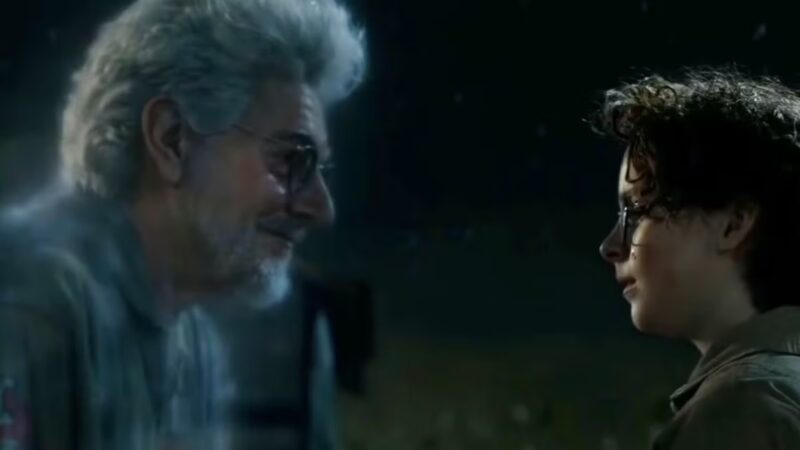
The continued evolution of CGI – and, more recently, generative AI – has led to a gradual acceleration of revived actors over the past decade, however. A digital Peter Cushing appeared in 2014’s Rogue One. Ghostbusters: Afterlife (2021) built part of its story around bringing the late Harold Ramis back as a ghostly Egon Spengler, returning from the hereafter to wield a proton pack one final time. Three years later, Alien: Romulus featured a mixed media rendering of Ian Holm as an eerie-looking synthetic human named Rook.
As technologies like Sora 2 continue to develop at a disquieting pace, regurgitating images and faces from the past is now easier than ever. Indeed, there’s an ongoing debate surrounding the ethics and legality of, say, a clip of Michael Jackson doing a standup routine in a kitchen, or a video of Stephen Hawking hurtling around a skateboard park.
The appropriation of a dead celebrity’s likeness was given a human voice earlier in October, when Robin Williams’ daughter, Zelda, begged her Instagram followers to stop sending her AI-generated clips of her late father.
“Stop believing I wanna see it or that I’ll understand, I don’t and I won’t,” she wrote. “It’s dumb, it’s a waste of time and energy, and believe me, it’s NOT what he’d want.”
As depressing as these clips are, they’re simply part of a wider culture driven by franchises and brand recognition. If a name, a face, a concept or a piece of intellectual property has nostalgia or familiarity attached to it, then it can and must be updated and recycled. This is why Tron, a 1982 movie that was a cult item rather than a critical or financial smash, is still a franchise 43 years later: there’s too much potential value in its name and imagery for it to be left to languish in Disney’s archives.
Read more: Tron: Ares review | Keep your pets indoors for the loudest film of 2025
This autumn’s big-budget sequel Tron: Ares, as sense-janglingly loud and busy as it is, also manages to sneak in some quite thought-provoking sentiments about the advent of AI and the ethical questions surrounding it – and perhaps inadvertently, comment on its own place in a culture of endless self-replication.


Suggested product
Issue #60 Magazine Bundle (3x Covers: A Scanner Darkly Magazine + 1991 + Roger Deakins)
£14.99
Like the previous movies, Tron: Ares imagines an alternate present in which artificially intelligent beings exist in a digital space called the Grid. The 1982 film established that flesh-and-blood humans could be uploaded to that virtual realm via a special laser; 2010’s Tron: Legacy showed that AI beings, like Olivia Wilde’s Quorra, could leave the Grid and emerge in the real world as physical people.

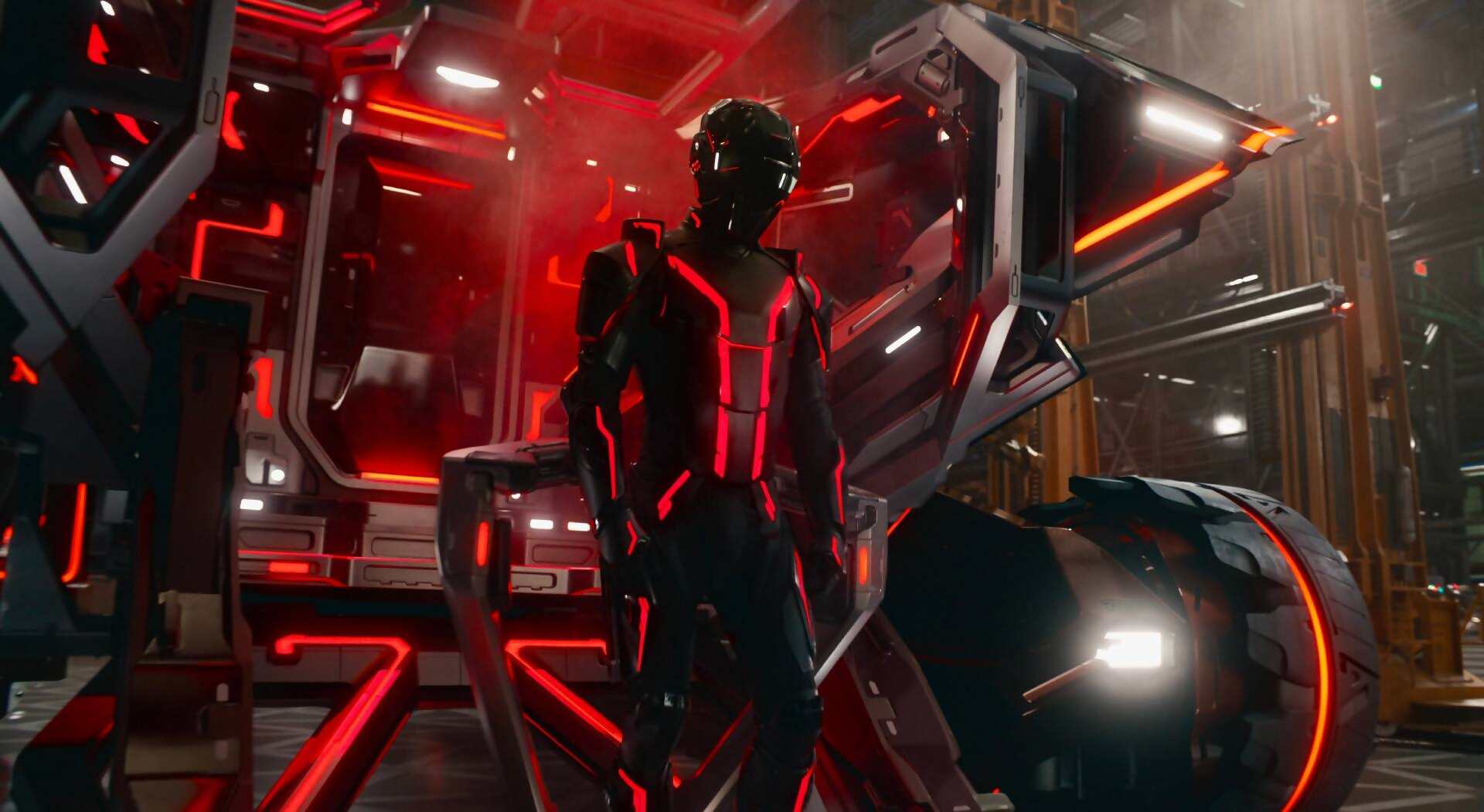
Tron: Ares takes this bridge between worlds a step further, at the same time establishing a pair of characters with contrasting approaches to AI technology. On one side, there’s Encom CEO Eve (Greta Lee), who wants to use the Grid and particle lasers to essentially 3D print an infinite supply of food and medicine. On the other, there’s the snivelling Julian Dillinger (Evan Peters), who plans to sell the same scientific breakthrough to the military. Early in the film, he explains how an infinite number of artificially intelligent, nimble soldiers could be conjured up on the battlefield. The most advanced of these is Ares (Jared Leto) who also serves as Dillinger’s overlord in the Grid.
In short, one CEO wants to use AI technology to create, the other to destroy. It isn’t difficult to spot the real-world parallel here: we’ve seen how AI can be used in medicine to spot illnesses early, and how it’s increasingly being employed in drones and other autonomous weapons.
The problem for both Eve and Julian is that objects or people ported from the Grid can only exist in our world for 29 minutes. Julian, in true modern tech CEO fashion, tries to hide this flaw from his investors by ushering them out of the building before Ares and his second-in-command, Athena (Jodie Turner-Smith) crumble to dust.
(It’s a nod, perhaps, to the ‘fake-it-til-you-make-it’ approach adopted by Elizabeth Holmes and her firm, Theranos, which pretended to have invented a transformative piece of medical equipment – its hope being that it would garner enough investment to turn the slight of hand into scientific reality.)
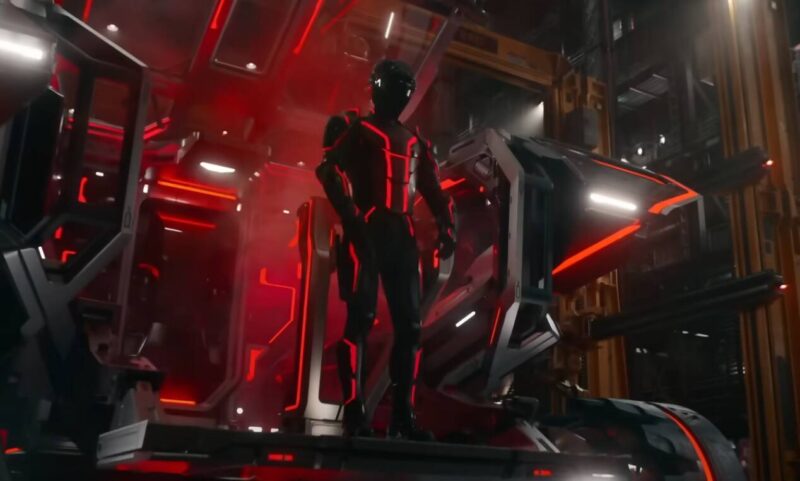
Eve, meanwhile, is off trying to find a computer program – a ‘permanence code’ – that will prevent things birthed from the Grid from falling apart. Ares wants that code, too – partly because he wants to be human, but also because he wants to be freed from Dillinger’s cycle of death and rebirth. The film makes plain that the last few of those 29 minutes are unfathomably painful, with both Ares and Athena left shrieking as their bodies crumble into digital ash.
Ares therefore faces a future of endlessly dying and respawning on global battlefields – a cosmic fate not unlike Tom Cruise’s in Edge Of Tomorrow (or to give it its more appropriate title, Live Die Repeat).
It’s a fate that echoes pop culture itself – an irony, given that Tron: Ares hails from Disney, which has made billions out of endlessly respawning new, digital versions of its past successes. Ares is trapped in a cycle, and only able to experience human existence in tiny 30-minute slices: drops of rain, a firefly landing on his fingers. By achieving permanence, he acknowledges, he’ll also be mortal. He’ll have one life, and that’s it: no respawning, no second chances. But he’ll be free, and there’s a wonder and dignity in that.
Covered though it is in its brutally loud Nine Inch Nails soundtrack and kaleidoscopic visuals, Tron: Ares could be read as a fractured portrait of where we are in 2025. Can we use our scientific breakthroughs to create new things and break from our species’ past mistakes? Or will we use it to accelerate what we already have: a rolling feedback loop of regurgitated ‘content’ and revived celebrities? Tron: Ares suggests that, as tempting as it is to use computers and AI to rake over the past, impermanence is written into our very DNA.
Time moves on, and so must we.
/**/