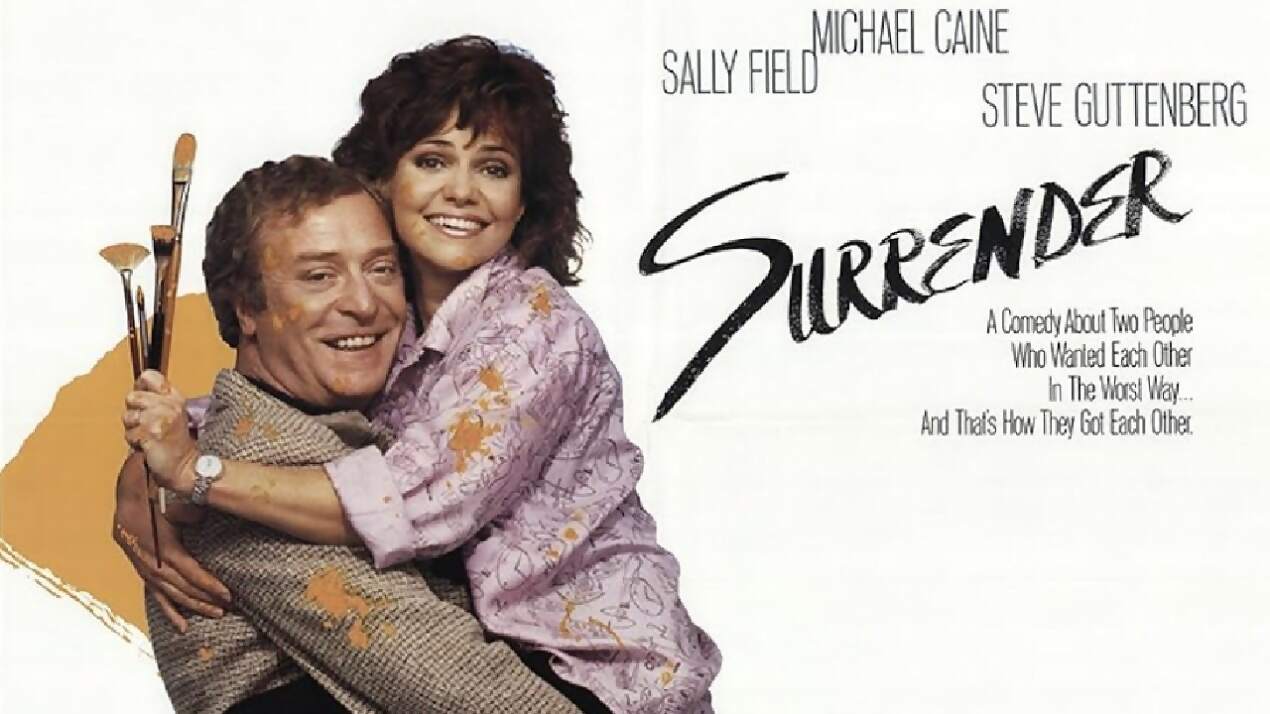
Our voyage through the 1980s work of Michael Caine continues with the romantic comedy, Surrender. A hidden gem? Er… Michael Caine showed no sign of slowing down as he entered his third decade as a leading man. The 1980s would see him win his first Academy Award (Hannah and Her Sisters), tackle new genres such ... The 1980s films of Michael Caine: Surrender (1987)
Our voyage through the 1980s work of Michael Caine continues with the romantic comedy, Surrender. A hidden gem? Er…
Michael Caine showed no sign of slowing down as he entered his third decade as a leading man. The 1980s would see him win his first Academy Award (Hannah and Her Sisters), tackle new genres such as horror (The Hand) and shark-based revenge movie (Jaws: The Revenge) whilst continuing to work with interesting new auteurs like Brian De Palma (Dressed to Kill) as well as old friends from classic Hollywood such as John Huston (Escape To Victory).
Film by film, I’ll be taking a look at Caine’s 1980s filmography to see what hidden gems I can unearth alongside the more familiar classics…
Spoilers for Surrender ahead…
Directed by:
Jerry Belson (Jekyll and Hyde…Together Again)
Tagline:
A comedy about two people who wanted each other in the worst way…and that’s how they got each other.
Other Featured Geezers:
Sally Field as Daisy Morgan, Steve Guttenberg as Marty, Peter Boyle as Jay, Jackie Cooper as Ace Morgan, Julie Kavner as Ronnie.
What’s It All About, Alfie?:

Suggested product
Issue #61 (Horror Special): Magazine + Signed Ben Wheatley F&TT&N: Issue #4 (Reprint)
£14.99

Caine plays successful novelist, and hopeless romantic, Sean Stein, author of such hits as “The Importance of Being Dead” and “L.S.D”. His career is booming but his love life is a shambles, leaving him bitter and resentful; “When I look out there, I don’t see men and women, I see animals sniffing at each other to see how much they’re worth” he tells his longsuffering lawyer Jay (Peter Boyle).
All his previous relationships have ended in legal proceedings angling for a slice of his earnings, leading him to completely lose faith in women, believing they are only interested in his money, and he has thus made the completely reasonable decision to emigrate to Kuwait where women can’t vote.
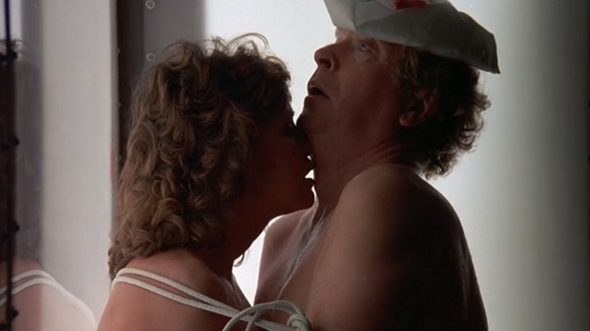
However, this plan is put on pause after he is involved in one of cinema’s most bizarrely contrived meet-cutes when armed gunmen rob a glitzy fundraising gala that he is attending, forcing him to strip off and tying him to struggling artist Daisy Morgan (Sally Field). In an empty storage room, unable to disentangle themselves, and waiting for police assistance, they get talking.
Daisy is sweet and caring, tending to Sean’s headwound, and most importantly she has a noticeable tic whenever she lies. Here, Sean believes he has found the perfect woman; “she’s a beautiful, giving woman who finds it impossible to lie”, and he thus pretends to be a broke, unpublished writer, to test whether Daisy can truly love him for himself. Shenanigans ensue!
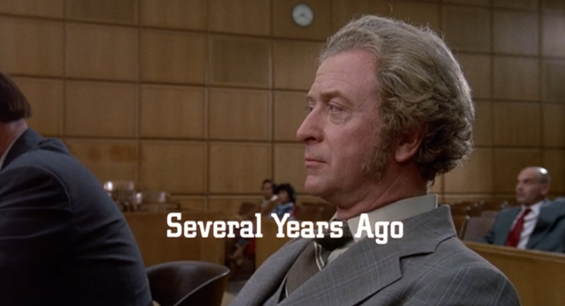
Caine-ness: Caine is the first actor that we see on-screen, but he takes second billing to Sally Field. Even so, he’s still effectively the lead as the thrust of the story follows his character, Sean Stein.
Perhaps it was tough for Caine’s ego to find himself no longer top billed, but he can at least be thankful that he’s still credited ahead of Steve Guttenberg. A lower billing than Guttenberg is not something that I think a onetime matinee idol could recover from.
Caine’s doing his usual accent, sans glasses, but he’s playing one of his least appealing characters. This is saying something considering he’s played cold-blooded gangsters and would go on to play Joseph Stalin.Daisy accurately sums up Sean’s basic vibe to his face; “You’re a weird person, aren’t you?”.
Sean attributes this to being “Pent up. I haven’t dated in a long time”. I attribute it to him simply being a creepy milquetoast loser and also a bit of an idiot. We see him, during one of his court proceedings with an ex, say; “We had an understanding. But I didn’t understand it.”
Sean’s idea of romance is surreptitiously finding out Daisy’s address, the woman that he’s only just met under highly traumatic circumstances, going to her home and then when she opens the door to him in an understandable state of wariness, matter-of-factly stating; “I found your address and tracked you here” like a much less concise, slightly more affable, Terminator.
Weirdly though, this approach does work successfully for him, so what do I know? The 80s were clearly a different time for dating pre-Tinder.
Perhaps though it’s not a sign of the times, and more the fact that these characters are simply two absolute weirdos with shockingly low standards and no concept of red flags.
On the day of his first evening dinner date with Daisy, the woman he’s sort of stalking, we first see Sean singing an improvised song into a bar of soap whilst showering (“Got a date with an angel, about quarter past seven” are the tuneful lyrics which show the bestselling author’s way with words), then he’s pacing up and down and constantly checking his watch, before turning up at hers in the middle of the day announcing; “Just wanted to know if we can start the date early, because I don’t have anything else to do, and I can’t wait to get to know you”.
What, to any normal person, would be a clear sign to call the date off entirely doesn’t phase Daisy and she instead says that’s okay with her. He then abruptly kisses her and propositions her for sex before they go to dinner, because the thought of her is making him jittery and he’s not sure if he can eat whilst unsatiated. Daisy at least stands her ground and says “Look I don’t make love before the first date” but otherwise she’s not too fussed by this absolutely insane behaviour from a basic stranger and they carry on with their dinner date.
This all plays incredibly creepy, and in no way whatsoever charming or amusing, but it’s very slightly offset by Caine being naturally a likeable and gentle presence. Very, very slightly. It’s very uncomfortable viewing, but Sean is not quite up to the level of Taxi Driver’s Travis Bickle. It would be interesting to see them both compete on Love Island: Cinematic Incel Edition though.
In spite of all this, there’s still something about Caine as an actor that makes his character watchable. He’s certainly not at his best as proven by a very unconvincing crying scene when he hears a song that reminds him of his first heart break. I’ve mentioned in previous articles how I believe that Caine is a top tier cinematic crier, he could manage it convincingly in front of Muppets, but here it feels forced. Perhaps it’s because he knows it’s a lightweight comedy that he’s not bothering to give it his all.
We also get signature shouty and pointy Caine acting. Sean gives a book to Daisy, that was published early in his career and didn’t sell, to prove that he’s been writing. Daisy, who still thinks he’s an unpublished amateur, reads it and gives detailed feedback saying it’s not ready to send to the publishers yet. Sean is furious and out comes the classic shouty and pointy Caine that we all love.
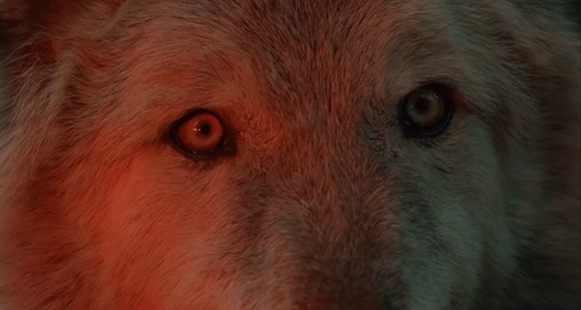
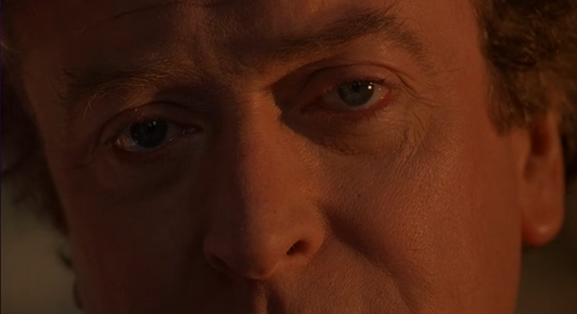
The scene, which is both simultaneously the high and low point of the film for me, is when Sean, trying to do a little soul searching in the early hours of the morning, rests on a hill and spots a wolf looking at him. They stare deeply into each other’s eyes as spiritual pan flute music plays.
Surrender was the last film that Caine made whilst living in L.A before returning to England after eight and a half years in the States; “Life is contrary. All the time I had lived in Los Angeles I had only made one film there, and now here I was leaving, and I had been offered a film that was actually being made in the City of the Angels”.
He reflects further in his autobiography, What’s it all About?, “It was a comedy that didn’t work […] and when a comedy fails it cannot be redeemed or rescued in the way you can handle a slightly ropey drama. I was surprised that it flopped since I had a marvellous co-star, Sally Field, and a director who is still one of the funniest men I have ever met – Jerry Belson. The script too seemed pretty hilarious, but as Harry Saltzman once said to me: “It’s amazing how often the public is wrong, isn’t it?””
Sorry Michael, but in this instance the public were right on the money.
Caine-nections*: Caine’s played writers before in Pulp (1972), The Hand (1981) and Deathtrap (1982) but Sean may be the most successful within the world of their respective films.
Sally Field previously played another ditzy romantic interest for Caine in Beyond the Poseidon Adventure (1979). A film that also featured Peter Boyle.
Sean drives by a billboard that says “Bill Cosby” and that disgraced comic was one of the stars of California Suite (1978), but in a different segment to Caine’s.
Julie Kavner was also in Hannah and Her Sisters (1986).
*I’m only counting connections from Zulu up to this movie.
Best Non-Caine Actor:
Sally Field is the co-lead and she’s a likeable presence as the sparky woman who doesn’t have luck when it comes to men. We hear how she’s had one failed marriage and many failed relationships. She even dated a guy for two years without realising that he was a junkie, she just thought he was a chemist. Now, with her biological clock ticking, she’s eager to settle down and start a family.
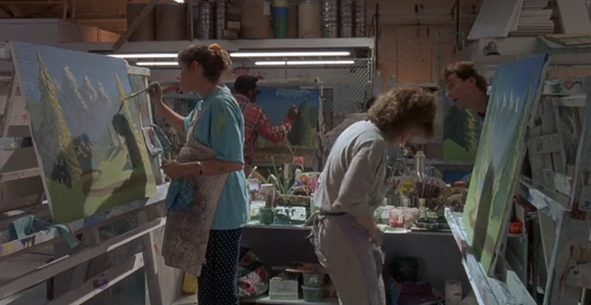
She’s broke though, both monetarily and spiritually. An artist currently working on a factory line, where her creativity is quashed, producing identical commercial paintings. She gets a complaint from her boss after she painted a woman drowning into a generic scenic landscape and the hotel client complained; “The Fresno Hilton does not want interesting, they want matching” she is told.
Field and Caine have decent chemistry and do a good job acting in close proximity during the scene where they are tied together in the buff. They mostly help to sell what is a completely unbelievable relationship and tamp down the inherent creepy vibes that exist on the page.
According to IMDB Trivia (the original source is unclear) Field mandated re-writes from Belson to flesh out her character before she agreed to star in the film. She wanted her part to be as good as the leading man’s. It did actually end up being as good as the leading man’s, but unfortunately that’s because the leading man’s part isn’t very good either.
Field was already a two-time Oscar winner (1979’s Norma Rae and 1984’s Places in the Heart) and it’s important for an actor to vary things up and not take themselves too seriously, but it does feel like both her and Caine are slumming it here.
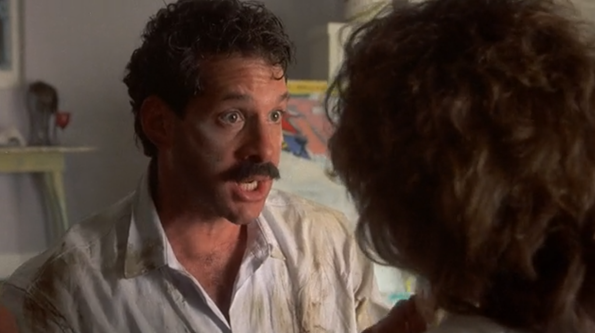
Steve Guttenberg is Daisy’s obnoxious yuppie boyfriend Marty. We first see him at home on the phone, clicking his fingers at Daisy ordering her to bring him a towel, and then shaving foam, and then something to write on, as he carries on his work conversation whilst treating his girlfriend as a secretary.
He’s a whiny spoilt jerk, the comic stereotype of a self-satisfied 1980s lawyer (chatting away on his phone on his StairMaster with the TV on), and also not too bright. “Sometimes I worry about the future” Daisy confesses to him. “What, you mean like having to go up into space?” he responds.
But, in a sentence that I’m surprised to find myself typing, after disappearing for the bulk of the film Marty returns, manic and dirty, and confesses to having had a profound change of heart after being taken hostage by Somalians. He now has decided to represent the Somalian’s side in a court case, going against his former avaricious company.
There is a lot of anti-Guttenberg sentiment out there. I wouldn’t call myself a fan, but I’ve also never took a particular disliking to him either. I think he’s fine in this, but if you are indisposed towards him, he’s not in it too much and regardless he has an undeniably impressive moustache that all can rally behind and appreciate.
Rounding out the cast is the always reliable Peter Boyle as Sean’s friend and lawyer Jay, an underused Jackie Cooper in his final theatrically released role as Daisy’s disapproving father, Julie Kavner as Daisy’s pregnant colleague (it’s weird to hear Marge Simpson’s voice coming out of a non-yellow three-dimensional human) and a dialogue free one-scene cameo for Mrs David Bowie, the model Iman, as one of Sean’s litigious exes.
My Bleedin’ Thoughts:
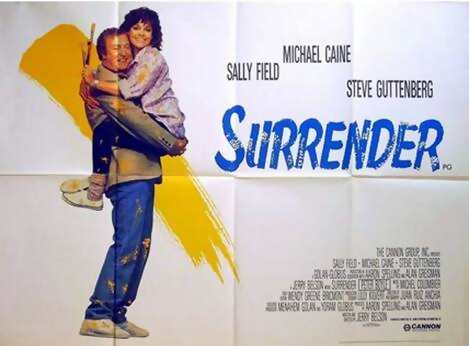
The poster looks like Sally Field is suffering from explosive diarrhoea. The more unkind among you may say that is an apt representation of this film. But, compared to his other two dated and misjudged 80s comedies, Blame it on Rio (1984) and Water (1985), this surprisingly is the most watchable. It actually had quite a few jokes that worked but overall, the unpalatable characters and shaky plot make it not fully cohere.
This was a Cannon Films production. When you think Cannon, your first thought is likely not quality rom-coms. Other Cannon films from 1987, the year that Surrender was released, include Over the Top, American Ninja 2: The Confrontation, Superman IV: The Quest for Peace, Masters of the Universe and Death Wish 4: The Crackdown. Surrender stands out as quite the oddity amongst that slate of B-movie action schlock.
This was only the second (and last) theatrical release by director Jerry Belson. Much like Dick Clement, the director of Water, another of Caine’s 1980 comedy duds, Belson’s background was primarily in writing television comedy, having co-created the sitcom version of The Odd Couple, and also having written on The Dick Van Dyke Show. Surprisingly, he also has writing credits on two Spielberg films; Close Encounters of the Third Kind (1977), which you’d happily shout about on your CV, and Always (1989), which you’d perhaps keep a little quieter.
Belson did a better job of utilising his comic sensibilities than Clement as overall I found it funnier than Water. The best joke was when, enroute to their hastily planned wedding in Vegas, Sean mentions getting a last-minute pre-nuptial agreement and an announcement is put over the aeroplane Tannoy; “Is their a notary public on the plane?” and it cuts to woman exasperatedly turning to her husband; “They never leave you alone”.
I also wanted to highlight the amount of unnecessary effort put into one single throwaway sight gag. Sean and Daisy, whilst they are visiting the zoo, have the following exchange as they are happily munching on popcorn; “I could go on like this forever, couldn’t you?” “Absolutely”.
In the enclosure behind them we see two ostriches with their heads in the sand. This shot would have taken way more effort to coordinate and film than it was worth in terms of the mild smirk it elicits. I respect that effort.
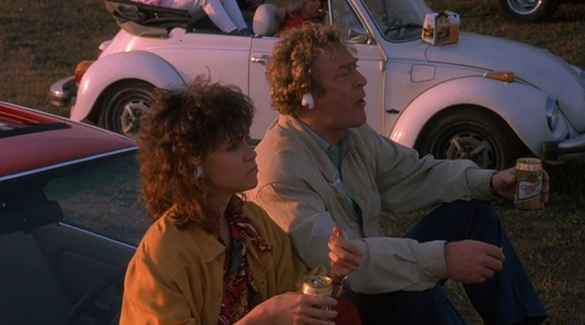
The film opens with the satirical Randy Newman song “It’s Money That I Love”, starting the film off on the right foot. It’s a good song and so you could convince yourself that you’re about to watch a decent film.
Sadly though, the rest of the score is generic, including the obligatory dodgy 80’s jazz muzak accompanying a romantic montage, and it feels like they spent all their music budget licensing that one song (and they got their money’s worth, as it plays off and on for what feels like about the first 10 minutes of the film).
It is a dated movie, but the sexual politics are not as cringeworthy as they could have been. Sean even comes to the realisation at the end of the film that “Women haven’t wronged me, I’ve wronged them” and he tries to make amends.
Lastly, I’m not entirely sure why this movie is called Surrender. It’s a weird title that doesn’t quite fit, and that’s not the only mystery that I was left pondering as the credits contain the following confounding note; “The producers would like to thank “Master Fishing Tackle Company” and “Penn Fishing Tackle MFG Co””. There are no scenes involving fishing. Cue X-Files theme.
Trivia (Courtesy of IMD): Actor Tony Borgia portrayed a character, Tony, who had the same first name as his own (Tony, just to clarify). 3 people downvoted that piece of trivia on IMDB and I bet you that none of them were called Tony.
Belson is quoted as saying “everything that happened in the movie happened to me. The only difference is that in the movie, it’s funny.” If this is what those situations look like when they’re funny, I shudder to think of what they were like when Belson was actually living through them.
Members of a local nudist colony were recruited for the scenes at the Air and Space Museum when background actors were unwilling to strip off. Caine and Field went for it though.
Overall Thoughts: It’s at the top end of Caine’s misguided and horribly dated 1980s comedies, but that’s a very low bar. It has a few good jokes, and is passably watchable, but this has been forgotten for a reason.
Rating: 2/5 Unexpected Spiritual Encounters with a Wolf.
Where You Can Watch This: This is impossible to watch (legally) in the UK unless you are willing to view it in very poor quality on the dodgier corner of the internet. It was released in UK cinemas but appears to have subsequently never had a physical release, even on VHS, here, and is not available digitally. But for sadists with a VPN, it is currently streaming on Tubi in the US.
Perhaps it’s a similar situation to Stanley Kubrick banning A Clockwork Orange in his then home of England, with Caine suppressing the continued distribution of Surrender in his homeland because of the violent backlash it could inspire.
Up Next: It’s Cockney Caine versus Victorian London’s most notorious serial killer in the two-part miniseries Jack the Ripper.
/**/