Richard Linklater is but one filmmaker who’s tried to adapt Philip K Dick’s Ubik. There’s still a small chance that a movie version might emerge… He sadly died before Blade Runner brought his writing to public attention, but author Philip K Dick’s subsequent influence on cinema in general has been huge. Aside from official adaptations ... Ubik | The Philip K Dick film adaptation we never got – and why it might one day happen
Richard Linklater is but one filmmaker who’s tried to adapt Philip K Dick’s Ubik. There’s still a small chance that a movie version might emerge…
He sadly died before Blade Runner brought his writing to public attention, but author Philip K Dick’s subsequent influence on cinema in general has been huge. Aside from official adaptations of his work – whether they’re loose (Total Recall, Minority Report) or faithful (A Scanner Darkly), there are all those movies that carry Phildickian strands of DNA. There’s the simulated reality of The Matrix; the dreams-within-dreams of Inception.
That latter film, in particular, has a number of parallels with Dick’s 1969 novel, Ubik – most notably its blurring of lines between dream and reality. So too did David Cronenberg’s eXistenZ, which contained one or two nods to Dick’s novels (a burger outlet called Perky Pat’s, for example).
As for Ubik itself, film history is littered with attempts at adapting it for the screen – though the book’s complexity and sheer weirdness have proved a stumbling block for a number of writers and directors over the past 50 or so years.
“Ubik has been a holy grail for a lot of filmmakers,” says producer Tommy Pallotta, who’s come closer to adapting the novel than most. “It’s one of his best books, and I’ve been thinking about it for decades, trying to figure out how to make it into a film. A lot of other people have been trying to do the same.”
Ubik imagines a future dominated by a breed of people with telepathic powers. In order to prevent these psychics from snooping on corporate affairs, an entire industry of ‘prudence organisations’ have sprung up – if the telepaths are the computer virus, then companies like Runciter Associates, and their teams of ‘inertials’ are the anti-virus software.
In the same world, Dick also throws in a technology that allows dead people’s consciousnesses to be preserved in a kind of suspended animation – but like a memory that fades the more it’s accessed, these ‘half-lifers’ gradually peter out of existence the more their friends and loved ones speak to them. Then there’s the titular Ubik – a product capable of repairing fraying holes in reality – and may or may not be the embodiment of god himself, packaged and sold in a spray can.
It might all sound disparate, but Dick manages to intertwine all these technologies in surprising, ingenious and disturbing ways. When the flamboyant boss of Runciter Associates is assassinated, protagonist Joe Chip and his colleagues begin to notice strange anomalies in the world around them. Time appears to be going backwards; perhaps reality itself is some kind of illusion…
Five years after Ubik was published, French filmmaker Jean-Pierre Gorin began working on an adaptation. Dick’s style of storytelling chimed, it seemed, with the French New Wave movement, which was all about existential philosophy and challenging the conventions of filmmaking. Dick himself was hired to write the adapted script, which, while remaining somewhat faithful to the book, comes up with an ending in which the fabric of the film itself appears to fall apart (more on this shortly).
This incarnation of Ubik was never made, though an edited version of Dick’s screenplay was later published in book form. In his introduction, fellow sci-fi author Tim Powers writes that Dick had also made a separate attempt to get the actor Victorial Principal interested in his script; he sent her a copy, Powers writes, with his home phone number written on one of the pages and a note begging her to ring him up. She never did, and a Ubik film starring Victoria Principal never materialised.
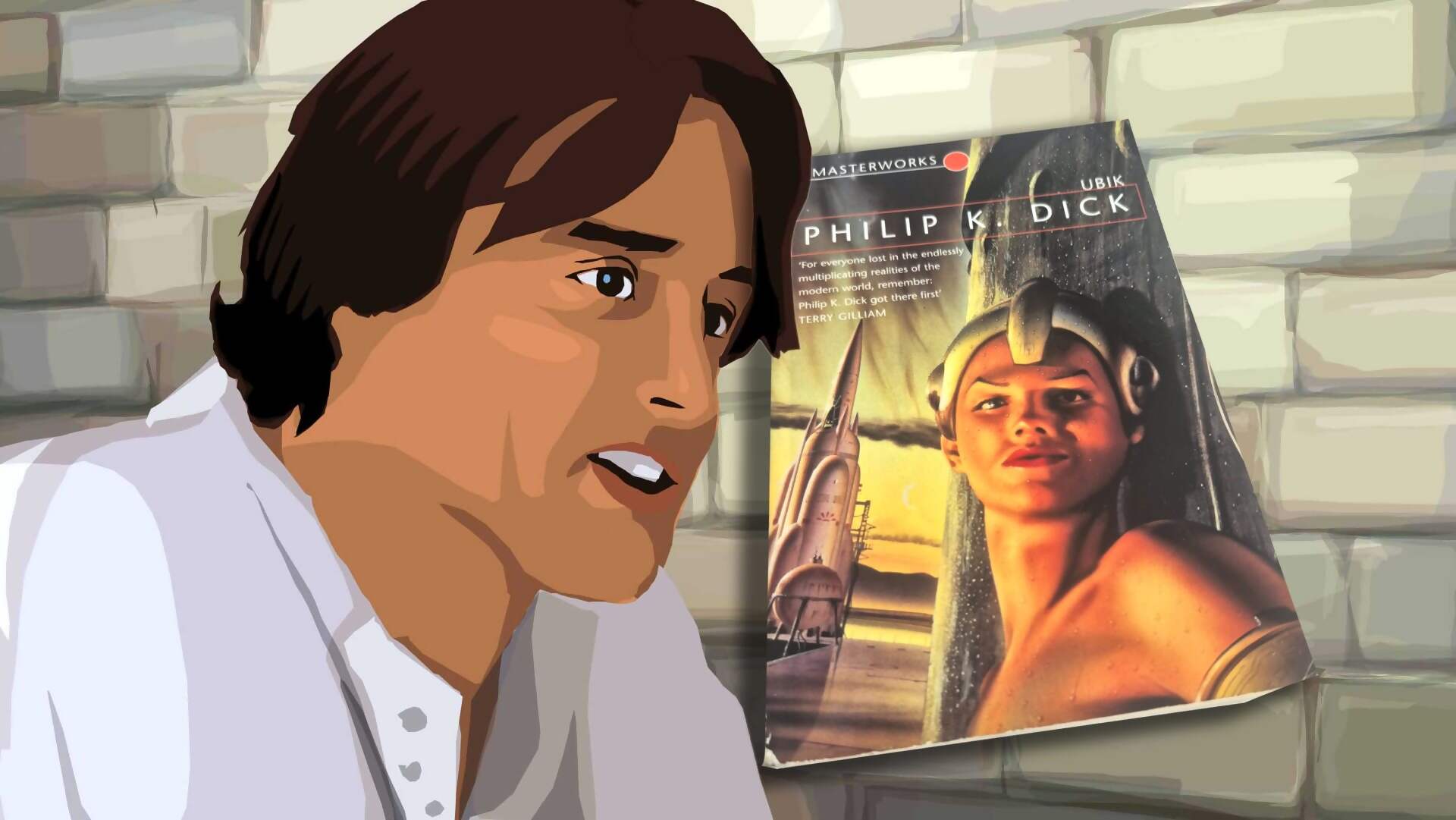
Some 30 years later, writer-director Richard Linklater began writing his own adaptation of Ubik. He and his producer partner Tommy Pallotta were both devotees of the author’s work, with Linklater embarking on a long monologue about Dick’s novel Flow My Tears, The Policeman Said in the 2001 animated film, Waking Life.
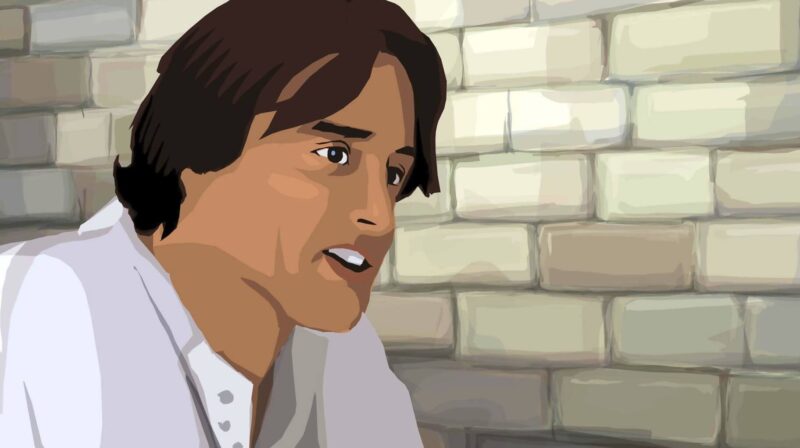
Says Pallotta, “I started reading Philip K Dick in a class taught by Louis Mackey, who later appears in Waking Life. He was a really cool philosophy professor at UT. We read The Three Stigmata Of Palmer Eldritch in his Philosophy and Literature class, and it wasn’t just a book I liked. It was seismic for me. It changed my relationship to reality.
“When I first met Rick, Philip K Dick didn’t come up immediately. But we shared an interest in philosophy and a lot of the same writers, and Philip K Dick was right in the middle of that. His work is a kind of shorthand for uncertainty about reality, and that’s something that runs through what Rick and I have done together.”
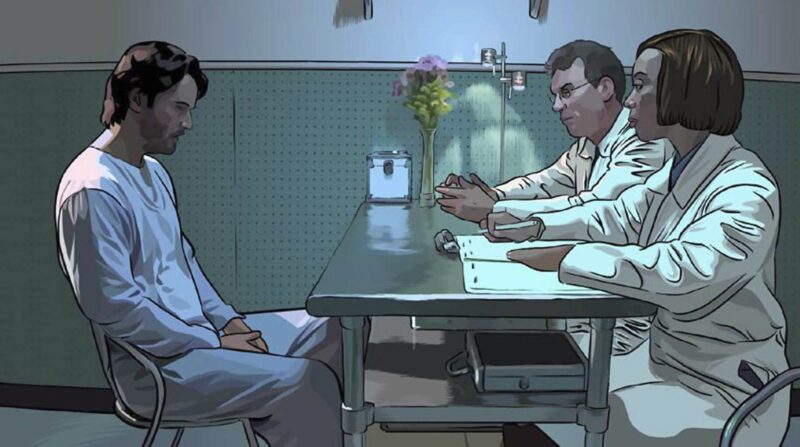
Linklater therefore began working on writing his own Ubik adaptation, with Pallotta as producer, but there was a problem: they didn’t have the option rights for the novel. And because the ownership of those rights turned out to be a bit of a Gordian Knot, Linklater and Pallotta instead moved across to another Philip K Dick novel, A Scanner Darkly – the adaptation of which released in 2006 (for the full story of that, be sure to buy a copy of Film Stories magazine).
Besides the rights issue, Pallotta tells us, even adapting such a complex book was a potential challenge.
“The rights were an issue at the time, and beyond that, it’s just a hard book to adapt without losing something,” the producer says. “There’s so much in it. It could be three different movies depending on how you approached it. We were pretty far into it. I think we may have actually cracked it.”
By 2008, the rights to adapt Ubik were bought up by the French production company Celluloid Dreams; three years after that, French director Michel Gondry announced that he would be overseeing the adaptation. The production experienced a number of delays, however, and when this writer caught up with Gondry in 2014, his version of Ubik was no closer to happening.
“It’s a very strong and dark story,” he enthused of the original novel, before noting how tricky it was to adapt. “There’s a lot of surprises. The book takes you to places you don’t expect to go. It makes it very hard to adapt, so I’m a bit scared at the moment.”
Weeks after that interview, it was reported that Gondry had received a draft of the screenplay that disappointed him to such an extent that he decided to bow out of the project entirely.
“The book is brilliant,” Gondry said, “but it’s good as a literary work. Having tried to adapt it with several screenwriters… at the moment I don’t feel up to doing it. It doesn’t have the dramatic structure that would make it a good film. I received a script that disheartened me a bit, and that was it. It was a dream, but in life you can’t always have what you want.”
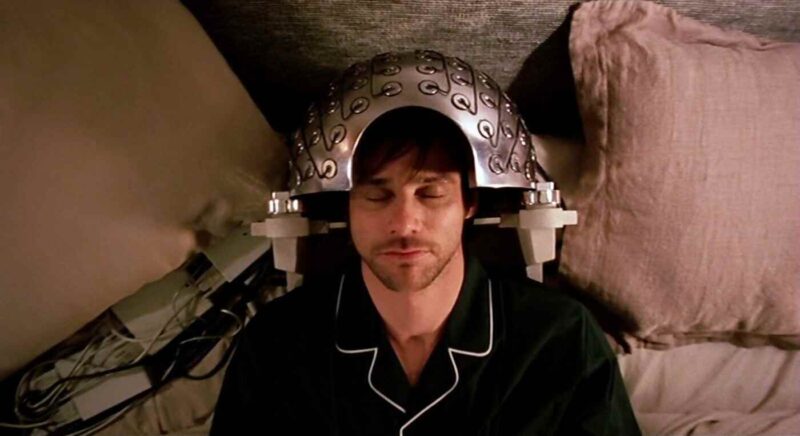
Isa Dick Hackett, one of the late author’s daughters and overseer of his estate, had previously talked enthusiastically about Gondry’s involvement – and for good reason. His work, such as Eternal Sunshine Of A Spotless Mind and The Science Of Sleep, have distinct echoes of Dick’s novels.
Gondry’s Mood Indigo, a poignant drama about romance and loss released in 2013, had a tangential similarity to Ubik that may or may not be a coincidence. As the film moves dreamily to its conclusion, Gondry’s filmmaking approach moves backwards through technological history: the colour fades to black and white, the film stock degrades to what looks like 8mm, the framerate stutters, until we’re left with nothing but darkness.
In his Ubik screenplay introduction mentioned above, PKD’s old friend Tim Powers described the unique ending that Dick had written for his film:
“The film itself [appears] to undergo a series of reversions: to black-and-white, then to the awkward jerkiness of very early movies, then to a crookedly jammed frame which proceeds to blacken, bubble and melt away, leaving only the white glare of the projection bulb, which in turn deteriorates to leave the theatre in darkness, and might almost leave the moviegoer wondering what sort of dilapidated, antique jalopy he’ll find his car-keys fitting when he goes outside.”
Over a decade on, Ubik remains one of the 20th century’s great un-adapted sci-fi novels. But there’s still just a small possibility that Tommy Pallotta and Richard Linklater might return to the project.
“I still hope I get to see it as a film one day,” Pallotta says, “though I sometimes come and go with it. I was thinking about it as a rotoscoped animation 20 years ago, but I don’t think the story would really be served by being animated. If it happens, I think it would happen as live action.”
Linklater, who spoke to us as part of our look back at A Scanner Darkly, compares Ubik favourably to that later novel, and also hinted that an adaptation of Ubik could happen – perhaps even with his involvement.
“[Ubik] covers some similar ground to Scanner,” Linklater says, “but is both more scary and overtly humorous – a satire, but kind of a prophetic, metaphysical horror film. Tommy has taken a few runs at getting it off the ground, and it’s always stayed with me, so you never know – it’s time could be coming still.”
“There’s so much in that book,” Pallotta adds, “and rarely does an adaptation surpass the book. I love reading Philip K Dick. I’ve read all of his books, and I still reread them. So I feel fine either way. If I get the chance to make it, I would love to. If somebody else makes it, I would be excited to go see the movie. And if it never gets made into a film in my lifetime, I’ll be happy to keep reading the book.”
The new edition of Film Stories magazine, with A Scanner Darkly on a variant cover, is available now from our online store.