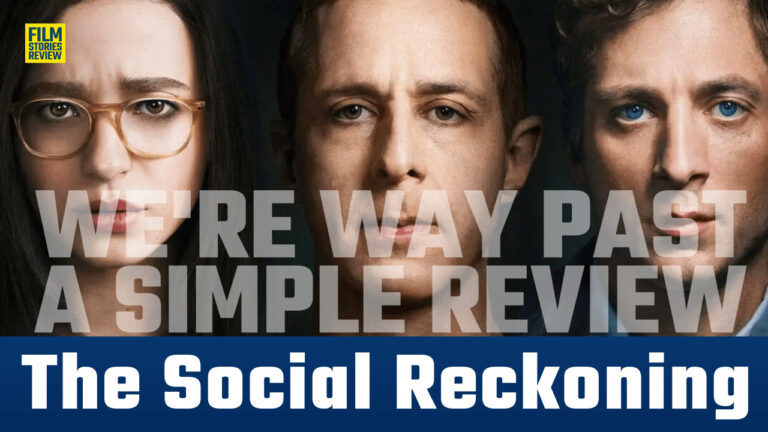
Aaron Sorkin returns to Facebook for The Social Reckoning – and discovers a very different Mark Zuckerberg. Here’s our review. Inevitably, The Social Reckoning is a film defined to a degree by what it isn’t as much as what it is. With marketing materials mirroring the look of 2010’s The Social Network (and the original ... The Social Reckoning review | A Facebook Like?
Aaron Sorkin returns to Facebook for The Social Reckoning – and discovers a very different Mark Zuckerberg. Here’s our review.
Inevitably, The Social Reckoning is a film defined to a degree by what it isn’t as much as what it is. With marketing materials mirroring the look of 2010’s The Social Network (and the original announced title of the film being The Social Network Part II), the incorrect assumption might be it’s a straight continuation of that story, or at the very least a film told in the same style.
Yet the big screen return to the story of Mark Zuckerberg and Facebook takes a different tack, and with a different style.
Set around the 2020s, The Social Reckoning immediately investigates what seems on the surface a relatively contained incident. A woman stood by what appears to be a broken down car, and two cops who pull over to see what’s what.
The power dynamics repeatedly switch between characters here, and the conversation is, of course, being recorded and streamed live on Facebook. What’s more, someone in the Facebook office has taken note of it.
Where’s this going? Well, into the territory of All The President’s Men and Spotlight, as it turns out.
The Social Network won Aaron Sorkin an Oscar for his screenplay, with David Fincher directing the movie. The Social Reckoning sees Sorkin taking on both roles, and wisely switches style. This time, we get dual narratives, that flip between time.
On the one hand, there’s Mark Zuckerberg being prepared for a deposition by his team. On the other, we’re at the Wall Street Journal, as a reporter called Jeff Horwitz – played by Jeremy Allen White – is recruited to tackle the Facebook beat, even though he can barely use a computer.
The key to his investigation, and what draws the two narratives together, is a whistleblower. Enter stage left Oscar-winner Mikey Madison as Frances Haugen, a Facebook employee with a list of concerns, that nobody’s really paying attention to.
It’s Horwitz’s investigation that I found myself most gripped by. Flanked by two interns who wouldn’t mind a) sleep and b) coffee, part of the film settles into the classic journalistic investigation movie, the kind of which I’m very happy to have put straight in my veins. How do you find a whistleblower? How do you get them to trust you? The uneasy coming together of Horwitz and Haugen I found particularly gripping, and a real highpoint of the film.
Which isn’t to say the practice deposition is without moments. Almost Hannibal Lecter-like we see Mark Zuckerberg sat in a witness box, as the team around him – in particular the superb Wunmi Mosaku as Raya – both try to get under his skin, and also manage him too. Quite the balance, that.


The role of person walking into a scene and smashing shit up is then duly awarded to Billy Magnussen as Teddy. I’ve long been a fan of Josh Lucas’ corporate bastard character in James Mangold’s Le Mans 66, and Magnussen proudly sits side by side with him.
I confess I didn’t really care for Jeremy Strong’s portrayal of Zuckerberg though, although accept that may be the point.
It’s little secret that Jesse Eisenberg was offered the opportunity to return but declined, and in his place Jeremy Strong presents a very mechanical, very contained man. He’s presented as evidently the most powerful man in any room he sits, but that also doesn’t come with certainty on his part. Well, until someone flicks a switch.
The problem there is I didn’t really find him that interesting to watch. He’s less central to the story than we saw with The Social Network, but we’ve lost a little bit of the mid-story here. What turned him from the sociopathic maverick of The Social Network into effectively the machine we see in The Social Reckoning? I wonder if the missing part of the jigsaw is there.
Still, Sorkin’s film isn’t afraid of a fight, and isn’t afraid of ruffling feathers, not least a final act that stares modern American history down, and questions Facebook’s role in it.
It’s better at posing questions than giving us answers, but it’s also deliciously old-fashioned and gimmick-free. Crackling with wit, and comfortable to treat its audience with actual intelligence, it’s absolutely not The Social Network Part II, and it’s absolutely not got the verve David Fincher movie either (Sorkin clearly appreciates he’d be on a hiding to nothing if he tried to mimic Fincher’s style anyway, and plainly doesn’t.)
But instead, it’s a contained, absorbing, slow burning drama, anchored by Mikey Madison’s standout lead, and a whole bunch of terrific supporting performances. If you see it for what it is, rather than what it isn’t, then there’s an awful lot to get your teeth into.
Not that the whole thing makes much difference to the world. All that’s happened while you’ve been reading this review is Zuckerberg has made a few more millions in interest. Sometimes, as the movies teach us, the good guys don’t win. At least the film is worth a watch.
The Social Reckoning is in cinemas from 9th October,