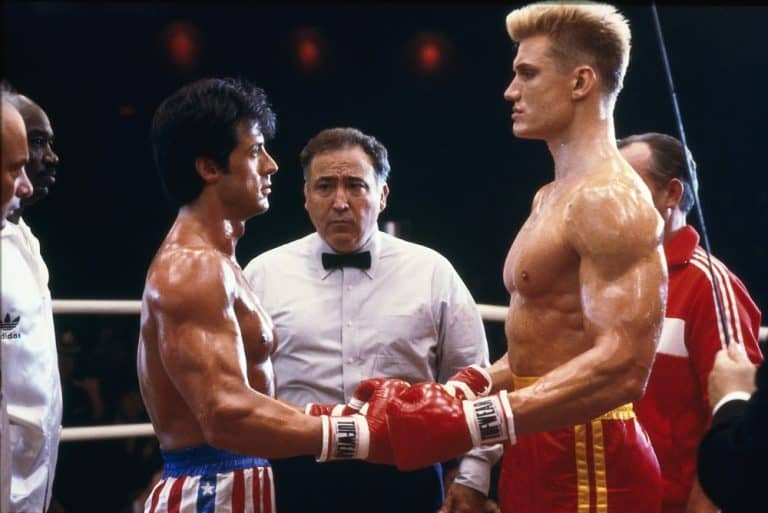
In 2021, Sylvester Stallone re-cut his 1985 Cold War boxing epic, Rocky IV. But how often do filmmakers improve their own work with these edits? There’s an extraordinary moment in Rocky IV where Ivan Drago, the Soviet boxer, is lifted up into the middle of the MGM Grand Casino in Las Vegas. It’s the opening ... Rocky IV, and when filmmakers re-cut their own movies
In 2021, Sylvester Stallone re-cut his 1985 Cold War boxing epic, Rocky IV. But how often do filmmakers improve their own work with these edits?
There’s an extraordinary moment in Rocky IV where Ivan Drago, the Soviet boxer, is lifted up into the middle of the MGM Grand Casino in Las Vegas. It’s the opening of an exhibition match between Drago and aging fighter Apollo Creed, who’s determined to use the occasion to prove that the United States is still top nation – and that he’s not past his prime.
Drago (Dolph Lundgren) emerges into a scene of sequined pandemonium. On the stage, James Brown cavorts and grunts his way through Living In America. There are at least two varieties of dancing showgirls. Creed (Carl Weathers), clad in a bizarre stars and stripes outfit, busts some moves in front of a gigantic golden bull’s head with glowing red eyes. At one point, the bull’s head splits open and emits smoke.
The perspective keeps cutting back to Drago, whose darting eyes and startled expression suggest that he’s never seen western decadence quite like this before. In the Cold War USSR imagined by writer-director and star Sylvester Stallone, they probably didn’t even have sequins.
Once the razzmatazz dies down, Drago climbs into the ring and punches Apollo Creed to death.
The sequence sums up Rocky IV in all its sabre-rattling, Reagan-era wildness. It marked the moment where the long-running boxing franchise finally lost touch with anything that resembled the real world, human ordinariness, or nuance. But therein lies its strength as a pop cultural artifact: it’s the kind of film that could only have emerged in 1985, right as east-west tensions were high again, and when filmmakers were increasingly channeling the mile-a-minute style of MTV.
Rocky IV is 91 minutes long, but even shorter once you take out the credits and flashbacks to earlier films. In 2009, the intrepid blogger Steve McCutchen calculated that a full 31.9 percent of Rocky IV’s duration is given over to musical montages. The final hour is roughly 50 percent montage.
Here’s Rocky Balboa driving around in his Lambo at night because he’s sad about the death of his friend. Here come not one but two training montages, back to back, one cut to John Cafferty’s pulse-quickening Hearts On Fire. If this isn’t MTV filmmaking, then I don’t know what is.
Roughly thirty-five years later, Sylvester Stallone woke up one day and decided that Rocky IV needed to be re-edited. A documentary, directed by John Herzfeld and uploaded to YouTube, captured Stallone’s Rocky IV re-edit for posterity. (It’s a really absorbing fly-on-the-wall piece, and well worth seeing.)
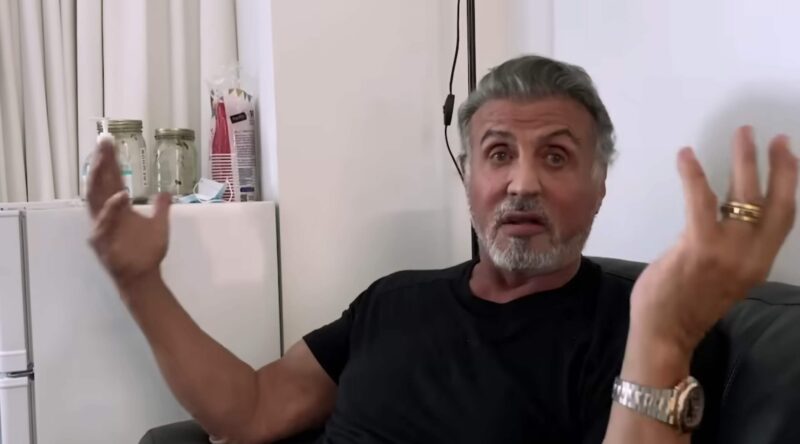
In the dark days of Covid-19, Stallone spent months or perhaps weeks in a sterile office on Sunset Boulevard while editor Dov Samuel set about reworking Rocky IV – taking out some scenes and splicing in ones that had been shot in 1985 but went unused.
The resulting Rocky IV: Rocky Vs Drago, released in 2021, has a duration of 93 minutes – so only the barest fraction longer than the 1985 theatrical version. But the number of minutes doesn’t get across just how much has changed: there are still musical montages, but fewer of them. What we get instead are far more scenes of drama, which theoretically give more substance to the story but really only serve to underline how implausible the story is.
Back in Herzfeld’s documentary – which, at 93 minutes long, is as long as the recut Rocky IV itself – Stallone talked about his thinking behind some of his edits. In the original cut, Stallone said, Creed goes out and “gets slaughtered because of ego;” in his new version, he’s shown to have been a true warrior to the end, even if he does still lose to the towering Drago.
“It was too superficial,” Stallone said of the theatrical cut. “Back then, I existed on a physical level. But later I realised that the physical level is nothing compared to the mental.”
Rocky Vs Drago, then, was Stallone’s attempt to go back and mine Rocky IV for its deeper emotional resonance: picking out more character moments, such as Duke’s eulogy at Creed’s funeral, and de-emphasising the more quintessentially kitsch, 1980s aspects of his own story.
One obvious victim of all this retooling is Sico, the bug-eyed robot that Balboa gives his layabout brother-in-law, Paulie (Burt Young) as a Birthday gift. The machine, which in the theatrical cut is implied to have provided childcare to Stallone’s son while he goes off to fight Drago behind the Iron Curtain, is nowhere to be seen in the 2021 cut. Fair enough, you might think, it was an odd plot detail in any case – though this writer quite liked the way the robot underlined the film’s man-versus-machine theme.
(The robot’s creator, Robert Doornick, claimed in 2020 that these scenes were cut out to avoid paying him royalty fees. Incredibly, Sico is a member of the Screen Actors Guild.)

Other changes seem more arbitrary. Brigitte Nielsen, who plays Drago’s wife and unofficial spokesperson, has a number of her lines cut; scenes that focused on her in the theatrical cut are given over to Michael Pataki’s Nicolai Koloff, Drago’s antagonistic manager and trainer.
Rocky IV’s theatrical cut contains a scene from the end of Rocky III in which Balboa and Creed climb into a ring for a jocular rematch (“Ding. Ding,” Apollo flirtily purrs as he rings an imaginary bell). It’s a playful moment that gets across their respect and friendship; in the 2021 version, the whole sequence is gone, and we get something much moodier instead: a separate clipping from Rocky III in which Balboa, bruised from his fight with Clubber Lang (Mr T), riding around on his motorcycle.
It’d take too long to go through all the other changes here, but it’s enough to say that they alter not just the tone of the film, but also its pace. The additional dialogue scenes largely serve to underline sentiments or themes that were already implied in the more brisk 1985 cut; Creed and Balboa now talk at much greater length about their motivations – Balboa’s happy with his lot in life and okay to age gracefully; Creed still wants the attention and glamour of prize fighting.
All of which goes to make a once fleet-footed film feel more like a bloated 140-minute epic. Where the theatrical cut is all zip and exuberance, Rocky Vs Drago is surprisingly leaden. The slower pace gives us more time to register how awkwardly actors stand in certain scenes, as though they don’t know what to do with their hands. Or how long stretches of the movie, when the montages aren’t playing, take place in almost total silence, with no incidental music to keep the dialogue company.
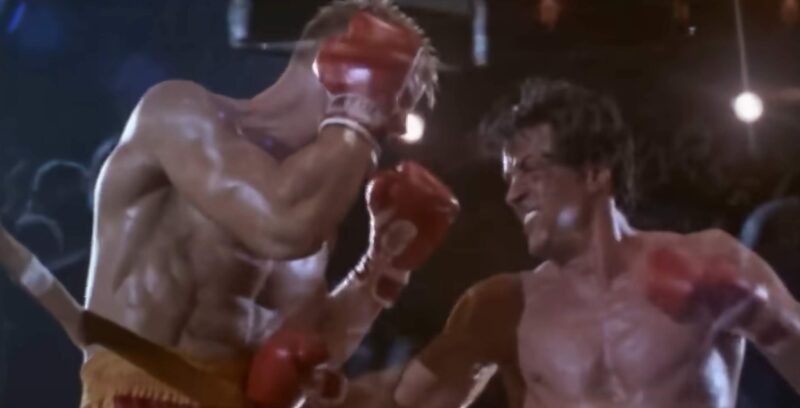
Admittedly, most critics weren’t all that enamoured with Rocky IV when it came out, and a lot of critics were much kinder to the more sombre Rocky Vs Drago in 2021. But for this writer, the greater emphasis on drama – bringing it closer in tone to the first two films – sits awkwardly with the overarching Rocky-wins-the-Cold War premise.
Stallone has taken out the big exploding boxing gloves from the original title sequence, replacing them with stark white text, but it’s still a film about Reaganism defeating cold-eyed, robotic Communism in the boxing ring. In short, 2021’s Rocky Vs Drago turns a piece of fascinating 1980s pop art into a less interesting drama.
In fairness, the batting average for directors who rework their own material isn’t exactly great. Ridley Scott may have achieved his original vision with his later cuts of Blade Runner and Kingdom Of Heaven, but few would choose Francis Ford Coppola’s 2001 Redux over the original Apocalypse Now, and even Spielberg later disowned his gun-free, CG-retouched version of E.T. The Extra-Terrestrial, released in 2002. Michael Mann has a long history of tinkering with his own work; we’re still waiting to see whether his new edition of 2006’s Miami Vice can improve on the theatrical release.
Maybe Stallone will have more luck with Rocky V, which he’s also said he’d like to one day re-edit. That film is so widely considered a disappointment that it’s hard to imagine that a revised cut could make it much worse.
The good news about Rocky IV, of course, is that both versions still exist. If you’re in the UK, both edits are currently on Prime Video, and it’s fascinating to sit and compare the two cuts side by side. There are previously deleted scenes in the newer revision that are worth seeing out of pure curiosity. But above all, Rocky Vs Drago highlights just how greatly a film depends on pace and rhythm to truly soar. This new cut may represent an older, wiser Stallone’s storytelling philosophy, but it’s the faster, shallower Rocky IV that functions as a piece of pure entertainment.