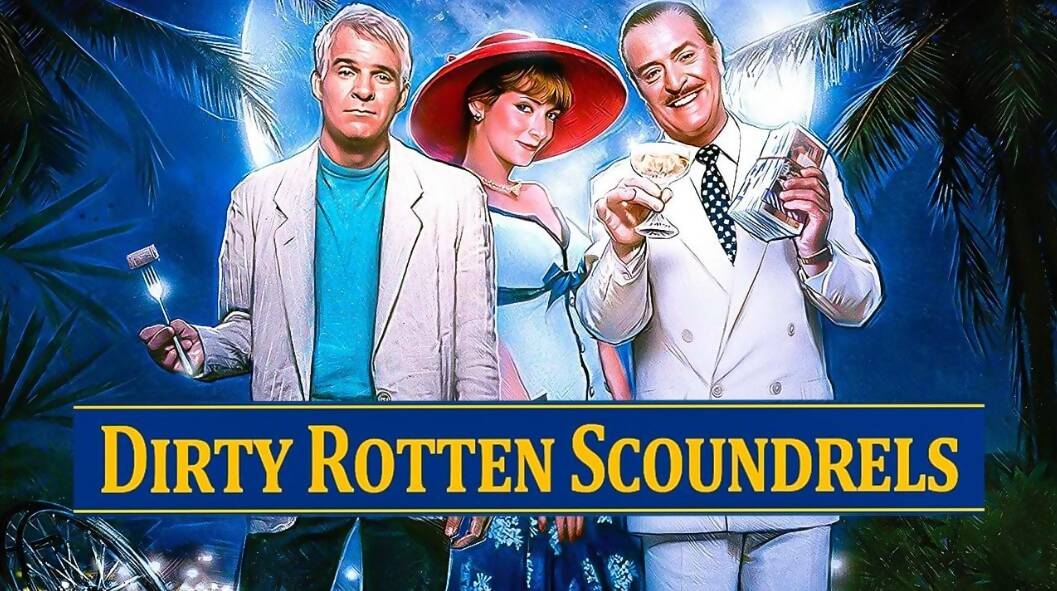
We close out Michael Caine’s 1980s career in style with the 1988 comedy, Dirty Rotten Scoundrels, co-starring Steve Martin. Michael Caine showed no sign of slowing down as he entered his third decade as a leading man. The 1980s would see him win his first Academy Award (Hannah And Her Sisters), tackle new genres such ... The 1980s films of Michael Caine: Dirty Rotten Scoundrels (1988)
We close out Michael Caine’s 1980s career in style with the 1988 comedy, Dirty Rotten Scoundrels, co-starring Steve Martin.
Michael Caine showed no sign of slowing down as he entered his third decade as a leading man. The 1980s would see him win his first Academy Award (Hannah And Her Sisters), tackle new genres such as horror (The Hand) and shark-based revenge movie (Jaws: The Revenge) whilst continuing to work with interesting new auteurs like Brian De Palma (Dressed To Kill) as well as old friends from classic Hollywood such as John Huston (Escape To Victory).
Film by film, I’ll be taking a look at Caine’s 1980s filmography to see what hidden gems I can unearth alongside the more familiar classics…
NB: Spoilers for Dirty Rotten Scoundrels lay ahead.
Directed by: Frank Oz (The Dark Crystal, The Muppets Take Manhattan, Little Shop Of Horrors, What About Bob?, Bowfinger).
Tagline: Nice guys finish last. Meet the winners.
Other Featured Geezers: Steve Martin as Freddy Benson, Glenne Headly as Janet Colgate, Anton Rodgers as Inspector Andre, Ian McDiarmid as Arthur.
What’s it all about, Alfie?: Caine stars as Lawrence Jamieson, a suave British conman who for years has been successfully relieving overly credulous wealthy women of their fortunes by posing as an exiled prince in the French Riviera town of Beaumont-sur-Mer, ably assisted by his police chief friend Andre (Anton Rodgers) and manservant Arthur (Ian McDiarmid).
However, his livelihood is threatened by the arrival of brash American hustler, Freddy Benson (Steve Martin), muscling in on his lucrative patch.
Eventually, unwilling to share territory, they agree to a bet; the first to con $50,000 from a naïve-seeming new hotel arrival, “United States soap queen” Janet Colgate (Glenne Headly), gets to stay. The other conman must leave the country.
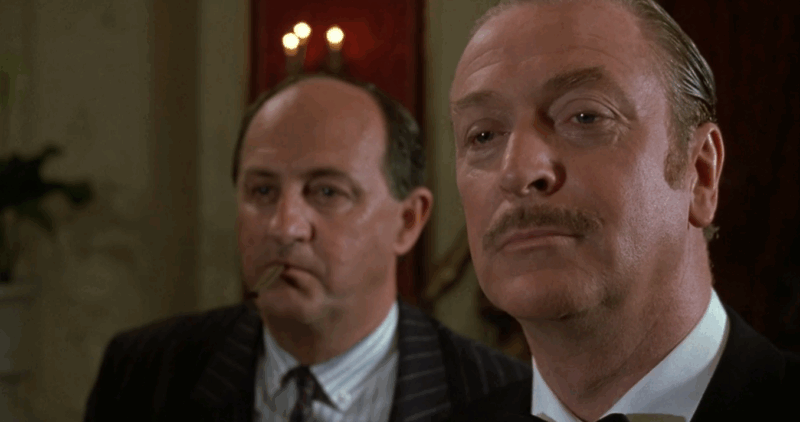
Caine-ness: Steve Martin is first billed, and Caine second, but they are equal co-leads, with Caine perhaps having slightly more screentime.

Suggested product
Issue #61 (Horror Special): Magazine + Signed Ben Wheatley F&TT&N: Issue #4 (Reprint)
£14.99

It’s Caine who’s introduced first, with his iconic voice being the second that we hear, when we see him conning an anonymous woman into giving him her pearl necklace. We get our first proper look at Caine, or to be precise the back of Caine’s neck, as dapper swindler Jamieson, immediately after the opening titles, when he’s in a casino smoothing down his hair, receiving intel on his next mark from corrupt copper Andre, before turning around to reveal a snazzy little moustache.
There’s no shouty and pointy Caine in this film, but instead only calm, affable and gentlemanly Caine. Lawrence is seemingly unphased and self-possessed whatever trouble comes his way. His method of dealing with bothersome rival Freddy is “taking him in gracefully, in order to get him out gracefully”. He flatly turns down Andre’s less graceful offer of putting in a word with “Renee the Knife”.
Then, at the end, when it’s revealed that Janet has conned him and Freddy and absconded with their dosh, Lawrence simply chuckles “isn’t she wonderful” while Freddy has a tantrum beside him.
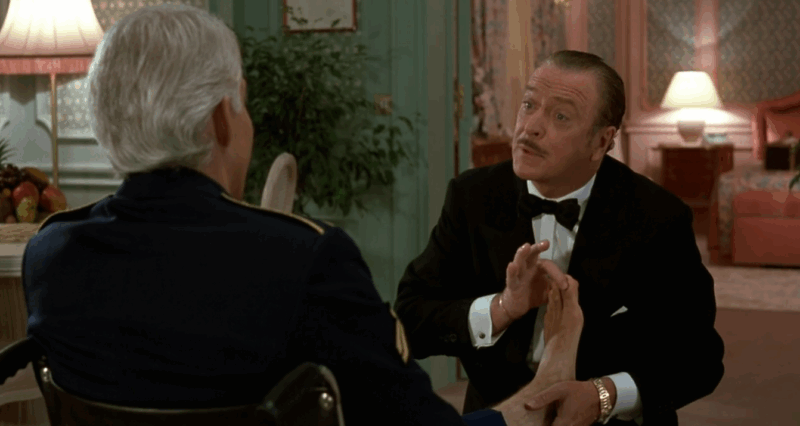
Caine gets to let loose and have fun with a German accent when Lawrence pretends to be a psychiatrist from Lichtenstein, Dr Schaffhausen, whom Freddy, who is pretending to be a disabled military vet, has said is the only person who can cure him of his psychosomatic disability.
Freddy is playing on Janet’s sympathies to get her to pay for this fictional doctor who may help him walk again. Freddy wasn’t expecting Lawrence to turn up as the doc to get the money himself (and torture Freddy in the process) in one of the film’s standout comic set pieces.
“I’m here to help you my boy” Lawrence says to the startled Freddy, his cheerful expression transforming into a look of malevolent delight as he leans in, away from Janet’s view. He then proceeds to tickle the bottom of Freddy’s foot and repeatedly hit his bare legs with an ornamental reed, asking if he can feel anything, which Freddy has to pretend he can’t.
Although a crook, with perhaps a smidgeon of sadism as far as Freddy is concerned, Lawrence has his own strict moral code. He’ll only con the wealthy and corrupt. When he finds out that Janet is apparently not the heir to a soap fortune, but merely the winner of an all-expenses paid trip from a laundry detergent competition, and she has been raising money that she doesn’t have to help pay for Freddy’s treatment, he is deeply touched and seems genuinely emotional when he tells her; “You are generous, sincere. You are wonderful.”
Lawrence is a likeable character, whom Caine imbues with his natural warmth and charm, and it’s a joy to see him spar affably with the more prickly and arrogant Freddy.
Caine writes at length, and with fondness, about this film in his autobiography, What’s It All About?: “I was offered an absolutely marvellous part in a comedy movie that despite some of my disastrous experiences in this genre looked absolutely foolproof.”
The thing that seemed to please him the most was that it was shot on location in the South of France; “one of the places that we most loved in the whole world.” And that he managed to rent a summer house near his pal Roger Moore’s.
This wasn’t just a jolly abroad, though – he cared about the work and was proud of the results. Reflecting on his methods, Caine describes how “I chose the route that I have always taken with comedy in films – play it for reality as though you were in a drama and let the laughs take care of themselves. I never for one moment joined in the joke and played everything absolutely straight […] any attempt on my part to be funny would have ruined it.”
His approach worked excellently, as I believe this is one of Caine’s best performances in a comedy; he suits the material, and matches his co-stars, perfectly.
Caine-nections*: Anton Rodgers was also in the previous year’s The Fourth Protocol (1987).
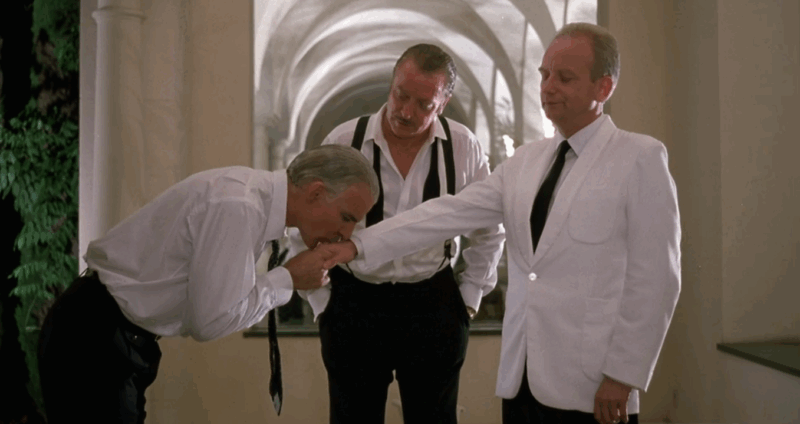
Louis Jourdan’s character instructs Caine’s on the proper way to kiss a lady’s hand in 1977’s Silver Bears, something that Caine’s character instructs Steve Martin how to do in this film using a less than impressed Ian McDiarmid’s help.
*I’m only counting connections from Zulu up to this film.
Best Non-Caine Actor: Steve Martin’s talents are perfectly employed; he gets to be slickly smarmy and also gets to unleash his “wild crazy guy” persona when he’s being “Ruprecht the monkey boy”.
Caine already knew Martin, as he explained, “I had made a picture with his wife Victoria Tennant [The Holcroft Covenant] and he and I had got along really well. He is not at all like the zany characters he plays in movies. As a matter of fact he is the complete opposite, come to think of it. He is a very shy, quiet man, uneasy with strangers.”
Much like Freddy and Lawrence, Caine and Martin were a similarly unlikely pairing. “He is so shy I don’t know how he became friends with a noisy individual like me. I liked him very much and I was looking forward to working with him.”
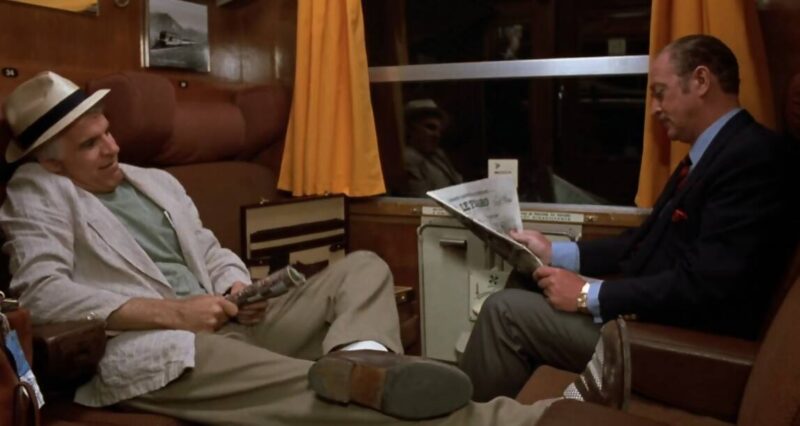
The contrast between the two characters is evident from when they first cross paths on the Zurich train. Lawrence is a dapper dresser while Freddy is clad in more casual tourist attire. Lawrence reads a French language paper, Le Figaro; Freddy reads Mad Magazine.
Freddy is also a much smaller-scale con artist, exploiting sympathy to get money for his “gram-gram’s” hospital bills. “Do you have any idea what it feels like to take a woman for 20 bucks?” Freddy asks Lawrence. “I’m afraid it’s a little out of my class,” Lawrence responds, before Freddy realises exactly who Lawrence is.
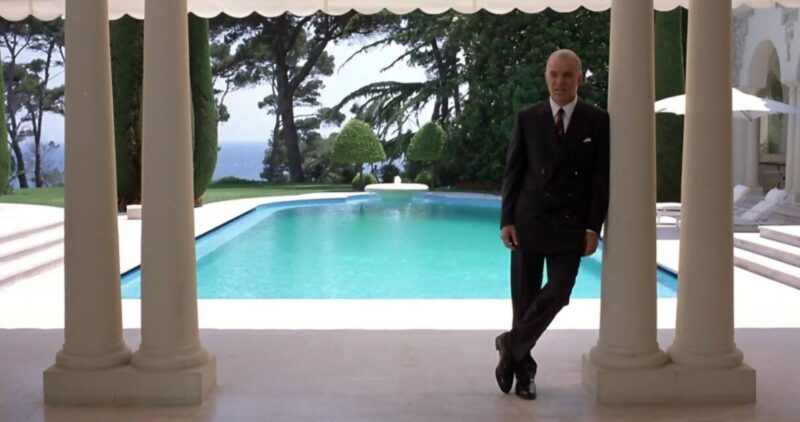
I love the Putting On The Ritz montage where we see Lawrence training Freddy in his high society ways: getting tailored, slathering hair with gel, teaching Freddy how to walk, how to bow with a hat, how to kiss a hand, and most importantly, how to casually lean against a pillar.
One of the film’s most memorable sequences is when Freddy pretends to be Lawrence’s disturbed younger brother, Prince Ruprecht, in a bid to scare away Lawrence’s suitors once he’s gotten enough money out of them.
Lawrence takes one unwitting fiancée to Ruprecht’s special quarters to introduce them. “No sudden moves”, he says to her, accompanied by the ominous sound of banging pots from inside.
Inside his room, Ruprecht is revealed to be sitting casually on his bed in front of a framed portrait of Napoleon. The rest of his décor is equally…interesting, including a tyre swing, a birdcage and a toilet with some loo roll ornately draped over the side.
“You’ve been banging on your pots again. I’ve told you, if you keep on doing it you won’t have any pots left!” Lawrence scolds him gently, but after Ruprecht puts his arms out sadly, Lawrence softens.
“Okay, cuddly cuddly,” he says, and goes to hug him, before being pulled onto the bed where Ruprecht starts trying to mount him.
“He’s very affectionate,” Lawrence explains. Then they hold hands as they approach the woman, Ruprecht walking a bit like a monkey. After Ruprecht then gives the woman an unsettlingly long hug, Lawrence sternly says to him, “Ruprecht, do you want the genital cuff?”
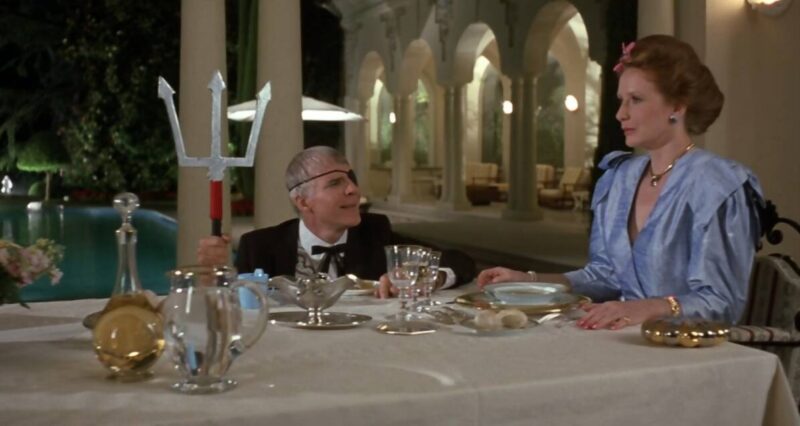
We then see another woman treated to an equally uncomfortable dinner, in which Ruprecht has a trident with him at the table and, just before they are about to start eating, he says “Excuse me, may I go to the bathroom first?”. He then pulls some interesting expressions before saying, “Thank you” and contentedly begins eating.
After deciding to go it alone, Freddy pretends to be a wheelchair-bound military vet with an elaborate backstory involving a cheating fiancée and a TV dance competition, who still needs money to help his sick grandmother, and who has to resort to trying to trade in his service medal for chips on the poker table.
Martin is great fun in all these guises, and this film puts his unique talents to excellent use. As well as Caine’s, this is one of Martin’s best films.
Glenne Headly, as con-woman The Jackal, doesn’t appear until 45 minutes in. She has great chemistry with Caine and Martin, and holds her own amid their comic one-upmanship. Caine notes in his autobiography how he was previously unfamiliar with her work but “she turned out to be fabulous both as a comedy performer and a person.”
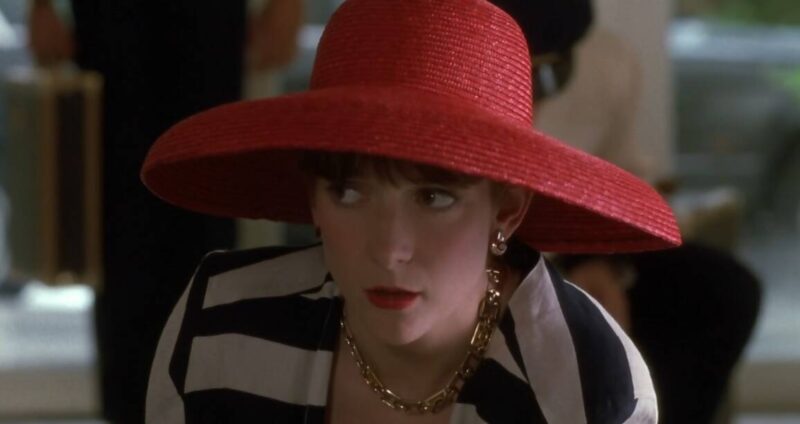
Although she’d been in a handful of films, such as Woody Allen’s The Purple Rose Of Cairo (1985), at this stage in her career Headly was mainly known for her successful work in the theatre, having been an ensemble member of the prestigious Steppenwolf Theatre Group in Chicago.
Even after gaining a higher profile from her role in this film, her focus still seemed to be the theatre, but she did pop up in a variety of films afterwards ranging from Dick Tracy (1990), Mr Holland’s Opus (1995) and Babe: Pig In The City (1998) before her death at just 62 years old in 2017.
Caine describes Anton Rodgers as “another nice guy whom I had known for years” who “played the Frenchman so well that I suggested we do parts of some scenes in French and he told me that he didn’t speak it but not to worry, he would make up his own French. Much to my amazement, this he did, and it was very funny.”
Although only a small role, Rodgers gets some good scenes. When Freddy is arrested, he states that he was only reported to the police as a conman because the woman that he was seeing caught him with someone else. “You’re French, you understand that,” Freddy pleads to Andre.
To which Andre drolly responds, “To be with another woman, that is French. To be caught, that is American.”
Also, somehow Palpatine has returned to play Lawrence’s butler. Ian McDiarmid doesn’t get to do much, but it’s nice to see him regardless.
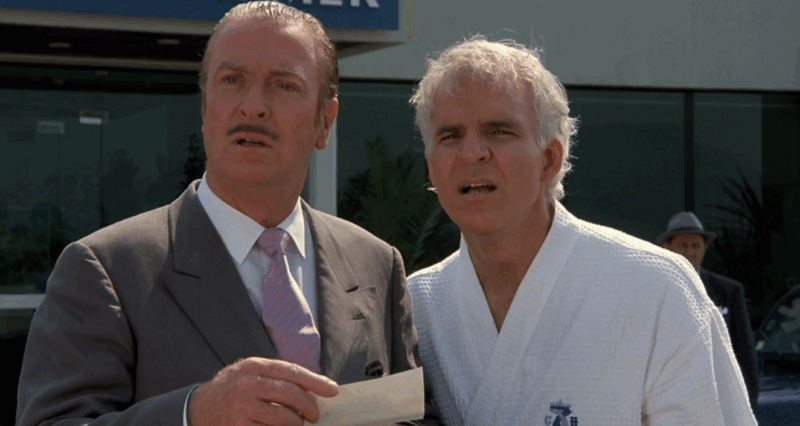
My Bleedin’ Thoughts: This is the first film directed by Frank Oz that doesn’t feature any puppets (unless you count Steve Martin, who certainly has a Muppet-y vibe). Oz is an underrated comedy director. His name isn’t cited as much alongside Judd Apatow, Harold Ramis or John Landis when it comes to top-tier comic moviemakers, but he has a filmography stacked with funny films: Muppets Take Manhattan, Little Shop of Horrors and Bowfinger are all particularly excellent. What About Bob, Housesitter, In And Out and Death At A Funeral, although perhaps a little more hit and miss, are still great fun too.
Dirty Rotten Scoundrels is my personal favourite of his. It’s a remake of the 1964 film Bedtime Story which starred David Niven in the Caine role and Marlon Brando in the Martin one. This remake was subsequently adapted into a fairly successful stage musical in 2004, which ran on Broadway (with John Lithgow as Lawrence) and the West End (with Robert Lindsay as Lawrence) and it in turn was remade in 2019 into a gender flipped version titled The Hustle starring Rebel Wilson in the Martin role and Anne Hathaway in the Caine role. This was critically panned.
Caine sagely notes in his autobiography, “I asked Steve and Frank why we were remaking a comedy that had flopped the first-time round. They said there was no point in remaking a successful film because you can’t improve on success but you can, however, improve on failure.” Something that the director of The Hustle (The Thick Of It’s Chris Addison, who has not directed a feature film since) might be wary of..
Apparently, Dirty Rotten Scoundrels was originally touted as a project for Mick Jagger and David Bowie after the positive reaction to their 1985 Dancing In The Street music video, which is a bizarre train of thought that could have only ever arisen from some heavily coked-up 1980s execs. I like both of those musicians, and that version of the film would have certainly been a curiosity, but I’m also pretty certain it would have been absolutely terrible.
According to Caine, the film had been previously offered to him under the title The King Of The Mountain and “the idea was that I should do it with one of the then-new crop of young American actors known as the Brat Pack, but we couldn’t get the money to set it up. The young American actor with whom they had wanted me to do it was called Tom Cruise.”
Again, another interesting pairing, but comedy isn’t Cruise’s forte – even though I would have liked to have seen his take on Ruprecht. The Color Of Money (1986) saw a young Cruise in a similar role as a pool hustler being mentored by a slicker elder statesman (Paul Newman), in a film that tonally was better suited to Cruise.
There’s an excellent score by Miles Goodman, which is whimsical but with a sinister edge. The film also looks great, with lots of lovely scenic location shots of the Riveria, certainly helped by having talented cinematographer Michael Ballhaus on board, a frequent Scorsese collaborator (who actually worked on the aforementioned The Color Of Money).
It’s always great when you walk away from a film on a high note, and I love this film’s ending.
Freddy and Lawrence are parting on seemingly amicable terms as Lawrence closes his house up for the quiet season, when Janet suddenly appears with a group of gullible investors and she introduces Lawrence to them as Chips O’Toole, “favourite son of Australia”, treating us, briefly, to some more of Caine’s unique accent work.
Lawrence initially looks a little miffed before going with the flow and putting on an Aussie accent; “Come up to the house, we’ll put a couple of shrimps on the barbie for you!” he smiles. Janet then quickly follows this up, before Freddy gets a chance to talk, by introducing Freddy as Randy who “unfortunately is a mute.”
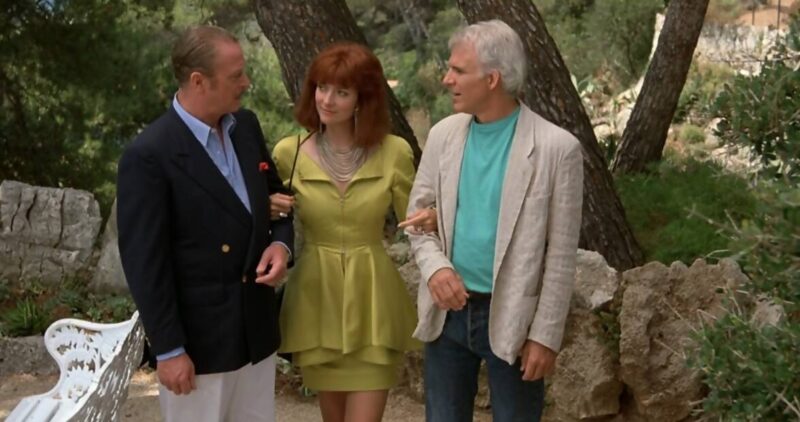
As their new victims walk towards the mansion Janet says, “Fellas, last year I made three million dollars, but your 50,000 was the most fun.” And they stroll off together, her linking arms in the middle, and the film’s jaunty theme plays. It’s such a charming ending, which always leaves me in a good mood.
Trivia (Courtesy of IMDb): Freddy attempts to use a US Army Good Conduct Medal as collateral at the roulette table which the dealer refuses. US military medals are made of low-grade metals specifically to prevent them from being sold, as their military tradition states that the value of the medal is in the action taken to earn it. So don’t go having any ideas.
Donald Pleasence visited the set one day and spent the afternoon playing boules with Caine on “The Village Brown”, which was Pleasence’s nickname for the local boules pitch and not the Wetherspoon’s loo.
Frank Oz has a cameo as a police officer at the airport near the end of the movie. It’s difficult to recognise him without Yoda or Miss Piggy on the end of his arm.
Overall Thoughts: The perfect end to Caine’s 1980s filmography. An excellent comic pairing that still holds up, one of Caine’s best, a real charmer.
Rating: 5/5 Scoundrels
Up Next: Caine kicks off the 1990s by reteaming with his Jack The Ripper collaborator David Wickes for another Victorian telly chiller: Jekyll And Hyde.