
Steven Spielberg returns to UFO territory with Disclosure Day – but its scale and tone make it the antithesis of Close Encounters. Spoilers ahead. NB: This is your final warning for major Disclosure Day spoilers. As well as the inventor of the summer blockbuster, Steven Spielberg has long since established himself as a chronicler of ... Disclosure Day spoilers: Steven Spielberg’s new thriller is the anti-Close Encounters
Steven Spielberg returns to UFO territory with Disclosure Day – but its scale and tone make it the antithesis of Close Encounters. Spoilers ahead.
NB: This is your final warning for major Disclosure Day spoilers.
As well as the inventor of the summer blockbuster, Steven Spielberg has long since established himself as a chronicler of the UFO age. From Firelight, the largely lost film he made as a teenager, to Close Encounters Of The Third Kind to E.T. to War Of The Worlds and now Disclosure Day, he’s returned to the subject of extra-terrestrials again and again.
Maybe it’s inevitable that Spielberg would spend so much of his career watching the skies. The filmmaker was born in 1946, just months before pilot Kenneth Arnold claimed to have seen saucer-shaped craft hovering above Mount Rainier. The infant Spielberg would still have been in nappies when, in July 1947, the story of a crashed flying disc in Roswell, New Mexico hit headlines.
Although the US air force insisted that the recovered debris was from a downed weather balloon, the incident soon passed into legend – an early instance, believers argue, of the government covering up its knowledge of alien visitors and their advanced technology.
That conspiracy theory shows up in Disclosure Day, Spielberg’s latest foray into the world of UFOs (or UAPs). For months, there was some speculation that his latest film, written by David Koepp, might be a stealth sequel to 1977’s Close Encounters. Instead, it not only remains separate from that sci-fi fairytale, but even appears to deliberately distance itself from that film in terms of scale. If Close Encounters is about heading up into the clouds, Disclosure Day brings the UFO phenomenon back down to Earth.
Close Encounters’ events span the globe, finding World War II pilots re-emerging in the Gobi Desert and investigating mysterious aerial phenomena in India before moving over to Muncie, Indiana. It follows a French scientist (memorably played by filmmaker Francois Truffaut), a blue collar lineman (Richard Dreyfuss) and a mother looking for her abducted son (Melinda Dillon) on their journey toward enlightenment. Spielberg ends with what amounts to a vast prog rock concert – a bravura display of light and magic that mixes John Williams’ unforgettable melody with Douglas Trumbull’s ingenious special effects and Vilmos Zsigmond’s awe-inspiring cinematography.
Read more: Disclosure Day review | Steven Spielberg returns to the saucer age
Disclosure Day itself has three plot strands, all of which involve the quest for the truth or the attempt to keep it quiet. But here, the tone feels more muted, the scale more contained than that earlier film. Spielberg’s new opus ends not with a breath-taking flex of filmmaking might in one of the biggest film sets ever conceived, but in a modest TV studio. Faces don’t look up in amazement, but down at their phones.
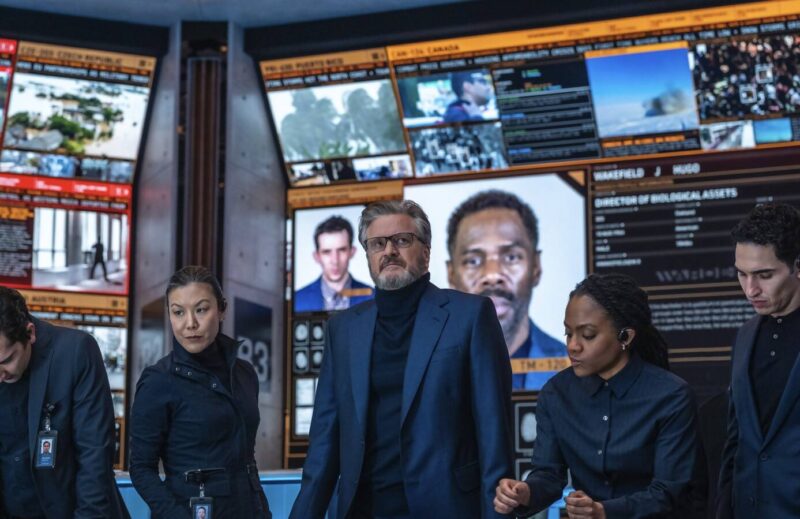
Before we get to those final moments, though, there’s the journey itself. In the world dreamed up by Spielberg and Koepp, we’re introduced to Wardex – a shadowy, Palentir-like company that appears to use all of its advanced surveillance technology to cover up the existence of aliens among us. (Wardex being a portmanteau of Wave Reporting, Development and Extraction, apparently.)
Under the unblinking gaze of its boss Noah Scanlon (Colin Firth), Wardex has entire archives filled with suppressed video evidence and bits of recovered alien technology. Most shockingly, the Virginia-based firm also has captured aliens, which it subjects to all kinds of unholy experiments.
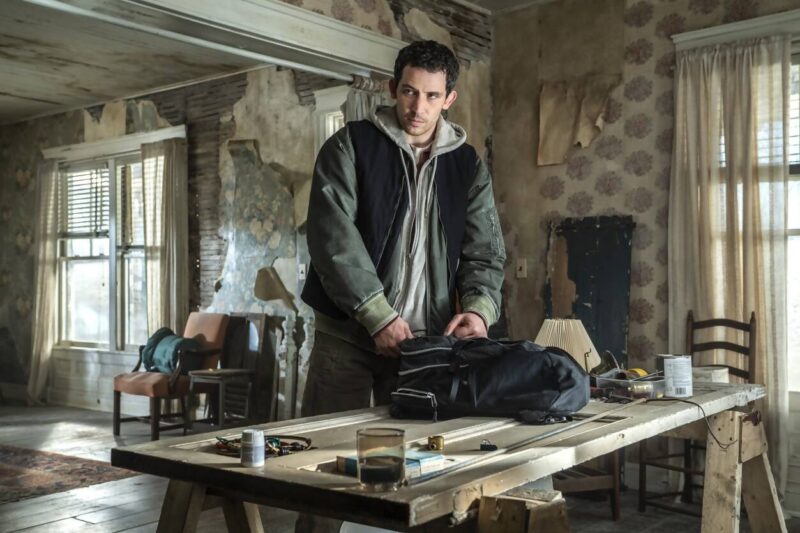
Security analyst Daniel Kellner (Josh O’Connor) has seen footage of those experiments, and is so haunted by the sight of it that he’s become determined to blow the whistle on the whole operation, Julian Assange-style.
Daniel smuggles out a trove of classified data, plus one of three alien artefacts that will become the film’s MacGuffins – these can variously allow their users to Quantum Leap their way into a target’s body, astrally project their likeness to a remote location, or render themselves invisible. (Networked together, the devices also appear to be able to give humans supernatural powers or whatever else the plot requires. More on all that shortly.)
Meanwhile, over in Kansas, the effervescent, ambitious weather presenter Margaret Fairchild is having a morning straight out of The Twilight Zone. While enjoying breakfast with her musican boyfriend Jackson (Wyatt Russell), a bird flies in through the window and appears to hold Margaret in some sort of hypnotic thrall.
Afterwards, she begins to slip into other languages without even realising it, displays telepathic powers and then, in a potentially career-ruining moment, blurts out a clicking alien tongue on live television. This is soon spotted by Wardex, and Margaret also ends up on the run from the company’s shadowy agents (this film’s twist on the men in black of UFO lore).
Eventually, Margaret and Daniel are brought together, not least thanks to the mysterious Hugo (Colman Domingo), another former Wardex employee who’s orchestrating the wider plan to disclose the truth of alien visitors to the whole planet. Hugo later reveals that Margaret and Daniel have a common story: they were both abducted by aliens when they were kids, their brains boosted with special powers. Margaret is able to read minds and speak multiple languages; Daniel’s good at maths. The skills were placed there, seemingly, for the day when the aliens are ready to reveal themselves to the world.
In Disclosure Day, the aliens are benign, much like the ones in Close Encounters and E.T. They’re beings of empathy, which Spielberg contrasts with we warlike earthlings, who are on the cusp of bringing about World War III for much of the movie. There’s talk of the US military being on Defcon Two; one scene takes place as panicked shoppers ransack supermarket shelves.
It’s not obvious how we’re meant to square the notion of the aliens being the embodiment of kindness when they go around kidnapping children from their beds in the dead of night. It’s possible that the aliens would say that the childhood trauma was a worthwhile trade off in the long-run. One thing that does seem plain, though, is that this plot point – and other aspects of Disclosure Day – are strikingly similar to Taken, a Sci-Fi Channel mini-series that Spielberg executive produced in 2002.
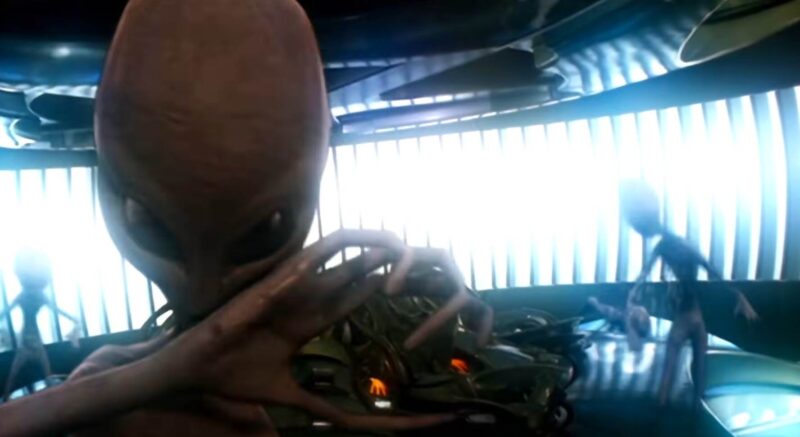
Like Disclosure Day, that series took in a number of real-life UFO cases, including the Roswell incident. It too explored government attempts to hush up its recovery of aliens and their technologies. Most strikingly, those aliens had the ability to assume different forms. One scene saw an alien disguise itself as a blue squirrel and coax a small boy from his room in the middle of the night; the boy follows the squirrel into the bough of an enchanted-looking tree, which turns out to be the alien’s ship.
We see almost the exact same thing happen in Disclosure Day, only this time the aliens appear as deer, red birds and the like; here, their ship is disguised as a fairytale house rather than a tree. It’s far too similar to be a mere coincidence; maybe we can chalk it up to a storyteller returning to ideas he liked and presenting them again in a new context.
Certainly, there are some exciting ideas and set-pieces in Spielberg’s latest outing. Firth’s scenes of Quantum Leaping – and the physical toll they bring about on him – are intense and weird. The scenes of cat-and-mouse and crunchy car chases are directed with real creativity and vim.
But the plot itself can feel somewhat mechanical in the way it moves its characters from place to place; Daniel and Margaret’s respective other halves, played by Eve Hewson and Wyatt Russell respectively, are essentially a means to an end, and ushered out of the way once they’ve gotten Daniel and Margaret where they need to be.
For all the chasing and evasion, the story is a there-and-back-again affair. Boil it down, and Daniel essentially steals some information, takes it to a TV station (in Kansas City, where Margaret’s tale started) and has it broadcast for the world to see. The events that take us to this end point are entertaining and often thought-provoking, but it’s a wonder whether some movie-goers might feel short-changed at how modest the whole thing ends up being.
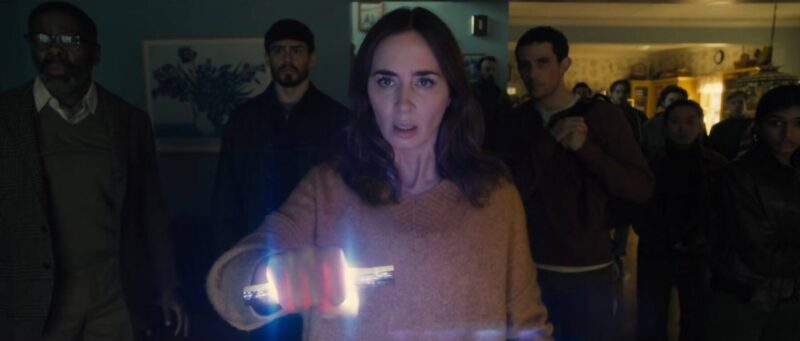
By design, Disclosure Day isn’t some big, bombastic summer movie, even if its June release timing might hint at such a thing. And while the film’s conclusion doesn’t give us the loud crescendo of Close Encounters, it is still, in a way, a moment of wish fulfilment. There really are alien visitors out there – it’s just that nefarious government types have been covering it up. Roswell really happened.
Just as Richard Dreyfuss experienced a saucer age religious experience at the end of Close Encounters – swept up in a glittering ship like an Old Testament prophet – so Disclosure Day offers its own salvation. The unbelievers and miscreants, like Colin Firth’s dastardly Scanlon, are defeated. The world learns the truth about aliens. And the arrival of a genuine extra-terrestrial, wheeled in front of cameras like some wise old sage, points to a brighter future for us humans. A society free from war. All we have to do, Spielberg suggests, is listen.
It’s possible to pick fault with the details of that ending, admittedly. From a technical standpoint, the creature doesn’t look much more convincing than the childlike beings that emerged from the ship in Close Encounters. And if the alien was sneaked out of Wardex HQ months earlier, wouldn’t they have used all their resources to get the being back? Stolen footage could be dismissed as fake if leaked; a real, walking xenomorph would be far harder to dismiss.
For this writer, the pace and sincerity of Spielberg’s filmmaking smoothed over the bumps. There’s a sense that the director genuinely believes in the story he’s telling, and within that heartfelt appeal to humanity’s better nature, there’s a hint of melancholy: the suggestion that our species is so lost that it needs a higher power to set it on the right path. It certainly feels like the work of a filmmaker who’s looked at the increasingly divided world outside and feels as thoroughly depressed by it as the rest of us.
But overwhelmingly, there’s the same Spielbergian excitement in Disclosure Day that we’ve seen in so many of his other movies. His new film’s final revelation may leave humanity looking down at their little black screens, but over 50 years into his long career, Spielberg is still looking up at the stars with childlike curiosity and wonder.
Disclosure Day is in cinemas now.