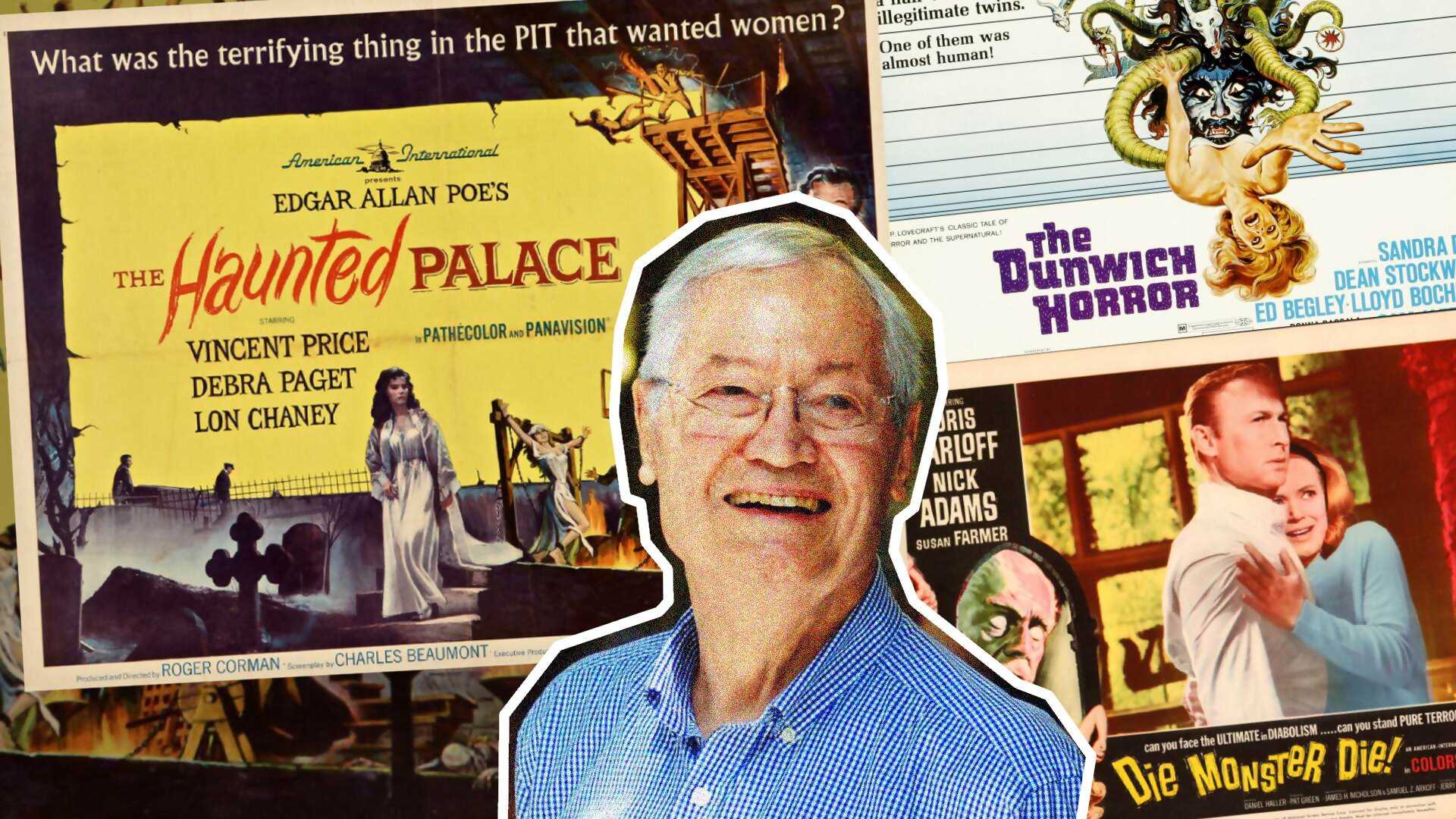
In 1963, Roger Corman’s The Haunted Palace introduced unsuspecting audiences to the weird fiction of HP Lovecraft. Pop culture hasn’t been the same since. Here’s one well known fact about author HP Lovecraft: he never had a book dedicated solely to his work published during his lifetime. Here’s another well known fact about Lovecraft: he ... How Roger Corman brought Lovecraft to the masses
In 1963, Roger Corman’s The Haunted Palace introduced unsuspecting audiences to the weird fiction of HP Lovecraft. Pop culture hasn’t been the same since.
Here’s one well known fact about author HP Lovecraft: he never had a book dedicated solely to his work published during his lifetime. Here’s another well known fact about Lovecraft: he had awful opinions that were regarded as unsettlingly racist even in the early 20th century. I certainly won’t try to defend or rehash any of that here, but nor can it go unacknowledged.
What can safely be said is that, irrespective of the deeply flawed personality of the author himself, Lovecraft’s work has permeated pop culture in a way that probably would have startled him. Comics, novels, films and videogames are either based on his work or make allusions to it; the forthcoming animated comedy Minions & Monsters appears to have its characters open a copy of the Necronomicon and summon up a pint-sized Cthulhu.
It’s all a far cry from a century ago, when barely anyone had heard of HP Lovecraft, much less the Necronomicon. Although from a privileged upbringing, the author made little profit from his stories, which were published in pulp magazines like Weird Tales and Argosy. He died almost penniless in 1937 at the relatively young age of 46, and it was only in the aftermath that his work began to find a wider audience – not least thanks to fellow writer August Derleth, who started Arkham Press to finally publish Lovecraft’s work in book form.
Given his reclusive nature – and relative obscurity in literary circles – it’s perhaps fitting that Lovecraft entered cinema in disguise.
The Haunted Palace, released in 1963, was based on the author’s 1927 story The Case Of Charles Dexter Ward, and was among the terrific cycle of Gothic horror films Roger Corman made for American International Pictures that decade, beginning with 1960’s House Of Usher, based on the story by Edgar Allan Poe.
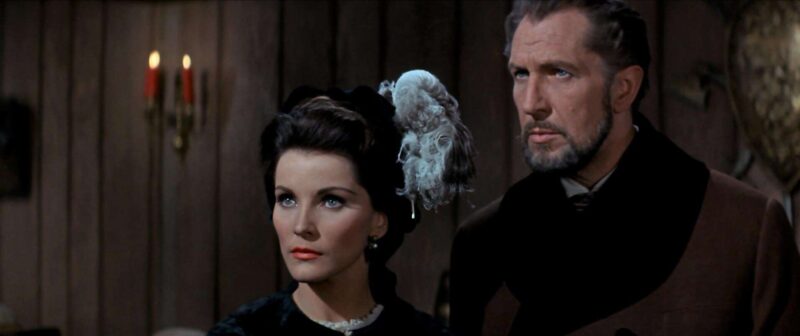
That film, fronted by the great Vincent Price on top brooding form as Roderick Usher, was so successful that AIP ordered more Poe adaptations, and Corman dutifully directed seven of them over the next four years.
Initially, Corman intended to make what became The Haunted Palace the first in a string of Lovecraft adaptations in a similarly histrionic, colourful mode to his Poe films. AIP producer James Nicholson, however, was nervous that audiences had no idea who Lovecraft was, and so the horror was branded Edgar Allan Poe’s The Haunted Palace instead. The plot is plainly still based on Lovecraft’s original text; the production cheekily created a tenuous Poe connection via a narrated poem during the film’s introduction.
“Jim Nicholson was always very good at titles, and after I shot the movie, he decided he wanted to call it a Poe film,” Corman told Fangoria in a 2015 interview. “So, we found a Poe poem titled The Haunted Palace, and after the picture was over in looping, which is when you add dialogue or replace dialogue, I put in a few lines to refer to the poem. It was sold as a Poe film but was never planned as a Poe film. These things happen in marketing films.”
Such changes aside, The Haunted Palace is vintage Corman, and a further reminder that, when he turned to largely producing and distributing low-budget B-movies, we lost a filmmaker with real skill at generating atmosphere and suspense.
Vincent Price plays Charles Dexter Ward, the inheritor of a huge estate perched on a clifftop outside a remote village called Arkham. It’s 1875, and Charles (plus his wife Anne, played by Debra Paget) are initially excited to see the house they’ve lucked into owning. But then they realise that Arkham is filled with villagers who are parochial and surly when asked about the house on the hill (brought over from Europe brick by brick, one resident explains). Even more disturbingly, some residents have blank faces where their eye sockets should be, courtesy of some not-quite-successful makeup effects.


Perturbed but not dissuaded from leaving the place immediately, Charles and Anne head up to the palace and find a Gothic pile straight out of Corman’s earlier Poe movies: there are eastern rugs on the floor, terrible ancestral paintings on the wall, hidden staircases, and servants with secrets to hide (including Simon, played by Lon Chaney Jr).
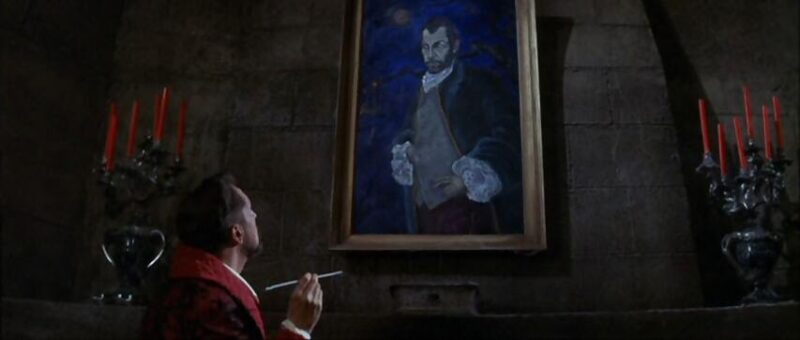
Gradually, however, Charles learns about the historical baggage that comes with the house. Over a century earlier, his ancestor Joseph Curwen (also Price) was holed up in the place, performing unholy rituals and taking young women from the nearby village as part of his evil schemes. The situation became so dire that the townsfolk picked up their flaming torches and burned Curwen outside his own house.
Decades later, and Curwen’s evil lives on via one of those hurriedly-rendered portraits on the wall. Charles, possessed by Curwen’s spirit, turns from a glittering-eyed husband to scheming villain, determined to exact his revenge on the people of Arkham – and continue those experiments with the monster lurking beneath the palace.
Although screenwriter (and noted sci-fi author) Charles Beaumont makes a few changes to Lovecraft’s novel, the film remains true to its dark spirit, right down to mention of the Necronomicon and a being called Yog-Sothoth. Even with Corman’s theatrical style, the implications of Curwen’s experiments are highly disturbing; and, given what we now know about certain wealthy people and their horrendous appetites, they still feel relevant in the 2020s.
Price is a standout, as always, in his dual role as the evil ancestor and his 19th century vessel; the production uses heavy makeup to signpost the shift between one persona and the other, but it’s almost surplus to requirements. Price may be remembered for his grandiosity, but there’s also subtlety and nuance even in his biggest performances.
It’s Poe’s name on the poster, so The Haunted Palace did little to turn Lovecraft into a household name. Still, it remains one of the most satisfying official adaptations of the author’s stories, and it’s fascinating to see how it anticipates the thematically similar Rosemary’s Baby by four years. That novel, which did so much to bring horror out of the past, was published in 1967; Roman Polanski’s film emerged just one year later. It too deals with evil goings on in a Gothic building, necromancers, and (going spoiler light) attempts to fuse human and inhuman DNA.
In a later interview, Roger Corman suggested that The Haunted Palace might have been the first of a series of Lovecraft adaptations, but these never happened; he made two further Poe films, then moved onto other projects. AIP producer Samuel Z Arkoff clearly didn’t forget about the author, though, because two years after The Haunted Palace, along came 1965’s Die, Monster, Die – the directorial debut of Daniel Haller, formerly the set designer on Corman’s Poe films.
Like The Haunted Palace, it begins with a stranger arriving in a village filled with hostile locals. But immediately, the differences are stark: this version of Arkham isn’t shot on a Hollywood sound stage, but a real village in Surrey. (Lovecraft, a noted anglophile, might have approved of the shift to the other side of the Atlantic.)
Stephen (Nick Adams), who’s meant to be a science graduate but looks about 45, has arrived with plans to visit his British fiancee, whom he fell in love with while they were both at university. What he doesn’t realise is that his beau, Susan (Suzan Farmer) is a member of the Witley family – a wealthy clan so despised by the rest of Arkham that nobody will go near their country estate. A local shopkeeper even refuses to sell Stephen one of his bicycles once he learns that the ‘youth’ plans to use it to get to the Witley mansion.
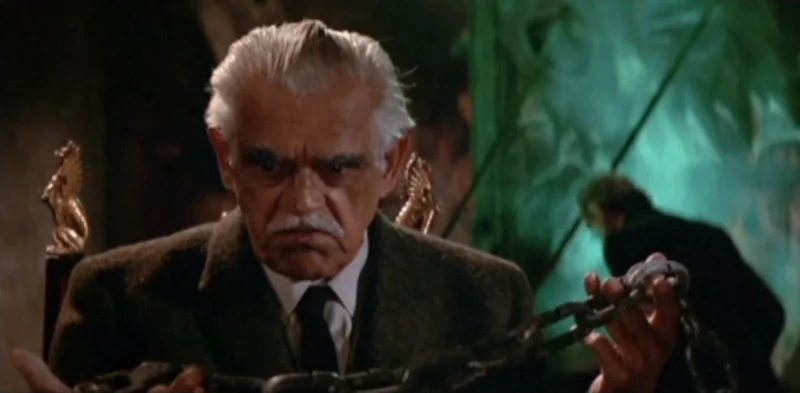
At first, Die, Monster, Die bears little resemblance to Lovecraft’s The Color Out Of Space, on which it’s based – at least until Stephen, having failed to purchase a bike, plods past the crash zone of what he later learns is a meteorite, which has brought with it some force that poisons every bit of flora in the area.
Arriving at the Witley house itself – another rambling country estate that will almost certainly go up in flames before the end credits – Stephen encounters a family living with a mysterious curse. Although Susan remains the picture of health, her father, Nahum (the great Boris Karloff) is frail and relies on a baroque wheelchair to get around. One servant has died under mysterious circumstances; another, played by Terence De Marney, doesn’t seem too far behind. Susan’s mother is so reclusive that she refuses to leave her four-poster bed, and is largely seen obscured by expensive net curtains.
Like Charles Dexter Ward, the Witley family has skeletons in its ancestral closet. Nahum’s father was a necromancer, whose rat-like face glares down from a terrible oil painting. There are hints of something awful kept under lock and key in the cellar. Nahum is up to all kinds of furtive things beneath the cover of night.
It’s all colourful and atmospheric, though the dullness of the ‘young’ leads is inescapable; ultimately, it’s Karloff who carries the film through sheer force of his charisma. Haller also struggles to stage a decent action scene; one late fight between Stephen and a glowing figure (seemingly a stuntman wrapped in tin foil) must have prompted guffaws among audiences even in the 1960s.
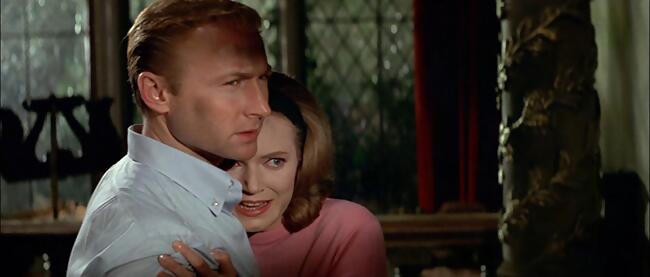
Although less satisfying than The Haunted Palace, Die, Monster, Die nevertheless contains the pet themes that pulsed through much of Lovecraft’s work. Decadent families who’ve fallen into madness, usually as a result of dabbling in the forbidden. There are abominable books (the Necronomicon in the former, The Curse Of The Outer Ones in the latter). And, above all, the overarching mythos that the universe was once governed by heartless alien beings who could be re-awakened if someone were to poke around in the wrong places. The mutants we glimpse in the final reel are also really quite something, and the film’s use of colour and shadow is quite lovely.
The second half of the 1960s saw the appearance of several films connected to Lovecraft. There was 1967’s The Shuttered Room, a low-budget British horror thriller which plays out like a supernatural dry run for Sam Peckinpah’s Straw Dogs (1971). About outsiders dealing with surly villagers and a mysterious entity locked up in an upstairs room, it was based on the story of the same name by August Derleth, who purportedly based the idea on notes left behind by Lovecraft.
Next came Curse Of The Crimson Altar, another British horror, this time based on Lovecraft’s The Dreams In The Witchhouse. There’s another remote house, more cults, and more families with dark ancestral pasts, with Christopher Lee, Barbara Steele and Boris Karloff (poignantly making his final screen appearance) among the cast. Beyond that, it’s a decidedly loose adaptation, displaying more interest in drunken, sweaty parties than Lovecraft’s hallucinatory gaze into the unknown.
That film was distributed in the US by AIP – who dipped into the Lovecraft vault once again with The Dunwich Horror in 1970. Keeping its source material’s title intact, it was directed by Die, Monster, Die’s Daniel Haller and executive produced by Roger Corman.
A young Dean Stockwell stars as Wilbur Whateley, a charismatic 30-something who’s keen to acquire a copy of the Necronomicon, kept under lock and key at Miskatonic University in Arkham. Possessing hypnotic powers, Whateley entrances a student, Nancy (Sandra Dee) and plans to use her as part of a ritual to revive ancient gods from their slumber.
Theoretically, Ed Begley’s Dr Henry Armitage is the hero of the piece, tracking down Whateley to his ancestral home in the titular Dunwich in the hope of thwarting his hellish plans. But like Die, Monster, Die, it’s the villain who steals the show; Stockwell, seemingly aware that he’s in a fun bit of hokum, really goes large with his performance. (Haller also struggles again with his fight scenes; there’s one hilarious and very quiet bout of fisticuffs which improbably ends with a security guard running headlong into an antique spear.)
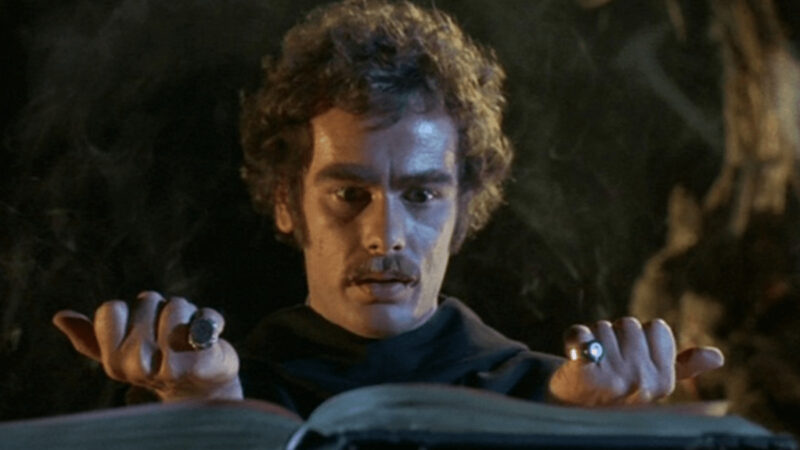
There’s the question whether a young Sam Raimi might have seen any of these early Lovecraft films. Both The Haunted Palace and The Dunwich Horror make prominent mention of the Necronomicon – a cursed book that Raimi later sneaked into his feature debut, The Evil Dead. Die, Monster, Die also contains sickness-possessed victims who emerge, bloodied and arms flailing, like Raimi’s Deadites in that film. And, to cap it all, there’s even a scene in that film in which Suzan Farmer is attacked by sentient tree branches – a curious forerunner of an infamous sequence in The Evil Dead. Coincidences? Perhaps. But the parallels are certainly intriguing.
By the 1970s, horror had moved away from the dusty castles and glowering oil paintings of Hammer and Poe, and towards the more raw style of Night Of The Living Dead and The Texas Chain Saw Massacre. But as horror shifted in the 70s and 80s, Lovecraft went with it.
The author’s cosmic horror, which inspired other writers in the 1950s and 60s, began seeping further into the cultural bloodstream later in the century. John W Campbell’s short story, Who Goes There?, was directly influenced by Lovecraft’s similarly icy novel At The Mountains Of Madness. Campbell’s more contained tale was adapted in 1951 as The Thing From Another World and The Thing in 1982.
Messiah Of Evil, a low-budget horror released in 1973, feels like a direct homage to Lovecraft, especially Corman’s The Haunted Palace, from its use of colour to its remote town full of weird, insular locals. (It also shares a distinctive actor with that earlier Roger Corman film: Elisha Cook Jr.)
Ridley Scott’s Alien, released in 1979, also contains distinct notes of Lovecraft – something director Guillermo del Toro pointed out to this writer in 2011.
“I’d say he’s not only influential, but one of the great unacknowledged writers,” del Toro told me. “Alien… is almost an outer-space version of At The Mountains Of Madness… and when you read the original draft of Alien they discover an ancient alien city – or in this case a city slash space ship. They discover the life cycle of the creature, which is sort of shape-shifting, and they even discover a mural that describes how that life cycle works, which is very much like Lovecraft’s story.”
It says a great deal about Roger Corman’s importance to genre filmmaking that, under a different set of circumstances, Alien could have been made as a low-budget B-movie. Instead, 20th Century Fox bought the script and Ridley Scott turned it into one of the big hits of 1979.
Corman died in 2024, leaving behind a vast body of work and a far-reaching legacy beyond his own films. As a producer, he helped a generation of actors and filmmakers get their start in a tough business; the likes of Joe Dante, Ron Howard and Francis Ford Coppola all got their start under Corman (look out for Talia Shire, credited as Talia Coppola, in The Dunwich Horror).
Besides all that, Corman also played a key role in dragging Lovecraft’s twisted imagination out of the yellowing pages of magazines and books, and into cinemas. Even if you’ve never read a page of Lovecraft’s often purple prose, his Cthulhu mythos and general mood are all over pop culture today – and for that, we also have Corman to thank.