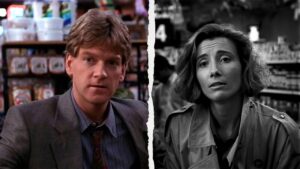
We look back at writer-director Steve De Jarnatt’s Miracle Mile – a one-of-a-kind hybrid of romance, thriller, and nuclear war film. As Kathryn Bigelow’s new drama A House Of Dynamite highlights, the threat of nuclear annihilation hasn’t gone anywhere, even if it has ceased to cast the same long shadow as it did in the ... Miracle Mile | Director Steve De Jarnatt’s 1988 film is still one of the best nuclear armageddon thrillers
We look back at writer-director Steve De Jarnatt’s Miracle Mile – a one-of-a-kind hybrid of romance, thriller, and nuclear war film.
As Kathryn Bigelow’s new drama A House Of Dynamite highlights, the threat of nuclear annihilation hasn’t gone anywhere, even if it has ceased to cast the same long shadow as it did in the 1980s. For younger generations, it might be hard to imagine what it was like when east-west relations were so strained that kids were often drilled on what to do in the event of an atom bomb going off.
From the 1950s to the late 1980s, though, a series of films dealt with the threat of nuclear war, from Stanley Kubrick’s Dr Strangelove in 1964 to WarGames and Threads in the 1980s. These were movies for a generation of movie-goers familiar with the phrase ‘duck and cover,’ or who’d read leaflets that told people to unscrew a door in their house and use it as a lean-to shelter in the event of a nuclear strike.
Few films captured the terror and faint absurdity of that period better than writer-director Steve De Jarnatt’s 1988 cult thriller, Miracle Mile. In some respects, it could be viewed as a blackly comic companion piece to Bigelow’s new movie. Both are set minutes before what may either be nuclear armageddon or a massive hoax; both pivot around epoch-changing phone calls, and both explore the various, recognisably human ways their characters react to what could be their final moments on Earth.
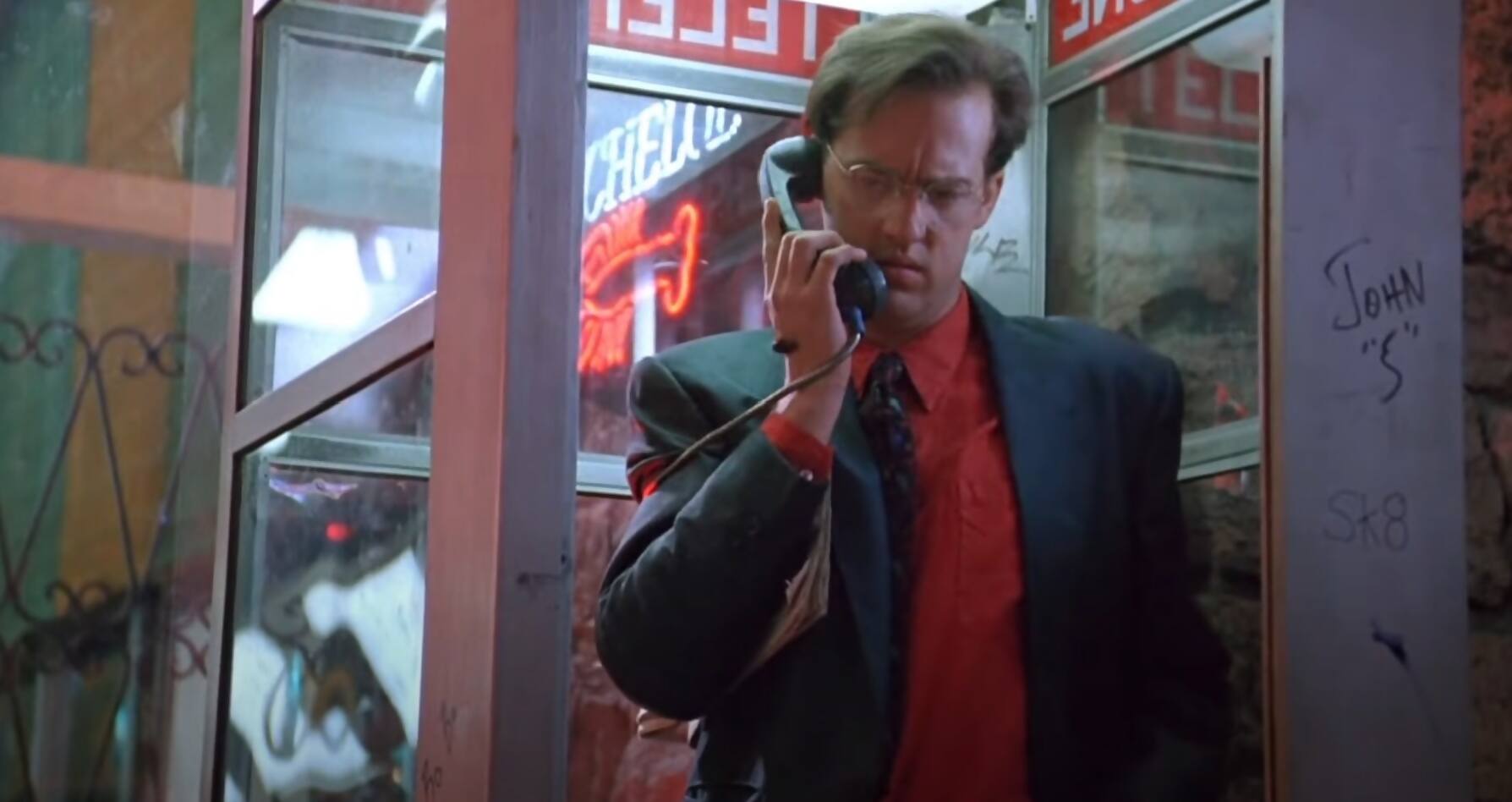
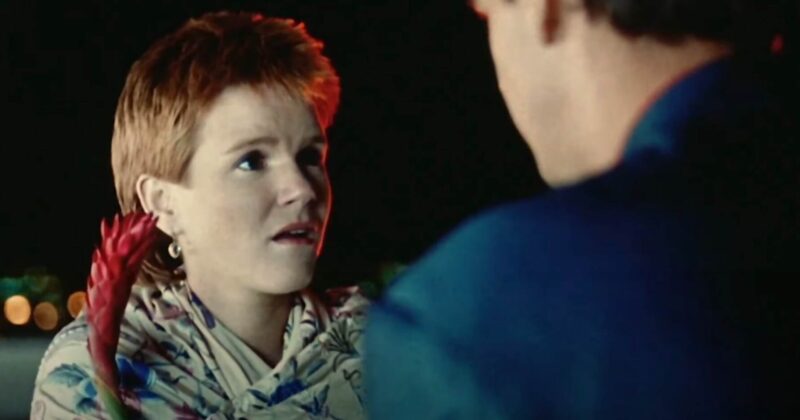
Miracle Mile is, at first, a pure-hearted love story. Jazz musician Harry (Anthony Edwards) meets a similarly eccentric waitress named Julie (Mare Winningham) while wandering a Los Angeles museum. They agree to meet again at midnight, when Julie finishes her shift, but a series of events cause Harry to miss his alarm. Waking up at 4am, he heads to the diner to find that Julie, assuming she’s been stood up, has understandably gone home. By pure coincidence, a payphone rings outside the diner; Harry answers it, and a terror-rattled voice on the other end of the line tells him that there’s just 70 minutes to go before a nuke hits Los Angeles.
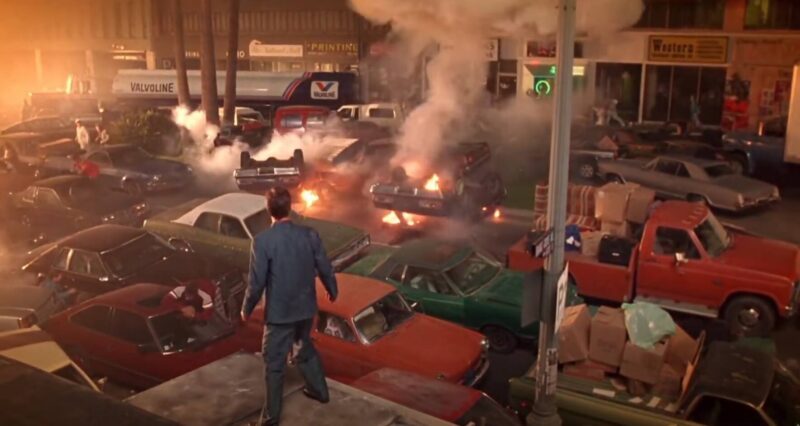
Mind reeling from the call, Harry staggers into the diner and begins talking to the other night owls sitting at the bar, drinking their coffee – among them Denise Crosby’s crisply-dressed businesswoman, Landa, and other colourful patrons played by the likes of Robert DoQui and Earl Boen. At first, Harry’s news is met with scorn, and even he has his doubts that the caller on the phone was genuine. Gradually, though, De Jarnatt builds up the tension, as it becomes ever clearer that something, somewhere in the corridors of power has gone wrong. As the city descends ever deeper into panic, Harry makes plans to track down Julie and escape Los Angeles with her – meanwhile, the clock counts down to what may or may not be the end of the world.
De Jarnatt originally wrote Miracle Mile in 1979, not long after he dropped out of a screenwriting course at the American Film Institute (among his classmates were John McTiernan, Martin Brest and Amy Heckerling). Having recently made the short film Tarzana, he began working on a feature script that could somehow capture the crackle of nuclear anxiety he felt growing up during the Cold War.
“We were certain this was going to happen,” De Jarnatt told me in 2016. “In school, you hide under your desks. You’re going to go to war with Russia, you’re going to hide in a bomb shelter, listen to the radio, stock up on cans and eat that. Then you’re gonna come back out of the bomb shelter and fight the Commies until there’s nobody left. I mean, it was just a given that it was going to happen. Pretty much everyone of my generation would have horrible nightmares.”
De Jarnatt fused that sensation with his perspective of Los Angeles – a city where, he once said, everything shuts down at 10pm and pay phones ring on empty streets. The resulting script arrived more or less fully formed, with that mysterious, panicked phone call De Jarnatt’s hook; it was this that he pitched, successfully, to Warner Bros executive Mark Rosenberg in the early 1980s.
“I just said, ‘What would you do if that phone was ringing right now? It was a kid calling from a missile silo, and you had 70 minutes to figure out what to do? And you don’t know if it’s happening. It’s hearsay. It’s Chicken Little.”
Warner Bros bought the script, but at the same time, its offbeat conclusion made them somewhat nervous. “They liked it a lot,” De Jarnatt said, “but they wanted to mess with it a bit. They weren’t even certain what they wanted to change, but undoubtedly, they would have changed the ending.”

Suggested product
Issue #60 Magazine Bundle (3x Covers: A Scanner Darkly Magazine + 1991 + Roger Deakins)
£14.99

At one stage, Warner wanted to turn Miracle Mile into a segment in what would become 1983’s Twilight Zone: The Movie, an anthology feature with stories directed by Steven Spielberg, Joe Dante and John Landis. De Jarnatt turned the studio’s offer down, which, given the infamous events behind the making of that movie, was probably the right decision.
Determined to get the film made how he envisioned it – and without the ‘it was all just a dream’ ending suggested by Rosenberg – De Jarnatt took the script back from Warner, even turning down the studio’s offer of a huge pay cheque for that Twilight Zone adaptation.
In the meantime, the re-escalation of Cold War tensions saw a raft of other films about nuclear armageddon emerge.
“I was kind of bummed, because when I wrote it, there weren’t any [nuclear war films],” and then WarGames came out, and then Testament, which are all good movies. The Day After, too, it certainly got the eyeballs. It fried the eyeballs, but it also got the eyeballs on television. But you could say, ‘Hey, there’s an audience for this kind of depressing movie. Look at how many people watched that.’”
Read more: The Day After | The disturbing nuclear war TV movie at 40
Through the first half of the 1980s, Miracle Mile remained one of those unmade but much-praised scripts circulating around Hollywood, while De Jarnatt himself was making a name for himself as a young filmmaker with a successful career ahead of him.
“I’d been attached to lots of movies. I was going to do a Hells Angels movie with Mickey Rourke. But I turned down 30 or 40 movies, and the more I turned down, the more I did nothing, the hotter I got for a while.”
(De Jarnatt did direct a well-received episode of Alfred Hitchcock Presents around this time, Man From The South – the third screen iteration of that story. “I got to direct John Houston, Kim Novak, TippHedren and Melanie [Griffith],” De Jarnatt recalled, “And then my stock went up from that because it got big ratings.”)
Throughout that period, De Jarnatt remained determined to get Miracle Mile made, and almost came close on a couple of occasions. There was a possibility of Paul Newman starring as an older version of Harry earlier in the project’s life; later in the 1980s, the lead role was on the cusp of going to Kurt Russell and then a young Nicolas Cage. On the eve of production, however, Cage’s attorney called and “did some switcheroo thing and pulled him out of the picture,” seemingly so the actor could make his uncle Francis Ford Coppola’s movie Peggy Sue Got Married (1986) instead.
With Miracle Mile again in limbo, De Jarnatt moved over to Cherry 2000 (1987) – an off-beat post-apocalyptic action film starring Melanie Griffith. It was a difficult production, with De Jarnatt replacing outgoing director Irwin Kershner just before filming began. (The story of that film’s making could fill an article by itself.)
Eventually, Miracle Mile finally got going thanks to independent production company Hemdale. After years of false starts, De Jarnatt began shooting in 1987, with Anthony Edwards (then known for his role in Top Gun) and Mare Winningham in the leads. The budget was a tight $3.7m, but this gave De Jarnatt the freedom to make the film how he saw it – from its beautiful shots of Los Angeles at night to the downbeat ending that made so many producers nervous.
“We were lighting up streets for city blocks,” De Jarnatt recalled of the shoot. “We had $3m below the line to actually make the film. It was a long time ago, but that’s still not very much money to do big stuff.”
Given the resources available, the look of Miracle Mile is pretty spectacular: it’s one of those stories that keeps escalating in terms of stakes and chaos as it unspools, and the film’s sequences of city-wide panic are superbly realised. Even smaller ideas, like a recurring image of a bird’s nest, or a huge clock that underlines the potential catastrophe about to happen, are wonderfully captured by cinematographer Theo van de Sande; a dreamlike soundtrack by Tangerine Dream only adds to the unsettling atmosphere.
Finally released in US cinemas in May 1989 following its festival debut the previous year, Miracle Mile was a critical rather than financial hit. Perhaps it was because Hemdale, already experiencing cashflow problems that would lead to its closure two years later, failed to give it the marketing and distribution push it needed. Or perhaps it was because, following the end of the Cold War, audiences weren’t in the mood for a film about the threat of nuclear annihilation.
Whatever the reason, Miracle Mile gradually built up a cult following, and is today regarded as one of the best end-of-the-world movies ever made. Although it’s blackly funny in places, it also highlights our collective fragility in the face of the bomb; as a society, we’re all so many baby birds huddled up in a nest.
De Jarnatt’s film may be over 35 years old now, but its premise remains almost timeless; as the filmmaker pointed out himself in a 2015 interview with Money Into Light, “People think the Cold War is quaint nowadays but I remind them that a nuclear attack is much more likely to happen tonight than it was back then… The missiles are still pointed and ready to go today.”
/**/