With The Odyssey in cinemas, attention has returned Wolfgang Petersen’s Troy from 2004. Is it the definitive depiction of the Trojan War? We pay a return visit: In what ended up perhaps the will of the gods, Christopher Nolan’s Troy never came to pass. In the early 2000s, Wolfgang Petersen had developed a large-scale take ... The Odyssey highlights what went wrong with Troy
With The Odyssey in cinemas, attention has returned Wolfgang Petersen’s Troy from 2004. Is it the definitive depiction of the Trojan War? We pay a return visit:
In what ended up perhaps the will of the gods, Christopher Nolan’s Troy never came to pass. In the early 2000s, Wolfgang Petersen had developed a large-scale take on Homer’s poem The Iliad – but had his head turned by a Batman Vs Superman project that would never be. Warner Bros offered what became Troy to Nolan, before Petersen’s sojourn into the comic book world folded and he returned to antiquity.
Following the release of The Odyssey, Troy ends up looking in retrospect like an unlikely, unofficial prequel to Nolan’s film. The Iliad depicts the Trojan War, in which a a coalition of Ancient Greek kingdoms led by the Mycenaean king Agamemnon attack the city of Troy.
The decade-long conflict was triggered when Helen, the wife of Agamemnon’s brother, was ‘kidnapped’ by (or ran off with) the Trojan prince Paris. Death and devastation follow.
Odysseus, the central figure in Homer’s follow-up poem The Odyssey, is a bit player in The Iliad; a ‘second division’ king who helps prop up Agamemnon’s army. But Odysseus also has the idea that wins the war: the Trojan Horse, a trick that allows the Greeks to open the gates of Troy and let the invaders in. As Nolan’s film explores, it’s Odysseus who brings about the end of Trojan civilisation. His subsequent trials and long difficult journey home were to some degree his penance for unleashing so much blood and carnage. The psychology of that choice is all over Nolan‘s work.
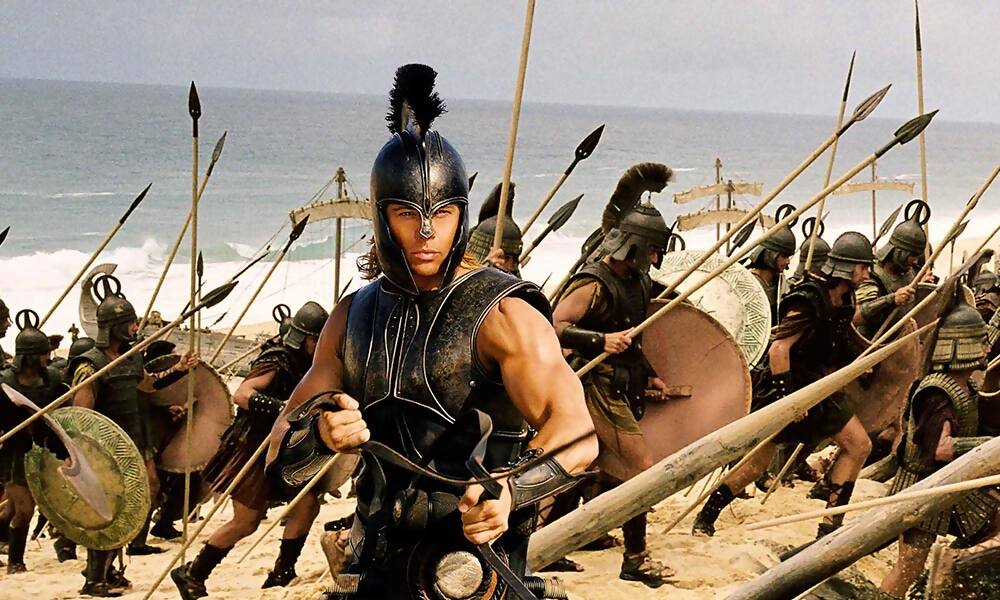
This is less true of Petersen’s film, which is a different beast from The Odyssey. It followed success of Ridley Scott’s Gladiator in 2000, which updated the ‘sword and sandal’ epic for a post-modern audience. As is always the case with a trendsetter, most of the films that emerged in Gladiator’s wake couldn’t hold a candle to that Scott’s visuals, performances and smarts, and frankly Troy is among that number. It believes it can repeat the trick with a similar combination of A-list stars (Brad Pitt, Eric Bana, Orlando Bloom), cinematic legends (Peter O’Toole, Julie Christie) and great character actors (Brian Cox, Brendan Gleeson) but the mixture simply isn’t the same.
Troy’s most egregious misstep, one which Nolan deftly avoids in The Odyssey, is trying to make this the same kind of historical, straight-up telling as Gladiator or the films that preceded it. The Trojan War is largely considered to be mythical. Many of the characters involved are either descended from or closely connected to the actual Greek pantheon of gods, such as Achilles or Odysseus.
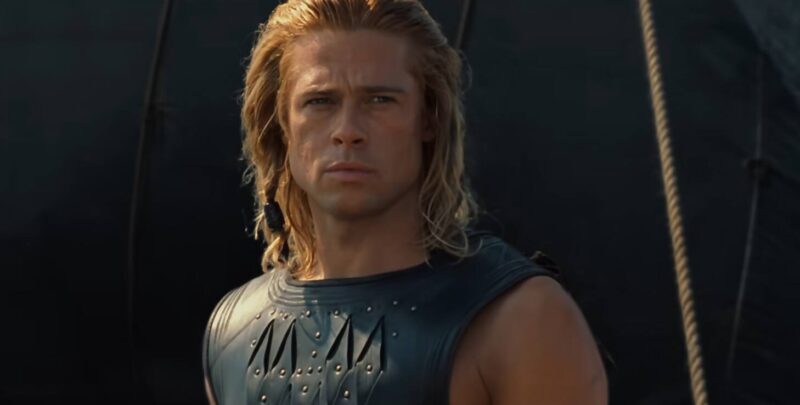
And while the gods are mentioned often in Troy, there’s not one whisper of any kind of supernatural or otherworldly presence. Even Gladiator had an ethereal connection to the spirit world baked into its narrative. Troy might as well just be re-creating a slice of history that, however ancient, we know actually happened. (One of the reasons that Terry Gilliam turned the film down was because he couldn’t understand why the mythical elements weren’t part of the script.)
The Odyssey depicts many of the same key events from Troy but imbues the film with a rich sense of atmosphere, suggesting these events take place in a world before any kind of rules around the natural order. That aids the depiction of Homer’s work, whereas Troy simply feels quite staid most of the time. It’s so laser focused on trying to turn Achilles into another Maximus that it fails to truly create a sense of mythical intonation. This thought process is summed up in something Achilles says to Rose Byrne’s Briseis, his (complicated) love interest: “I’ll tell you a secret. Something they don’t teach you in your temple. The Gods envy us. They envy us because we’re mortal, because any moment might be our last. Everything is more beautiful because we’re doomed.”
Petersen’s film isn’t really interested in the gods. It wants us to pore over Pitt’s physique. It wants us to feel for Bana’s noble Hector. It wants us to believe in the love between Helen (Diane Kruger) and Paris (Bloom). David Benioff’s script is all about making these semi-mythical figures human and relatable, and that to me just defies the point of depicting the Trojan War and, in theory, history’s greatest doomed romance.
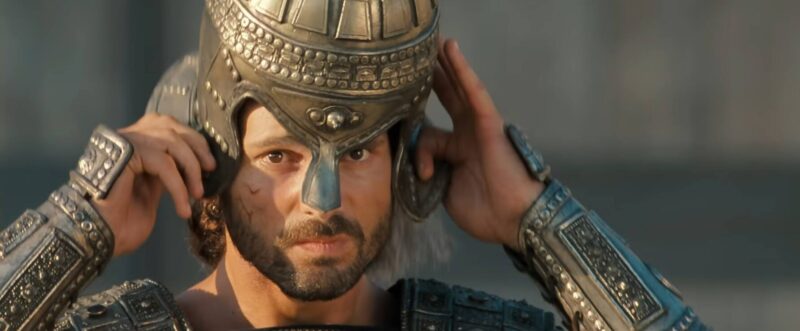
Troy isn’t even that interested in Paris and Helen at all: the big love story is Achilles and Briseis. That in itself is a bit bonkers given Helen was the “face that launched a thousand ships”, with the entire fate of Troy decided by her decision to leave Sparta for love. Or she’s the excuse Agamemnon needs, anyway.


Suggested product
Issue #60 Magazine Bundle (3x Covers: A Scanner Darkly Magazine + 1991 + Roger Deakins)
£14.99
Troy falls into classic Hollywood traps, in other words. Cox, a genuinely great actor, hams it up as a snarling, old-fashioned bad guy. O’Toole wants to echo his old drinking buddy Richard Harris’ take as Marcus Aurelius in Gladiator, but the writing just isn’t there. Pitt, playing a hero who’s quite hard to like, proves he is far more interesting when he isn’t locked into these kind of stock, classical hero roles. It’s likely that the role of Paris – depicted here as a blithering idiot – did Bloom’s career little good in the long run.
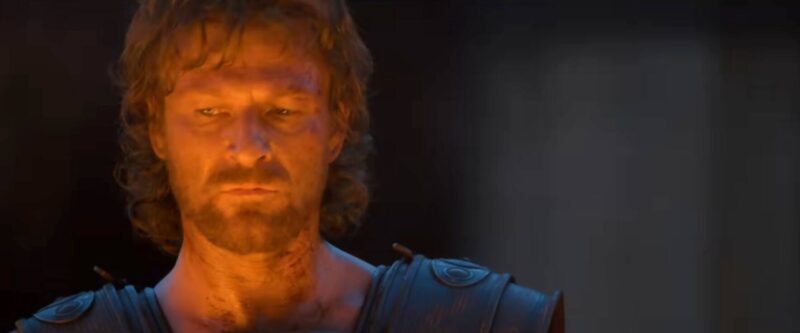
Sean Bean comes out well as Odysseus, this perhaps being a low key audition for Ned Stark: Benioff later partnered with DB Weiss to adapt Game Of Thrones into the TV show that defined the 2010s.
By all accounts, Troy was a nightmare of a production. It cost a huge amount of money, spanned several continents (due to the Iraq War, the shoot had to move from Morocco to Mexico for safety concerns). A hurricane destroyed several sets. In an irony beyond ironies, Pitt damaged his Achilles tendon and delayed production for several weeks.
Controversies around the payment of extras reigned, with one actor later dying from complications related to an injury. Gabriel Yared’s score was thrown out and replaced by a percussive one from James Horner (a great composer, but this isn’t his greatest work). Lots of commentators challenged the film over, if not its historical accuracy, then certainly how much it departed from The Iliad.
At the end, the film does state ‘inspired by The Iliad’, which is perhaps the kindest way to read Troy: in some respects, it’s as fictional as Gladiator’s narrative. Benioff compresses the time frame of the Greek attack on Troy (something Nolan doesn’t do in The Odyssey). In making the gods a psychological element rather than a literal one, he and Petersen end up with a compelling beginning and a thrilling sack of Troy at the end, but the midsection is weighed down by a siege, character inter-relationships, and a lack of momentum. That’s a problem for a film that runs for almost three hours.
Achilles deserves better on film. He’s cast here less as a hero of the ancient world, and more a disillusioned soldier in the post-Vietnam cycle of depictions where military men have lost their faith in the chain of command. It doesn’t help that Agamemnon is less the impassioned brother seeking personal vengeance after Helen’s kidnapping, more an aggressive imperial expansionist. Petersen at the time acknowledged possible allusions to the War on Terror, and the Bush/Blair justifications for imperialist wars in foreign states, but all of this grounds what could and perhaps should have been a tale with a far greater sense of classical romanticism, scope and enigma.
The film is also in conversation with the meaning of heroism and legacy. Achilles talks of this at numerous points, as he’s given the choice of staying in Greece and enjoying a long, contented life, or going to Troy and die a hero. The film chooses to bookend its story with a voiceover – not from Achilles but rather Odysseus.
“If they ever tell my story, let them say that I walked with giants,” Odysseus says. “Men rise and fall like the winter wheat, but these names will never die. Let them say I lived in the time of Hector, tamer of horses. Let them say I lived in the time of Achilles.”
Troy clearly wants us to feel the grandeur of these events, even if the film grounds the characters behind them in earthy warfare and human foibles and relationships. That’s a contradiction Troy never resolves.
Troy certainly has its moments but, as Nolan has proven with The Odyssey, there remains scope for an adaptation of The Iliad which truly dials into the ancient conflation of history, myth and fantasy that turns the Trojan War less into a Gladiator-style historical war epic and something altogether stranger and more memorable.
You can find A J. on social media, including links to his podcasts and books, via Linktr.ee here. Don’t miss him on the Film Stories Podcast Network too.