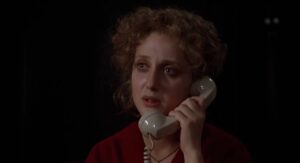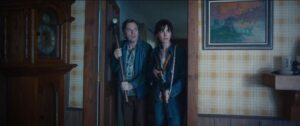
The BBFC is now fairly relaxed about scenes of people being killed with power tools. This was not the case in the 1980s… It’s quite a title, The Texas Chain Saw Massacre. Rolling beautifully off the tongue, it hints at all kinds of horrific acts. It also sounds more violent and sordid than Tobe Hooper’s ... The Texas Chain Saw Massacre and the BBFC’s 1980s fear of power tool horror
The BBFC is now fairly relaxed about scenes of people being killed with power tools. This was not the case in the 1980s…
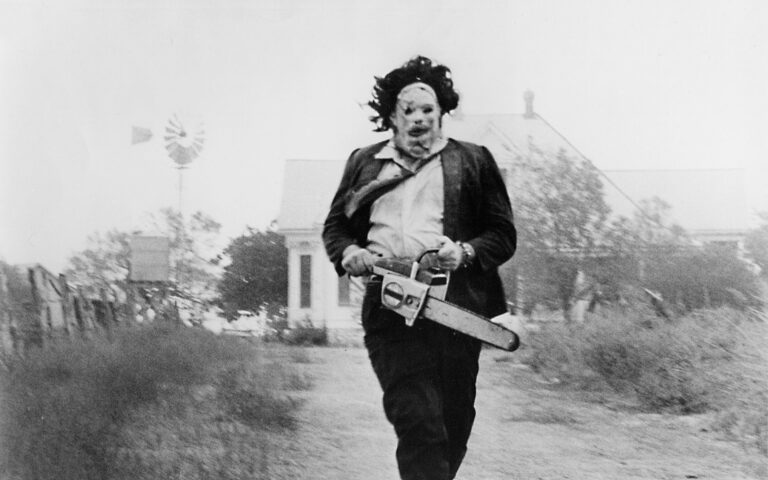
It’s quite a title, The Texas Chain Saw Massacre. Rolling beautifully off the tongue, it hints at all kinds of horrific acts. It also sounds more violent and sordid than Tobe Hooper’s 1974 movie actually was.
Far from just another gore-drenched slasher movie, Hooper’s Texas Chain Saw was more about the anticipation of violent death than its depiction; his use of sound, editing and careful framing made the few murders really count, and tricked viewers into thinking they’d seen something far nastier and brutal than they really had.
If anything, Hooper did his job too well. In spite of his movie’s relative restraint, critics decried it as violent and brutal – Variety, for example, fussed about the film’s “Heavy doses of gore”, which is curious, given that the production didn’t even have the budget for extensive blood and prosthetic effects.
At any rate, Texas Chain Saw’s provocative title, controversy and sheer filmmaking power made it a huge hit. Put together for less than $140,000 (perhaps as low as $80,000) the movie made around $30 million worldwide.
In its wake came a wave of other horrors, each attempting to capture some of Hooper’s success – more often than not, by featuring the word ‘massacre’ in the title. See Naked Massacre (1976), Meatcleaver Massacre (1977), and my personal favourite, Long Island Cannibal Massacre (1980).
Texas Chain Saw also popularised the use of power tools in horror. Not that it was the first to use them: in Night Of The Living Dead, a zombified little girl kills her mother with a trowel, while Wes Craven’s infamous Last House On The Left featured its own, spectacularly noisy chainsaw death. It was the ferocious image of a squealing Gunnar Hansen waving his petrol-driven saw about, however, that really captured movie-goers’ imaaginations.
The Texas Chain Saw Massacre also made the British Board of Film Classification very, very nervous. Its head, James Ferman, famously condemned the movie as “the pornography of terror”, flatly refused to grant the movie a classification. He once said to a screening room full of people at the London Film Festival, “It’s all right for you middle-class cineastes to see this film, but what would happen if a factory worker in Manchester happened to see it?”
As we’ll see later, the anxiety that horror films featuring power tool deaths might trigger copycat killings informed the BBFC’s classification decisions for years afterwards.
Read more: Film Stories magazine #61 | An autumn horror special, available to order now
It was undoubtedly Texas Chain Saw that inspired much gorier and less competently-made movies like The Toolbox Murders (1978), which saw a slow-moving killer in a ski-mask wandering around and killing people with various screwdrivers, drills and nail guns. It probably would have been a quite shocking film had its effects not been so startlingly shoddy – the effectiveness of at least two murder scenes were also undercut by the filmmakers’ decision to play 50s ballads in the background.

Suggested product
Issue #60 Magazine Bundle (3x Covers: A Scanner Darkly Magazine + 1991 + Roger Deakins)
£14.99

(In a weird twist of cinematic fate, Tobe Hooper directed a 2004 remake of The Toolbox Murders, which had almost nothing to do with the original.)
Filmmakers’ 80s enthusiasm for power tools and slasher movies became a thorn in the side for the BBFC. As a moral panic began to percolate around violent and sexually explicit movies on videotape, movies including The Texas Chain Saw Massacre, The Toolbox Murders, The Last House On The Left, The Burning (the latter containing death by garden shears, music by Rick Wakeman) and more than three dozen others were all banned under the 1984 Video Recordings Act.
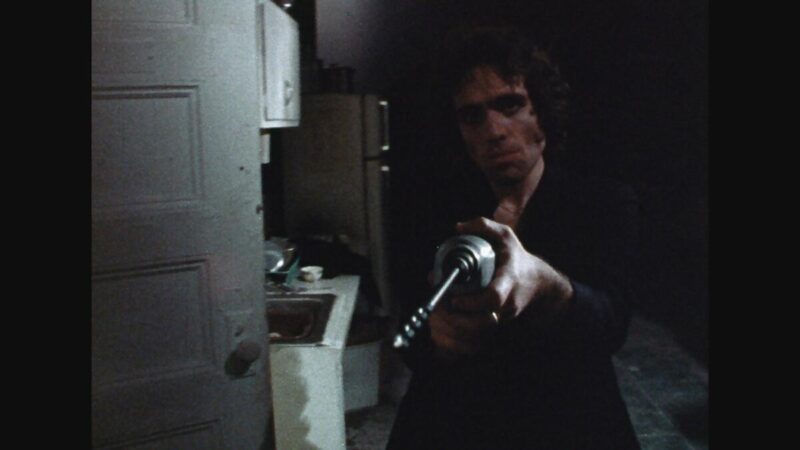
The BBFC’s principal examiner, Mike Bor, once said that the entire video nasties flap, and that subsequent list of banned films, was due to another movie featuring power tool deaths: Abel Ferrara’s 1979 flick, The Driller Killer. Oddly, the movie hadn’t caused any controversy when it US appeared in cinemas, and while it contained several violent scenes, it was more a kind of punk arthouse film than a grindhouse gore-fest.
What really irked the BBFC, it seemed, was distributor Vipco’s graphic videotape box art, which showed a frame from the film in which a bearded man is trepanned with an electric drill. This single image appeared to sum up everything that terrified BBFC boss James Ferman about power tools in violent films; almost every home in the country has something in it that could be turned into a deadly weapon.
What if every impressionable, ordinary citizen in the land got hold of this film, and were suddenly inspired by it? What if they took up their electric carving knives and hedge trimmers, and suddenly turned on each other in the street?
What if they came after us?
To this end, the BBFC refused to certify – or demanded cuts to – various films containing such scenes throughout the 80s. Mad grandad of Italian horror Lucio Fulci had one key scene cut from his 1980 film City Of The Living Dead, which featured an unfortunate victim’s head being slammed into an industrial drill (a quite astonishing special effect for its time). This gore-spattered snippet wasn’t restored until 2001.
The BBFC’s editing decisions often seemed rather arbitrary during this period. Although the controversial Evil Dead (1981) was eventually given an 18-rating, the board demanded the removal of 49 seconds of footage, mostly of axe body blows and a pencil being jammed into an ankle. A scene in which Ash (Bruce Campbell) dismembers a woman’s body with an axe sailed through with no cuts.
As the 80s wore on, rumours began to build that James Ferman had some sort of irrational hatred of weapons in general (especially nunchucks) and chainsaws in particular. A murder scene featuring a chainsaw was cut from the UK version of Brian De Palma’s Scarface in 1983, despite it being shot with relative restraint, at least by the director’s own standards.
When Cannon Pictures attempted to release Tobe Hooper’s ultra-violent, blackly comic Texas Chainsaw Massacre 2 in the UK in 1986, the BBFC stated that at least 20 minutes of footage would have to be removed from the movie before it could be released on tape. Since the censored version of the movie would have been a little more than an hour long after the cuts were made, Cannon simply gave up – the movie didn’t appear on VHS in the UK until 1990. (Incredibly, an uncut version of the film didn’t show up in Australia until 2006.)

After James Ferman stepped down as the head of the BBFC in 1999, the board relaxed its view on power tool-based deaths and horror as a whole, and numerous 70s and 80s movies were either released uncut or with minimal edits. To put into perspective just how much things have changed, look at how the BBFC has reacted to the 2003 The Texas Chainsaw Massacre remake or the numerous sequels and prequels that have emerged since. Although these films are far more violent than the 1974 original, and possibly more bloodthirsty even than Tobe Hooper’s 1986 sequel, they were all passed uncut.
The BBFC has calmly waved through other ultra-violent movies in this vein: the Board noted that 2003’s High Tension (also known as Switchblade Romance) contained “a person being killed with a circular saw” but passed it uncut. (In the US, the theatrical version was edited to get an R rating.)
So now the BBFC’s power tool angst has subsided, horror fans are free to enjoy all the chainsaw and home appliance deaths that filmmakers can dream up. The lingering question that remains, perhaps, is why audiences find such sequences so entertaining in the first place. Maybe it’s because they satisfy our childlike appetite for the macabre. Maybe it’s because we’re faintly horrified yet fascinated by the notion that those electrical appliances in our homes could be used against us.
Whatever the reason, the Texas Chainsaw franchise managed to far outlast James Ferman’s tenure at the BBFC, and with a reboot in the works from Obsession director Curry Barker, it looks as though Leatherface’s chainsaw will be buzzing through skin and bone for a long while to come.
This is a revised, updated version of a feature previously written by the author in 2013.