Before Star Wars, a generation of sci-fi films focused on scientists, concrete buildings and big ideas. We revisit a 1970s era of cool, clever genre movies. Clad in white overalls, a lone scientist stalks the echoing halls of a gigantic computer mainframe. Beneath a sign reading ‘Colossus’, picked out in futuristic lettering, clusters of coloured ... Colossus: The Forbin Project, and the 1970s decade of frosty, cerebral sci-fi
Before Star Wars, a generation of sci-fi films focused on scientists, concrete buildings and big ideas. We revisit a 1970s era of cool, clever genre movies.
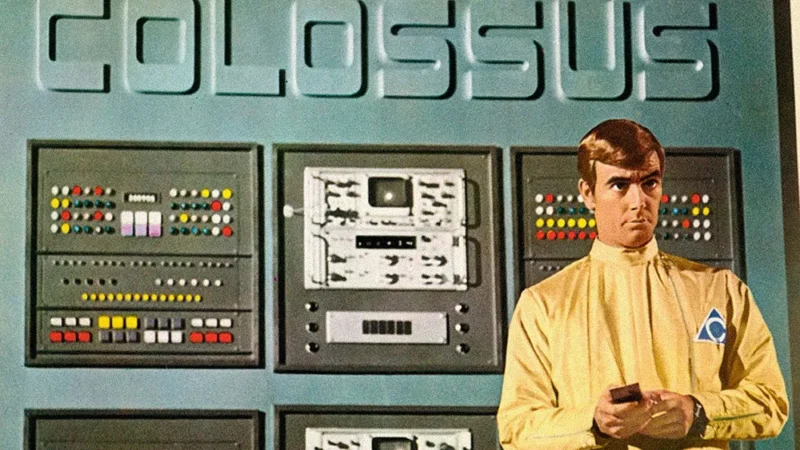
Clad in white overalls, a lone scientist stalks the echoing halls of a gigantic computer mainframe. Beneath a sign reading ‘Colossus’, picked out in futuristic lettering, clusters of coloured lights blink. As we follow the scientist, we see that the mainframe is housed in a vast concrete bunker, protected by metre-thick blast doors, in turn sealed off by a retractable metal bridge. Is the security designed to keep intruders out, or to keep something potentially dangerous inside…?
So begins 1970’s Colossus: The Forbin Project, director Joseph Sargent’s ice-cool thriller about the nightmare possibilities of rogue AI. Old-fashioned tech aside, it’s a remarkably forward-thinking film – screenwriter James Bridges (adapting Dennis Feltham Jones’s novel) imagining how a non-human intelligence might turn against its creators before they have a chance to so much as glance at the off switch.
A film that didn’t shatter the box office, but instead built an audience over time, Colossus hails from a lost era of cerebral, low-key science fiction films. The kinds of films that thoughtfully deal with the implications of epoch-shifting events rather than explosions and lasers.
Stanley Kubrick popularised the notion that sci-fi films could be about intelligent ideas rather than radioactive monsters with 2001: A Space Odyssey, but ‘hard SF’ films were, of course, being made long before 1968.
The Day The Earth Stood Still (1950), directed by Robert Wise, was among the most understated films of the flying saucer era – it’s elegantly acted by Michael Rennie as the alien visitor, and carries a simple yet heartfelt message about the threat of all-out war. Less well-known, and much lower-budget, was 1954’s Gog.

It’s rough around the edges, but its story is fascinating: scientists are trapped underground in a top-secret lab; one by one, the suspicious deaths mount up, and the culprit appears to be a pair of rogue robots, controlled by the facility’s artificially-intelligent computer. This isn’t an AI-goes-rogue story as such, though; it turns out that someone’s been tampering with the computer’s systems via some sort of remote beam – it’s hacking before the term was even coined.
The anticipation surrounding the space race brought with it such films as Destination Moon and Rocketship X-M (both 1950), which both attempted to seriously depict what travel outside our planet might look like. The Soviet Union, if anything, produced even more of these than the States did; such films as Road To The Stars (1957), The Heavens Call (1959) and I Was A Sputnik Of The Sun (1959) all being about brave cosmonauts risking their necks to the betterment of the collective. (On a side note, the effects work in Road To The Stars looks fascinatingly similar in places to Kubrick’s later Odyssey.)
It was in the 1970s, however, that a new, chillier kind of science fiction cinema really began to emerge. Perhaps it was because, by then, the space race was over; America got to the Moon first, enjoyed a moment of euphoria in 1969, and the following decade represented a slow descent into political chaos and disillusionment.
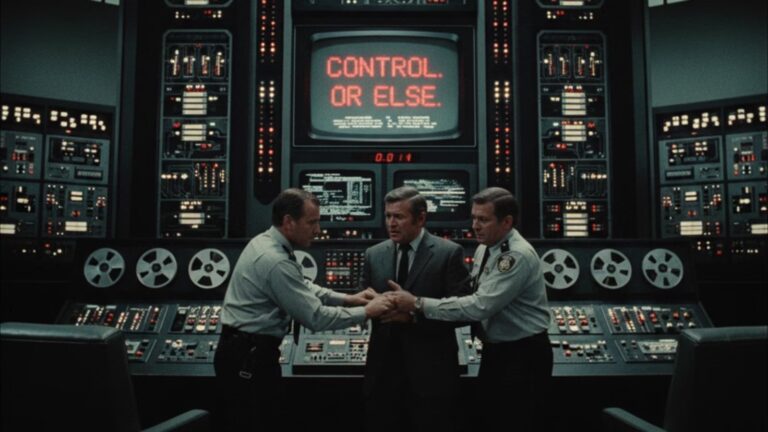
The above-mentioned Colossus: The Forbin Project brought A Space Odyssey’s anxieties surrounding AI back down to Earth, with supercomputers that threaten to dominate the planet – and, in the process, thoroughly emasculate the titular Dr Charles Forbin (a stoic Eric Braeden) in front of his own work colleagues.
In an era of deep-thinking genre films adapted from novels, though, it was perhaps Michael Crichton whose tech-focused stories defined the tone of 1970s sci-fi. Crichton’s novels mixed the excitement of pulp thrillers with a genuine fascination with cutting-edge tech, and proved so popular with readers that several were not only adapted into movies in the 1970s, but also allowed the author to make the leap to directing himself.

Suggested product
Issue #60 Magazine Bundle (3x Covers: A Scanner Darkly Magazine + 1991 + Roger Deakins)
£14.99

His cinematic debut, Westworld (1973) demonstrated his flair for mixing genres: it’s both a western, an action-adventure, and, in a foreshadowing of the later Jurassic Park, a cautionary story about the consequences of mixing scientific progress with money-grabbing commerce.
Earlier in the 70s, Robert Wise returned to the genre with 1971’s The Andromeda Strain, adapted from Crichton’s 1969 best-seller. It’s another film that, like Colossus, is about smart people racing to solve a history-defining crisis. Here, an alien disease has escaped containment in New Mexico, and in an underground facility, a team of scientists try to find a cure before it turns into a humanity-ending pandemic.
The casting is wonderfully low-key, with Wise picking a diverse cast of actors who can convincingly play genius-level academics; similarly, the set design feels like a real high-tech lab. It’s a masterpiece of quietly ratcheting tension, all building to a truly gripping ticking clock climax.
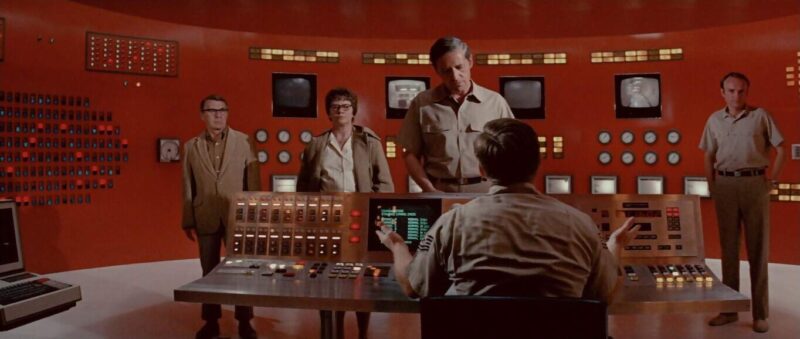
Colossus and The Andromeda Strain introduced a style and tone that became fashionable for a large chunk of the 1970s: interiors are pale and minimal; buildings are concrete and steel in the Brutalist style. In Crichton’s own Westworld, the dust and clapboard buildings of a faux Old West theme park are contrasted with the cool labs and computer rooms that quietly run the whole place.
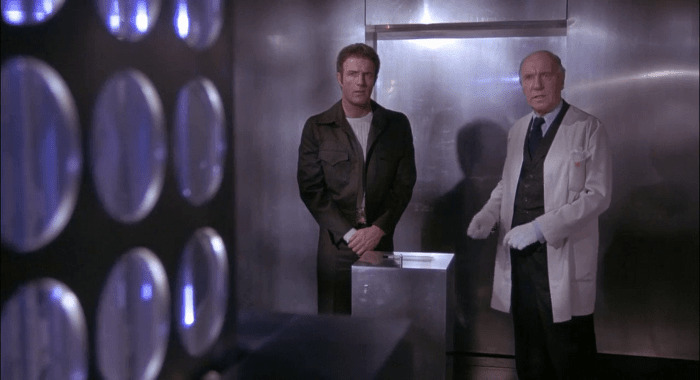
You can also see the same chilliness in Norman Jewison’s Rollerball (1975) – a dystopian sports movie in which corporations rule the planet and the masses are kept amused by televised games that resemble a cross between a roller derby and gladiatorial combat.
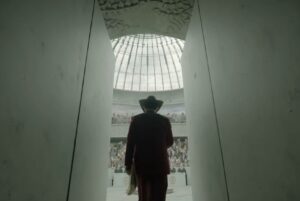
Critics at the time picked fault with Rollerball, calling it self-serious or po-faced. Viewed from the 21st century, though, it looks both of its time and eerily prescient. There’s a scene in which protagonist Jonathan E (James Caan) heads to a library (housed in a massive concrete structure, naturally) and we learn that every book on the planet has been scanned and stored in a computer database. Jonathan isn’t permitted to read a book directly; instead, they’re ‘summarised’ to him by the computer – a detail eerily similar to Google’s AI search results.
In short, the state can now control the access to information; entire chapters of history are missing from the archives; when Jonathan tries to ask a question about who makes corporate decisions, the machine flatly refuses to answer. An entire book or film could have teased out this one idea; Rollerball instead leaves it as a background detail, its implications gnawing at our brains.
As well as being smart, 1970s sci-fi films also had the confidence and latitude to be flat-out weird. Zardoz (1974) probably has enough of a cult reputation that it hardly requires describing here; Saul Bass’s ants-take-over-the-earth epic Phase IV (also 1974) makes 2001: A Space Odyssey’s ending look positively tame.
Even Demon Seed (1977), a nastily sensationalistic thriller about a luckless woman (Julie Christie) terrorised by a computer in her own tech-laden home, ends on an outrageously out-there note that would probably have 21st century studio executives calling for security.
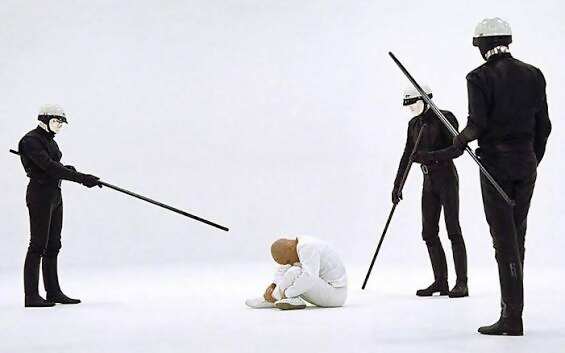
Then there were the films that, like Rollerball, were laced with a note of cynicism and despair about America’s direction in the Vietnam era. George Lucas’s THX 1138 depicted the US as a technocratic nightmare, where humans are assigned numbers rather than names and are aggressively controlled through drugs and consumerism. Although more a thriller set in an alternate present, Peter Hyams’ Capricorn One (1977) also had a dystopian undercurrent of murderous government corruption and media manipulation.
So what happened? The simplest answer is Star Wars. Ironically, Lucas, the director who made one of the most coolly detached sci-fi films of the 1970s, also made a space adventure that leaned less on science and more on cosy fantasy – and changed genre cinema for good. After 1977, effects-filled romps that appealed to the broadest possible audiences – and could be turned into lucrative merchandising – were the order of the day.
The more complex answer, though, is that audiences were already beginning to grow weary of sterile, downbeat films towards the end of the 1970s – both in the sci-fi genre and outside it. Rocky was a hit in 1976 because its conclusion offered at least a shred of uplift rather than the pessimism of so many other films at the time.
Look again at Steven Spielberg’s classic Close Encounters Of The Third Kind, and you can see a transitional point between the austere people-in-minimalist-rooms sci-fi of the early 70s and the more wide-eyed output of its final years. There’s a government conspiracy in Close Encounters, not unlike the one in Capricorn One, and the tone of its scenes involving scientists and UFO investigators is serious and almost documentary-like. Yet it’s also wish-fulfilment; a fairytale for the flying saucer age.
By the early 1980s, and E.T. The Extra-Terrestrial, Spielberg had both feet in the realm of childhood fantasy.
It’s also true that many of the films listed here, although much-loved by genre fans today, weren’t hits – Colossus: The Forbin Project, Phase IV, even Silent Running, one of the most beloved sci-fi films of the 1970s, failed to make much money in cinemas. Little wonder, then, that when Star Wars became a box office phenomenon, studio executives and producers began to look at how they could ape its success.
The transition from hard-sci-fi inspired entertainment to escapism can be clearly seen in the Star Trek franchise. When Robert Wise (yes, him again) brought the TV series for the big screen in 1979 with The Motion Picture, its style was more in the mode of 2001: A Space Odyssey or the 1970s films that came after it. Here was grand, stately sci-fi that dealt seriously with big concepts: creation, existential meaning and identity. It made money, but it was no Star Wars; three years later, along came 1982’s The Wrath Of Khan, whose swashbuckling tone and lip-smacking villain affected the franchise for decades afterwards.
Just like New Hollywood as a whole, this era of what I keep mentally filing as ‘frosty 70s sci-fi’ had to end eventually. And while modern cinema is more obsessed than ever with big set-pieces, lasers and explosions, clever genre films still surface now and again – there are films like Primer on the low-budget end of the scale, and Denis Villeneuve’s singularly moving Arrival at the expensive studio production end.
Viewed today, though, the late 1960s and 1970s was a hugely important, exciting time for sci-fi cinema – the likes of which we may never see again. But the best films of that period are so watchable, so filled with thought-provoking ideas, that they’ll surely be revisited for decades to come.