


It was a decent-sized hit for MGM, so why didn’t Logan’s Run get the trilogy its makers talked about? This and other avenues explored, 50 years on. Cinefantastique didn’t particularly like Logan’s Run. Scratch that: the US genre magazine hated Logan’s Run, and dedicated the greater portion of its autumn 1976 edition to telling its ... Logan’s Run at 50 | Why MGM’s sci-fi thriller didn’t get a trilogy, and why it deserves a remake
It was a decent-sized hit for MGM, so why didn’t Logan’s Run get the trilogy its makers talked about? This and other avenues explored, 50 years on.
Cinefantastique didn’t particularly like Logan’s Run. Scratch that: the US genre magazine hated Logan’s Run, and dedicated the greater portion of its autumn 1976 edition to telling its readers as much.
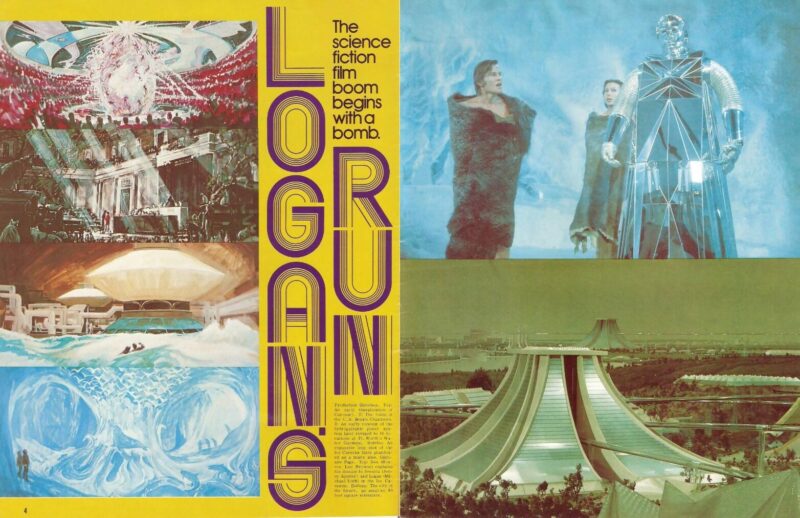
In a move you definitely wouldn’t see from a sizeable publication today, Cinefantastique’s journalists – having been given inside access to the Logan’s Run in the build up to its release – spent multiple pages picking apart the screenplay, and “where it went wrong,” concluding its chunky cover story with a damning summary:
“…the bottom line on Logan’s Run is the shameful waste of time, money and talent it represents,” a sample paragraph reads.
Again comparing the sci-fi thriller to its source novel, it dismisses the film as “nothing more than a collection of B-film cliches in science fiction dress-up, shorn of the intelligence and imagination which the genre requires.”
Yikes.
Between the grumpy editorialising, however, there are all kinds of insights into MGM’s expensive thriller, which had been released just a few weeks before this edition went to press in 1976. We find production sketches, comparisons of different script drafts, interviews with producers, and more besides. The source novel’s co-author, William F Nolan, even talks about writing follow-ups to that book, and how they might one day become movies – turning Logan’s Run into a trilogy.
Despite Cinefantastique’s grousing, Logan’s Run was a decent hit for MGM, with its profits helping a cash-strapped studio through a difficult period in its long history. So why didn’t that trilogy happen? The answer to that question can be found in the film’s production itself, and the seismic shift that genre cinema underwent afterwards…
Enter Sandman
About a future society in which anyone over the age of 21 is automatically eliminated, Logan’s Run was first published in 1967. Told at a brisk clip by Nolan and co-writer George Clayton Johnson, it follows the journey of its titular protagonist, Logan, who initially serves the state as a Sandman – an operative who hunts down and eliminates those who attempt to avoid elimination on their 21st birthday.
When his own termination date approaches, Logan – you guessed it – goes on the run, joined by Jessica, a young woman also trying to avoid being gassed into oblivion by the state.
According to George Clayton Johnson, Logan’s Run was written as a comment on the “youth culture” that exploded in the 1960s.


“What Logan’s Run is about is a society that tries to exist without old people, and thereby loses its sense of continuity,” Johnson told Cinefantastique at a vegetarian restaurant in LA shortly before the film adaptation’s release. “It is the ultimate youth culture. In our society right now, with the old people living in nursing homes instead of with their families, this continuity has already been lost.”
Johnson said that he and Nolan wrote the book in just 20 days, with the pair planning to later pitch it as a movie. When the book came out in 1967 and became a well-reviewed best-seller, the authors – who’d previously written for The Twilight Zone together – began adapting the material into a film script.
Their script, after a bit of shopping around, was eventually purchased by MGM, who paid Johnson and Nolan a flat fee of $100,000 for their work.
From there, Nolan’s Run spent several years in development hell. Initially, it was under the creative wing of George Pal, veteran producer of such sci-fi classics as War Of The Worlds and The Time Machine. When his two years on the project failed to gain traction, it passed over to producer Irwin Allen, who for a while thought he might make it after his disaster thriller hit, The Towering Inferno. That didn’t happen, either.
Logan’s Run was then taken over by Saul David, producer of the 1966 sci-fi adventure, Fantastic Voyage. By now, it was 1974, and the script had been rewritten by Richard Maibaum; that version was thrown out, and in came a new screenwriter, David Zelag Goodman, whose various changes from the novel included shifting the termination age from a tender 21 to 30 – thus increasing the potential pool of Hollywood stars the producers could attract for the main roles.

Saul Good, Man
In a curious quirk of fate, Saul David had prior history with Logan’s Run, and didn’t particularly like it. Before he became a Hollywood producer, he was an executive at Bantam Books, and had personally rejected the novel for being a “comic book” (it was published at Dial Press instead). Years later, he ended up at MGM as a story editor, and that’s when Logan’s Run landed on his desk. All of which might explain why the story shifted a fair bit between page and screen.
“Saul David had a vision of the film that was quite specific,” Goodman said. “The material was shaped to fit us, rather than we adjusting to the material.”
Michael Anderson (The Dam Busters, the 1956 adaptation of 1984) was brought in as director in January 1975 – just 18 months before Logan’s Run came out in June 1976. Michael York and Jenny Agutter were cast as Logan and Jessica, while smaller roles went to Peter Ustinov and Farrah Fawcett. Filming took place in January 1975, with existing, futuristic-looking locations around Dallas chosen to save money on building expensive sets.
At the same time, a considerable chunk of the budget was spent on depicting parts of the film’s city circa 2274, including the Carrousel – a kind of arena that wasn’t in the original novel, and where citizens could fight for their chance for ‘renewal’. This, coupled with some extensive optical effects, saw the budget climb considerably – MGM expected to spend $5m on Logan’s Run, but the figure soon climbed towards the $9m mark. According to Cinefantastique, a further $3m was spent on marketing, putting the final outlay somewhere around $12m.
Read more: A few of cinema’s more unexpected and strange robots
As a result, what was originally envisioned as an adult thriller had to be toned down to secure a PG age rating. Any glimpses of nudity, including a love scene between the two leads, had to be trimmed out – resulting in some glaringly disjointed edits in the theatrical release.
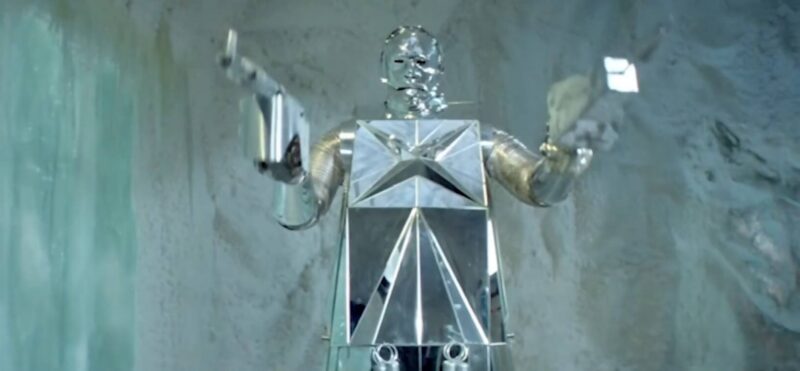
The pace of production may also have been the reason why, impressive sets aside, some other aspects of Logan’s Run’s design fared less well. The ungainly robot, Box, (essentially actor Roscoe Lee Browne emoting from inside a costume covered in tin foil) is one obvious example.
Cinefantastique concluded that, “Quite frankly, for $9m, Logan’s Run is quite tacky.”
Everybody runs
As the film emerged, William F Nolan was rather more diplomatic. “Very much,” he said, when asked whether he liked the adaptation. “I still have reservations about the film, but they relate to the way I would have presented Logan’s Run on the screen. Within the framework of the […] presentation, I think Logan’s Run works.”
It worked so well, Nolan added, that he and Johnson were working on two sequel novels, both of which were likely to become movies. “I’ll write the first of these, as Logan’s World, and George will do the second,” he said. “We might end up with two more movies!”
Logan’s Run was a sizable hit for MGM, making $25m in cinemas – a tidy profit even considering the unexpectedly inflated outlay. So why didn’t the sequels happen? Because Saul David, it seemed, was more intent on producing a follow-up TV series.
Starring Gregory Harrison and Heather Menzies as the new Logan and Jessica, the series – also called Logan’s Run – made its debut on CBS in 1977. Ratings were low, however, and the series was cancelled after just one season.
By the summer of 1977, Star Wars mania had taken hold, and the kitsch dystopia of Logan’s Run – and its tin foil robot – already looked somewhat quaint compared to George Lucas’s groundbreaking special effects work.
Given its unsparing criticism of the first Logan’s Run, few at Cinefantastique were likely to have mourned MGM’s lack of appetite for making further sequels. The outlet’s main beef with the adaptation was that it drifted too far from the source novel, and that much of its allegorical power, about a society that had fallen into hedonism and disregard for the future, had been lost.
Read more: Before Mad Max and Fallout, there was A Boy And His Dog
Further attempts to adapt Logan’s Run for a new generation, in a version that hews more closely to Nolan and Johnson’s original text, have failed to bear any fruit – filmmakers as diverse as Alex Garland and Nicolas Winding Refn had been attached as directors or screenwriters at one stage.
Ironically, parts of the book and film’s backstory remain strangely relevant 50 years on. Nolan and Johnson imagined a 23rd century in which the young, angry at older generations, violently overthrew them, establishing a new order where life is limited to the age of 21. We now live in an age where the young have every right to be angry at the old; where epoch-changing decisions are made by doddering old men, and where anyone under the age of about 30 struggles to find a reasonably-priced place to live.
Perhaps a new take on Logan’s Run could harness some of that disillusionment – while at the same time reminding us what we stand to lose as society becomes increasingly divided. In the world of Logan’s Run, the future is barely given a thought; its citizens care only about the moment, with planning and control having been handed off to a computer called the Thinker. But as Logan later discovers, the Thinker has itself fallen into disrepair. It’s a symbol, as Cinefantastique puts it, of “a world that has destroyed its own future.”
In the right hands, a new Logan’s Run could offer a chilling contrast to MGM’s disco-era dystopia.


