Written by Seven’s Andrew Kevin Walker, Psycho Killer emerged this year to hostile reviews. Here’s why it could end up being reassessed as a cult item… Are serial killer films back in fashion again? The success of 2024’s Longlegs, which unabashedly drew on the likes of Silence Of The Lambs and Seven, might have suggested ... Psycho Killer | A cult horror in the making?
Written by Seven’s Andrew Kevin Walker, Psycho Killer emerged this year to hostile reviews. Here’s why it could end up being reassessed as a cult item…
Are serial killer films back in fashion again? The success of 2024’s Longlegs, which unabashedly drew on the likes of Silence Of The Lambs and Seven, might have suggested that there’s a renewed audience appetite for them.
But then films like Netflix’s The Whisper Man serve as a reminder of how difficult it is to find new stories to tell within the genre’s well-established framework. And Psycho Killer, which sneaked into cinemas in early 2026 with little marketing and beneath a cloud of negative reviews, might suggest that the renaissance was a mirage.
In fairness, Psycho Killer always had its roots in the 1990s rather than the 2020s. Its script is by Andrew Kevin Walker, most famous for his unforgettably dark Seven screenplay, as well as 8mm and Sleepy Hollow; he then wrote Psycho Killer, among other things, later in the 90s. It then took roughly 16 years to become a movie, with Gavin Polone (more famous as a producer than a director) finally bringing it to cinemas in February.
Psycho Killer’s production story is a bit like that of Solace – another film that began life as a 90s thriller script, but took so long to make that, by the time it came out in 2015, its Seven-inspired stylings looked rather old-hat. The difference between Solace and Psycho Killer is that, while its roots clearly lie in the 1990s, there’s just about enough madness and mayhem in here to make it worth watching.
This writer would even suggest that, while it isn’t necessarily a good film, there’s more to it than the more hostile reviews suggested.
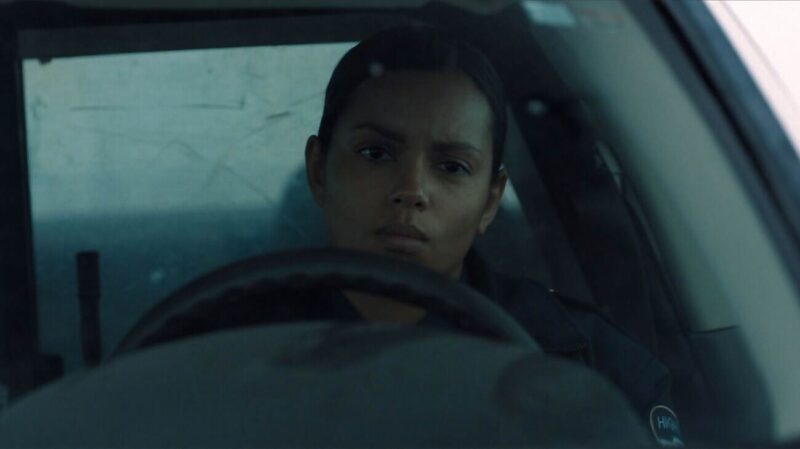
The plot is about as subtle as the title implies. A hulking serial murderer is driving across the USA, leaving a string of victims in his wake and crime scenes daubed in occult symbols. On his journey, the Satanic Slasher, as the media dubs him, stops off in Kansas and carries out yet another senseless attack. This prompts local cop Jane Archer (Barbarian’s Georgina Campbell) to pack up her rifle and track him down.
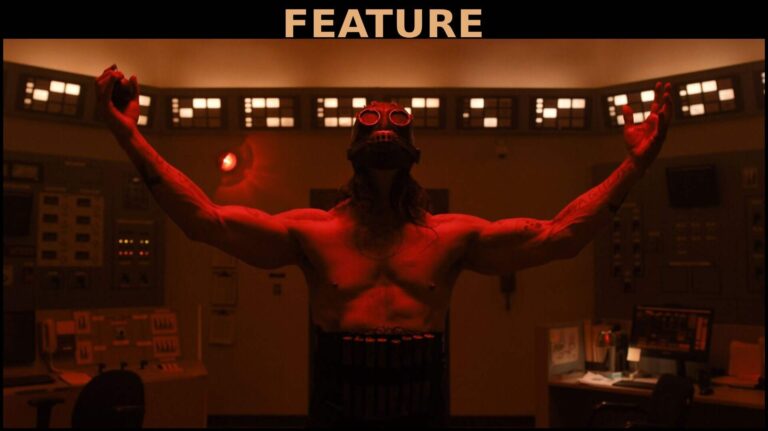
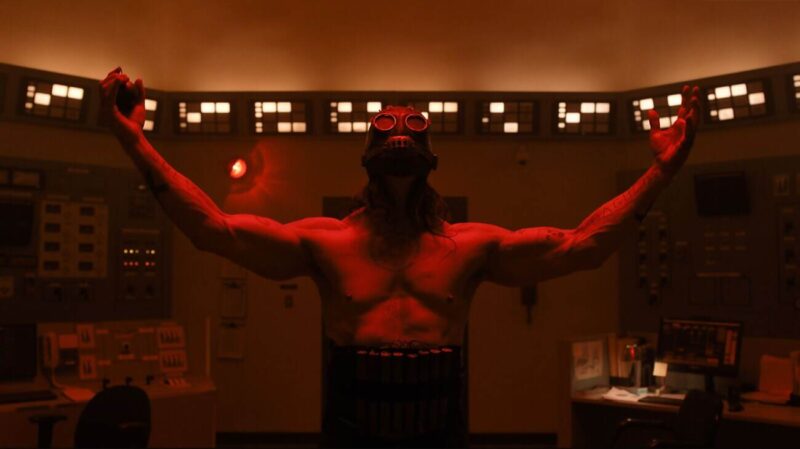
Played by wrestler turned actor James Preston Rogers, the titular killer is a hulking brute akin to Jason Voorhees; the conceit here being that, as well as wearing a My Bloody Valentine Day-esque mask with round eyeholes, Psycho Killer is constantly being framed or lit so his face is obscured; we see reflections of his prey in large mirrored shades, or we get glimpses of his features veiled in shadow.
It’s an intriguing idea at first, particularly in a tense opening scene which contrasts between wide, locked-off shots of the killer’s grubby black Mustang and claustrophobically tight cuts to his reflective shades. But like a number of things in Psycho Killer, his obscured features feel more like a neat idea than something that has a meaningful impact on the plot. More on this shortly.
In its mix of road movie and horror, Psycho Killer feels like an homage to the nightmarish 1986 cult film The Hitcher mixed with the similarly over-the-top gore of 1980’s Maniac (Tom Savini’s head-busting makeup effects for that sleazy classic even get a namecheck in Walker’s script).
Like Maniac (and its remake) or Michael Mann’s Manhunter, however, Psycho Killer also spends an inordinate amount of time following its villain. There are recurring scenes of the character moving from motel room to motel room. We get glancing insights into his traumatic childhood – his habit of sleeping in closets next to a loaded shotgun could also point to this. From his murderous antics to his placement of classified ads in newspapers (a nod to Manhunter, perhaps, or the real-world Zodiac), Rogers’ killer gets at least as much screentime as Campbell’s heroine.


Suggested product
Issue #60 Magazine Bundle (3x Covers: A Scanner Darkly Magazine + 1991 + Roger Deakins)
£14.99
Walker’s original screenplay – the second draft of which can be freely downloaded from his website – takes this even further. The film introduces Campbell’s cop in its earliest scene, establishing her in the audience’s mind as the protagonist. The script does something more daring: it spends roughly 20 pages with the killer first, with a mind-bogglingly destructive set-piece involving a darkened country road and a juggernaut. We don’t meet Archer until the end of the first act, forcing the reader to see the world from Psycho Killer’s warped perspective. It’s not unlike the script’s near namesake, American Psycho.
The film’s reordering of scenes lets the audience off the hook psychologically, since we’re reassured that there’s at least one figure of righteousness in the story’s hellish landscape. Speaking of hell, the script also takes us deep inside the killer’s recurring dreams – baroque power fantasies in which he presides over the underworld as tortured bodies descend from the world above.
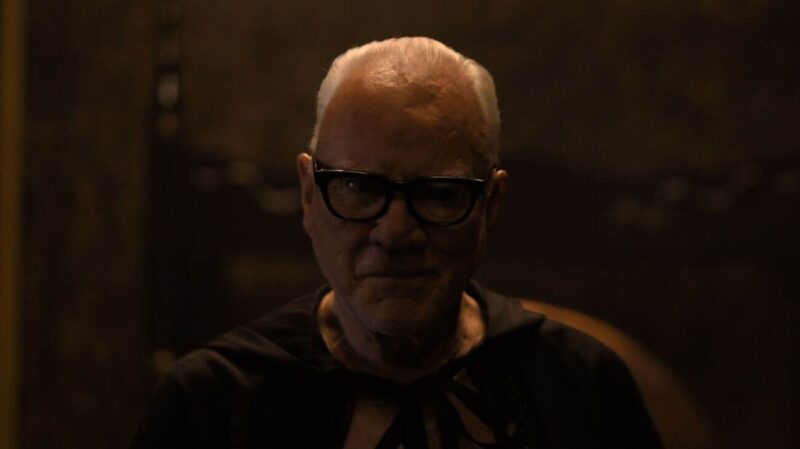
It’s easy to see why these would be cut for budgetary purposes (though a more imaginative filmmaker might have realised them with, say, hand-drawn animation), but they help underline the mood Walker’s going for. His script is more obviously a death metal-infused slasher. The whole thing may even have worked more satisfyingly as a graphic novel, with the line between the killer’s Devil-worshipping fantasies and the mundane reality of motels and self-serving Satanist buffoons (as represented in the film by Malcolm McDowell) thoroughly blurred out.
This isn’t to say that the script has been ruined in its translation to the screen: many of the problems in the film can also be found on the page. Both the killer and his pursuer are unknowable cyphers, and the decision to obscure the former’s face, although it may have sounded neat in theory, is more distracting in practice – especially given that his identity isn’t a particularly well-disguised secret.
Nor is it obvious what, if anything, the underlying theme or philosophy this story has. Manhunter was so electrifying because its characters felt so alive; the late Tom Noonan’s Francis Dolarhyde became one of the great screen villains because he was both a monster and a recognisably damaged human being. Similarly, William Petersen’s cop on his trail felt as though he could drift into murder all too easily; as he often does in his films, Mann establishes that the line between both characters is at times uncomfortably thin.
Psycho Killer pitches its faceless murderer as the product of a cruel, violent world, but the figure we see for much of the movie is a kind of larger-than-life antihero like Todd McFarlane’s Spawn – he has a vaguely superhero-esque outfit, his own cool car, and goes around bashing heads and axing stomachs in CGI-infused slow-motion. It’s unclear at times whether we’re meant to be unsettled by him or actively rooting for him.
Without spoiling things too much, the killer’s backstory also has vague parallels with Spawn. There are suggestions here and there that he might have been the subject of some sort of secret experiment; a TV news story also compares the killer’s antics to those of real-world criminals Charles Manson and David Berkowitz (the latter better known as the Son of Sam).
There have been conspiracy theories going around for several years that those real-world figures (and others like them) were ‘programmed’ by US government agencies as part of some MKUltra-like operation. There’s no direct evidence of this, it should be made clear, but it is a subject that has been explored in various books and documentaries. Was Walker making a deliberate connection here? Or is its grimdark, hellish character origins simply a nod to Spawn?
The answer to that question is as uncertain as Gavin Polone’s grip on a buckwild story that veers from generic cop thriller to gross-out comedy horror to… well, a third act that really threatens to go to some big, dark places. Georgina Campbell, always a watchable performer, keeps a straight face throughout, though it’s a wonder whether the entire film should have leaned into the Stuart Gordon-esque madness flirted with in certain scenes, and made it all consistently as Grand Guignol as it sometimes threatens to become.
Psycho Killer is an ungainly beast, then. But there’s also something strangely engrossing about it all; it certainly isn’t as grey and bland as The Whisper Man, or The Runner, or numerous other identikit thrillers that shuffle onto streaming services these days.
Sure, there are plot holes and implausibilities all over the place, including a pattern of crimes that a highway patrol cop spots but the FBI bafflingly doesn’t. There are performances that range from convincing to high camp. But all the while, Psycho Killer keeps building and building, its events becoming more bizarre right up to the kind of climax which, it has to be said, isn’t the kind of thing Thomas Harris would have come up with in a million years.
Psycho Killer is one of those films that would have flourished on the VHS or DVD market 25 years ago or so, with people discovering it on the bottom shelf of their local rental emporium and maybe taking a punt on it one Friday night. It’s the kind of experience that would be greatly enhanced when watched with a group of friends in the mood for a weird genre piece, possibly after a drink or three.
The ever-moving state of modern pop culture seems to make it more difficult for films to be reappraised as cult classics. They either find an audience right away or they don’t; and even if they do, the hits are soon dropped in favour of whatever the big new discussion is. But if it is still possible to become a cult item in the hell-on-Earth that is the 2020s, it might just be Psycho Killer. No, it isn’t great, but it sure is a ride – and at less than 90 minutes discounting its lengthy opening credits, it doesn’t outstay its welcome.
Psycho Killer is available to stream now on Disney+ UK.