Robert De Niro shuffles and mumbles through Netflix mystery The Whisper Man, which suggests there’s still an audience for middling killer-of-the-week thrillers. There’s an important place in our culture for the mid-budget pot-boiler. Serviceable thrillers have long played an unglamorous yet vital role: they keep us amused on a quiet Tuesday evening; they keep jobbing ... The Whisper Man proves that the spirit of the deteriorating late-night movie is alive and well on Netflix
Robert De Niro shuffles and mumbles through Netflix mystery The Whisper Man, which suggests there’s still an audience for middling killer-of-the-week thrillers.
There’s an important place in our culture for the mid-budget pot-boiler. Serviceable thrillers have long played an unglamorous yet vital role: they keep us amused on a quiet Tuesday evening; they keep jobbing actors and filmmakers in employment; they serve as a palette cleanser between better, worthier movies.
There was a time when mid-budget nail-biters were a common staple of late-night TV. You’d often get stuff like 10 To Midnight (starring Charles Bronson!) or The Mean Season (Kurt Russell! Mariel Hemingway!) appear on television after the nine or 10 O’Clock news.
These were the kinds of films that didn’t make a fortune at the box office and, as a result, were probably unfamiliar to people sitting in their living rooms on a mid-week evening, trying to decide whether to keep watching the television or do the sensible thing and head off to bed.
Invariably, the temptation to watch the film would win out, partly due to sleep procrastination, but also thanks to old-fashioned intrigue. Will Charles Bronson’s detective catch Gene Davis’s deranged killer? Will Kurt Russell’s jaded hack catch a serial murderer terrorising Miami?
Just as invariably, thrillers like these seldom lived up to the promise of their third acts. Viewers were left wondering why they sacrificed 100 minutes’ decent sleep for yet another ho-hum mystery, even if they were entertained enough to keep watching right to the end. In short: it’s the phenomenon of the deteriorating late-night movie.
All of which brings us to The Whisper Man – the kind of thriller that could easily have played after the News At Ten in the 80s or 90s. But because streaming has essentially killed video stores and scheduled television, it’s now available to view on Netflix.
Like all the best pot-boilers, its thrills immediately recall other, better films. There are wan detectives gazing down at bodies discovered in remote areas. There’s a convincted killer with a sinister name – Michael Keaton’s titular Whisper Man – and a copycat who’s following the same modus operandi.
From the opening aerial shot, we know roughly where we are with The Whisper Man – but as we’ve established above, this isn’t necessarily a bad thing. Michelle Monaghan acquits herself well enough as Beck, the detective on the hunt for a child murderer who torments his victims’ families with recordings left on old audio cassettes.
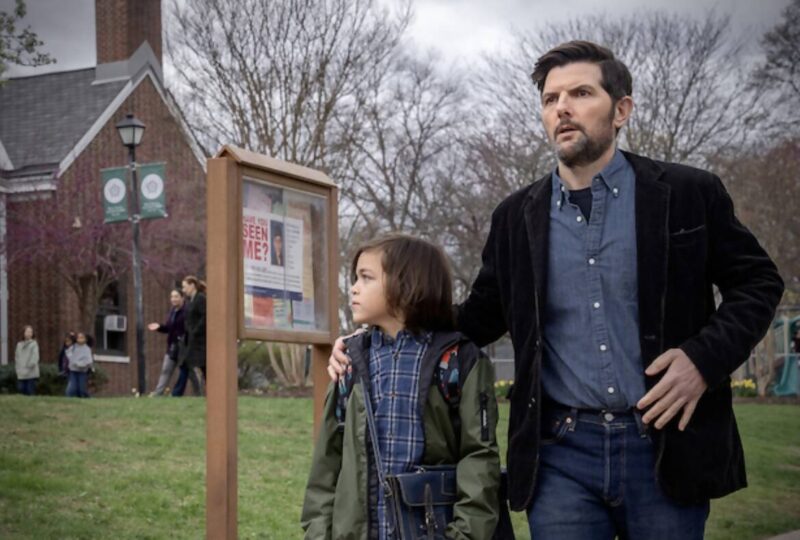
Meanwhile, the reliably nice Adam Scott plays grieving novelist Tom Kennedy, who’s moved to the small town of Garreton with his young son, Jake. Their respective wife/mother died before the opening credits, leaving Tom with writer’s block and a drinking problem, while Jake’s so withdrawn that he speaks almost exclusively to his imaginary friend.
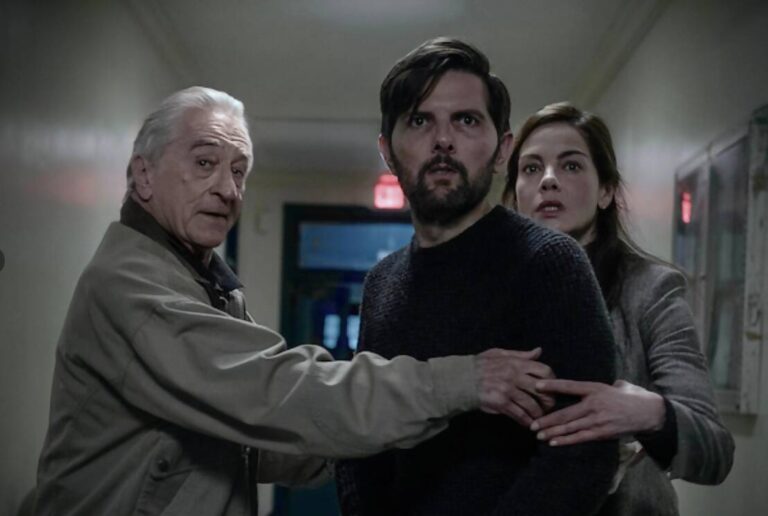
When Jake’s abducted from Tom’s leaky rental house one night, Tom turns to his estranged father for help: retired detective Peter, played with minimal intensity by Robert De Niro. Decades earlier, Peter caught the official Whisper Man; can he dust off his old skills and find the 21st century knock-off who’s snatched his grandson?
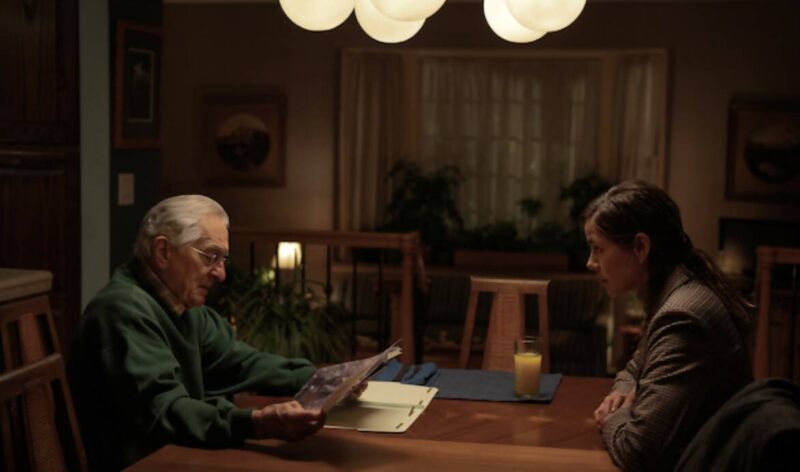
Adapting Alex North’s 2019 novel, director James Ashcroft generates some moments of intrigue and suspense among the more obvious twists and turns. Jake’s imaginary friend is introduced in such a way that even the viewer might wonder whether they’re seeing things at first. A sequence before Jake’s abduction, where a gloved hand emerges through a letterbox, is quite unsettling.
Tonally, the de-saturated colour palette and austere setting recall Denis Villeneuve’s 2013 thriller, Prisoners – another film about a serial child abductor. But that film elevated the pulpiness of its source material through sheer craft – Roger Deakins’ cinematography is beautiful in its bleakness; a talented cast, led by Hugh Jackman, Viola Davis and Jake Gyllenhaal, is uniformly top-notch.
The Whisper Man, by contrast, lacks that film’s consistently high standard of acting and filmmaking, and its over-reliance on ideas written up years ago by Thomas Harris ultimately become too distracting for comfort.
Take, for example, the inevitable scene where an incarcerated serial killer is grilled for information and clearly knows more about the current murder case than he’s willing to let on. Here, it’s De Niro interviewing Keaton – a prospect that, 30 or so years ago, might have been widely anticipated enough to generate the odd news piece or two.
Instead, it’s 2026, and nobody involved in The Whisper Man can make this meeting of acting talents amount to a hill of beans. Keaton’s ageing killer (real name: Frank Carter) tries to needle at De Niro’s Peter, just as Brian Cox’s Lecktor got under Will Graham’s skin in Manhunter, or Anthony Hopkins’ Lecter zeroed in on Clarice Starling’s vulnerabilities in The Silence Of The Lambs.
But the dialogue in The Whisper Man states the film’s themes so bluntly that even Keaton seems reluctant to recite it (“For you, mostly it was endings, really – marriage, career, fatherhood – it’s kind of like one long dirge on the road to your grave, right?”). As Keaton rambles away, the perspective occasionally cuts to De Niro or Michelle Monaghan on the other side of the table, wearing expressions that sit somewhere on the border between boredom and outright pity.
(The lack of energy is all the more glaring given how good Keaton has been as a villain elsewhere – see also Spider-Man: Homecoming, or more pertinently to this piece, the thrillers Pacific Heights (1990) or Desperate Measures (1998).)
While The Whisper Man’s attempts at dramatic heft fall flat, the parts where it trips into pure camp are far more entertaining. Hamish Linklater channels a hint of Vincent Price ham as a collector of serial killer memorabilia; Owen Teague delivers an eye-rollingly animalistic performance as another sketchy character connected to the case.
It all builds to a flat-out ridiculous conclusion that simultaneously asks us to believe that some theoretically smart people wouldn’t have investigated an obvious bit of evidence sooner, and also relies on us forgetting about a home maintenance problem that was glaringly signposted in the first 30 minutes.
The Whisper Man isn’t a great thriller, then. But like the movies of its type that used to commonly appear on late-night TV or in video shops, back when mid-budget mysteries were still a key part of a healthy film industry, it isn’t entirely without its grim pleasures.
Massive companies like Netflix may have changed the way we watched movies, for better and worse, but there’s a strange comfort in seeing that old-fashioned affairs like this are still being made. As these words are being written, The Whisper Man is currently at the number one spot on Netflix UK – suggesting that there really is an audience out there for this film’s brand of throwback nonsense.
The Whisper Man is available to stream now on Netflix.