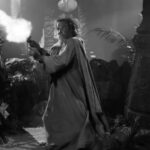
Writer-director Larry Cohen’s God Told Me To is cheap, cynical, grimy, weird – and far more mesmerising than any $250m blockbuster. From the moment a crazed sniper starts mowing down innocent civilians in bustling Manhattan, it’s clear that 1976’s God Told Me To isn’t going to play nicely. We’re two minutes in, having sat through ... God Told Me To | What modern cinema could learn from a low budget, 50 year-old thriller
Writer-director Larry Cohen’s God Told Me To is cheap, cynical, grimy, weird – and far more mesmerising than any $250m blockbuster.
From the moment a crazed sniper starts mowing down innocent civilians in bustling Manhattan, it’s clear that 1976’s God Told Me To isn’t going to play nicely. We’re two minutes in, having sat through a weird title sequence of abstract, lava lamp shapes and choral chanting, and we’re suddenly confronted by the tonal whiplash of seeing over a dozen people shot to death by a rooftop gunman.
It’s a characteristically in-your-face opening from writer-director Larry Cohen, an independent filmmaker now famous for his run-and-gun style and almost casual blending of genres. He rose to fame in the early 70s with the blaxploitation thrillers Black Caesar and Hell Up In Harlem (both 1973) before hopping on the trendy contemporary horror gravy train with It’s Alive the following year.
God Told Me To could be seen as another cynical attempt to follow the trends of the era. There’re cop thriller elements, akin to something like Dirty Harry, released five years earlier, and Cohen’s deployment of horrendous, seemingly motiveless crimes feels loosely inspired by that earlier film. Much as Dirty Harry drew on the real-world Zodiac killer for its villain, Scorpio, God Told Me To’s sniper has a torn-from-the-headlines feel.
But just as we’re settling – if that’s the right word – into New York cop Lt Peter Nicholas’ murder investigations, the film switches gear into supernatural horror territory – and later, changes direction again, this time into the realm of trippy sci-fi.
As Cohen dowses us with unexpected plot developments, the film’s anchored by Tony Lo Bianco’s performance as Lt Nicholas. Taking over from Robert Forster when the more famous actor walked off the set, Lo Bianco makes light work of quite a strange character: he’s a married, devout Catholic, but also having an affair with a much younger woman, Casey (Deborah Raffin). His sense of religious guilt is such that he can’t bring himself to divorce his wife, Martha (Sandy Dennis, who looks uncannily like Piper Laurie in Carrie), whom he often visits and uses as a kind of confessional service.
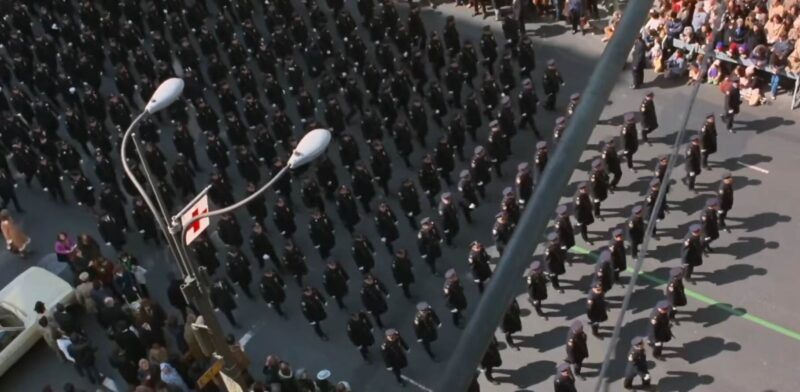
While he deals with his spaghetti-like personal life, Nicholas also wrestles with a spate of killings unfolding across New York. Not long after that sniper episode, there’s a stabbing incident in a supermarket, a mass shooting at a St Patrick’s Day parade (yes, that is Andy Kaufman holding the gun) and most chillingly of all, a man who murders his own wife and child. Most of the culprits take their own lives before they’re caught; when asked why they committed their dreadful crimes, all respond: “God told me to.”
It’s a catchy hook for a police thriller, but Cohen is too off-beat and restless a writer to follow the usual genre template. What begins as a procedural soon begins to interrogate Nicholas himself – a character whose stereotypically weathered cop exterior masks a murky and highly unusual past. Lo Bianco gamely rolls with everything Cohen throws at him, as the tale runs the gamut from Manson Family-era fear and loathing to outright violence to a conclusion that almost defies description.
God Told Me To was shot independently on a low budget that makes itself plain from the opening scenes. Cohen, never one to worry about things like permits, shoots much of the film on location – you can tell, because bystanders often look over at the camera with quizzical looks on their faces.
There’s a gritty energy to Cohen’s direction, however, that turns what could be flaws in other hands into assets. The opening sequence with the sniper, Harold (played by a reedy-voiced Sammy Williams) is intercut with newscasters reporting on the unfolding situation, while the shooter’s mother (Jo Flores Chase) is being interviewed on-camera and insisting there are multiple shooters and her son’s being framed.
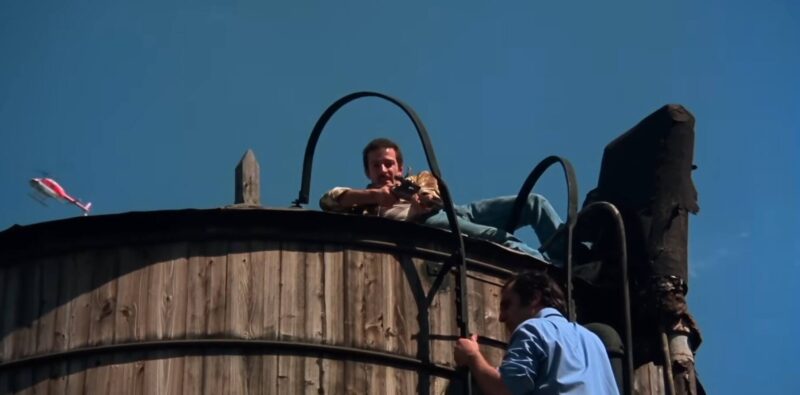
Meanwhile, Nicholas clings to the metal rungs of a ladder attached to a water tower, trying to talk Harold down. “There are a lot of people down there who would like to know why you did this,” Nicholas says. “You mad at somebody?”
“It was a nice day,” Harold says with an eerily casual air.
Cohen isn’t remembered as a visual stylist, necessarily, but he directs these scenes with real skill. There’s a naturalism to the performances – perhaps a side effect of the film being shot in a hurry – and real suspense in the editing and shot composition. Cinematographer Paul Glickman’s camera slowly zooms in and out of Harold’s impassive face, framed by the metal hoop of a ladder’s handhold; the increasingly ominous conversation is accompanied by the rhythmic beat of a helicopter hovering overhead.
The whole film is couched in a similar sense of everyday realism – which, like Lo Bianco’s performance, keeps things grounded even as the plot visits some increasingly bizarre realms. It’s a style of a piece with the general tone of American cinema in the 1970s, as a wave of younger filmmakers avoided Hollywood gloss in favour of something that felt closer to everyday experience.
Around the same time Clint Eastwood and Don Siegel were making Dirty Harry in San Francisco, former documentary filmmaker William Friedkin was shooting the similarly unvarnished cop thriller, The French Connection. While Cohen was making God Told Me To, Martin Scorsese wasn’t far away, shooting Taxi Driver. (Composer Bernard Hermann was originally supposed to score God Told Me To, but sadly died in 1976, making Taxi Driver his final piece of work.)
Read more: Special Effects | Revisiting director Larry Cohen’s 1980s Vertigo homage
Watching God Told Me To almost 50 years after it was made, its rawness feels quite striking. There’s the time capsule quality, certainly: the fashions, the bushy hairstyles, the run-down, crime-ridden New York hovering on bankruptcy. But beyond that, there’s the urgent rawness of the film: it feels vibrant and alive in a way too many modern thrillers simply don’t.
It’s a cliche to say, “They don’t make movies like this anymore,” but in this case, it’s true. It’s rare, in 2025, to see a movie largely shot with handheld cameras, featuring this many natural-looking, lived-in faces, and that moves at such a breathless pace.
In some respects, 21st century mainstream filmmaking has moved back to where it was in the 1960s, when Hollywood studios were seeing diminishing returns from glossy, expensive movies. In 2025, superhero movies are no longer the surefire route to box office glory they were in the 2010s.
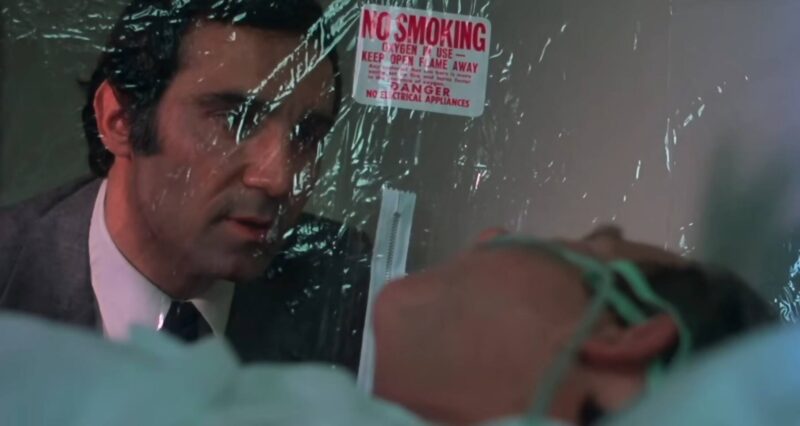
The cost of making films is generally trending upwards, while the returns they’re making are heading in the other direction. Changing audience habits are part of the cause – more people staying home to watch things on Netflix and the like. But there’s also a question of whether audiences have become numbed to ever more pristine, digitally-augmented images; or whether it’s time that filmmakers swung back to the more grounded style of 70s directors like Friedkin, Scorsese or, yes, Larry Cohen.
To go all anecdotal for a moment: I watched God Told Me To the night after I caught up with Mission: Impossible – The Final Reckoning. The seeming swansong for Tom Cruise’s superspy Ethan Hunt, it’s an action thriller that bends over backwards to entertain: a three hour banquet of plot twists, sweaty bomb defusals and high-wire stunts.
Yet it’s God Told Me To, this low-budget film from almost 50 years ago, that has remained lodged in my head. At roughly half the length of the latest Mission: Impossible, it’s even more packed with turns, suspense, and moments that left my eyes bulging in shock.
This isn’t to say that Cohen’s thriller is some masterpiece of formal filmmaking; it’s a B-movie, as its director intended it to be. But it’s a B-movie with a sly wit – the whole thing is clearly a grinning jab at formal religion – and an uncanny ability to burrow under the skin.
It’s better to leave the film’s later revelations unspoiled, so let’s end with this bit: roughly 25 minutes in, Nicholas follows a lead that takes him to a dingy apartment building in Little Italy.
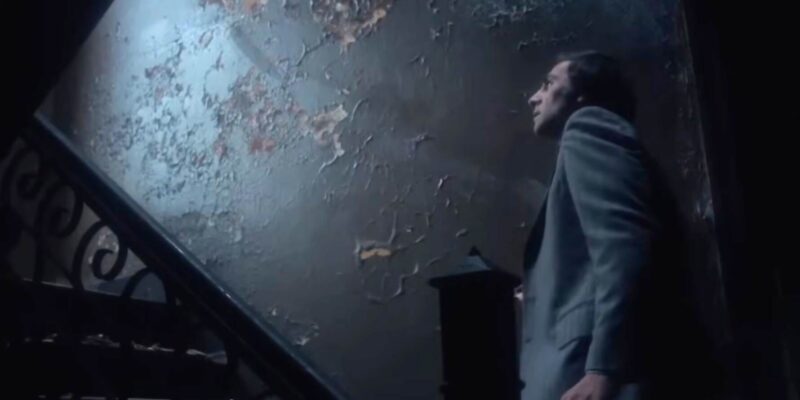
Ordinarily, we might expect some sort of interrogation scene here, or a bit of banging on doors. Instead, a woman leaps out of a shadowy hallway, shrieking, and attacks Nicholas with a knife. A scuffle ensues, and the pair end up tumbling down a flight of stairs – a moment that could be regarded as a reference to Hitchcock’s Psycho, except it’s so painfully underlit that we can’t see the fall that ensues.
Again, the lack of clarity in the image and the disjointed editing could be seen as slapdash filmmaking or outright technical failure. But if anything, they only make the scene more disturbing: there’s the blurred flailing of limbs, a nauseating shake of the camera, and a primal screech that is then looped over and over again for maximum, shudder-inducing effect.
Nicholas, seemingly driven to his wits’ end by this latest turn of events, begins shaking the now gravely injured assailant by the shoulders. “Say it! Say it!” Nicholas all but screams into the stricken figure’s face. Breathing her last, the woman’s attempt to say, “God told me to” is replaced by a rattling, guttural sigh.
“Gagghhhh…”
In an era that prizes clarity and pristine images, the roughness of this scene and others like it seem all the more startling. Modern cinema, I’d argue, could do with a little more of Larry Cohen’s do-it-yourself, proto punk rock attitude.
God Told Me To is currently streaming on Prime Video in the UK.
/**/