Jurassic Park, yes, but also Possession, Event Horizon and more besides. We celebrate the work and incredible genre films of the late Sam Neill. It says a great deal about Sam Neill’s self-deprecating humour that he recently picked a logical hole in one of his most iconic screen moments. As Dr Alan Grant in Jurassic ... Sam Neill and his amazing contributions to genre cinema
Jurassic Park, yes, but also Possession, Event Horizon and more besides. We celebrate the work and incredible genre films of the late Sam Neill.
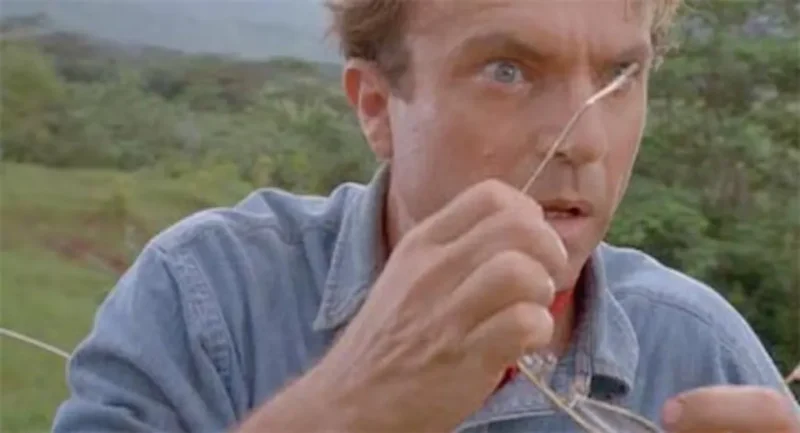
It says a great deal about Sam Neill’s self-deprecating humour that he recently picked a logical hole in one of his most iconic screen moments. As Dr Alan Grant in Jurassic Park, he peels off his sunglasses to get a better look at the real, live dinosaur standing in front of him. That shot has since been the subject of countless gifs and memes, and for good reason: it’s a beautiful moment of physical acting. It’s clumsy, human and vulnerable in a way we don’t always see in blockbuster films.
In an interview with The Guardian, conducted shortly before he tragically passed away at the age of 78, Neill said that the sunglasses moment was his idea – but swiftly followed this by arguing that the move was “counterintuitive when you think about it.”
“When you stare into the bright sky,” he said, “you ought to really put on your sunglasses, not take them off.”
For a generation of younger movie-goers, Jurassic Park may have been their introduction to Sam Neill and his captivatingly warm screen presence – the kind that could ground the extraordinary, the supernatural, the weird or plain horrific in something that felt real. His Dr Alan Grant serves as a kind of father figure among the ensemble cast, yet one who hasn’t lost his childlike fascination with the natural world; his astonishment at seeing one of John Hammond’s genetically-engineered dinosaurs is a sublime character moment, and a summation of Neill’s brilliance as an actor.
Simply put, Neill brought the same effort and charisma to every role, whether it was a low-budget drama or an expensive tentpole like Jurassic Park. And, across a career lasting over 50 years, he starred in a quite staggering array of classic genre films, each of them showing off a different facet of his broad talent. He could play the pure-hearted good guy, the grouchy curmudgeon, or right at the other end of the spectrum, the earthly incarnation of Satan himself.
After finding wider attention in his native New Zealand in 1977 with director Roger Donaldson’s Sleeping Dogs, Neill later found himself on the global stage with 1981’s Omen III: The Final Conflict. Playing the now adult Antichrist, Damian Thorn, he seemed unfazed by the frequent goofiness of what most will agree was a lesser sequel.
It’s a terrific turn: filled with both affability and menace, superficial charm and barely-hidden mania. We need to believe that Thorn could seduce an entire planet into thinking he’s its saviour, but also ruthless enough that he could order the massacre of an entire generation of baby boys. Needless to say, Neill pulls this off, and even The Final Conflict’s harsher critics conceded that he was the best thing in it.
Amid all the mayhem, director Graham Baker’s film also pauses to allow Neill to indulge in this wonderful piece of blasphemous monologuing:
It’s an example of how Neill could deliver a heightened performance without tipping over into scenery-chewing ham – a talent he demonstrated in the singular Possession, also released in 1981. Andrzej Żuławski’s break-up drama to all break-up dramas is filled with wilfully unnatural dialogue and nightmare imagery, yet Neill is equal to everything the Polish auteur throws at him. Together, Neill and co-star Isabelle Adjani turn a collapsing relationship into outright cosmic horror.
It’s the kind of film that less brave actors would have turned down flat; the production was utterly grueling by all accounts, with Adjani, in particular, left mentally scarred by the experience. Neill later described it as “the most extreme film I ever made… I only just escaped that film with my sanity barely intact.”


Neill busied himself with a range of roles through the 80s and 90s, appearing with Meryl Streep and Charles Dance in the 1985 drama, Plenty, and alongside Nicole Kidman and Billy Zane in Philip Noyce’s tense high seas thriller, Dead Calm.
By the 1990s, he was putting in committed turns in John McTiernan’s The Hunt For Red October – still among the best adaptations of Tom Clancy’s Jack Ryan novels – and Wim Wenders’ meandering sci-fi noir, Until The End Of The World. The latter wasn’t a hit, and nor was John Carpenter’s 1992 comedy, Memoirs Of An Invisible Man, in which Neill played a smoothly sinister CIA agent villain, but Neill was still great value in both.
In 1993, of course, Neill landed the role of a lifetime in Jurassic Park, though that same year also saw him take on a key role as the brutal Alasdair in Jane Campion’s acclaimed The Piano and appear as the artist Norman Lindsay in writer-director John Duigan’s well-received period drama, Sirens. Neill continued to work at a brisk pace for the rest of the decade, memorably starring alongside Robin Williams in The Bicentennial Man in 1999 and taking the lead in the 2000 comedy drama, The Dish.
Of his work ethic, Neill once linked acting with his self-doubt and depression, saying in an interview with ABC Arts that keeping busy helped means that “the darkness goes away.”
“But if you’re not getting a job, that darkness can close in on you,” he said. “I’ve had a few periods in my life where I’m not working and I can feel that darkness close in. When I did get a job, I’d think, ‘How did I get that job? When are people going to find out that I can’t actually act? Do they know I’m not trained?’”
Perhaps it was his understanding of darkness that led him to shine so brightly in so many films – especially ones that had a dark side of their own. Just look at his turn as mild-mannered insurance guy John Trent in John Carpenter’s sorely underrated In The Mouth Of Madness – a character whose sanity crumbles when he experiences a terror far beyond anything conjured up in the horror books of missing author, Sutter Cane (Jürgen Prochnow).
Note, in particular, how Neill sells this sublime moment of visual horror:
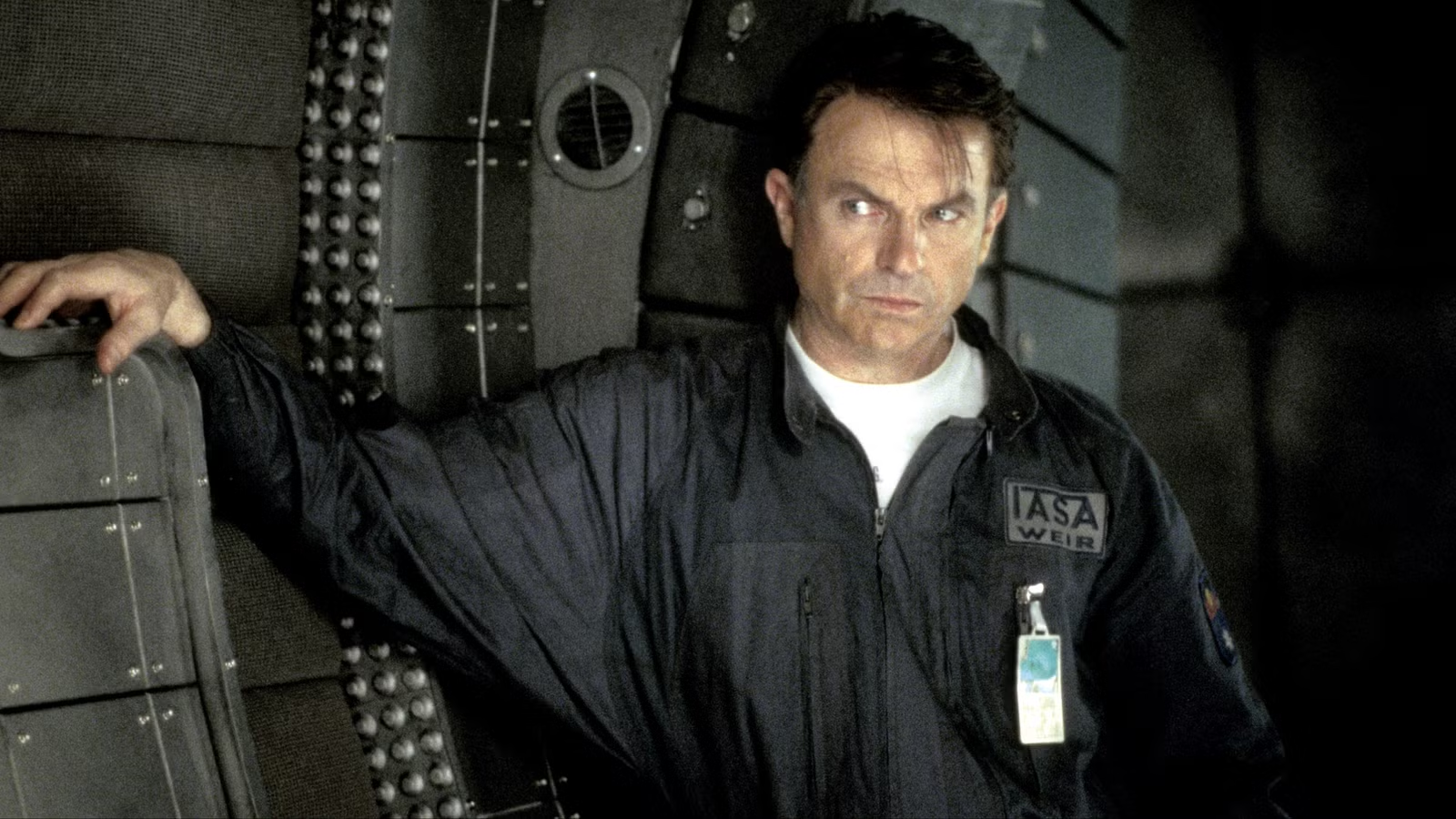
Then there’s scientist Dr William Weir in 1997’s Event Horizon, a character whose arc takes him from from cool rationality to hallucinatory, spaced-out madness. (There are certainly parallels to be drawn between Neill’s work in Possession and these more mainstream 1990s horrors.)
For the rest of his long, varied career, Neill continued to appear in a broad variety of roles, with all kinds of genre work sprinkled in among the dramas; he was coolly villainous in the 2009 vampire sci-fi horror Daybreakers, and endearingly grouchy in Taika Waititi’s 2016 comedy adventure, Hunt For The Wilder People. He also reprised the role of Alan Grant more than once – in 2001’s Jurassic Park III and in 2022’s Jurassic World Dominion.
Aside from all the performances and characters we saw from Neill, he was also known for a role that didn’t quite go his way: James Bond. He famously screen tested for the super spy in 1986; footage released online of Neill, shirt unbuttoned, wielding a Walther PPK, hint at an incarnation of the antihero with a glint of Roger Moore-esque mischief in his eye. The gig instead went to Timothy Dalton, who took the role in a darker direction.
Years later, Neill talked about that career moment with his usual self-deprecating wit. Although he said he would have taken the role had it been offered, he also had his doubts about what would have happened afterwards.
“I’m also aware that I wouldn’t have enjoyed my life so much if I was an ex-Bond,” he told The Guardian. “That’s what people would say when I went for my morning coffee. ‘Look – it’s what’s-his-name, who used to be James Bond?’ ‘Yeah, he was the one I never really liked.’”
Bond or no Bond, Neill was the opposite of an actor nobody liked; whether he was playing Alan Grant or a beleaguered cold war spy or an ornery foster uncle, he brought humanity to every screen appearance. And as tributes have rolled in following his sad passing, it’s clear that he was a lovely human being off screen, too: on Bluesky, there’s an anecdote that, on the set of Peaky Blinders – in which he played the witheringly brutal Chester Campbell – he learned that a fellow actor’s role had been cut down to a non-speaking part.
Neill, off the cuff, improvised a question to the actor mid-scene, beefing his role in the show back up and improving his pay packet at the same time.
“I’d like to think that, in life, I’m a goodie,” Neill said in his final interview, “so the chance to play a baddie can be a lot of fun.”
Sam Neill, you were indeed a goodie. Rest in peace.