Moon landings. MKUltra. Stanley Kubrick has been connected to a number of conspiracy theories over the years. But why? We pick out the truth behind the myths. Danny Torrance’s space rocket jumper. His mother Wendy’s choice of novel. A skiing poster glimpsed on a wall. These aren’t mere background details according to some parts of ... Unpicking the truth behind Kubrick conspiracy theories
Moon landings. MKUltra. Stanley Kubrick has been connected to a number of conspiracy theories over the years. But why? We pick out the truth behind the myths.
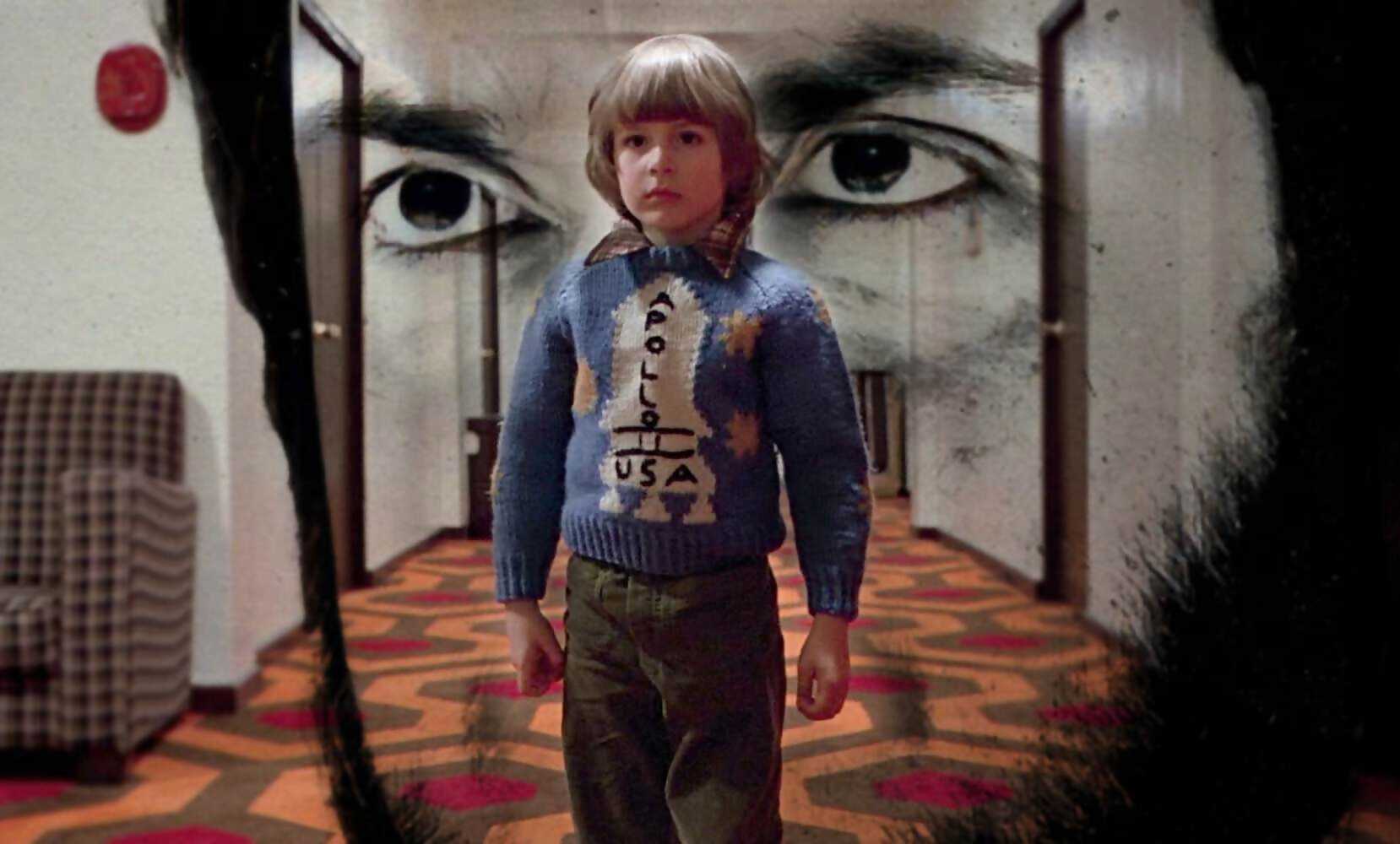
Danny Torrance’s space rocket jumper. His mother Wendy’s choice of novel. A skiing poster glimpsed on a wall. These aren’t mere background details according to some parts of the internet; they’re clues, deliberately placed there by a genius filmmaker who wanted to open the world’s eyes to a web of interconnected conspiracies.
Since his death in 1999, the mythology surrounding director Stanley Kubrick has only grown. In recent months alone, we’ve seen increased online interest in the theory that the filmmaker’s last work, Eyes Wide Shut, was intended to expose elite sex trafficking rings in New York and beyond. From his enclave in Hertfordshire, the theory goes, Kubrick used his final years to make a thinly-fictionalised film about the billionaire paedophile Jeffrey Epstein and others like him.
There are even darker suggestions that Kubrick was silenced for his efforts, and that his swansong was re-edited to remove some of its more contentious material.
Dark side of the moon

Conspiracy theories have surrounded Kubrick for decades, however. Suggestions that the Moon landings were faked began to circulate in the 1970s, and a theory soon emerged that Kubrick had been contacted by US intelligence agencies and secretly paid to use his talents as a director to create the landings on a soundstage.
His work on 2001: A Space Odyssey, the thinking goes, proved that he was a filmmaker uniquely placed to pull off such a technically involved stunt. Comments from the president of the International Flat Earth Research Society may have helped perpetuate the theory. In 1980, Science Digest published a feature dedicated to the ‘landings were faked’ theory, Johnson claims that the mission was “faked by Hollywood studios,” and that sci-fi writer Arthur C Clarke scripted the whole thing. Clarke wrote 1968’s 2001: A Space Odyssey, and so it’s possible that Kubrick’s connection to the conspiracy began here.
A compendium of other Kubrick legends slowly grew, many of them connected to the intelligence community: that he knew about the CIA’s experiments with LSD and mind control, and alluded to them in A Clockwork Orange and in particular The Shining.
The Shining, in particular, has become a magnet for theories since its release in 1980, and filmmaker Rodney Ascher explored several of these in his 2012 documentary, Room 237. In it, a series of contributors lay out their arguments about the 1980 horror and its hidden meanings – the most famous one, perhaps, being that Danny Torrence’s Apollo 11 jumper is Kubrick’s sneaky admission that he faked the Moon landings.
Other contributors have interpretations rather than conspiracy theories: that The Shining could be interpreted as a metaphor for the genocide of Native Americans, or that it’s an updating of the Minotaur myth.
The theories became even more elaborate, meanwhile, in an unrelated trio of documentaries called Kubrick’s Odyssey. The first two films, released in 2011 and 2012 and both directed by Jay Weidner, dealt with the faked lunar landings theory. The third documentary, 2024’s A Clockwork Shining: Kubrick’s Odyssey 3, explored Kubrick’s alleged connection to the CIA and its MKUltra project.
Mind control

For our purposes, the story begins in 1963. Kubrick had just released his Cold War satirical masterpiece, Dr Strangelove, and the CIA were perturbed to note just how accurately it re-created the cockpit of a B-52 bomber – the design and layout being classified information at the time. (Kubrick and production designer Ken Adam pieced together the cockpit using photographs published in an aviation magazine.)


It was here that Kubrick first appeared on the intelligence community’s radar, the story goes, leading to the filmmaker’s hiring to fake the Moon landings. In the years that followed, he’s said to have become aware of the CIA’s experiments in mind control, MKUltra, which secretly took place between the early 50s and early 70s, and began to incorporate what he knew into his films.
A Clockwork Orange, based on the book by Anthony Burgess, is about a young criminal who’s ‘reformed’ via a mixture of chemicals and psychological manipulation. Its poster’s design, supposedly at Kubrick’s insistence, includes references to a Masonic Eye of Providence symbol – said to be a further hint from the filmmaker at his movie’s hidden meaning.
According to the documentary, Kubrick then took things a step further in The Shining. In adapting Stephen King’s novel, he turned it from a modern haunted house yarn into a story about an ordinary man hypnotised into murdering his own family – not by ghosts, but by a secret experiment.
The evidence for these claims? That Shelley Duvall’s character, Wendy, is seen reading a copy of The Catcher In The Rye in an early scene. According to conspiracy theorists, CIA scientists used certain words to ‘activate’ citizens under their control, as seen in The Manchurian Candidate.
Such infamous figures as Mark David Chapman (who murdered John Lennon) and John Hinckley Jr (who shot but didn’t kill US president Ronald Reagan) were found to own copies of The Catcher In The Rye when they were apprehended. Theorists have come to the conclusion that they were MKUltra subjects who were triggered into staging their crimes by reading unspecified passages in JD Salinger’s book.
There’s more to the theory, too: that LSD was proliferated among a generation of youths by the CIA, with counter-cultural figures like Jim Morrison hired in as actors to help popularise the turn on, tune in, drop out movement. The whole conspiracy, the thinking goes, is quietly summed up in The Shining.
Myth and legend

It’s impossible to think of another filmmaker who’s quite so surrounded by myths and legends as Stanley Kubrick. The reason, perhaps, comes down to a combination of timing and Kubrick’s own personality. There are parts of the Kubrick story that are undeniably true: that he was a perfectionist, and increasingly obsessed over the minutiae of his filmmaking as his career progressed.
The success of Kubrick’s films in the 1960s, from Spartacus onwards, saw him granted a level of creative control seldom afforded to even successful filmmakers. At around the same time, he moved out of Hollywood and to a large, remote estate in the UK, where he became increasingly reclusive for the rest of his life.
Seldom giving interviews, and often spending years on developing his movies, Kubrick amassed a level of mystique rarely seen before or since, at least among filmmakers. And with that mystique came the conspiracy theories – all arising amid a growing anger and disillusionment with authority in the wake of the Watergate scandal that engulfed President Nixon.
(It’s worth noting here that an entire rash of conspiracy theories emerged at that time, including Capricorn One – Peter Hyams’ 1978 thriller about the faking of a NASA Mars mission. When I asked Mr Hyams about the theories of the Moon landings being faked, he told me in 2014, “It’s absolutely absurd.”)
The obsessive level of detail in Kubrick’s films, and his general reluctance to give interviews, left film fans and theorists to come up with their own interpretations, which have only grown more outlandish over time. At some point, Kubrick stopped being regarded as a fallible human being capable of making mistakes, to the point where even continuity errors in his films have been pointed out as intentional pieces of symbolism.
(The Shining’s protracted, year-long shoot was interrupted by a devastating fire which destroyed the Overlook hotel set, which is a more likely explanation for details like a missing light switch in the first act.)
Kubrick’s career happened to coincide with the second half of a turbulent century, pockmarked by the Cold War and the Space Race at one end and the arrival of the Internet age at the other. By the time Kubrick passed away in 1999 at the age of 70, it was easier than ever for devotees of his work to share and promote their interpretations, no matter how wild they might be.
With no Kubrick around to confirm or deny all these interpretations, the aura around his work has only grown – as we saw when filmmaker Roger Avery popped up recently, claiming that Eyes Wide Shut was re-edited by Warner Bros after its maker’s untimely death.
It’s all too easy, however, to single out a tiny detail in a movie – particularly a movie as deliberately-crafted as The Shining – and apply some sort of bizarre theory to it.
As an example, let’s pluck out a random fact from the ether and see how much mental effort it takes to turn it into a new myth.
Hedge your bets
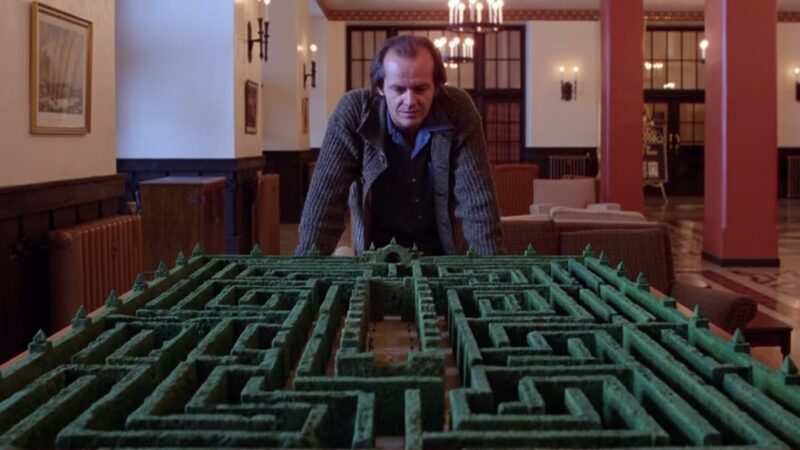
One of The Shining’s key images is its hedge maze. This wasn’t in Stephen King’s novel; instead, the author wrote that the Overlook hotel was fringed by topiary animals which later came hauntingly to life. Kubrick, either sensing that this would look goofy on film or too expensive to pull off, introduced the idea of a hedge maze instead.
The Shining was released in US cinemas on the 23rd May 1980, and made its UK debut in October that year.
Over in Japan, Pac-Man was released in arcades on the 23rd May 1980, and began to appear in American arcades that October.
Pac-Man is a game in which ghosts roam a maze. The Shining is a ghost story in which Jack Nicholson’s character is shown gazing down on a maze as tiny figures of Danny and Wendy run around like sprites in a video game.
With our conspiracy theorist hats on, we could therefore conclude that Kubrick, being the genius that he was, knew about Pac-Man in advance thanks to his connections in the intelligence community, and decided to use The Shining as a means of warning the world that this addictive game would soon be used to hypnotise and control us all.
Except, of course, none of this is true.
Kubrick was a flawed yet brilliant filmmaker whose best work rewards repeat viewings. But there is no firm evidence that he was ever involved with the CIA, or particularly committed to becoming cinema’s biggest whistleblower. We can’t prove he didn’t fake the Moon landings or know all about sex trafficking rings or mind control experiments, but there’s nothing concrete to support those claims, either. Two things existing at the same moment in time doesn’t mean there’s some sinister connection between them. Correlation does not equal causation.
Sometimes an Apollo 11 jumper is just an Apollo 11 jumper.