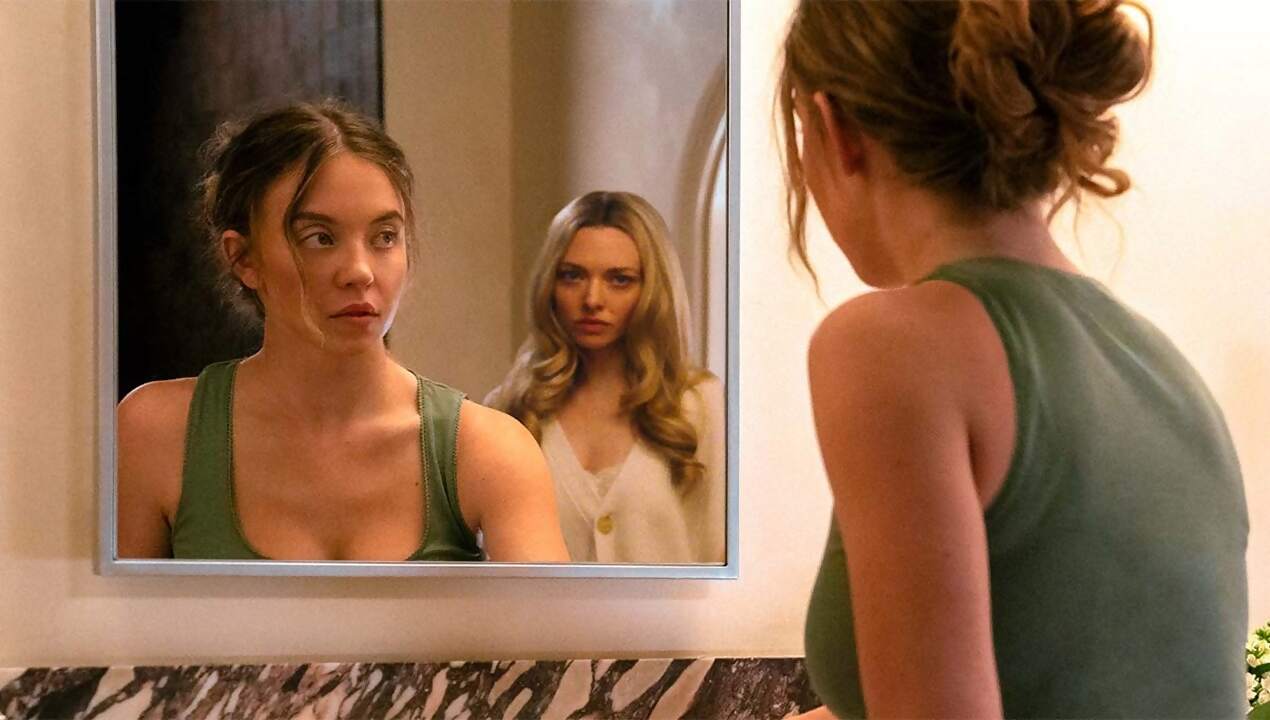
Sydney Sweeney and Amanda Seyfried do battle in Paul Feig’s domestic thriller, The Housemaid. Our review: It won’t be a reference for all, but in the 2004 version of the sci-fi TV show Battlestar Galactica, there’s an opening episode where we follow some reporters who are getting a guided tour of the titular spaceship. I ... The Housemaid review | Paul Feig takes a hell of a turn
Sydney Sweeney and Amanda Seyfried do battle in Paul Feig’s domestic thriller, The Housemaid. Our review:
It won’t be a reference for all, but in the 2004 version of the sci-fi TV show Battlestar Galactica, there’s an opening episode where we follow some reporters who are getting a guided tour of the titular spaceship. I read a piece once deriding this, declaring it an obvious trick to set up the series’ central location, although I always though it a pretty effective one. And it came to mind with Paul Feig’s new film, The Housemaid.
After hitting us with the film’s title in a very large point size, Feig swiftly gets down to business with his adaptation of Freida McFadden’s hit novel by having Sydney Sweeney’s Millie turn up at the rather posh front door of Amanda Seyfried’s Nina Winchester.
Millie, as the film’s title suggests, is applying for the job of Nina’s housemaid, and on the surface, it looks like Planet Earth’s easiest job interview. As much as a bit of voiceover narration tries to convince us otherwise, within seconds we’re taken on a guided tour of the very expensive house. Oh look! There’s a spiral staircase with something dangling above it! The housemaid sleeps in an attic room at the top of the house? There’s a weird, creepy doll’s house that belongs to Nina’s young daughter. And sure! Of course you can use the man cave of Nina’s husband, Andrew. I’m sure nothing will go wrong there!
Cut to Sweeney’s Millie washing her armpit with soap and water, the only person involved in the entire production on either side of the screen who thinks she’s flunked the job interview. But – wow! – job is offered, and a conventional-ish thriller seems to take hold.
It’s worth a pause here to note that The Housemaid is Paul Feig’s second film of the year, after his sequel, Another Simple Favor. That too was powered by two female leads to a degree pitted up against each other, although I wasn’t too fond of the movie (full disclosure: I went to a special screening, where the moderator of pre-film interviews sat in front of me and excitedly ruined key moments of the movie just before they happened.)
The Housemaid plays out a lot more conventionally, right up until the point when things turn a little. There’s a Rocky IV-style montage of cleaning the house, Mille and the kid don’t quite see eye to eye, Nina starts to go off the rails a bit, and Andrew proves to be the calming, moderating force. Oh, and there’s a gardener who doesn’t say much, and an overbearing mother who pops in with some china.

All perfectly entertaining, albeit with plot developments that would’ve been harder to guess if they’d been written out in the font at the start of the film. Feig is clearly having a blast using the house to frame unease, and he and cinematographer John Schwartzmann are entirely comfortable picking their camera angles. And a good chunk in, I was pleasantly enjoying it, mulling that it was a long time since I’d seen characters in a film – and this is a relatively small cast – make so many piss-poor decisions. Boxes are ticked, tension is raised, people are humped, keys are put in locks, jumpers are worn.
All perfectly fun. What I didn’t see was what attracted Paul Feig to the movie. Right up until the point when I saw exactly what attracted Paul Feig to the movie.
Had I rented The Housemaid from a VHS shop, going utterly spoiler light, by the time the stylish end credits started rolling, I’d have hit the rewind button, gone back to a certain point in the movie, and started watching all over again from there.
Even writing this, I can’t wait to see The Housemaid again. Accepting the film runs slightly long at 131 minutes, most of the that time is spent double-bagging the setup, fleshing out Nina and Milly, giving Feig ample fuel when he then lights the rocket. If you’d have told me that the setup at the start would lead to someone delivering the line “I fucking love gravy” with consummate glee, I’d have assumed you’d got your films mixed up.
Yet The Housemaid is one of the most gleefully entertaining, off its head movies I’ve had the pleasure of seeing all year, with both Amanda Seyfried and Sydney Sweeney taking full advantage of the opportunity presented to them to uncoil and let rip.
We go from the metaphorical screw being turned – and things start to go wrong quickly – to every hammer in the toolbox being smacked at the screen. Feig leaving teeny bits of wiggle room for lightness in the early stages means that he also gives himself space for a tonal shift when he needs it.
He needs it.
It’s playing in cinemas at the same time as James Cameron’s latest Avatar sequel, where 197 minutes are used to tell its story. I’ve not had the pleasure of the film yet, but I’m going to suggest it’s going to have to go some to match the entertainment offered by the knowing unhinged-ness of The Housemaid. I bring this up because it’s being said that Avatar is crucial to the future of cinema. But for me, cinema is just as much – if not more – about enjoying things like this with a large crowd. I can’t wait to see it again. And I’m quite fond of gravy too, incidentally.