Forty years on, and the tawdriness of the Back To The Future tie-in game still stings. We take a gloomy look back. NB: The following contains spoilers for Back To The Future on the ZX Spectrum. Released in the US in July 1985, Back To The Future was that year’s biggest hit, beating out such ... Back To The Future | The timeless disappointment of the ZX Spectrum tie-in game
Forty years on, and the tawdriness of the Back To The Future tie-in game still stings. We take a gloomy look back.
NB: The following contains spoilers for Back To The Future on the ZX Spectrum.
Released in the US in July 1985, Back To The Future was that year’s biggest hit, beating out such films as Beverly Hills Cop and Rambo: First Blood – Part II.
Inevitably, a film of that magnitude got a tie-in videogame – a common enough sight in the 1980s. Electronic Dreams, a sub-company of publisher Activision, acquired the licence to produce a Back To The Future around the time of the film’s release, and early previews made the game sound rather promising. An issue of Your Computer magazine excitedly wrote that, “[By] using digitised sequences from the film, the icon-driven game breaks new ground in having an on-screen kiss!”
Your Sinclair magazine was a bit more calm when it wrote that Back To The Future “will be the first game to incorporate pictures from the film, which have been digitised onto the screen.”
Digitised graphics figure heavily in the Back To The Future game, as you’ll soon discover.
Back To The Future was released in late 1985 for the ZX Spectrum, Commodore 64 and the Amstrad CPC for £9.99 (around £30 in today’s money). For those of us of a certain age, this kind of money was only spent on videogames two times per year: on your birthday or at Christmas. It’s easy to imagine, then, that there were a certain number of kids who made the Back To The Future tie-in one of the few games they bought that year – and they were almost certainly horribly disappointed with their purchase.
Reviews were certainly less than favourable, with the ZX Spectrum version averaging a score of 35%. Even after it was re-released and included in a compilation pack with other games in 1989, Your Sinclair magazine described it as “A total waste of tape.”
The game was also re-released on the Firebird budget label in 1986 for £1.99, while an Italian independent ZX Spectrum magazine, Load ‘n’ Run, allegedly gave away an illegal free copy on a cover mounted tape that same year. Different times.
By the time I finally saw Back To The Future, the ZX Spectrum was in the twilight years of its popularity. The tie-in game had been sitting on the shelves in local computer shops for some time.
In these pre-internet days, the only source of information about games like this was from magazines. If you’d never read a review in one of those mags, judgements were usually being made based on the tiny screenshots on the back cover of the game itself.

Suggested product
Issue #60 Magazine Bundle (3x Covers: A Scanner Darkly Magazine + 1991 + Roger Deakins)
£14.99

The publishers didn’t always use screenshots of the version you were buying, either. In most cases, they used pictures of the more colourful Commodore 64 release, and you had to essentially imagine what the ZX Spectrum version might look like. A risky tactic.
So what exactly is the Spectrum version of Back To The Future like? Glad you asked…
Ronald Reagan? The actor?
The game gets off to a promising start with its loading screen: a digital re-creation of Drew Struzan’s famous poster which shows Marty McFly looking at his watch in surprise.
After a wait of several minutes for the game to load, we’re presented with the main menu accompanied by some music. The humble 48K ZX Spectrum didn’t have the best sound hardware, but some games did include some impressive tunes.
The main menu’s music is a rather-too-fast rendition of The Power Of Love by Huey Lewis and the News (oddly, the Amstrad CPC version plays the same track too slow). A second visit to the main menu after a failed game plays a much better rendition of Chuck Berry’s Johnny B Goode.
The Commodore 64 release has no music for the main menu, but instead plays looping renditions of The Power Of Love or Johnny B Goode depending on where the player is in the game.
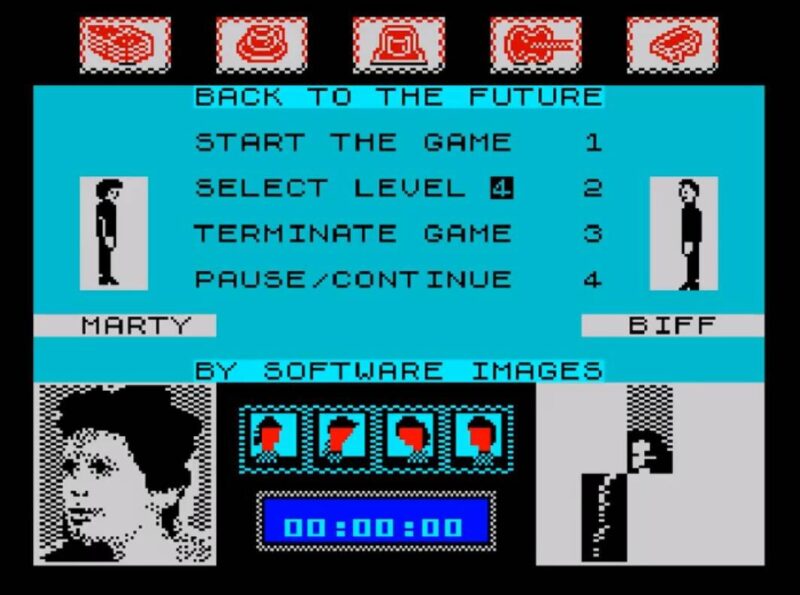
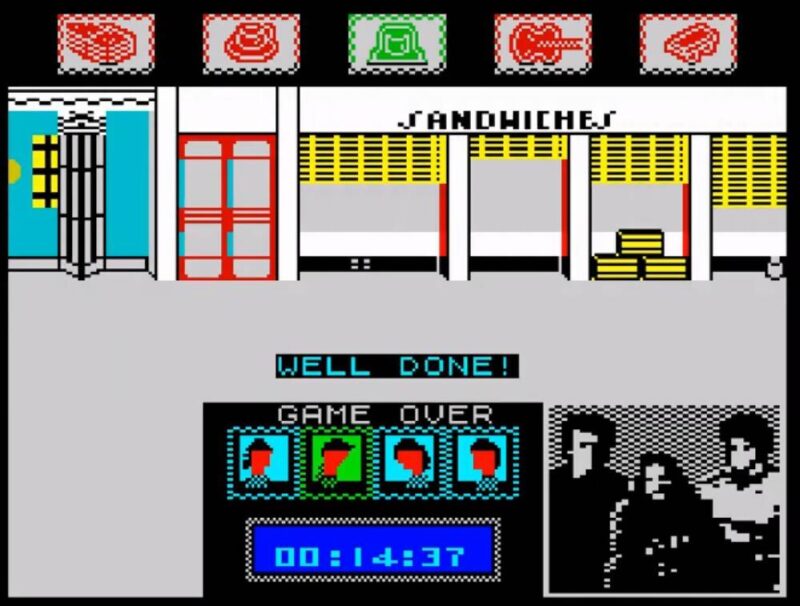
The main menu features the game’s dashboard, which occupies a third of the available space, it’s here you can finally see the digitised images promised in those earlier previews.
On the left-hand side of the screen is a three quarter-profile headshot of Marty McFly, which, as the game is played, is made up of a grid of eight rectangular strips in a two by four configuration. The resemblance to Michael J Fox in these early days of low resolution graphics is better on the Commodore and Amstrad machines than it was on the ZX Spectrum.
The other side of the dashboard features what is supposed to be a photo of Marty with his siblings Dave and Linda. Again, due to the computer’s low resolution, the faces are almost unrecognisable. If you’re a fan of the film, it’s possibly a little easier to see what the developers were going for. Once again, this picture is created by eight rectangular strips for gameplay reasons.
In-between these two larger photos are small thumbnail pictures intended to represent George McFly, Lorraine Baines, Biff Tannen and Doc Brown – the only other characters in the game.
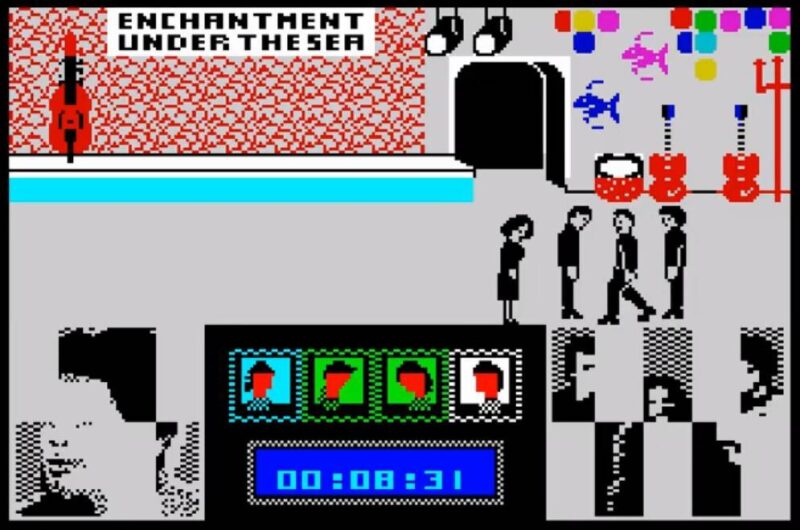
Back To The Future’s characters inhabit a simple game map: a scrolling street that contains the major 1955 locations from the film. There’s Lou’s Diner, Doc Brown’s House, the school, and the hall where the Enchantment Under the Sea Dance takes place.
This is heavy
Each building contains a single room where you can pick up one of four objects. For example, the school contains a collection of romantic poems and the dance hall contains an electric guitar. At either end of the street there’s a pile of packing crates that you can turn into a skateboard, allowing Marty to get around the map a bit more quickly. Biff can’t hit you while you’re riding the skateboard, either, but in all honesty, it’s never needed.
The aim of the game is to use these various objects to coax George and Lorraine into falling in love.
The aforementioned digitised pictures represent your in-game health. If things are going wrong – such as Lorraine falling in love with you – the picture of Marty will gradually disappear, one strip at a time. Once those eight strips vanish, a single strip of the sibling’s photo disappears. So it repeats until there are no strips of any photo left, and it’s game over. The reverse happens if events are playing out well.
Now so far, this sounds like a logical idea – it’s a faithful re-creation of the film’s plot. In practice, however, it falls woefully short – even for a dedicated Back To The Future fan like me.
The characters on screen are large, quite well-animated sprites, but they look nothing like their big-screen counterparts. Marty looks like he has an Afro. The scrolling as Marty walks along the street is horrendous; luckily, Commodore 64 owners were spared from this due to the machine’s superior hardware.
The instructions on the cassette inlay inform you how to tell the characters apart by their colour, but on the ZX Spectrum version, they’re all monochrome.
But what is this all leading to? Well, the game can be completed in under ten minutes once you figure out the best method of getting George and Lorraine to fall in love, thereby restoring Marty’s past.
In essence, using the aforementioned guitar on either character forces them to stand still for a period of time. By using it on both of them as they occupy the same space means they start to fall in love. Repeated use of the guitar on each of them means they don’t move: instead, the digitised photos slowly materialise.
Once both pictures are revealed in full, a visit to Doc Brown’s house will see an 8-bit representation of the DeLorean speed down the street. It vanishes without any flashing or twin trails of fire on its journey back to 1985.
Finally, the game flashes up an inspiring message as a reward for your effort: “Well Done.”
As either a fan of Back To The Future or gaming in general, this was hugely disappointing. It also affirmed the suspicion that maybe games based on film licences weren’t all necessarily made with an artisan’s care for the final product.
Great Scott!
To be fair, basing a game on a comedy adventure film was always going to be tricky. Unlike, say, Ocean Software’s RoboCop, which was a hit tie-in game later in the 1980s, Back To The Future doesn’t contain the kinds of action sequences that could be easily translated into game levels.
Controlling Marty on a skateboard around 1955 Hill Valley Square could’ve worked as one sequence, but what else was there? A puzzle section where Doc Brown has to reassemble the jigsaw like pieces of Marty’s warning letter about 1985? Maybe not, though a number of other 1980s and 90s tie-ins made mini-games about similarly incidental moments from movies – RoboCop contained a segment where you had to piece together a criminal’s face, for example.
Not that you can necessarily blame the developers for making such a disappointing BTTF tie-in. Interviewed in Sinclair User in December 1986, one of the game’s designers, Mark Eyles, admitted: “Back To The Future was a bit of a rush. We knocked it out in about two months flat. We really wanted about twice as long to do the film justice, but the deadline was pressing…”
Forty years on, and it’s easy to look back at the 1980s with wistful nostalgia. The Back To The Future game, on the other hand, is one of those pop cultural relics best left in the past.