Though Weapons has dominated the conversation this year, Zach Cregger’s Barbarian contains dark, powerful ideas around cycles of trauma. We unpack its deeper meaning… NB: The following contains spoilers for Barbarian. A trigger warning, too, for discussion of potentially disturbing topics involving sexual violence. You might remember writer-director Zach Cregger’s striking debut feature, Barbarian, for ... Barbarian | The dark meaning behind Zach Cregger’s 2022 movie
Though Weapons has dominated the conversation this year, Zach Cregger’s Barbarian contains dark, powerful ideas around cycles of trauma. We unpack its deeper meaning…
NB: The following contains spoilers for Barbarian. A trigger warning, too, for discussion of potentially disturbing topics involving sexual violence.
You might remember writer-director Zach Cregger’s striking debut feature, Barbarian, for the unexpected right turn it takes around halfway in. Like any decent twist, it subverts our expectations of what kind of film we’re watching. But one of Barbarian’s more quietly memorable aspects lies in its depiction of a specific archetype: the serial male facilitator of abuse.
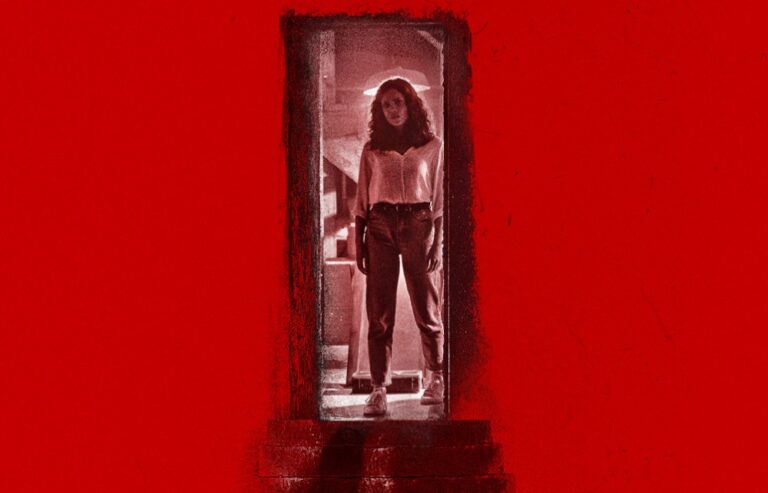
In the first 45 minutes, we’re led to assume that Keith (Bill Skarsgard) fits that archetype, especially given he’s played an actor known for his performance as Pennywise the clown in the recent It movies, among other menacing performances. As he unexpectedly shares an Airbnb with Georgina Campbell’s cautious Tess, we in similar fashion are coded to expect the worst of a man who shouldn’t be there, alone, with a vulnerable young woman.
Cregger once said in a press conference that he was unaware of what he called the “tiny red flags” in life that women have to constantly factor in – at least until he read a non-fiction book on the subject called The Gift Of Fear:
“There was a chapter in the book that was really primarily directed towards women, and he was encouraging women to pay attention to these little minor red flags that men can give off in day-to-day situations… things like complimenting you when it’s not necessarily appropriate or doing you a favor that you didn’t ask for, or touching in a nonsexual way that’s not initiated by you… he was basically saying the gift of fear, it’s important to pay attention to these little red flags because you’re equipped with that to identify potential threats.”
This informed how Cregger presents Keith in the first act, but his hideous murder at the hands of the ostensible monster of the piece, the inbred ‘mother’ living underground, puts paid to that assumption. Keith was a decent bloke, himself aware of Tess’ own anxieties and who worked to try and put her at ease. He’s the precise opposite of the real abuser who Cregger’s story immediately then flips to – AJ. Played by Justin Long, he’s a famous actor who owns the Airbnb, and has just been accused of the rape and abuse of a female performer.
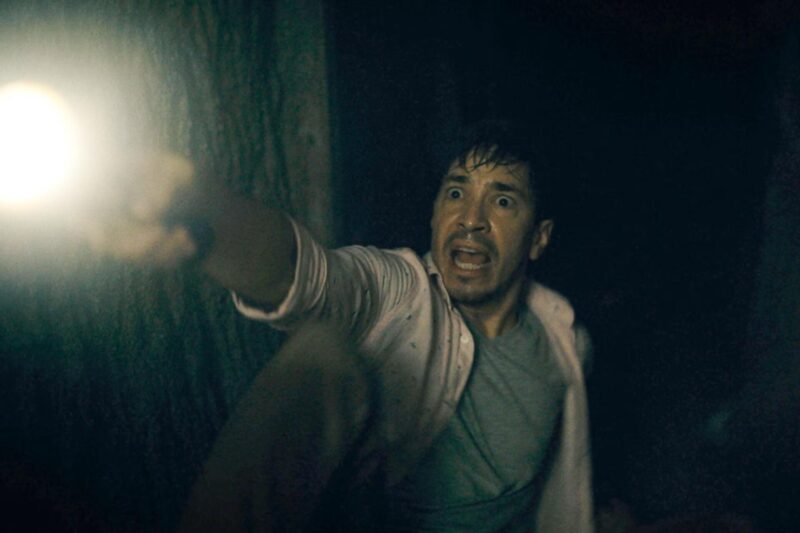
Where Keith was hyper aware, AJ is the precise opposite. He’s ignorant of any kind of female perspective in relation to male privilege. He actively abuses his influence for his own gratification, and later tries to spin a narrative that he’s being victimised. He’s a product of the post-#MeToo culture, in which toxic masculinity has reacted to female agency. Rather than explore how he might have abused his accuser, AJ tries deflect from the real issue, and immediately works to use his PR machine to slander her.
There’s a deliberately reprehensible aura around AJ, as Justin Long told Screen Rant in 2022. “I don’t think I’d ever played anyone who did something so awful, and I remember that day, having to confess that in the scene, was a tough one, only because I try to find the truth in any scene, and it was hard to.”
The truth is, much as Cregger blindsides us into thinking AJ might have a redemption arc, there’s really no redeeming him once he doubles down on his misogyny and self-interest. An ongoing cultural debate continues to rage as to whether men such as AJ deserve to be rehabilitated following ongoing, pervasive abuse, and there is a strong argument that even if society accepts them again, they should not have any kind of cultural platform to influence or repeat their crimes.
Barbarian ultimately sees him punished for his victimisation of women by the ultimate, primal expression of motherhood in the ‘monster’. But AJ is the symptom of a much darker, misogynistic disease which significantly pre-dates him or #MeToo. An expression of this lies in perhaps the darkest force in Barbarian – not AJ or the ‘mother’, but Frank (Richard Brake), who plays a small but significant role in the film’s lore.


Frank is the ultimate source of the ‘mother’. He’s both her father and grandfather – a grim inversion of the American nuclear family archetype. In an even more unexpected and lurching narrative device than switching from Tess’ nightmare to AJ’s high profile scandal, Cregger suddenly yanks us out of AJ’s comeuppance back to the 1980s and the origin story of both the house and Frank. Moving back in time, the Detroit street goes from a run-down, dystopian suburb into a white picket fence community.
Crucially, when we arrive, most of the neighbours are upping sticks: people who quite probably have lived here since the 1950s and the halcyon, post-war pinnacle of the nuclear family concept. Frank speaks to a neighbour, Doug, who’s leaving before the crime and economic neglect which has affected much of Detroit creeps into their suburb. “This neighbourhood’s going to Hell, Frank,” he tells him – an utterance that ends up having more than one meaning as Cregger digs further into Frank’s dark life.
We see Frank gather equipment from a hardware store, posing as as a workman in order to bluff his way into the home of a vulnerable young woman, and leave a window open for him to creep into later at night and abduct her. We don’t see that act itself, but Cregger has told us enough, through what Tess and AJ see, to understand what Frank has spent decades doing: abducting, raping and impregnating women, whom he keeps captive (before presumably killing them), and breeding with the children they birthed. It’s an abhorrent cycle that leads to the mutated ‘mother’, who’s simply searching for someone to nurture.
It’s a story almost too bleak to contemplate, but cuts to the nerve of what Barbarian depicts. Frank could exist in the world of Mindhunter, David Fincher’s depiction of the sinister murderous underbelly of American society in the mid-20th century, or any number of traditional serial killer stories. He’s an abusive murderer born out of the end of the sexual and cultural post-war revolution – the mild-mannered, polite guy who could live next door and never be noticed while he commits his vile crimes.
Fast forward a few decades, and the nature of such an abuser has changed. Men such as Frank still exist, of course, but the enigma of them is gone. Men like AJ have begun to fill that space as a modern example of toxic male entitlement and abuse. Where Frank operated at night and in secret, AJ feels he is invulnerable due to his fame and operates in the open, believing he has the power to treat women however he wants. He might not kill by creeping into homes, but he tries to murder Tess to protect his reputation. He hasn’t been mythologised as Frank has, but he is no less monstrous.
There is a moment toward the end of Barbarian that cements this idea. AJ, not Tess, is the only one who stumbles on Frank’s ancient, decrepit form, lost to time beneath the house in his basement, presumably long considered dead or having moved away. Frank had surrounded himself with trophies and records of his acts, but AJ initially considers him a victim of the ‘mother’ as he is. Then Frank, pointing to a bedside table, makes AJ aware of one of his VCR tapes. What AJ sees horrifies him. And because he would never consider himself in any way similar to Frank, AJ regards him as a freak.
Aware that he has been discovered, Frank wants a gun. He knows that if AJ alerts the authorities, Frank will end up in a prison cell. Yet in taking his own life, he passes the torch of this abuse to a new generation. His time is over. No longer do men such as this need to hide underground, concealing their true thoughts, feelings and beliefs about women. No longer do crimes have to be committed in the shadows. The pervasive influence of the Franks of the world have given way to the AJ’s – men just as abusive, but who truly believe themselves to be justified in their actions.
Cregger has discussed this perception: “A lot of people have said that the movie is about the ripple effects of abuse, and I think that’s a pretty apt way of putting it. It’s essentially a horror movie about the fallout of abuse, and how it continues to grow and infect other people.”
The true monster of Barbarian is not, of course, the outwardly horrific figure of the ‘mother’. She is both a victim and a symptom of sadistic male entitlement,. Frank and AJ are the monsters. Man, at his worst, is the scourge. And though Tess survives the ordeal, a classic Final Girl, she walks back into a world where AJs continue to exist. Perhaps they’re even perhaps growing in number.
Here lies the most terrifying message of Zach Cregger’s film: abuse spawns abuse, and it will take profound change to break that cycle.
You can find A J. on social media, including links to his podcasts and books, via Linktr.ee here. For more on Barbarian and horror, seek out his Film Stories Podcast Network show, Modern Horror.
/**/