Linda Hamilton starred in Kong Kong Lives – a weird sequel that few asked for and even fewer saw. Forty years on, a look back. The look says it all. Terminator star Linda Hamilton, sitting on the arm of a full-sized King Kong prop, has a far-off look in her eyes. Next to her, fellow ... King Kong Lives | One of the most bizarre sequels ever made, 40 years on
Linda Hamilton starred in Kong Kong Lives – a weird sequel that few asked for and even fewer saw. Forty years on, a look back.
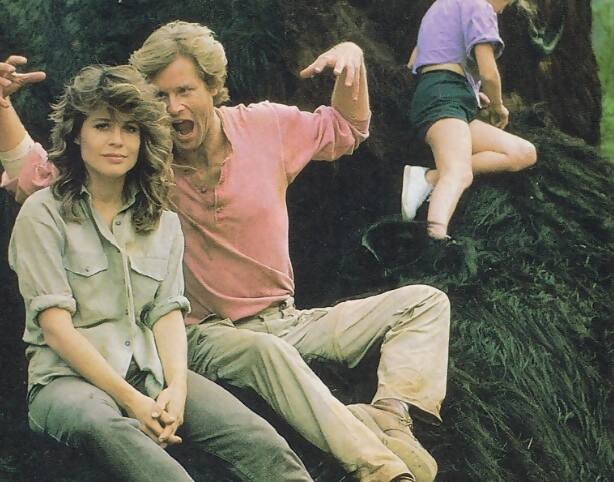
The look says it all. Terminator star Linda Hamilton, sitting on the arm of a full-sized King Kong prop, has a far-off look in her eyes. Next to her, fellow actor Brian Kerwin wears a goofy expression, his arms flung wide and his jaw hanging open, looking like he’s pretending to eat Hamilton’s head.
Hamilton is either unaware or simply ignoring him. She looks wan, like someone wondering how on earth they ended up sitting on a giant stuffed ape.
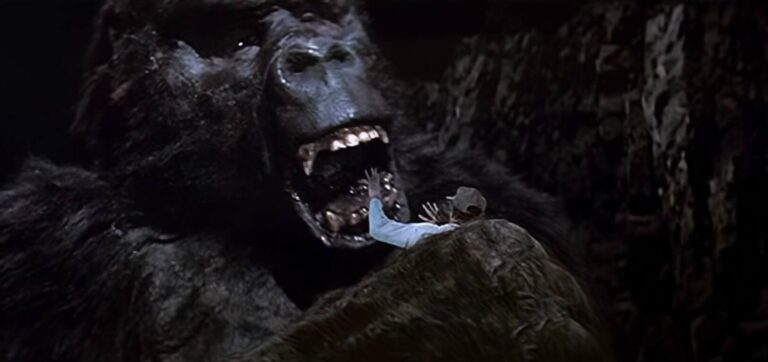
The photo was taken by Starlog magazine on the set of King Kong Lives – a sequel that seemed to come out of nowhere. Here was a follow-up to the 1976 King Kong remake – a monster movie that, most critics agreed, couldn’t come close to matching the much-loved 1933 original.
Hyped as one of 76’s must-see blockbusters, and costing a then sizable $23m to make, King Kong did reasonably well at the box office – but not the kind of numbers that suggested appetite for a sequel.
One person who did absolutely want a second King Kong film, though, was producer Dino De Laurentiis, who had been plotting to make one right after his first attempt came out in cinemas.
“Dino loves Kong and has been looking to resurrect him for ten years,” producer Martha Schumacher told Cinefantastique magazine in 1985.
The idea languished for almost a decade, partly due to the 76 remake’s reception, partly due to rights issues, and also because no one could quite figure out how Kong could have survived the first film’s ending.
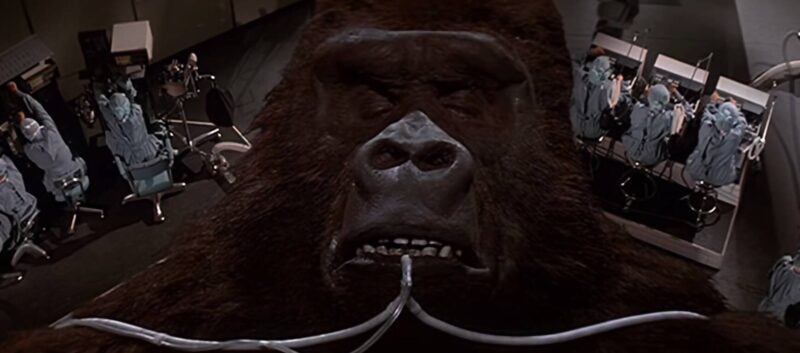
By the mid 1980s, however, screenwriters Ronald Shusett (of Alien and Total Recall fame) and Steven Pressfield had cracked the Kong code. Despite all the gunshot wounds and a huge fall from the World Trade Center, the beast did indeed survive – albeit narrowly.
Now kept in a gigantic intensive care unit, Kong lies in a coma; to survive, he needs an artificial heart and a blood transfusion. But colossal apes aren’t exactly abundant in North America, so Kong’s carers are left in a bit of a bind. At least until Brian Kerwin’s dashing explorer finds a female giant ape – Lady Kong, as she’d dubbed – in the wilds of Borneo.
King Kong has a potential donor. But what are the odds of the pair escaping captivity and causing havoc? You can probably guess the answer.


Suggested product
Issue #60 Magazine Bundle (3x Covers: A Scanner Darkly Magazine + 1991 + Roger Deakins)
£14.99
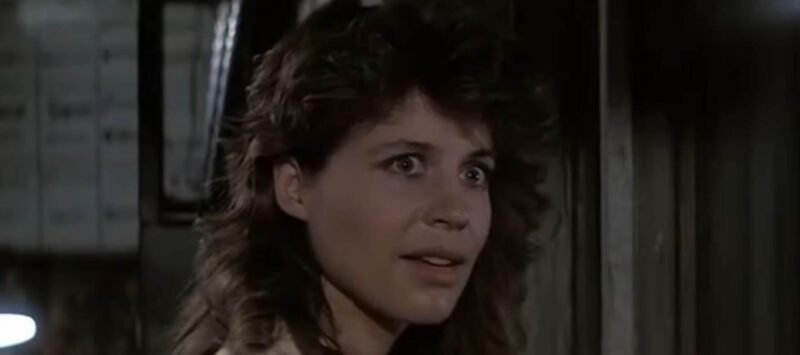
So it was that Linda Hamilton ended up on the set of King Kong Lives in North Carolina, having signed up for the role of Dr Amy Franklin. Her role would require her to put on a surgeon’s gown and perform the life-saving heart transplant on the stricken Kong – perhaps one of the most bizarre medical scenes in film history.
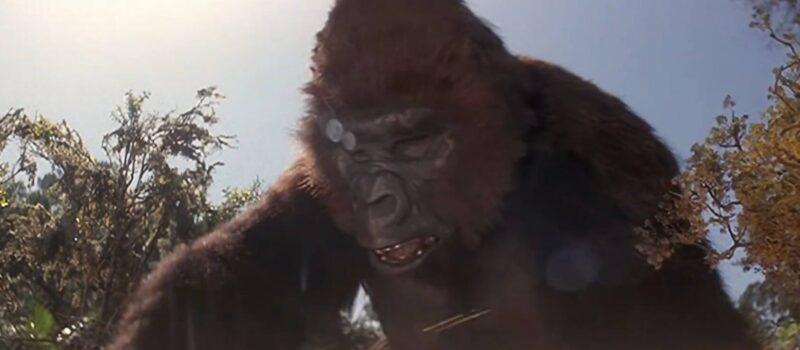
Then again, just about everything about King Kong Lives is rather bizarre. It’s certainly ambitious from a storytelling point of view: the plot requires its two giant apes to fall in love – not an easy thing to portray with miniatures and stunt people in suits, at least without audiences rolling in the aisles with laughter.
To save money, much of the action takes place in the middle of nowhere, with King Kong and Lady Kong feasting on trees and fighting off attacks from the military, led by John Ashton’s Lieutenant Colonel Nevitt. What unfolds is both a comedy and tragedy, though it’s never clear whether the humour is intentional or not. At one stage, Nevitt tells his men, “We should have no problem identifying the enemy. They’re approximately 50 feet tall, and they’re wearing their birthday suits.”
In another scene, we learn that Kong has become something of a celebrity in the intervening years. We see a great crowd of fans in Kong T-shirts, while a news reporter tells viewers at home, “Kong mania has arrived. Everyone’s gone bananas!”
All of which might sound as though King Kong Lives had all the resources and ambition of a straight-to-video sequel, but this was far from the case. The budget was lower than the 76 outing, certainly: returning director had roughly $18m to play with, which was a fair bit less than the $23m he had a decade earlier, especially accounting for inflation, but not by a vast margin.
You can see a lot of where this money went in the finished film: there are wide, sweeping shots of tanks and helicopters roaming the landscape, while armies of soldiers dowse the giant apes with flamethrowers and machine guns. The script may be shaky, but the production values are solid.
Effects designer Carlo Rambaldi, also returning from the 76 remake, was keenly aware that he’d have to reign in his expenditure a bit, though. One of the legendary stories surrounding the 70s King Kong was that Rambaldi and his team spent about $1.7m making a giant furry robot.
The plan was that the new film wouldn’t rely on quaint things like stop motion or people in suits, but would use a full-sized mechanical ape (or bits of ape, like functioning hands) for the majority of its scenes. Then the reality hit: the robot was too complicated and too unreliable. In the finished film, the contraption is only glimpsed in one solitary scene.
When Starlog magazine caught up with Rambaldi in 1985, he conceded that making full-sized ape robots was a bad idea.
“With modern technology, it’s possible to make a giant Kong,” he said. “But I’m afraid the movie will cost $200m and three years of shooting.”
The 1976 film did have a useful legacy, though: lots of props and parts left over from its shoot. Some of those bits were salvaged to make a new moving Kong arm prop, while Rambaldi’s hoarding habit also meant that Kong’s face would be an exact match from the previous movie.
“We’re using the same face mould for Kong as it was 10 years ago,” production designer Peter Murton enthused. “So never throw anything away!”
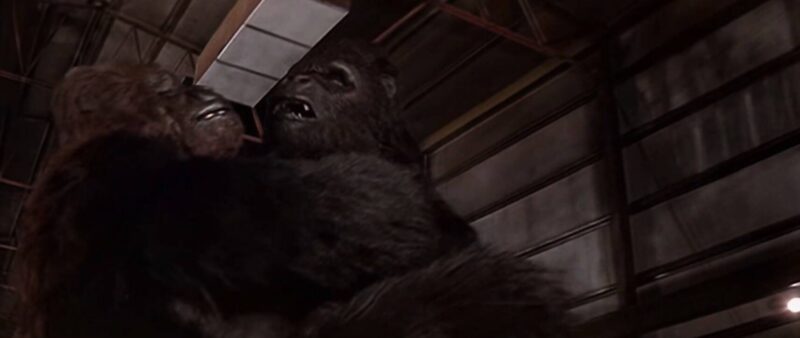
As in the 1976 film, most of the effects shots were achieved by putting actors in hairy suits designed by Rambaldi (Peter Elliott and George Yiasoumi, who played King Kong and Lady Kong respectively, are listed first in the film’s end credits).
Rambaldi still needed some full-size Kong props for certain sequences, though, and for this he and his team came up with a cunning idea: an inflatable ape with room inside for crewmembers to move around inside and simulate the rising and falling of its chest. To save money, they also built a single Kong body with interchangeable King and Lady heads.
In a case of history repeating itself, King Kong Lives was rushed for a Christmas release, just as its predecessor was. A fair amount of money was put into a publicity campaign, but that couldn’t save the hairy sequel from critics’ sharpened knives.
While notable writers like Janet Maslin and Robert Ebert called it dull and boring, audiences provided their own verdict: King Kong Lives barely made a sound in US cinemas, though an unexpected turnout in the Soviet Union made its $48.9 worldwide gross sound less grim than it might have been.
Linda Hamilton, who’d put a brave face on things during the shoot (“I feel very good that I’m involved in a Kong movie, because it’s a legend,” she told Starlog), later admitted that she’d starred in a bit of a dud.
“What can I say about King Kong Lives! I was stunned when I saw it,” Hamilton told Starburst in 1991. “It was the most ridiculous movie… It was a hoot when I finally saw those monkeys flirt and bat their eyes.”
Among the baffling and awful sequels that litter film history, King Kong Lives isn’t talked about all that much compared to, say, Superman IV or Jaws The Revenge. But in many ways, it’s just as fascinating: similarly ill-conceived, and even more so than those movies, seemingly made without an obvious audience in mind.
And while the film contains such unintentionally amusing lines as, “It ain’t a him! It’s a her… and a damn good looking one, too,” it appeared to have been made with serious intentions.
“There is humour,” insisted producer Martha Schumacher in 1985. “There is adventure. There is hard emotion and also a love story, too. This is not a rip-off of a sequel. It’s a serious picture. It’s not a joke.”
We’d politely beg to differ. Forty years on, King Kong Lives remains a singularly weird beast.