It’s almost 50 years since the first remake of King Kong. We pay tribute to the grand, doomed plan to make cinema’s first giant robot ape. Regardless of the film itself, the ambition behind 1976’s King Kong was difficult to fault. Headed up by Italian producer Dino De Laurentiis, it was billed as that year’s ... King Kong 1976 | A salute to its spectacularly unreliable mechanical ape
It’s almost 50 years since the first remake of King Kong. We pay tribute to the grand, doomed plan to make cinema’s first giant robot ape.
Regardless of the film itself, the ambition behind 1976’s King Kong was difficult to fault. Headed up by Italian producer Dino De Laurentiis, it was billed as that year’s big event movie – a giant blockbuster in every sense.
A remake of the 1933 original, it aimed to take the tragic story of a colossal ape into the modern era, dispensing with the stop motion animated effects by Willis O’Brien in that earlier film and replacing them with a full-sized, mechanical Kong.
In short: King Kong’s makers planned to build a 40 foot-tall, hairy robot.
It was an optimistic goal, to say the least – particularly given that, only a year earlier, Steven Spielberg had faced a production nightmare with his mechanical shark on the set of Jaws. The creature at the heart of King Kong, far from being an ocean-going predator, had to emote and interact with human characters – most of all leading lady Dwan, played by Jessica Lange.
To make things even more challenging, De Laurentiis’ King Kong was rushed into production due to a rival project going on at Universal Pictures. For a while, there was a bit of a stand-off between Universal and De Laurentiis’ distributor, Paramount, as the two studios clashed over whether they’d make two rival movies or collaborate on one. In the end, Universal backed down and Paramount carried on with De Lautirentiis’ take.
A then-huge $16m budget was given to the new King Kong, with a considerable percentage of that going to realising the titular ape. While director John Guillermin – who’d just made The Towering Inferno – set about getting his cast together (Lange, Jeff Bridges, Charles Grodin), the production mulled over how to make Kong himself.
Italian designer Carlo Rambaldi, later of E.T. fame, was hired to create the beast. It was, needless to say, a huge undertaking; making a mechanical ape would require a complex array of hydraulics, metal and fur. Moreover, the thing had to be at least somewhat safe; if it malfunctioned, or worse, toppled over, the damage could have been horrific.
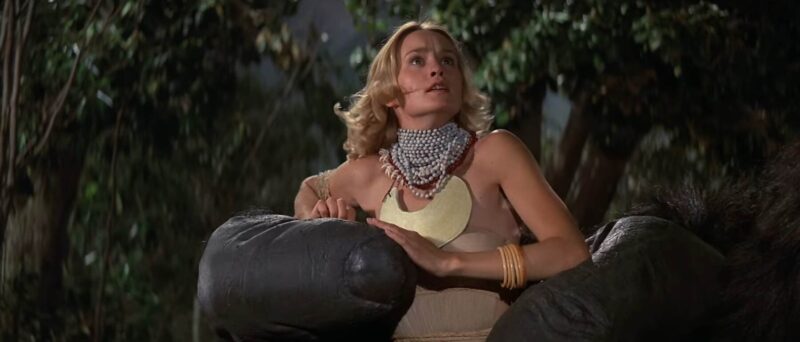
As well as the full-size, moving ape, other props had to be made as shots required. Two colossal mechanical hands, employed for scenes where Kong scooped up Lange’s character, were designed and built, themselves requiring complex moving parts, latex and aluminium. There was also a full-sized, static Kong, and a human-sized ape suit for miniature effects shots – the latter eventually worn by young FX artist Rick Baker.
The cost of all this stuff was, needless to say, huge. The mechanical ape cost somewhere north of $1.7m (some accounts suggest it was $8m). The building-size Kong sculpture cost $300,000; the ape suit and the mechanical hands cost a reported $400,000.
Aside from the cost of design and construction, materials played a factor in those huge sums. Kong’s dark fur was created from the tails of an unfeasible number of Argentine horses.


Suggested product
Issue #60 Magazine Bundle (3x Covers: A Scanner Darkly Magazine + 1991 + Roger Deakins)
£14.99
With all this cost, complexity, and a generally rushed production (the film had to meet a self-set release date of December 1976), it was inevitable that problems would arise. Charles Grodin recalled in his autobiography, It Would Be So Nice If You Weren’t Here, that the construction team accidentally built two right hands for Kong.
Something rather more serious occurred on the 10th May 1975. As recorded in Bruce Bahrenburg’s excellent book, The Creation Of Dino De Laurentiis’ King Kong, a test run for one of the mechanical hands took place that day and almost went fatally awry.
Standing in for Jessica Lange, stunt actor Sunny Woods was placed in a Kong hand and lifted into the air. At a critical moment, the hand prop suddenly broke at the wrist, almost causing Woods to plummet 10 feet onto the ground below; thankfully, she was able to cling on until the crew could lower her to safety.
Lange herself suffered at the hand of Kong. Its mechanical fingers, operated remotely by four operators, had a tendency to close too hard, prompting agonised screams from Lange as she wriggled in its grasp. Grodin later recalled in his book that Lange “emerged from 10 months of shooting significantly bruised from Kong.”
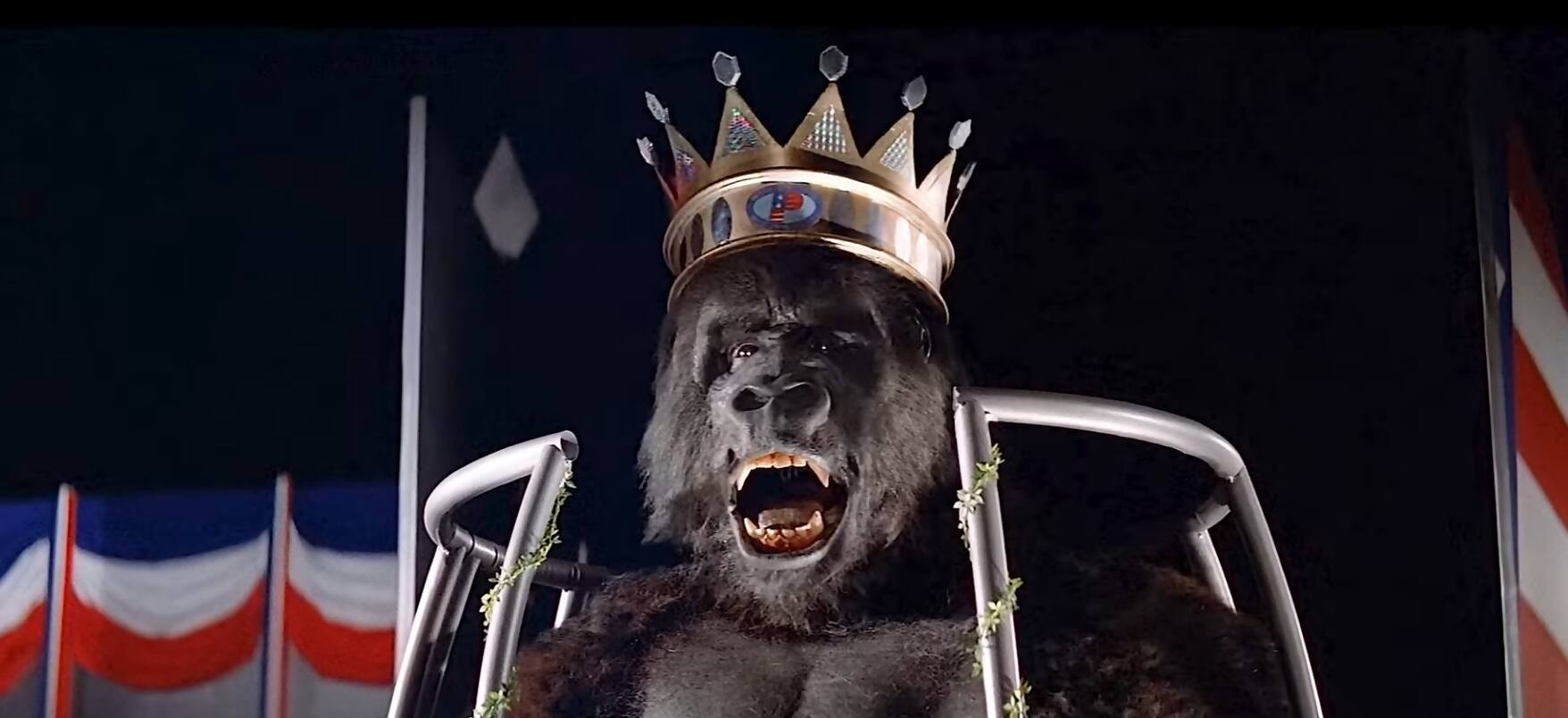
The full-size mechanical ape was even less cooperative. In the build up to release, there was much publicity about the robot being able to walk and move its arms; in the final event, the prop proved to be so unreliable that it’s only briefly seen in the finished film. Its big close-up moment occurs near the climax, where a captured Kong is unveiled at a stadium in New York; for a shot or two, we can see it stiffly moving its arms and head.
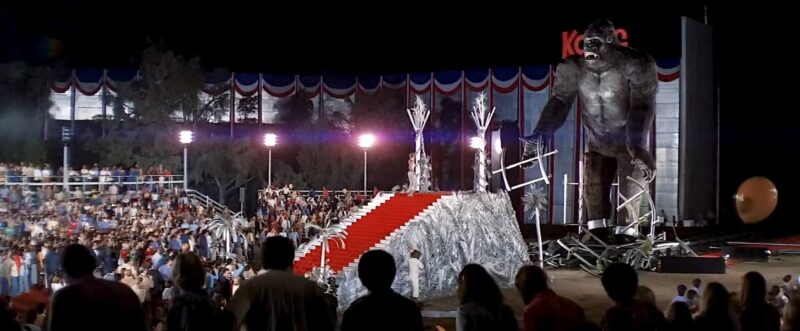
Even that appearance had to be cut short when the prop broke yet again; a pipe inside the contraption broke, leaving a torrent of hydraulic fluid seeping down Kong’s leg in front of a startled crowd.
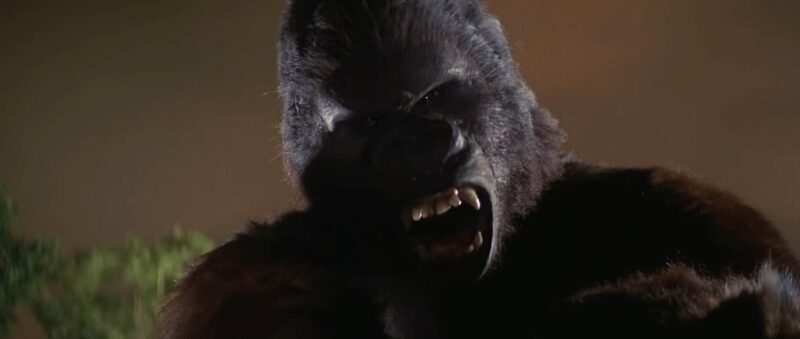
In the end, the greater percentage of King Kong’s wider shots were achieved by simply filming Rick Baker traipsing around in his ape suit. For all its hype and huge budget, most of the movie’s big disaster scenes are no more technically advanced than Ishiro Honda’s Godzilla and its many sequels.
King Kong was sold on the promise of spectacle and the unique prospect of seeing a three-storey high ape menace the streets of Manhattan. In the end, more low-tech solutions saved the day.