Better known for his comedies, Rob Reiner turned to horror and suspense with 1990’s Misery – and created a classic, grisly set-piece. There’s a story Stephen King often liked to tell about the inspiration for Misery, his hit 1987 horror novel. He was in New York, promoting some book or other in 1979, when he ... Misery | How Rob Reiner made the grisliest horror sequence of 1990
Better known for his comedies, Rob Reiner turned to horror and suspense with 1990’s Misery – and created a classic, grisly set-piece.
There’s a story Stephen King often liked to tell about the inspiration for Misery, his hit 1987 horror novel. He was in New York, promoting some book or other in 1979, when he emerged from a television studio late one night to find a group of fans waiting expectantly for autographs.
One face in particular stood out: a bespectacled young man clutching a Polaroid camera. The man asked King if they could have a picture taken together – what we’d now call a selfie – and King, despite thinking “the guy was weird,” agreed. Then came another request: could King sign the photograph? Sure, King said.
The young man took out a pen, and King scribbled a few words on the still-developing Polaroid. “To Mark. Best wishes, Stephen King.”
That fan, King later said, was Mark Chapman, the gunman who, one year later, shot John Lennon on the steps of his Manhattan apartment.
King admitted to the Washington Post years later that he couldn’t be certain that the man who took the selfie was the same Mark, but insisted, “I’m pretty sure it was him. Chapman dug celebrities. He was into fame.”
This was the seed, at any rate, for Misery – a 300-page nightmare about a famous author, injured and entirely at the mercy of a crazed fan of his books. In it, King exorcised the uneasiness he felt about being famous, and the parasocial connection his readers sometimes have with him and his work.
“You look in their eyes, and it’s like looking into vacant houses,” King told the Post about the fans he met, clutching their pens. “They don’t know why they want autographs. They just want them. And then you realise, not only is this house vacant, but it’s haunted.”
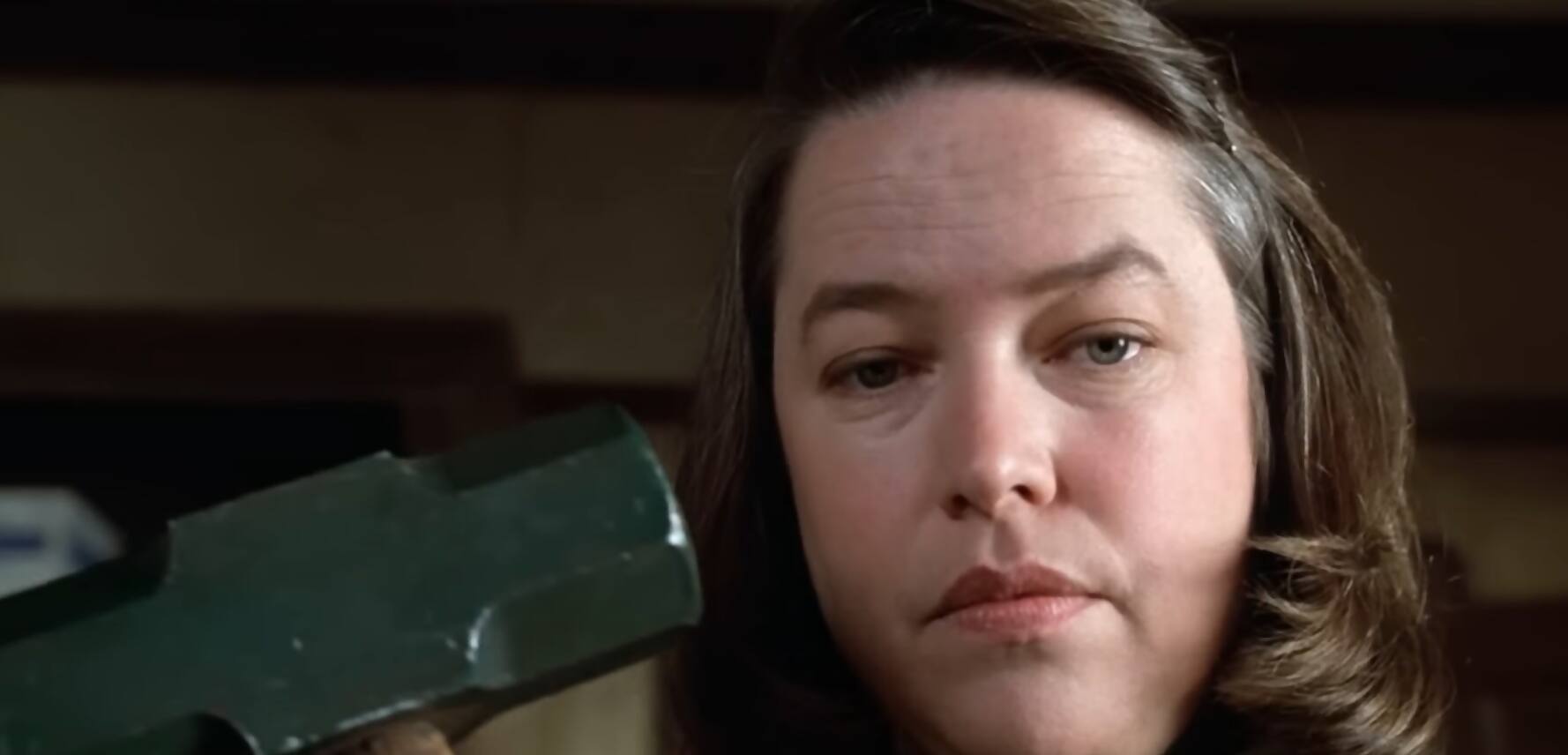
That haunted quality was crystalised in Annie Wilkes – the self-described “number one fan” who finds novelist Paul Sheldon, injured following a car crash, and drags him back to her remote Colorado house. At first, Annie nurses Paul back to health, but her sinister side soon makes an appearance: she’s angry that Paul killed off her favourite fictional character, Misery Chastain, and demands that he write a new novel that brings her back.
Essentially bedbound, Sheldon reluctantly begins writing this new work – all the while trying to figure out a means of escaping an increasingly unstable Annie…
Misery was a focused shocker, its pages of tension flipping over into abrupt and toe-curlingly graphic violence. And so it might have seemed a little surprising that Rob Reiner, better known in the late 80s for such hit comedies as This Is Spinal Tap, The Princess Bride and When Harry Met Sally… would choose to tackle such a gory book.
Reiner had adapted a King story before – the author’s slim volume The Body became Stand By Me – but that was a sweet, wistful coming-of-age drama rather than outright horror.
The director’s response to the project was straightforward enough: as far as Reiner was concerned, Misery wasn’t a horror novel, but rather a “metaphor” for the life of a successful artist confined by the kinds of books he’s become famous for. Paul Sheldon may write swooning period romance rather than horror, but he’s evidently a stand-in for King.
As Reiner told Cinefantastique in 1991, “Somebody like Stephen King, who is as successful as he is, I know he is tormented the way Paul Sheldon is tormented. He is wondering, ‘Can I write something other than the things I’ve been writing? Will I lose my audience?’ That’s what fascinated me. That’s what I focused on.”
Besides, Reiner was contractually obliged to produce Misery – and King not-so-secretly wanted him to direct. The author was initially reluctant to have the book adapted at all, but after seeing Lord Of The Flies, the 1990 adaptation that Reiner produced, King changed his mind. He would sign the rights to Misery over to Reiner’s production company, Castle Rock Entertainment, but on the proviso that Reiner’s name had to be on the opening credits.
Reiner hired veteran screenwriter William Goldman, who’d recently written The Princess Bride, to rework Misery for the big screen. The resulting script impressed Reiner so much that he decided he’d direct it himself.
“I started getting more and more interested,” Reiner said. “Eventually, I took it on. But ultimately that’s because King himself regarded it as a very personal book, something that he cared about. He didn’t want to see it destroyed.”
Beyond King’s protectiveness over Misery, there was an uneven quality to some of the previous adaptations of his work in the 1980s. The Shining, The Dead Zone and Christine were all made by talented directors; Children Of The Corn, Firestarter and Cat’s Eye were rather less creatively successful. It’s understandable, then, that King wanted Misery to go to a filmmaker who could do it justice.
Filming got underway in Reno Nevada with Kathy Bates – then better known as a stage actor – cast as Annie Wilkes and James Caan as Paul Sheldon. Several high-profile actors had been offered the Sheldon role, including Michael Douglas and Dustin Hoffman, but declined – perhaps because the character spends so much of the film incapacitated and at the villain’s mercy. It’s hardly a glamorous role.
“I play a total victim,” Caan conceded at the time. “I get the crap beaten out of me. And I look like I’m between 80 and death.”
Through Misery’s shoot, Reiner remained uncertain about how much of the book’s splatter he could get away with leaving out. He’d told Cinefrantastique that he was focusing on the characters rather than the horror, adding that, “if you’re a blood and guts fan, you’re not going to like Misery.”
At the writing stage, he and Goldman had already toned down some of the violence described in the book. Originally, King wrote that Annie chops off Paul’s foot with an axe, before staunching the flow of blood with a blowtorch. In the script, Annie smashes Paul’s feet with a hammer.
“I’m not a big horror fan,” Reiner said at the time. “I don’t really like those things particularly unless there’s some real substance to it, like The Exorcist.”
Through the shoot, there seemed to be a hint of uncertainty over how graphic that foot scene should be. A pair of prosthetic legs made from gelatin were created by special makeup effects artist Greg Nicotero and his team; a pair of prosthetic Annie Wilkes heads were also created for a late fight scene. It was never clear, however, how much of these effects Reiner would actually use.
“In our first meeting with him,” Nicotero told Cinefantastique, “he was very concerned about our perception of the script. He kept saying, ‘Look guys, this isn’t a blood bath. I don’t want to throw a ton of blood on the set.’ He really is a strong believer in, ‘Let’s use the actors and get it right.’ He’s not a big effects director.”
As it turned out, Reiner did use those prosthetic effects – although they’re only glimpsed, the shots of Paul’s legs shattering under the weight of Annie’s sledgehammer were truly withering. Indeed, it’s arguable that the concept of Annie smashing ankles was even more unsettling than King’s original concept. Rather than go for splatter, the film version of Misery goes for a more low-key, shudder-inducing approach that audiences could feel in their bones
That sequence became one of the more talked-about screen moments in 1990, as was the impeccably acted interplay between Caan and Bates. The following year, Bates became one of a vanishingly small number of actors to win an Oscar for their work in a horror film – though, like Reiner, the Academy probably got around this by mentally pigeonholing Misery as a thriller rather than a horror flick.
But even Reiner eventually came to relish staging some of Misery’s grislier moments. In a gleefully cathartic moment, in which Annie ended up having a typewriter swung directly into her face, Reiner, along with cinematographer Barry Sonnenfeld, briefly set his prior restraint aside and let the claret flow.
“We put a ton of blood on [Kathy Bates’] nose to simulate a [break],” Nicotero recalled. It was, like, BLAM! And there was blood all over. I remember Howard [Berger, effects artist] coming home from the set one day and saying, ‘Well, they didn’t want a lot of blood, but there sure was a lot of blood.’”
A bankable hit in 1990, Misery remains one of the most acclaimed adaptations of King’s work. Indeed, between Stand By Me and his producer work on The Shawshank Redemption – which he almost directed – Reiner did more to ensure the ongoing quality of King’s big-screen work in the 1990s than any other director. Shawshank was eventually headed up by screenwriter and first-time director Frank Darabont, who went on to make two further acclaimed King adaptations: The Green Mile (1999) and The Mist (2007). Without Reiner, Darabont almost certainly wouldn’t have gotten his break as a feature filmmaker.
Reiner and his wife Michele died under tragic circumstances in December 2025, and amid the tributes pouring in by those who knew him, the filmmaker is widely remembered as one of Hollywood’s few truly good men. And yet, Misery’s team up between Reiner and one of horror’s darkest minds resulted in a true genre classic.
“It’s an odd kind of marriage on the surface, if you think about it,” Reiner reflected in 1990. “But I think it made for a pretty interesting film.”
/**/