He hasn’t been on our screens in years, but Professor Quatermass’s impact on British sci-fi can’t be understated… In the summer of 1953, audiences across the UK watched history being made. Airing on the 18th July, The Quatermass Experiment was a true first for the BBC: the earliest original work of science fiction made for ... The importance of Professor Quatermass
He hasn’t been on our screens in years, but Professor Quatermass’s impact on British sci-fi can’t be understated…
In the summer of 1953, audiences across the UK watched history being made. Airing on the 18th July, The Quatermass Experiment was a true first for the BBC: the earliest original work of science fiction made for British television, and the debut outing for Professor Bernard Quatermass – the fictional rocket scientist who appeared in further adventures in film and TV through the 1950s and 1960s.
It’s hard to imagine in a modern age of media saturation, but back in the early 1950s, the BBC was the UK’s only television channel; ITV didn’t launch until September 1955. As a result, The Quatermass Experiment was viewed by just about every British person who owned a television; it was reckoned that some 3.4 million people tuned in to watch the first episode, and that the figure steadily climbed to a staggering five million by the sixth and final episode, which aired that August.
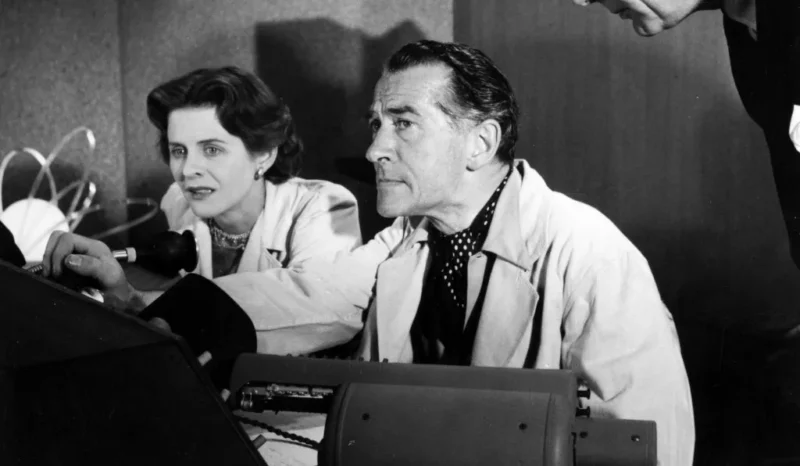
As was often the case back then, The Quatermass Experiment was performed live, much like a piece of theatre, with Reginald Tate starring as Quatermass, the intellectual hero combatting a mysterious threat brought down from space. The show’s success turned Nigel Kneale into one of the UK’s best-known writers, and prompted him to write further adventures for Quatermass.
Although he’s hardly an obscure figure in the 21st century, it’s arguable that Professor Quatermass is one of the more underused fictional characters from the British sci-fi and fantasy canon. And it might be all too easy for younger generations to overlook just how seismic that first 1953 outing was, both for British TV and cinema for culture as a whole.
Wimbledon, we have a problem
The Quatermass Experiment is brilliant in its simplicity. Professor Quatermass is the genius-level overseer of Britain’s space programme, which has just put the first rocket into space. But days after the craft was launched, ground control lost contact with its three crew.
The rocket subsequently lands in Wimbledon, where a rescue team finds just one survivor: the gaunt Victor Carroon (Duncan Lamont). His two other crewmembers have vanished, leaving only a pair of empty spacesuits behind.
Initially, then, The Quatermass Experiment presents itself as a locked room mystery worthy of Conan Doyle: how can two people vanish from a sealed rocket and leave no tangible trace behind? Gradually, however, Quatermass and his team uncover the grim truth: Carroon has been infected by some extra-terrestrial force which has turned him into a being capable of absorbing anything it touches – whether it be a human colleague or a plant that happens to sit in his hospital room.
The series proved to be such a sensation that the BBC immediately commissioned more work from Kneale, including an adaptation of George Orwell’s 1984 and The Creature, which aired in 1955. A sequel series, simply named Quatermass II, also aired that same year, this time with John Robinson in the title role (Reginald Tate tragically died months before production began).
A small British company called Hammer Film Productions also became interested in The Quatermass Experiment, and while the BBC needed a bit of convincing, it sold the rights to Hammer shortly after the series aired in 1953 (the price: a bargain £500).


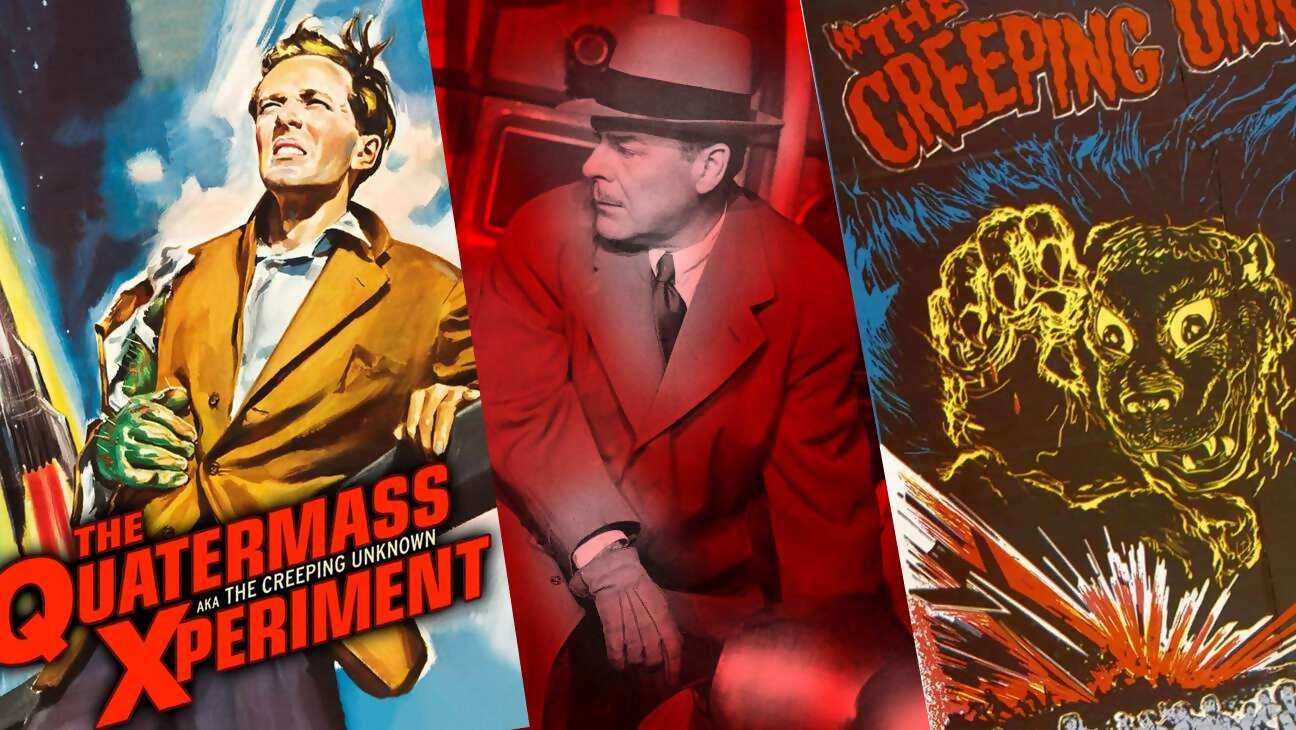
Shot on a low budget by director Val Guest, The Quatermass Xperiment (renamed to draw attention to its X-rating) was a brisk retelling of Kneale’s concept. The American actor Brian Donlevy brought a more steely, combative edge to Quatermass, and in an era of Space X and privately-run space programmes, there’s something almost parodic about watching a scientist brushing off protests from police and government officials when his experimental rocket almost wipes out a British village.
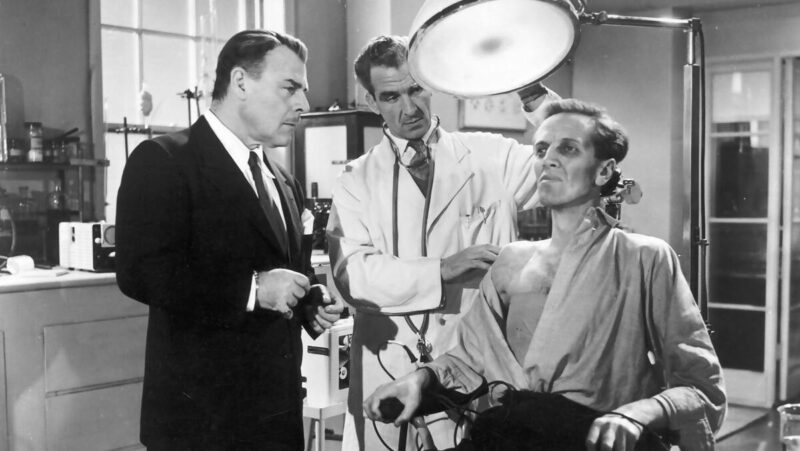
Kneale himself never particularly cared for Guest’s adaptation; he thought Donlevy was all wrong for the lead, and disliked the monster-of-the-week style ending (his TV version ended more thoughtfully, with Quatermass saving Earth with a few well-placed words rather than vast jolts of electricity).
He did, however, praise Richard Wordsworth’s performance as the big-screen Victor Carroon, and for good reason. His doomed space traveller scarcely has a line of audible dialogue, but his drawn, haunted face tells a story all on its own, and later scenes turn him into a tragic figure in line with James Whale’s Frankenstein monster, played by Boris Karloff.
Named The Creeping Unknown in the US (something else Kneale loathed), The Quatermass Xperiment was as consequential for Hammer as the original series was for the BBC. It was the film’s 1955 release, which was a hit on both sides of the Atlantic, which triggered the wave of horror films for which Hammer would become known from that point onwards.
X The Unknown came out in 1956 and a film version of Quatermass 2 the year after, while The Curse Of Frankenstein (1957), starring Peter Cushing and Christopher Lee was the first of its Gothic horror films which stretched on into the 1970s.
Hammer also adapted Kneale’s 1958 sequel series, Quatermass And The Pit, in 1968. Both the TV show and the film are spectacular works of sci-fi – tense, smartly written and building to intense climaxes. Both channel the ‘ancient aliens’ concept once written about by Lovecraft, meaning Quatermass And The Pit serves as a fascinating midpoint between, say, At The Mountains Of Madness, Erich Von Daniken’s spurious tome Chariots Of The Gods and Ridley Scott’s Alien (not to mention its prequel, Prometheus).
More than any other show, The Quatermass Experiment proved to the BBC, which might otherwise have been sniffy about the genre, that there was a public hungry for science fiction. Without Quatermass, there may never have been a Doctor Who – first airing in 1963, and which also received a couple of big-screen adaptations in the 1960s.
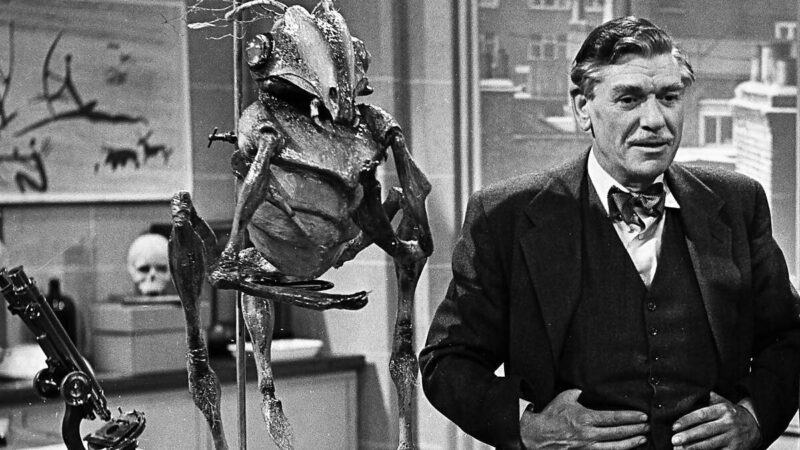
There are obvious parallels between Professor Quatermass and the Doctor; both are heroes who solve problems with their intellect rather than violence; and both have saved our planet from alien threats more than once.
Kneale, never one to mince his words, was unimpressed by Doctor Who; in fact, he’d asked to be involved in the series early in its production, but had turned the offer down flat.
“It sounded a terrible idea and I still think it was,” he said in a 1986 interview.
“I was approached by [creator] Sydney Newman, who was then running BBC drama, and it was his idea,” he said. It struck me as a producer’s idea and not a writer’s idea, and I think there’s a difference. I think what offended me about it was that it was clearly to be put out as a Children’s Hour story, and I didn’t write Children’s Hour stories. It was to go out at five or six o’clock and the tinies could watch – and I felt I’d find that very inhibiting because I didn’t want to bomb tinies with insinuations of doom and terror. In fact, that’s what they got to doing.”
Without Professor Quatermass to light the way, the science fiction TV and cinema landscape would have looked very different. Kneale may not have liked all the results, but his creation was arguably one of the most important pieces of British SF storytelling since HG Wells put pen to paper in the late 19th century.
It’s unfortunate, then, that the hero’s fame has faded somewhat over the past couple of decades. Kneale wrote one final TV outing for the professor – Quatermass, starring John Mills and airing in 1979 – plus the radio drama, The Quatermass Memoirs, which aired a year before he passed away in 1997.
In 2005, the BBC rather boldly remade The Quatermass Experiment as a 97-minute live broadcast, this time with Jason Flemying as the professor. A few minor gaffes aside, it was a success.
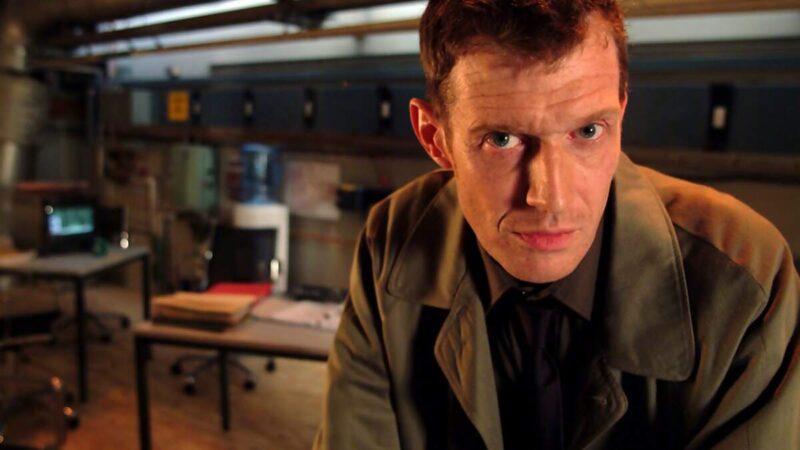
To date, however, no other writer has attempted to take up Kneale’s mantle and update Bernard Quatermass for a new generation of viewers. It’d be like Sherlock Holmes’ adventures suddenly coming to a halt after the passing of Sir Arthur Conan Doyle in 1930.
There was talk at the revived Hammer of a Quatermass reboot in 2019, but to date, nothing has emerged beyond a news story or two. Just as tragically, four of the six episodes of the original Quatermass Experiment series have since been lost in the archives.
For a writer who did so much to change British sci-fi, though, Kneale remained remarkably self-effacing about his creation.
In 1989, Starlog magazine caught up with the writer, by then in his late 60s, at the London home he shared with fellow writer Judith Kerr (yes, The Tiger Who Came To Tea Judith Kerr).
Over cucumber sandwiches, Kneale talked fondly about his time at the BBC, and how he’d actually played the mutant creature at the end of The Quatermass Experiment himself – it’s his hands in the glove puppet that stands in for the monster. (“There was no special FX department of any kind in the BBC at the time, so they said that I had gotten them into this, I had to get them out of it.)
He also recalled that, because the BBC was the only channel on television, there was a certain thrill to knowing with certainty that what he had worked on was being watched by millions. One day that summer in 1953, he emerged from a stuffy studio at Alexandra Palace and looked out over the London sprawl.
“You would stagger out into the hot summer air,” he said, “and see little TV aerials stuck out of houses – and you knew that they had all watched. You could see your own audience; it was a curious sort of feedback.”