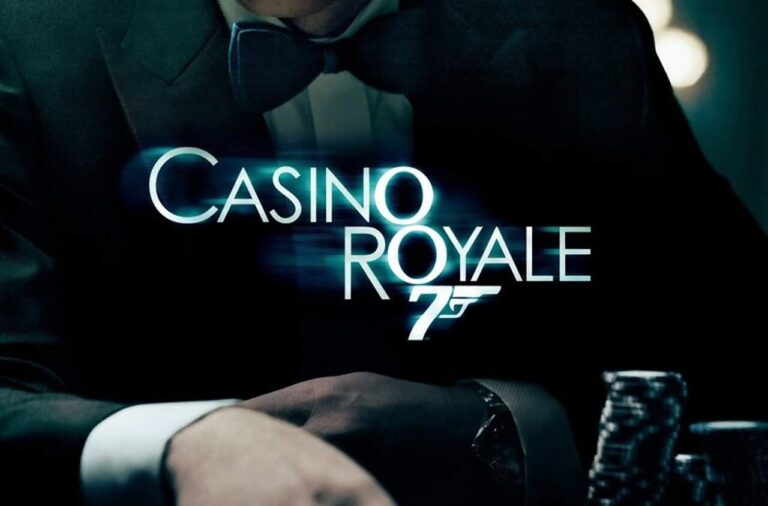
With 2006’s Casino Royale now 20, we look back at one of the more tantalising 007 ‘what if’s?’ Brosnan in Ian Fleming’s first novel, with a very distinctive director… It is hard to fathom that Casino Royale, the James Bond film that saw 007 roar back to cultural and critical relevance in 2006, is now ... Pierce Brosnan as James Bond 007 in… Casino Royale | looking back at a 007 ‘what if?’
With 2006’s Casino Royale now 20, we look back at one of the more tantalising 007 ‘what if’s?’ Brosnan in Ian Fleming’s first novel, with a very distinctive director…
It is hard to fathom that Casino Royale, the James Bond film that saw 007 roar back to cultural and critical relevance in 2006, is now 20 years old.
Daniel Craig, as of writing, is still technically James Bond despite having officially appeared for the last time five years ago. Such is the chasm of time that now exists between Bond projects. Craig’s celebrated tenure, on that technicality, a princely 21 years since he was announced as 007 until we reputedly learn of his replacement later this year, will likely never be beaten.
In the early 2000s, however, audiences might well have imagined that his predecessor would have at least reached a decade in the role, and maybe even tried to match Roger Moore’s then record 13 years as 007. Pierce Brosnan was as 2003 beckoned cemented as Bond for a new generation. Four films in, his last effort, 2002’s exuberant Die Another Day, had once again done extremely well at the box office and seemed to assure Brosnan was locked in for a fifth Bond adventure.
Now on a film-by-film contract basis, Brosnan was even initially assured as much by Barbara Broccoli and Michael G. Wilson, the Bond scions at Eon Productions.
During the Brosnan tenure, as audiences were dazzled by his fun adventures, one of many behind the scenes wranglings over 007 rights had been going on. The biggest had always been the running Eon attempts to stop roguish producer Kevin McClory repeatedly trying to end run its series and remake Thunderball, which he had done in 1983 with Never Say Never Again. He was able to do so due to a complex legal ruling from the 1960s after original Bond author Ian Fleming played a bit fast and loose with emerging copyright law while writing Thunderball the novel. It’s a whole other fascinating story.
One other book that had ran into cinematic complications was Fleming’s first, the aforementioned Casino Royale, which original Bond producers Cubby Broccoli and Harry Saltzman initially sought to adapt as their first production on buying the rights to most of Fleming’s series in 1960.
Only problem was that this deal did not include Casino Royale, which ultimately ended up in the preserve of a classic old Hollywood movie producer by the name of Charles K. Feldman. He ended up heaving together an abomination of an adaptation in a 1967 psychedelic comedy take. One with an incredible cast, but also multiple directors and an array of jarring visual and narrative tones.
There had even been a black and white, 1954 TV adaptation for a show called Climax! starring Barry Nelson (best known as the manager of the Overlook hotel in The Shining much later) as ‘Jimmy Bond’, but this Americanisation of the character soon became lost in the annals of TV history.
In short, nobody had done Casino Royale justice on screen until 2006, the rights still tied up and away from Eon Productions. Until 1999, that is, when movie producing honcho John Calley decided to trade them with Sony for the rights to Marvel’s Spider-Man. It returned the rights to Fleming’s first work, moving it ‘in house’ for the first time ever.
You can debate the logic of this. It worked out fiscally for Sony, who bet the house on Spider-Man in the 2000s with Sam Raimi and very much won, helping set the scene for superhero cinematic dominance in the subsequent decade. Creatively, however, it sundered a James Bond product that ended up being very special, tethered closely as it was to the formative aspects of Fleming’s spy. Hence why following Die Another Day, rumblings began that Casino Royale would be the next adapted work and Pierce Brosnan would be the man facing off against Le Chiffre and romancing Vesper Lynd.
Brosnan was still the 007 in the cultural consciousness of audiences in the early 2000s. Electronic Arts released still one of the most celebrated James Bond video games in 2004, Everything Or Nothing, featuring Brosnan’s Bond voiced by the actor, with regulars such as Judi Dench, John Cleese and even Richard Kiel (returning after decades as Jaws) involved, plus talented contributors such as Willem Dafoe and, uh, Heidi Klum.
To many, this was the unfilmed, original fifth Brosnan adventure. Nobody would have imagined he could be replaced after almost a decade now in the role. Especially the director who voiced interest in adapting Casino Royale, one Quentin Tarantino…
He told the BBC: “I’ve always wanted to do it. I bumped into Pierce Brosnan and we talked about it. He liked the idea … I would like to do the original book Casino Royale and do it more or less the way the Ian Fleming book is.”
It’s worth remembering that Tarantino was in his pomp at this point. He was riding the success of Pulp Fiction and Kill Bill, the latter of which was his first truly sizeable global hit financially as well as breaking through popular culture. Tarantino didn’t need Bond at all. As a lover of 1960s and 1970s pulp cinema and exploitation, the early 007 movies arguably were artefacts of his coming of age years, hence the nostalgia he felt for the franchise (he flirted with making a Star Trek movie around a decade or so later for similar reasons).
Tarantino’s take, by all accounts, would have been radically different for the Bond series. He would have returned the spy to the 1960s where he made his cinematic name, stripping the series of any kind of financial exorbitance by making a thriller with a much lower budget and predominantly black and white sequences.
He also suggested his muse Uma Thurman could play Vesper opposite Brosnan’s elder 007.
Brosnan claims, after discussing it (over Martini, of course) with Tarantino, he took the idea to Broccoli and Wilson, who very quickly shot it down. He was, at this stage, still in the running for a fifth film, which he told the New York Times he was offered: “And I said I would. But then in the middle of negotiations, they changed their minds. They never offered a sound reason. I was shocked. They said they wanted to go in a new direction.”
Broccoli later explained the rationale as the script for Casino Royale took shape: “Because it was Bond’s first mission, it couldn’t be someone who had played the role before. So, I mean, that was the kind of difficult part to it, because it meant that we had to make a change. We did discuss it with Pierce, and he was very gracious about it, and he’s a great guy.”
That, ultimately, was that.
Daniel Craig was soon cast, beating out numerous younger rivals, and Brosnan’s tenure was officially no more. Despite being stung at losing the mantle, Brosnan clearly never fell out with Eon and the Broccoli dynasty, often over the years has since been happy to engage with his history with Bond and the role, conscious it will be the first thing on his epitaph.
There is also little doubt among Bond fans that while he may not go down in the pantheon of top tier 007s, as Sean Connery and arguably Craig now are, he was tremendous even when the films around him were not.
We are left to tantalisingly wonder what Pierce Brosnan as James Bond 007 in… Casino Royale would have been like. Tooled around an elder Bond, maybe even one at the end of his career, in his smallest scale but perhaps emotionally most powerful story yet, in one of the most iconic Bond settings. Martin Campbell’s 2006 film was a towering triumph for the series, but Tarantino’s Brosnan-starring version will always remain one of the great 007 ‘what if’s?’ Maybe they could have even done it better.
For more on Casino Royale at 20 years old, check out a six-part series on Film Stories Podcast Network show The Bond Corner, starting with the origin of the novel:
You can find A J. on social media, including links to his podcasts and books, via Linktr.ee here.