Preston Sturges’ Sullivan’s Travels is a comedy with a heartfelt moral core – as summed up in its use of three very different cinema screens. Written and directed by Preston Sturges, the 1941 comedy Sullivan’s Travels was a major influence on the Coen Brothers – you can see its combination of slapstick and intelligence in ... Sullivan’s Travels | A story told on three cinema screens
Preston Sturges’ Sullivan’s Travels is a comedy with a heartfelt moral core – as summed up in its use of three very different cinema screens.
Written and directed by Preston Sturges, the 1941 comedy Sullivan’s Travels was a major influence on the Coen Brothers – you can see its combination of slapstick and intelligence in many of their films, most obviously Barton Fink and O Brother, Where Art Thou?.
What makes Sullivan’s Travels particularly Coen-esque is that, although it presents itself as a broad comedy – and a rebuke to the notion that broad comedy is a lesser artform – also contains some beautifully considered social commentary. Sturges’s film both mocks the vanity of its central character, Hollywood director John L Sullivan, while at the same time achieving something he ultimately doesn’t. Sturges makes a film that depicts poverty with respect and kindness.
When we first meet Sullivan (Joel McCrea), he’s a successful mainstream movie-maker who’s become dissatisfied with the shallowness of his hit comedies, which have titles like Ants In Your Pants and Hey, Hey In The Hayloft. He therefore sets himself the goal of making a film about ‘the common man’ – and settles on adapting a gritty novel called O Brother, Where Art Thou? (we told you it was an influence on the Coens).
Less than enamoured with the idea of a successful comedy director turning to something worthy and almost certainly less lucrative, Sullivan’s studio bosses try to talk him out of it. Sullivan’s a privately-educated, middle-class guy, they reason. What does he know about poverty?
Unexpectedly, Sullivan agrees: he’s lived too comfortably to honestly adapt the novel. So he has a costume designer fit him out in a stereotypical poor person’s get-up (threadbare trousers, shoes with split toes and so forth) and sets off on an ill-fated attempt to understand what it’s like to be truly penniless.
Ingeniously, Sturges tells the story of Sullivan’s progress by showing us three cinema screens – each one underlining something important about his character and how he develops.
Screen one
The first screen can be seen right after the opening credits. It’s a private cinema located in the plush offices of a Hollywood studio. Sullivan has just screened a sequence from a recent movie – a jarringly violent set-piece in which a criminal and a railway worker fight on top of a moving train. The criminal is shot multiple times by the railway worker, and the pair, still grappling with each other, fall from the top of the carriage and into a river.
“You see?” Sullivan raves to his bosses as the lights go up. “You see the symbolism of it? Capital and labour destroy each other! It teaches a moral lesson! It has social significance!”
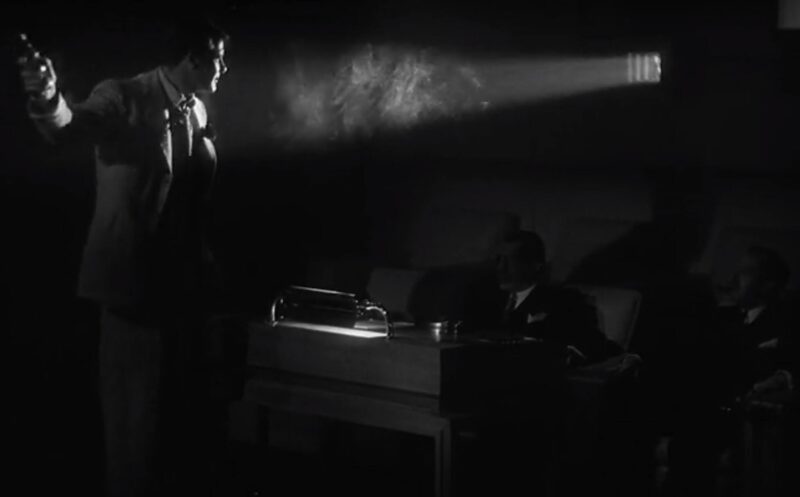
Here we get to see Sullivan in his natural setting – successful, privileged, and influential enough that he can at least get two studio executives to listen to his ideas. But as one of his butlers points out a few scenes later, Sullivan is also painfully naive in his desire to “find out what it’s like to be poor and needy.”
“Only the morbid rich would find the topic glamorous,” the butler says, gravely.
Sullivan bullishly embarks on his mission anyway, leaving Hollywood in his fake poor person’s clothing – pursued in a bus occupied by an absurdly huge retinue that includes assorted doctors, lawyers, reporters, cooks and other hangers-on.
Eventually, Sullivan ends up staying at the house of a middle-class widow in the countryside. She immediately takes to Sullivan, as underlined by a scene in which she observes him bare-chested, chopping wood outside her window. The widow then takes Sullivan on an awkward sort-of date with her sister.
It’s here that Preston introduces his second cinema screen.
Screen two
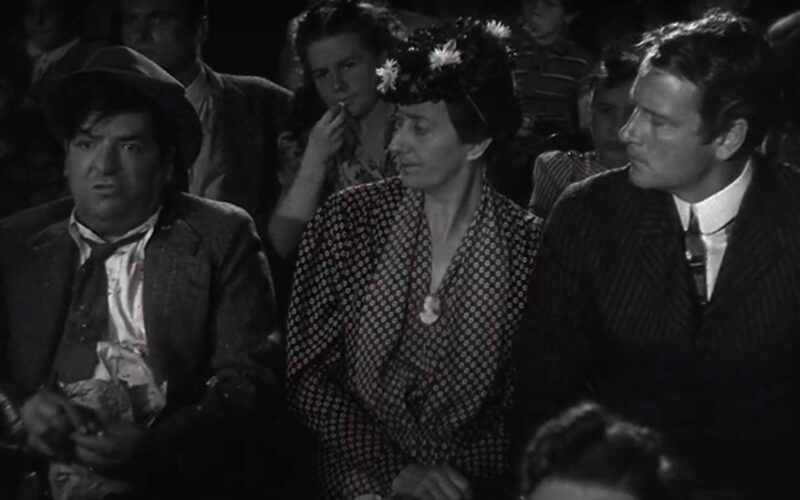
Sandwiched between the two middle-aged women, Sullivan looks around at the packed seats all around him with distaste. A greasy chap sitting nearby, hiccupping between mouthfuls of peanuts. Somewhere off-screen, a baby cries incessantly. What he’s experiencing isn’t even grinding poverty – it’s simply an ordinary cinema you’d find in smalltown America, packed with working class people of all ages.
Sullivan may claim to care about “the average man” and “modern conditions,” but this sequence suggests that his sympathy only runs skin-deep.
In this regard, Sullivan is essentially a poverty tourist – play-acting the role of a homeless person while still being able to fall back on his wealth and privilege. When he meets and falls for a struggling young actor (Veronica Lake, billed simply as The Girl), Sullivan immediately rushes off to retrieve his expensive convertible so he can give her a lift.
Sullivan also has identity cards sewn into the soles of his shoes, which serve as a kind of panic button he can press whenever the ‘trouble’ becomes too much to bear. The plan ultimately backfires when Sullivan’s cash and shoes are stolen by a homeless man who’s subsequently struck by a train and killed.
Sullivan, who was knocked unconscious and plonked on a train carriage to who knows where, is truly cut off for the first time. His colleagues assume he’s dead when his shoes are found on the remains of the deceased thief. Woozily getting into a fight with a railway security worker (echoing the opening movie-within-a-movie), Sullivan is arrested, sentenced to six years’ hard labour, and ends up working in a chain gang.
Performing manual labour for days on end, sleeping in a cold barracks cheek-by-jowel with his fellow prisoners, Sullivan finally experiences the life he’d previously fantasised about.
It’s here, right in the middle of the last act, that Sturges brings in his third and most important cinema screen.
Screen three
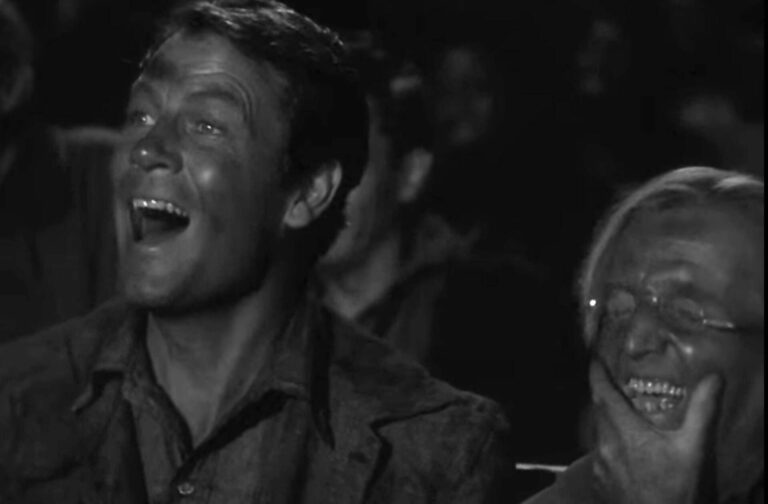
In a small, evangelical church, a preacher (Jess Lee Brooks) asks his largely African American congregation to prepare a makeshift screening room. A sheet is pinned up in front of the pulpit. The oil lamps are turned down; a rattling projector fires up. The first few pews are cleared to allow space for some visitors – the chain gang, who shuffle dejectedly into the church.
Sullivan sits among them, surrounded by dirty, lined faces and mouths missing teeth.
On the screen, a Walt Disney animation plays: Playful Pluto, in which the titular canine goofs around and gets his ear stuck to a piece of flypaper. Sturges captures the audience’s reaction: unabashed, childlike laughter. Amid a life of grinding harshness, they find a moment’s joy. Sullivan, his own face covered in dirt, can’t help but be swept up in it.
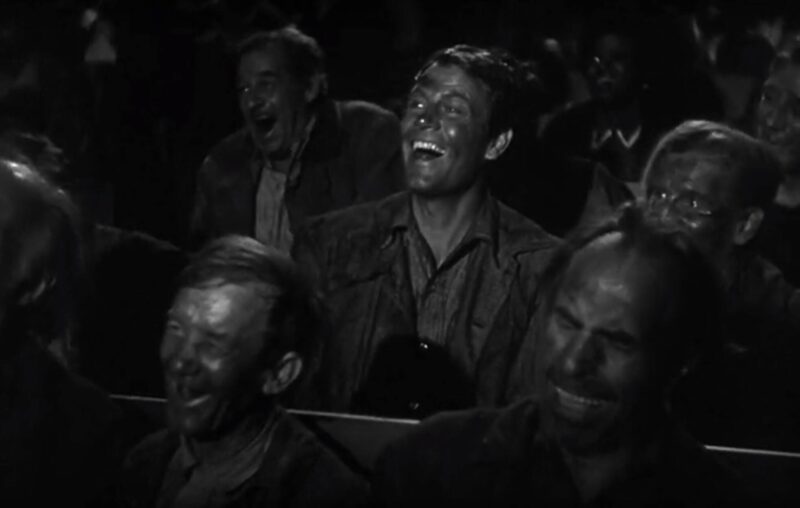
It’s a scene filled with disarming empathy. A congregation who have almost nothing still finds it within themselves to share a little warmth and respite.
Sullivan is later able to find his way back to Hollywood and his old, comfortable way of life. But his experience in the chain gang, and most importantly the church cinema, has changed him. He decides not to adapt O Brother Where Art Thou, but decides instead to continue making comedies.
“Did you know that’s all some people have?” he says. “lt isn’t much, but it’s better than nothing in this cockeyed caravan.”
Sturges, however, wilfully complicates the purported meaning of his own movie. On the face of it, the point he tries to make is that comedies have more cultural value than po-faced dramas with sincere messages. But look again at the opening scene.
Sullivan says he wants to make a “true canvas of the suffering of humanity.” An executive, in an oft-quoted line, advises, “But with a little sex in it.”
The director then argues that movies shouldn’t pander to the public; if they did, he says, “We’d still be making Keystone chases, bathing beauties, custard pie operas.”
Sullivan’s Travels, however, contains all these things. There’s a madcap chase sequence. A moment where the cook gets the slapstick equivalent of a pie in the face. Veronica Lake’s The Girl even gets a poolside scene where she’s shown loosely wrapped in a towel.
Sturges, to quote another bit of rapid-fire dialogue from the opening, manages to make a film that contains both “tramps, lockouts… people living in piano boxes” and “nice, clean young people who fall in love.”
The point being that a film can be both silly and weighty, lightweight and important. Long since hailed as a classic, and rightfully a favourite of the Coens, Sullivan’s Travels is a rare example of a comedy that has social significance… but with a little sex in it.