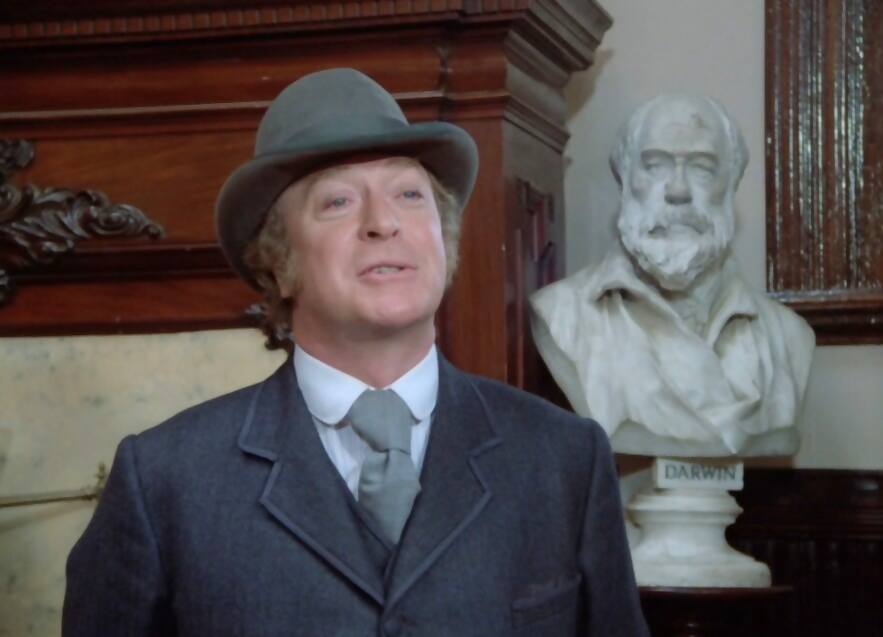
Michael Caine took a rare jaunt into TV for 1988’s Jack The Ripper. A look back at a lavish, entertaining period drama: Michael Caine showed no sign of slowing down as he entered his third decade as a leading man. The 1980s would see him win his first Academy Award (Hannah And Her Sisters), tackle ... The 1980s films of Michael Caine: Jack the Ripper (1988)
Michael Caine took a rare jaunt into TV for 1988’s Jack The Ripper. A look back at a lavish, entertaining period drama:
Michael Caine showed no sign of slowing down as he entered his third decade as a leading man. The 1980s would see him win his first Academy Award (Hannah And Her Sisters), tackle new genres such as horror (The Hand) and shark-based revenge movie (Jaws: The Revenge) whilst continuing to work with interesting new auteurs like Brian De Palma (Dressed To Kill) as well as old friends from classic Hollywood such as John Huston (Escape To Victory).
Film by film, I’ll be taking a look at Caine’s 1980s filmography to see what hidden gems I can unearth alongside the more familiar classics…
NB: Spoilers for Jack The Ripper ahead…
Directed by: David Wickes (Sweeney!, Silver Dream Racer, Jekyll And Hyde)
Tagline: The hunt is on for the world’s most infamous diabolical murderer.
Other Featured Geezers: Lewis Collins as Sergeant George Godley, Armand Assante as Richard Mansfield, Ray McAnally as Sir William Gull, Ken Bones as Robert James Lees, Susan George as Catherine Eddowes, Jane Seymour as Emma Prentiss, Lysette Anthony as Mary Jane Kelly.
What’s it all about, Alfie?: A two-part television miniseries, a big budget UK/US co-production that, 100 years after the crimes, purported to finally solve the Whitechapel murders of 1888.
Inspired by real historical figures, albeit taking many factual liberties, the series focuses on the Metropolitan Policeman, Chief Inspector Frederick Abberline (Michael Caine), placed in charge of the Ripper investigation alongside his stalwart partner Sergeant George Godley (Lewis Collins).
As the grisly murders escalate, potential suspects increase. Could the killer be the cocky two-faced American actor Richard Mansfield (Armand Assante)? John Netley (George Sweeney), the working-class coach driver who boasts of surgical knowledge? The violent Marxist agitator George Lusk (Michael Gothard)? Or is this a conspiracy that goes higher? The Queen’s spooky psychic medium, Robert James Lees (Ken Bones), and her affable personal physician, Sir William Guy (Ray McAnally), are also not above suspicion.
In the midst of this, Abberline finds time for a spot of light, not historically accurate flirting with beautiful newspaper illustrator Emma Prentiss (Jane Seymour) before the shocking – and discredited by experts – conclusion.
Caine-ness: This was Caine’s return to television drama for the first time since the 1969 episode of ITV Sunday Theatre, titled Cornelius, that was later edited together with two other Alun Owen scripted episodes into the anthology movie Male Of The Species.
At a time when TV work was mostly less prestigious than today, and Caine was still headlining Hollywood movies, this was a big deal, and thus he was rewarded for taking on this role in Jack The Ripper with his own showy opening title card: “Michael Caine in…” (and a hefty pay cheque).
It was a notable televisual event, with the big selling points being the heavily marketed tease that it was going to uncover new Ripper revelations (it ultimately didn’t) and the fact that it starred Caine (which, thankfully, it did).
In his autobiography, What’s it all About?, Caine writes, “It was a mini-series with an American television company attached to the deal, so I received the same fee as I would have for making a film. Television had come a long way from when I used to work for the BBC and get paid in guineas.”
Jack The Ripper was a success with audiences and critics on both sides of the pond. Caine recalls: “in Britain it got the highest viewing figures on television except for the wedding of Prince Charles and Lady Diana. It also knocked one of our soap operas out of the number one spot in the ratings for the first time in over 20 years.”
It also deservedly won Caine a Golden Globe for Best Performance in a Miniseries or Television Film, in a year in which he was up against Richard Chamberlain for playing a pre-Matt Damon Jason Bourne.
Even though it’s titled Jack The Ripper, Frederick Abberline would be a more apt title, as he’s the focus – and Caine is wonderful in the role. We first hear about Abberline, and get an idea of his reputation, before we see him. A reporter tells his boss, “they’re putting Abberline on the case”, instantly grabs the boss’s attention because “Abberline’s the best detective they’ve got”.
Although it would initially seem otherwise, as we then cut to a police station where George Godley (Lewis Collins) is looking for Abberline and finds him passed out in a drunken stupor in an open police cell. This is the first time that we see Caine, five minutes in, looking very dishevelled.
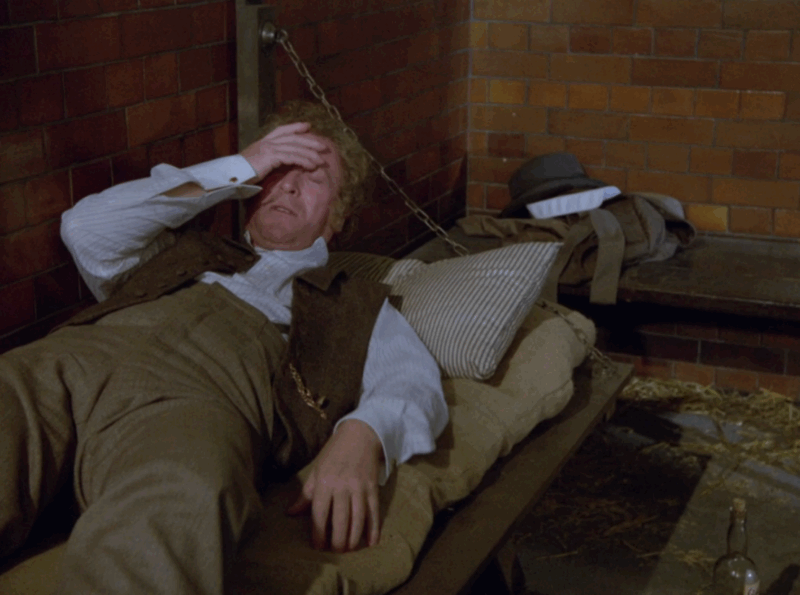
It should be noted that the real Abberline was not known to be an alcoholic, but this fictitious backstory does give Caine juicy dramatic material to work with as Abberline grapples with his demons whilst trying to catch an elusive killer. He often comes close to succumbing but mostly resists. “No, you bastards, it’s not going to be that easy!” is one line that he gets to deliver in signature Caine fashion.
Caine is playing up the working-class Cockney everyman element of his persona as Abberline. We hear how he worked his way up the ranks through hard work rather than connections. “I like Whitechapel,” he says.
“Good, because one day they’re going to send you back here permanently,” Godley retorts.
Abberline is a no-nonsense, mostly unruffled, copper. When an unsubtle pickpocket tries to take his watch as he disembarks a carriage, he firmly but calmly says, “Put it back, would ya,” without even glancing at the urchin.
“I only wanted to see what time it was,” the ruffian pleads.
“Half past four,” Abberline flatly responds.
Caine gets to demonstrate his full acting repertoire. There’s shouty Caine and there’s barely contained simmering anger Caine after finding the mutilated body of Mary Jane Kelly: “When we catch whoever did that George, I’m gonna kill him!”
There’s scary, aggressive Caine when Abberline, at the end of his tether, manhandles the distressed coachman suspected of being the Ripper’s accomplice.
There’s emotional and tired – yet still angry – Caine at the climax, when he realises that they’re being forced into a coverup. In response to Godley’s outraged reaction that he expected “straightforward bloody justice”, Abberline bitterly responds, “Then you should have let me shoot him, shouldn’t you? Shouldn’t you?”
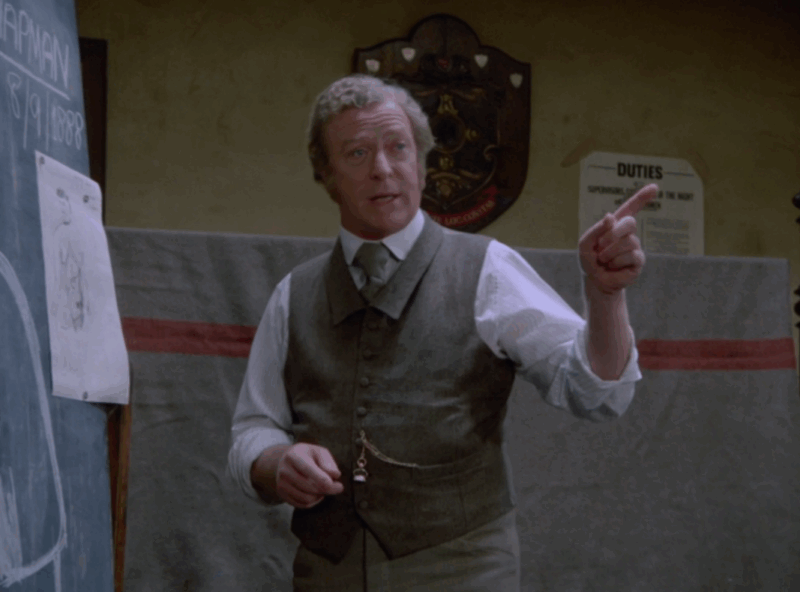
There’s plenty of light humour to the role, too. When an apron’s found near the body of one victim, the police round up various people who happen to wear aprons in their line of work. Hoping to find out whether one of these suspects is the killer, Abberline tests their anatomical knowledge by asking them to point to where their liver is located.
“No, that’s only in Bavaria,” he says to an anatomically ill-informed German butcher.
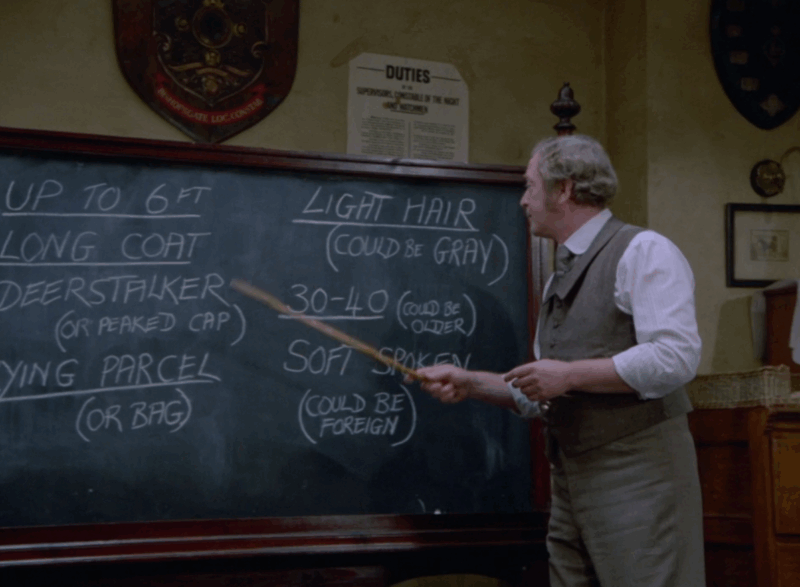
The only misstep in Caine’s performance, where it tips over into cheese, is the scene where, in a close up, he shouts at a blackboard drawing of the killer; “Who are you, you bastard?”, accompanied by a dramatic music sting and a fade to black, where presumably, back in the day, you would have then been treated to an advert for Findus Crispy Pancakes.
In his autobiography, Caine looked back fondly on making it. “The show was shot in London and was great fun to make, even if the schedule was a little brisk for someone used to working at the leisurely pace of feature films, but I never liked hanging about at work anyway, so it suited me.”
Jane Seymour, in a 2017 interview with AV Club, corroborated Caine’s speedy process. “I had been warned that Michael is tough on actors and actresses unless they know their lines and are very professional, which mostly I was,” she said. “But they didn’t tell me that he literally liked to do one take and then go and have lunch with his wife.”
Caine-nections*: Barry Foster was originally cast as Abberline, and had even started filming, but was replaced by Caine when the production suddenly got more funding from CBS and could afford a bigger star. Their paths had previously crossed when Foster took the role of the killer in Frenzy (1972) that Caine had been offered and turned down. Foster also appeared alongside Caine onscreen as an old friend in The Whistle Blower (1986).
Ray McAnally was also in The Fourth Protocol (1987).
Harry Andrews was in Too Late The Hero (1970), Battle Of Britain (1969) and Play Dirty (1969).
Susan George played Caine’s daughter in The Jigsaw Man (1983) and was “Russian Girl on Train” in Billion Dollar Brain (1967).
John Cameron was the composer and conductor on this and on The Jigsaw Man.
Michael Gothard was in The Last Valley (1971).
*I’m only counting from Caine’s first starring role in Zulu up to this
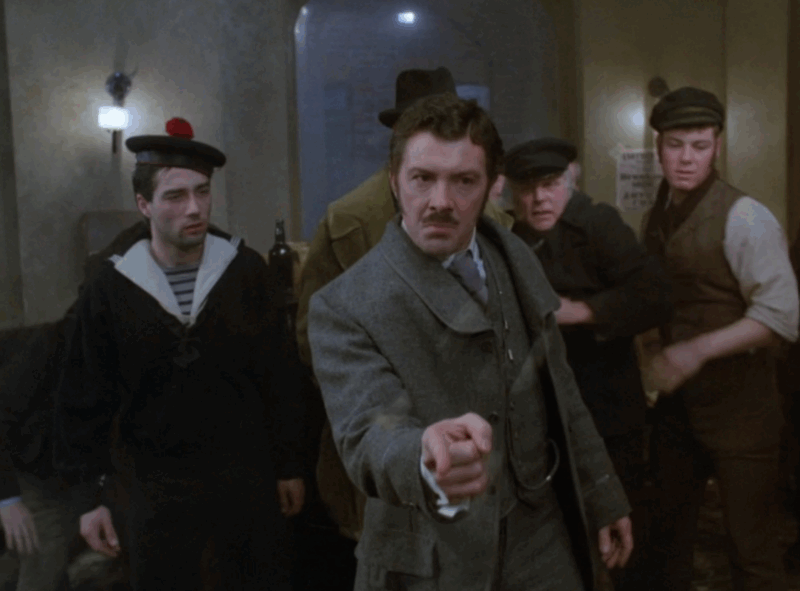
Best Non-Caine Actor: Lewis Collins is fantastic as George Godley, and has excellent chemistry with Caine’s Abberline. Godley starts out prickly towards Abberline, but it becomes clear that it’s simply because he’s disappointed to see a man he respects, and has been working closely with for four years, lose his talents to drink.
Once Abberline sobers up, there’s much more warmth and camaraderie between the two. Godley keeps him in check, which Abberline seems to appreciate. And Godley in turn doesn’t seem to mind Abberline manhandling him while re-creating crime scenes.
When Abberline briefly succumbs to drink again, he justifies it by saying it “relaxes the throat”.
“Last time it relaxed your brain,” Godley reminds him. “Cheer up George, we’re winning.”
“Is that a promise?”
“Yes, my old friend,” Abberline says, putting the booze down.
I found these gentle bantering moments between the two endearing. Caine and Collins pitch them just right.
Collins gets to deploy his Professionals action man credentials when Godley is dispatched to interview some sex workers and unintentionally kicks off a bar brawl with a pimp, ending with the whole bar, including the barman and his protective mallet, getting involved.
Godley, bloodied and knackered, finally manages to throw the pimp outside and apprehend him as Abberline saunters up behind him.
“How long have you been there?” an annoyed Godley asks.
“I looked in but you seemed to be doing alright,” is Abberline’s laconic response.
There’s some excellent distressed acting from a teary-eyed Collins, looking sick to the stomach, when they find the final victim. And the multifaceted Collins can also do comedy, as demonstrated in the scene in William Gull’s office.
When they arrive, Gull’s son-in-law says; “would you care for some milk?” This is an odd offer; immediately it would make him my prime suspect, but what’s even odder is that Godley says yes. He’s then presented with a massive glass beaker of milk, which he bemusedly holds.
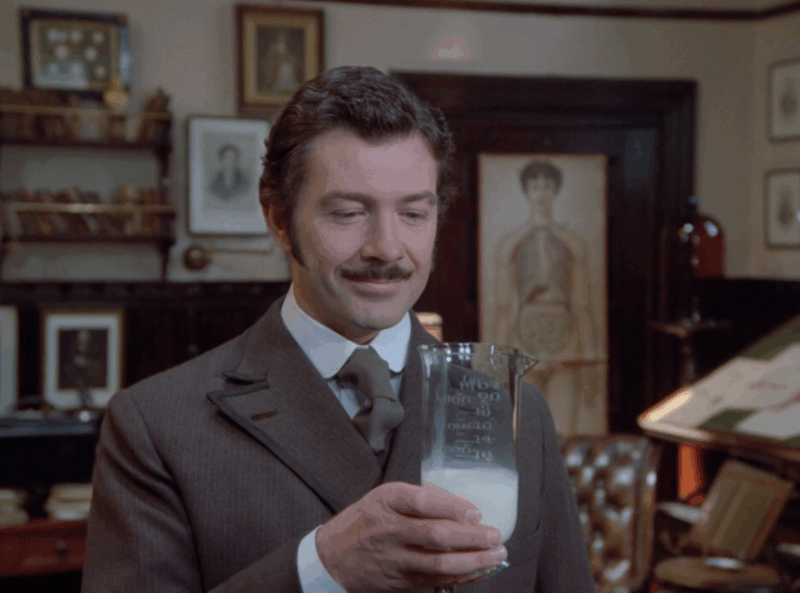
Having had his fill of milk, Godley proceeds to interview Gull about his theories on madness, and it cuts to Godley trying to take notes but finally having to give up with a resigned look after an onslaught of relentless medical jargon.
Sadly, this was Collins’ last acting role of note – barring one episode of The Bill before he passed away in 2013. He has just seven credits on IMDb after Jack The Ripper, one of which is as Colonel Mustard in the Richard Madeley-hosted gameshow, Cluedo. It’s an unfair coda to an actor who could have been James Bond if Cubby Broccoli hadn’t found his audition “too aggressive.”
Gary Kemp did tweet “RIP Lewis Collins. You were supercool” after he died, so there’s that cold comfort I suppose.
Armand Assante, often typecast as gangsters and/or relatives of Sylvester Stallone, gets something different to do with the role of Richard Mansfield, the intense American thespian (who in real life was English but lived part of his life in America) starring in a controversial West End production of Jekyll And Hyde during the Ripper murders. There’s an impressively unnerving transformation scene at the theatre, with Assante and his pulsating forehead, that understandably disturbs the audience.
Jane Seymour is wasted in the underwritten role of Emma Prentiss, the newspaper illustrator and Abberline’s old flame. Her character is cynically shoehorned in to give Abberline (who was a happily married family man in real life) a half-arsed love triangle with Mansfield as his rival suitor. Seymour isn’t bad, she looks great in Victorian attire and does some nice drawings, but her scenes feel the most out of place and unnecessary filler.
Rounding out the cast is Hugh Fraser (whom you may recognise as Poirot’s mate Hastings) playing Sir Charles Warren as an upstanding man trying to do the right thing in difficult circumstances. Ken Bones plays the intense psychic Robert James Lees, who calms down after receiving distressing visions by stroking a cat.
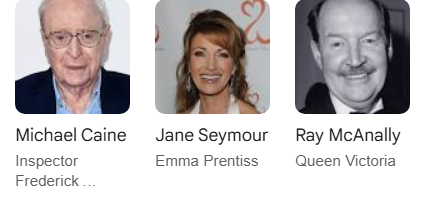
Ray McAnally is great as the seemingly avuncular doctor, Sir William Gull. Although, according to trusty old Google, McAnally actually played Queen Victoria in this, which is the bigger twist. Google may be spouting inaccuracies about his performance, but at least his default picture is more flattering than Caine’s:
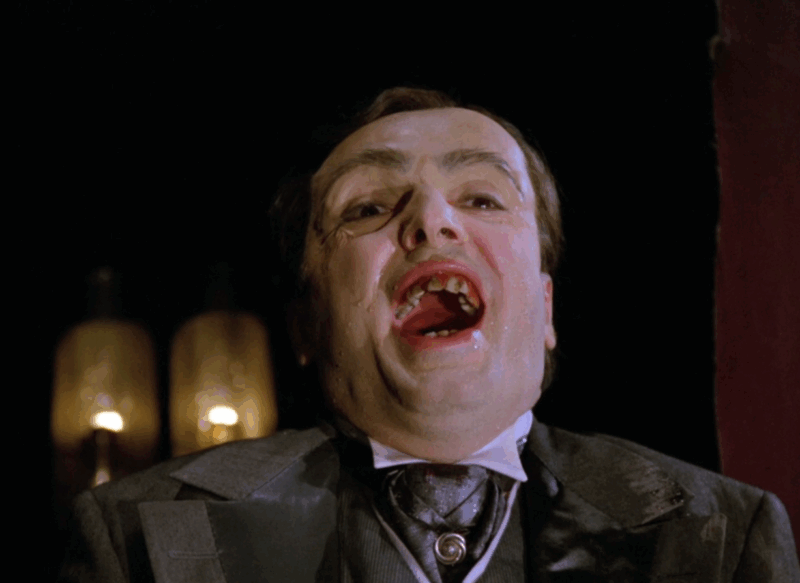
My favourite character, however, is the small role of Rodman (Roger Ashton-Griffiths), a grotesque doorman outside a brothel. Blind, with rotting teeth, and calling everyone a “bleeder”, he’s a character straight out of The League Of Gentlemen.
Award for lumpiest head goes to Armand Assante pictured here being told that he’s won;
My Bleedin’ Thoughts: Jack The Ripper is an odd but entertaining mix of serious crime drama and pure melodrama. It opens with a sombre voiceover reading out scrolling text over a Victorian night-time street: “For 100 years the murders in Whitechapel committed by Jack the Ripper have baffled the world. What you are about to see is a dramatisation of those events…”
I struggled to take this seriously though because it reminded me of the opening of the Two Ronnie’s Phantom Raspberry Blower sketches.
For all the talk of the production revealing new information, the ending wasn’t a revelation by any stretch. The same theory, now discredited by most experts, had previously been floated in 1979’s Murder By Decree, and was taken from Stephen Knight’s book Jack the Ripper: The Final Solution published in 1976.
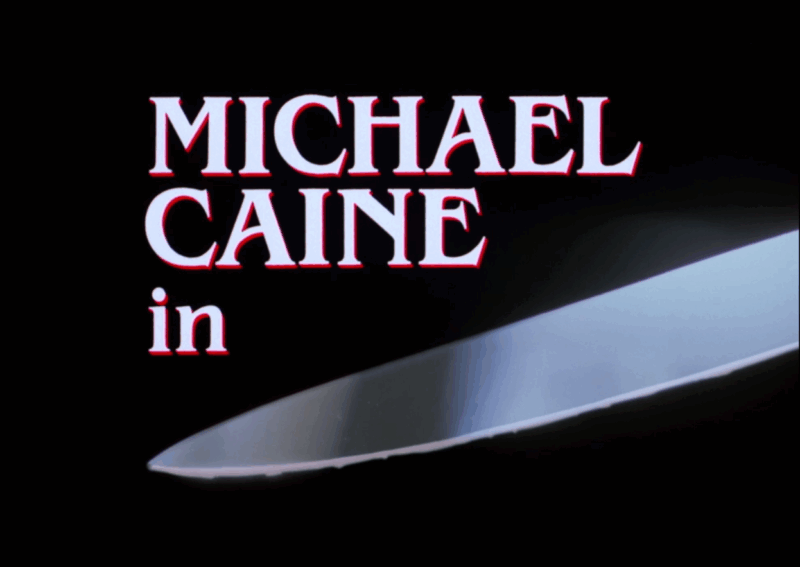
The opening title sequence, which consists of lots of close ups of knife slashes, lets us know that it’s actually not that classy, as does the schlocky ending of part one which climaxes with a shocking murder. A woman is hauled inside a black coach before blood drips down toward the camera as the words “To Be Continued” appear.
This had a big budget for television at the time, and it shows in the sets, locations and assorted extras. But it still has a definite televisual feel, especially with its 4:3 aspect ratio. The overall look is pedestrian, but Wickes gets some great performances from his cast.
Trivia (courtesy of IMDb): In the DVD commentary, Wickes states that in the scene where Collins attacks McAnally, it was momentarily thought that Collins had killed the latter, who was in a weakened state after recently having undergone a major operation. McAnally sadly did die the year after this miniseries was released, but Collins had an alibi that time.
Four different endings were filmed in order to hide the Ripper’s ‘true’ identity. In the unused endings, George Lusk, Inspector John Spratling, and Prince Albert Victor were revealed as the killer. I personally think they should have filmed one where Rodman was the killer.
Overall Thoughts: Although a little dated, this is an excellent little miniseries, with great central performances from Caine and Collins. It admittedly suffers from this story having been told so often, and in flashier style elsewhere, but it’s still well worth a watch.
Rating: 4/5 Massive Glass Beakers of Milk
Where You Can Watch This: At the time of writing this is available to stream for free on ITV X or to rent or buy digitally on Prime Video. For physical media fans there’s also a DVD and Blu-ray.
Up Next: Caine’s still hanging about 19th century London and doing a spot of sleuthing, this time alongside Sir Ben Kingsley. It’s the charming Sherlock Holmes comedy, Without A Clue.