Michael Caine was on form as a hapless Holmes in 1988’s Without A Clue. We take a look back… Michael Caine showed no sign of slowing down as he entered his third decade as a leading man. The 1980s would see him win his first Academy Award (Hannah And Her Sisters), tackle new genres such ... The 1980s films of Michael Caine: Without A Clue (1988)
Michael Caine was on form as a hapless Holmes in 1988’s Without A Clue. We take a look back…
Michael Caine showed no sign of slowing down as he entered his third decade as a leading man. The 1980s would see him win his first Academy Award (Hannah And Her Sisters), tackle new genres such as horror (The Hand) and shark-based revenge movie (Jaws: The Revenge) whilst continuing to work with interesting new auteurs like Brian De Palma (Dressed To Kill) as well as old friends from classic Hollywood such as John Huston (Escape To Victory).
Film by film, I’ll be taking a look at Caine’s 1980s filmography to see what hidden gems I can unearth alongside the more familiar classics…
NB: Spoilers for Without A Clue ahead.
Directed by: Thom Eberhardt (Night Of The Comet, The Night Before, Captain Ron)
Tagline: Behind every great detective is one even greater.
Other Featured Geezers: Ben Kingsley as Dr John Watson, Jeffrey Jones as Inspector Lestrade, Lysette Anthony as Fake Leslie Giles, Paul Freeman as Prof Moriarty, Nigel Davenport as Lord Smithwick, Pat Keen as Mrs Hudson, Peter Cook as Norman Greenhough.
What’s it all about, Alfie?: What if Watson, not Sherlock, had the brains?
Genius amateur detective Dr John Watson (Ben Kingsley) has conceived an alter ego called Sherlock Holmes as a way to pursue his sleuthing hobby incognito, thereby not jeopardising his burgeoning medical career with unwanted notoriety.
As his detective work, and the stories that he publishes about it, bring greater fame and a growing clamour from the public to see Holmes in the flesh, Watson finds himself having to hire an actor to portray his creation.
His mistake is hiring washed-up lush Reginald Kincaid (Michael Caine). A gambling, womanising drunkard, who may be convincing to the public as the super-sleuth but in reality is nothing but a dim-witted irritant for Watson.
Watson finally reaches a breaking point at being sidelined while Sherlock/Kincaid gets all the credit and decides to bring their rocky partnership to an end. But first they must work together one last time to foil a criminal scheme orchestrated by Moriarty (Paul Freeman) involving a missing employee of the Royal Mint.
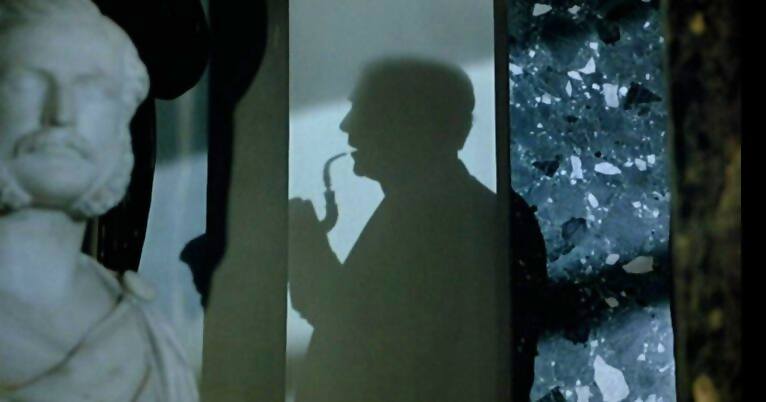
Caine-ness: Caine’s silhouette and voice appear less than a minute in, even before the opening titles, with an iconic outline that not only is immediately identifiable as that of Sherlock Holmes but also as Michael Caine.
Two ne’er-do-wells are attempting to steal a shiny trinket. “Gonna be rich,” one confidently exclaims before we hear: “Not this time gentlemen,” followed by our first proper look at a smirking Caine in his Sherlock guise lighting a pipe.
Caine’s screen persona isn’t a natural fit for the Holmesian archetype, but his casting soon makes sense when we see that this is very much not our usual Sherlock.
As the duo are left alone, a furious Watson bellows, “You idiot!” at Holmes before storming off in a huff.
“Watson, what did I do wrong? I did everything you said!” Holmes plaintively responds, his voice morphing into Caine’s signature cockney accent.
It’s then revealed that Caine isn’t playing Sherlock Holmes. He’s playing Reginald Kincaid, a second-rate actor snatched from the gutter, and it is Kincaid who is playing Sherlock Holmes.
Watson and Kincaid’s double act had been mostly working for them. At crime scenes Kincaid mooched around with a magnifying glass occasionally exclaiming “Aha!” to keep Inspector Lestrade distracted, while Watson got down to the real investigating in peace.
Things get trickier when Kincaid must demonstrate his acumen – such as when a dead body is dragged from a lake in front of him. With onlookers eagerly awaiting his verdict, he prods it with a stick and, after a dramatic pause, declares; “Yes, it is my opinion that he is dead.”
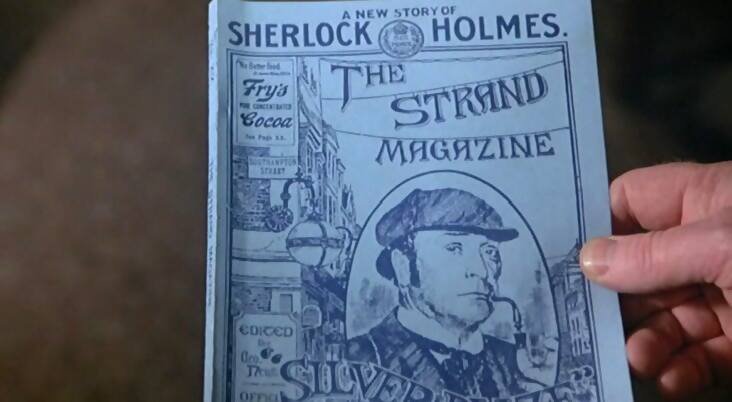
Kincaid has all of Holmes’ typical self-regard and vanity – preening over his picture in The Strand and imploring Watson to include fewer dreary case details and more about him in future stories – but absolutely none of his intellectual aptitude.
He accuses Watson of underestimating his native deductive skills, and to prove this, after hearing footsteps approaching their door, he confidently states that their visitor will be a “woman about five feet five, weighing about twelve and a half stone, age fifty-four” before he opens the door to instead reveal a group of scruffy street urchins.
We are also told by Watson that Kincaid “once declared with total conviction that the late Colonel Howard had been bludgeoned to death with a blunt excrement” which Kincaid blames on Watson’s poor handwriting.
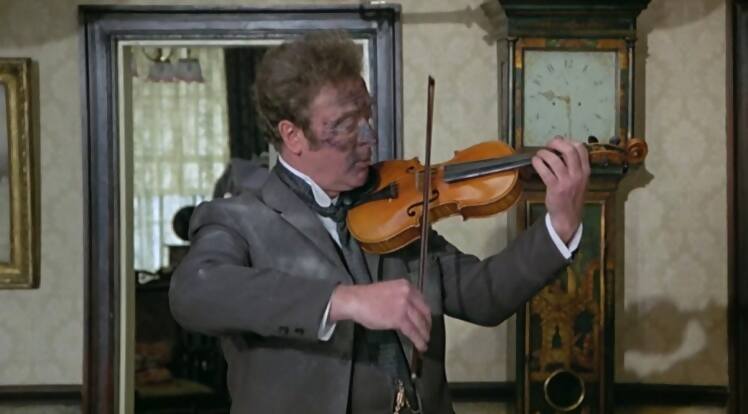
Momentarily it seems Kincaid does contain at least one Holmesian trait when we see him playing the violin. However, he then moves the bow away and the music continues, revealing that he’s been miming along to “Violin Lesson Number 2” on the gramophone.
Rather than classical music, Kincaid’s favourite pastimes are getting drunk and pinching women’s bums.
He’s also a coward, and mortally afraid of Moriarty. He triggers the emergency stop on a train so that he can jump off and hide in a field when he hears that Moriarty is involved in the case they’re investigating. Moriarty isn’t even on the train; Kincaid just feels the innate need to run off.
He does later redeem himself when he tries to rescue Watson from the Thames after it appears he’s been shot. Unable to find him, and thus assuming Watson’s dead, Kincaid endeavours to solve the case himself. He doesn’t have much luck, though, as his main deduction is that the moniker Moriarty is an anagram, and his enemy’s real name is “Arty Morty!” (it isn’t).
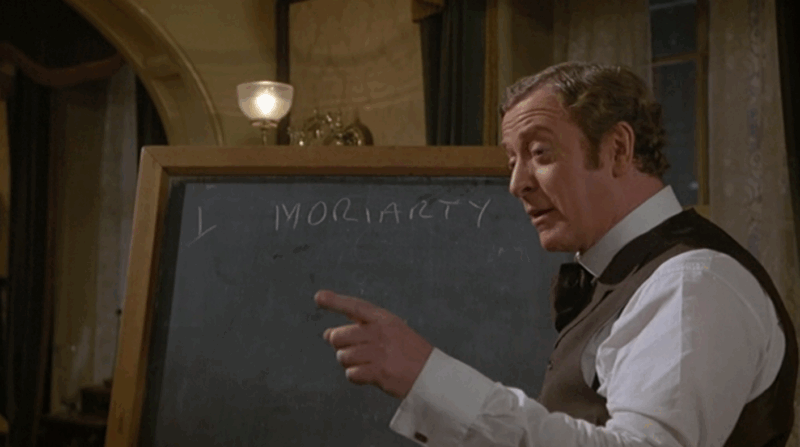
Ultimately, he managed to track down and confront Moriarity in an abandoned theatre, and his fighting skills, and newfound bravery, come in handy for saving the day.
Some of Caine’s most critically acclaimed work has been in comedy drama, such as Alfie, Educating Rita and Hannah And Her Sisters (which admittedly I didn’t like, but Oscar voters did). He’s also had success with caper comedy, The Italian Job, and darkly comic mysteries, Sleuth and Deathtrap, but straightforwardly broad comedies have mostly been his Achilles’ heel so far, with the results ranging from the embarrassing (Blame It On Rio), to the dull (Water) to the confounding (Surrender) – and that’s just in the 1980s.
One of my least favourite films that I’ve covered for this retrospective is Neil Simon’s interminable 1978 California Suite (of which Caine and Maggie Smith are the only watchable parts).
Here, though, Caine’s found the perfect comic project, and from now on mostly seems to be better used in comedies (I will likely take back those words when I get around to watching Bullseye). His next film after Without A Clue, Dirty Rotten Scoundrels (also 1988) is one of my favourites. Going into the 2000s, he continued to have scene-stealing supporting roles in broad comedies such as Goldmember and Miss Congeniality.
Caine is excellent at the deadpan slapstick required here, whether it’s hanging perilously outside a window, being attacked by dogs, or bumbling around a theatre, trying to not make noise – which inevitably sees him falling down a trapdoor and landing on a drumkit.
Caine pitches Kincaid at just the right level of idiocy, and his natural warmth makes what could be a frustrating and unpalatable character into likable, good company. There’s a goofy innocence to his Kincaid that makes him hard to dislike – while also allowing you to sympathise with Watson’s frustration.
Caine-nections*: Nigel Davenport was also in The Last Valley (1971) and Play Dirty (1969).
Peter Cook (who played Sherlock Holmes in a 1978 comedy version of The Hound Of The Baskervilles) was in 1966’s The Wrong Box.
Caine would again appear in an unconventional take on Arthur Conan Doyle’s creation in 2018’s animated curiosity Sherlock Gnomes.
Caine’s TV miniseries Jack The Ripper premiered on American television on the exact same day that this movie was released: 21st October 1988. Both productions also starred Lysette Anthony and George Sweeney, were set in Victorian London, and shot by cinematographer Alun Hume.
*I’m only counting connections from Caine’s first leading role in Zulu onwards
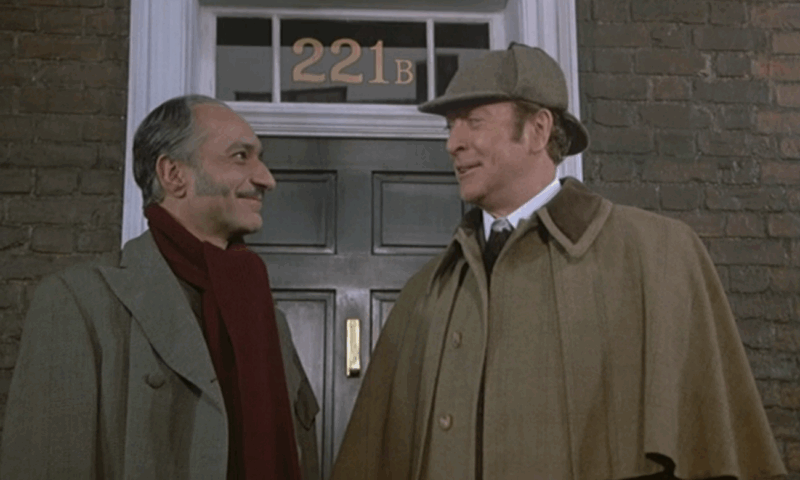
Best Non-Caine Actor: Ben Kingsley as Watson is a fittingly exasperated foil to Caine’s blithe bumbling idiot. They have a great bickering comic chemistry, with Kingsley as the straight man, and they work incredibly well as a double act.
“What are you doing?” Kincaid asks a pensive Watson. “Thinking,” he responds. “Right, I’m going to think too,” A long pause.
“What should we think about, Watson?”
The two also manage to sell the eventual warmth that grows in their relationship as the film progresses, which leads to a sweet ending where Kincaid finally shares the credit, and limelight, with his newly professed “friend” Dr Watson.
Kingsley had followed his breakthrough Academy Award winning role in 1982’s Gandhi with a slew of roles in similarly worthy dramatic fare, with Without A Clue being his first foray into cinematic comedy. Although he’s mostly playing it straight, he demonstrates a light comic touch, and it shows a different side to him as an actor. However, this taste for light comedy may have been the start of the dangerous slippery slope that would lead to him playing Guru Tugginmypudha in Mike Myers 2008 flop The Love Guru.
The female lead of the movie, Lysette Anthony (whose varied credits include Krull, Husbands And Wives and six years in Hollyoaks), doesn’t appear until around 50 minutes in, and she doesn’t get much to do until her villainous heel turn – after which she’s unceremoniously accidentally dispatched by Mrs Hudson (Pat Keen, who also played Mrs Hudson in The Baker Street Boys TV series).
Paul Freeman, who started the decade with an iconic villainous turn in Raiders Of The Lost Ark, fares a little better as a believably sinister Moriarty, and Peter Cook has a fun one-scene cameo as Norman Greenhough, Watson’s publisher at The Strand.
Most Victorian Looking Cast Member: Nigel Davenport is the undisputed winner – just look at those mutton chops!
My Bleedin’ Thoughts: The director, Thom Eberhardt, had an odd career. Starting in schlocky B-Movies, his biggest hit before this was 1984’s comedy horror The Night Of The Comet, and the only film he directed of particular note after Without A Clue was the Martin Short/Kurt Russell family comedy Captain Ron in 1992. He also wrote scripts for the Honey I Shrunk The Kids sequel Honey I Blew Up The Kid and All I Want For Christmas.
This film’s writers, Gary Murphy and Larry Strawther, were most known for their work on American sitcoms. But they were also professed Sherlockians, and the film does feel like a loving tribute to Holmes, even though the closing credits read: “With apologies to the late Sir Arthur Conan Doyle.”
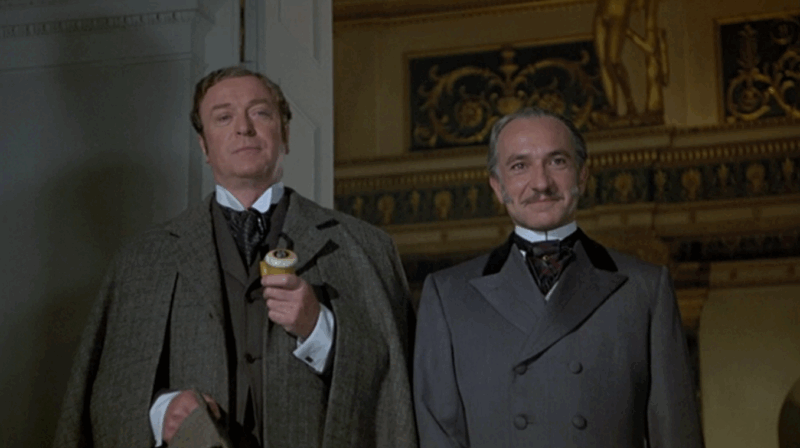
The background to the key creatives may be somewhat lower brow, but the film still manages to have a sophisticated feel, helped by the grand, old time-y, bombastic Henry Mancini score, the pretty Victorian print style opening titles, and some evocative location shooting. You could almost be watching one of the ITV Jeremy Brett Sherlock adaptations.
Overall, it’s a warmly affable and good-natured film, something that’s fun for all, with the only aspects aging poorly are what could be considered a transphobic joke during the film’s climax and the casting of a since revealed sex offender as Lestrade. But for an 1980s comedy to only now have two problematic elements is pretty good going.
So, I have no idea why this film wasn’t well received on its release, apart from at the “Festival du Film Policier de Cognac” at which it won the 1989 Special Jury Prize (but who hasn’t won a prize at the Festival du Film Policier de Cognac, am I right?). Most reviews at the time were sniffy, and it underwhelmed at the box office, but it has since rightly grown in appreciation and nowadays gets more respect.
Trivia (Courtesy of IMDB): This movie was the last major, theatrically-released Sherlock Holmes-related film for 21 years until Guy Ritchie’s Sherlock Holmes in 2009.
Composer Henry Mancini had recently composed the music for another unconventional Sherlock movie, Disney’s The Great Mouse Detective (1986).
Danny DeVito and Sean Connery had both been touted to possibly portray Dr Watson. It would have been nice to have seen Caine re-teamed with his pal Connery, and the thought of a DeVito/Caine partnership is also tantalising – but I’m happy with the combo we ultimately got.
Overall Thoughts: An excellent central comic performance from Caine, with wonderful straight man support from Kingsley, and a fun twist on the classic Sherlock mythology. Great fun!
Rating: 4.5/5 Arty Morty’s
Where You Can Watch This: At the time of writing this is currently available to stream for free on ITV X, but otherwise is unavailable digitally in the UK, but can be purchased on DVD or Blu-ray.
Up Next: Caine ends the 1980s on a high with another fine comic turn alongside Steve Martin in one of my favourite films: Dirty Rotten Scoundrels.