An investigation probe set up by the EU could be the last chance to reverse Google’s web domination – and save smaller websites from oblivion. Let’s play a little game. Think of your favourite cult movie. Preferably an obscure one. Doesn’t matter what it is. Now go to Google and type the name of the ... Film websites, and why we’re running out of time to halt Google’s domination of the web
An investigation probe set up by the EU could be the last chance to reverse Google’s web domination – and save smaller websites from oblivion.
Let’s play a little game. Think of your favourite cult movie. Preferably an obscure one. Doesn’t matter what it is. Now go to Google and type the name of the film into the search bar. Look at the results and see if anything jumps out.
I’m playing along and typing in ‘Megaforce 1982’ (I’ve added in the year of release to help differentiate it from Power Rangers Megaforce, which is a separate thing entirely).
The first things that come up are links to trailers and clips (all on YouTube, owned by Google) and links to IMDb, Rotten Tomatoes, Reddit and Amazon. I have to scroll all the way to the bottom of the page before I get to a link to a site that isn’t owned by some huge corporation – Moriareviews just about sneaks into the first page of results with a Megaforce review.
You’ll probably get similar results for the film you’ve typed into Google search: at every turn, the internet giant’s algorithms have a tendency to favour the biggest websites over smaller outlets. And while some of the results that Google prioritises make sense – IMDb and Rotten Tomatoes are go-to sites for film fans – they’re still telltale signs of just how corporatised the internet has become over the past 25 years.
Google, which has long since dropped its ‘don’t be evil’ corporate motto, is now essentially the foundation of the entire internet. Its Chrome browser has a roughly 70 percent market share (and that’s at the lower end of the estimate). Google’s search engine has a 90 percent market share – its nearest competitor is Bing, with roughly four percent. Google also controls a significant majority of the digital advertising sector through its AdSense and AdX services.
We’ve written before about how entertainment websites like this one are constantly adapting in order to appeal to Google’s search algorithms; websites traditionally rely on ad revenue, and to get that ad revenue, they need a constant flow of traffic, and to get that traffic, they need to rank highly on Google.
We’ve also written about Google’s AI Overviews, and how the tech giant essentially feeds on information researched and written by websites and serves it up on the engine’s front page. Type in ‘RoboCop budget,’ for example, and you’ll get a paragraph of text telling you that the 1987 film cost $13m to make, while the 2014 remake cost about ten times as much. A little link at the foot of the paragraph tells you that the data was scraped from Box Office Mojo and sites like it; a token gesture from Google, given that most users won’t click through to those sites and give them the sliver of ad revenue they need.
Those synthesised results are all part of the generative AI goldrush we’re all currently living through, and they’re partly a response to the increased use of ChatGPT as a search engine. But at a more basic level, Google’s AI Search is merely the latest business move from a company that has gotten so big and so powerful that it can essentially do what it wants.
Publishers and website owners are now in a rather unique quandary. They’re hugely reliant on ad revenue shares rolling out of a company which can change the rules of the game at any moment, or, with another tweak of its AI search results, potentially choke off traffic entirely. The anxiety among publishers over falling traffic is such that it has its own industry term: Google Zero, coined by The Verge’s editor-in-chief, Nilay Patel. What do websites do when the entity that essentially runs the internet decides it no longer wants to send traffic to them?


Suggested product
Issue #60 Magazine Bundle (3x Covers: A Scanner Darkly Magazine + 1991 + Roger Deakins)
£14.99

This existential crisis has led to a varied number of responses. There’s the suggestion that websites should stop relying on Google entirely, and instead appeal directly to their users through newsletter subscriptions and alternate funding sources like Patreon. Some outlets (including this one) have quite reasonably pivoted to video and podcasts.
None of this changes the reality of the situation, however: Google has reached the point where it’s now in control of what information internet users see and who gets paid for that information – assuming they get any payment at all. Pivoting to video could also prove to be a short-term solution, given that Google owns YouTube.
Indeed, Google’s move of training its generative AI algorithms on YouTube videos – without compensation to those videos’ creators – is one of the flashpoints for a new European Union antitrust investigation.
Announced on the 8th December 2025, an EU commission will look into Google’s habit of taking information from websites and videos and re-synthesising it for its AI search results.
A statement from the EU published by Deadline reads, “The Commission will investigate to what extent the generation of AI Overviews and AI Mode by Google is based on web publishers’ content without appropriate compensation for that, and without the possibility for publishers to refuse without losing access to Google Search. Indeed, many publishers depend on Google Search for user traffic, and they do not want to risk losing access to it.”
Of Google’s usage of YouTube videos in particular, the commission wrote that the search giant was doing so “without appropriate compensation to creators and without offering them the possibility to refuse such use of their content.”
It remains to be seen what conclusions the EU’s investigation will come down to, but their statement already cuts to the heart of the problem most publishers face. They exist in an eco-system created and managed by Google; their only options are to keep pressing on in a climate of dwindling returns or try to find alternatives – most of which are also either owned or choked off by Google or other similarly massive companies like Amazon. For example: just try launching a new magazine or book imprint these days. It’s far from easy.

For its part, Google has dismissed the EU’s claims as “meritless,” and adds that attempts at regulating its activities would merely stand in the way of progress.
“This complaint risks stifling innovation in a market that is more competitive than ever,” a Google spokesperson said (again via Deadline). “Europeans deserve to benefit from the latest technologies and we will continue to work closely with the news and creative industries as they transition to the AI era.”
The problem, at least for the little people who aren’t Silicon Valley millionaires and billionaires, is that the AI era is essentially a euphemism for syphoning away cash from already stricken sectors of the economy. A few exceptions aside, publishers have been making do with less for decades. Zooming further out, most major countries are hugely in debt. Meanwhile, AI companies have multi million-dollar market valuations because investors are willing to bet that they’re about to hoover up even more money and ‘disrupt’ even more jobs.
Again, the AI epoch is merely the latest phase in a corporate takeover of the internet that has been going on for over 20 years. There have been signs here and there of at least a little pushback from those with enough power to still do so; Disney and Universal are currently suing the AI company, Midjourney, over the software’s appropriation of copyrighted characters and imagery. A report from the EU earlier this year refuted OpenAI’s claims that using authors’ work to ‘train’ their software didn’t count as fair use, and recommended that “timely reform” be introduced.
This latest EU commission could be another bit of resistance to tech’s increasing dominance of the world’s flow of information.
As EU commissioner Teresa Ribera put it this week, “A free and democratic society depends on diverse media, open access to information, and a vibrant creative landscape. These values are central to who we are as Europeans… [AI] progress cannot come at the expense of the principles at the heart of our societies.”
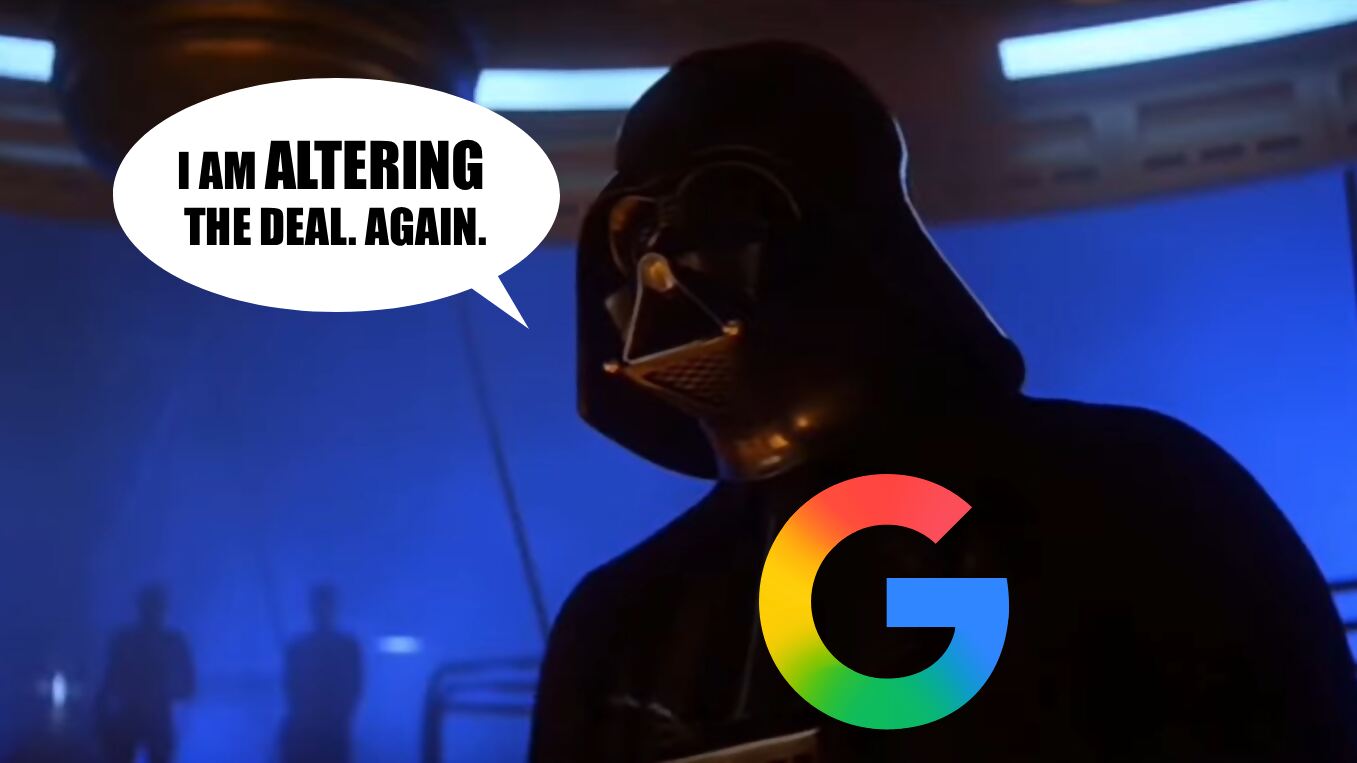
For too long, Google has been allowed to set the rules of the internet game and change them at a whim. We’ve all been Lando Calrissian, being flatly told by Darth Vader that the deal has been altered – and that we’d better pray it doesn’t get altered any further.
If there’s one good thing about the advent of generative AI, it’s that it has made some people with their hands on the lever of power wake up to just how formidable big tech has become; but if legislations and protections aren’t brought in soon, it’ll be too late. In that scenario, there’ll be nothing to stop Google Zero from happening – and the fight for the flow of information, whether it’s hard-hitting journalism or passionate little pieces about obscure, 43 year-old cult films, will be lost.
/**/