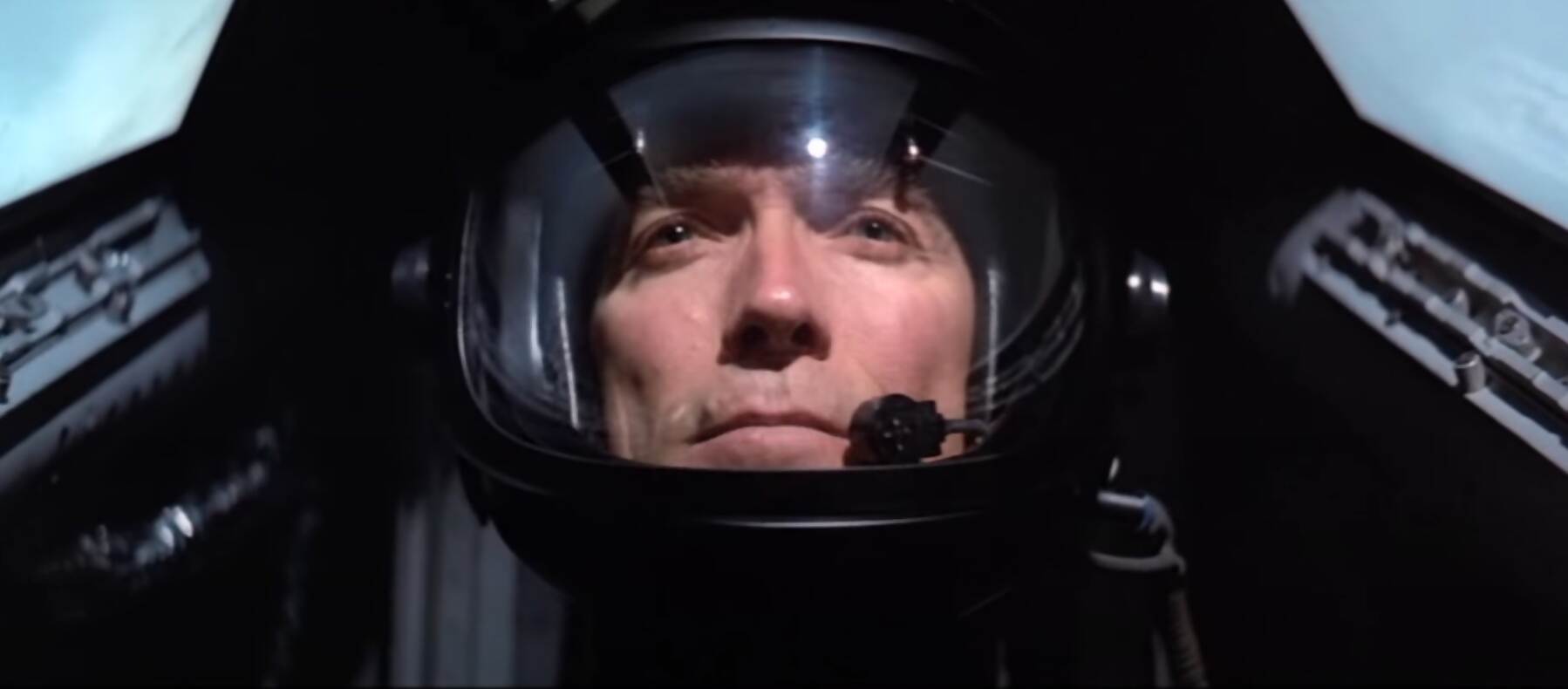
Clint Eastwood went out of his comfort zone to make Firefox in 1982 – a film still noteworthy for its groundbreaking visual effects. Star Wars proved that VFX shots could be movie stars. Although George Lucas’s 1977 space fantasy introduced some much-loved characters, and turned Harrison Ford into a screen icon, it’s telling that the ... Firefox | In 1982, Clint Eastwood made a risky foray into special effects movies
Clint Eastwood went out of his comfort zone to make Firefox in 1982 – a film still noteworthy for its groundbreaking visual effects.
Star Wars proved that VFX shots could be movie stars. Although George Lucas’s 1977 space fantasy introduced some much-loved characters, and turned Harrison Ford into a screen icon, it’s telling that the film’s eyeball-searing opening scene is comprised entirely of visual effects: the Tantive IV rushing away from the looming might of an Imperial Star Destroyer, its arrowhead shape whooshing overhead.
Thereafter, movie studios clamoured to replicate its success, leading to Alien, Moonraker and Star Trek: The Motion Picture in 1979, and an entire wave of effects-led movies in 1982, among them Blade Runner, The Thing, Star Trek II: The Wrath Of Khan, and E.T. The Extra-Terrestrial.
That same year, Clint Eastwood put aside the grisled cowboys and maverick cops that helped make him famous to direct Firefox – arguably the riskiest film of his directing career up to that point. As a director, he’d made thrillers of varying sizes (his 1971 filmmaking debut, Play Misty For Me, The Eiger Sanction, The Gauntlet) and westerns (High Plains Drifter, The Outlaw Josey Wales, Bronco Billy), plus a foray into romantic drama territory (1973’s Breezy).
Firefox, meanwhile, was not only far more expensive than anything Eastwood had made before (its budget eventually came to around $21m), but also more technically complex. Adapted from the Craig Thomas 1977 novel of the same name, it was a classic Cold War spy thriller with an added sci-fi twist: western intelligence agencies learn that the Soviet Union has quietly developed an advanced, thought-controlled stealth fighter plane. Alarmed at this technical breakthrough, veteran pilot Mitchell Gant – who happens to be fluent in Russian – is asked to sneak in, steal the plane and fly it to the west.
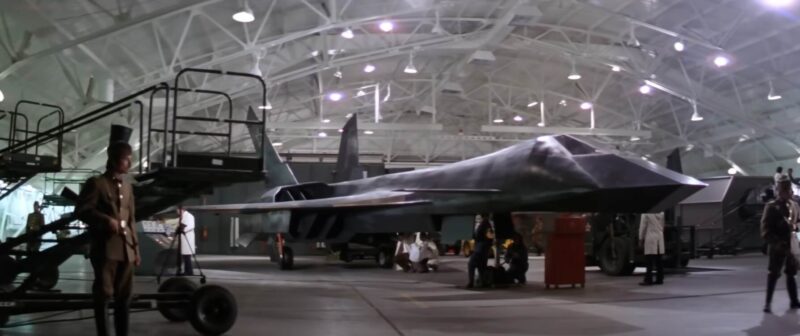
In adapting Firefox for the screen, Eastwood served as director, producer and star, casting himself as the solitary, PTSD-suffering Vietnam veteran, Major Gant. Given the amount of creative control Eastwood had – Firefox was produced through the star’s own company, Malpaso – it’s notable that he chose to lean into the project’s VFX-heavy potential rather than try to play it down.
According to a 1982 edition of CineFex magazine, screenwriters Alex Lasker and Wendell Wellman brought their adapted script to Eastwood in the late 1970s, around the time he was working on the primate comedy sequel, Any Which Way You Can. Eastwood was said to be impressed by the script’s pace – especially its second half which, like Craig Thomas’s original best-seller, was an extended aerial pursuit and dogfight, as Gant is chased by Soviet fighters and helicopters.
Recognising that Firefox couldn’t be made without a considerable amount of visual effects, Eastwood initially worked with Entertainment Effects Group – the studio run by 2001: A Space Odyssey and Close Encounters Of The Third Kind VFX maestro, Douglas Trumbull. Eastwood then began working closely with Trumbull, art director Bill Creger and miniature modelling specialist Greg Jein on what the titular aircraft should look like.
In Thomas’s novel, the plane is described as looking much like other Soviet fighter craft of its day; it was soon decided that the movie needed something more visually distinct. Eastwood was said to have been quite hands-on when it came to design; the reflective dark grey paintwork seen in the finished movie was based on one of his suggestions.
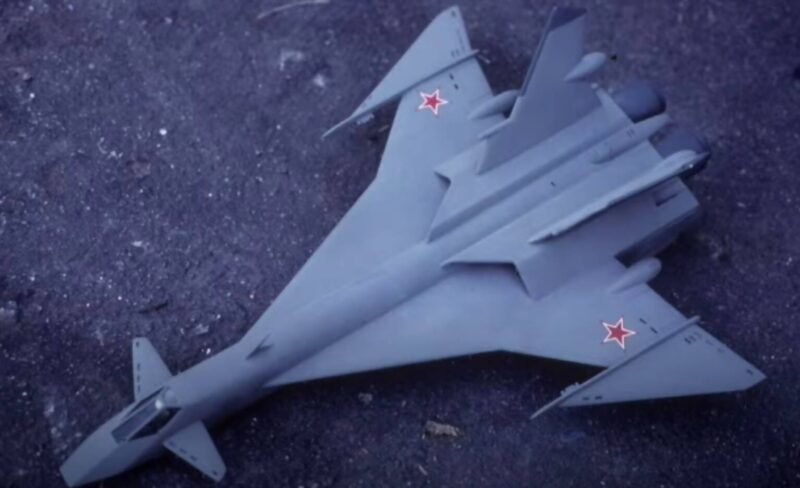
Trumbull and Eastwood continued to work on the look of Firefox for several months, resulting in numerous miniature prototypes. A shot of these, published in CineFex, shows how the design evolved from a rounded, organic style to the more angular version the production eventually selected.
Ultimately, Eastwood’s production parted ways with EEG, and the film’s VFX work passed over to Apogee, Inc – a studio owned by John Dykstra. (According to the 2011 documentary, Sense Of Scale, Trumbull was lured away to work on Blade Runner with Ridley Scott.)


Having cut his teeth on Douglas Trumbull’s Silent Running, Dykstra then led the effects team on Star Wars, before disagreements over the cost and production time of that film’s ground-breaking shots resulted in Dykstra’s departure. Dykstra’s construction of a then-new motion-control Dykstraflex camera system was undoubtedly pivotal to Star Wars’ creative success, however, and he continued to produce cutting-edge effects afterwards, having established Apogee in 1978. He worked on Universal’s TV series Battlestar Galactica (a space fantasy show that prompted Lucas and 20th Century Fox to sue Universal), and Star Trek: The Motion Picture before commencing work on Firefox in the early 1980s.
Although it wasn’t set in a galaxy far, far away, Firefox presented its own significant challenges. A sci-fi fantasy project leaves an effects artist with a certain level of creative freedom; an action thriller needs to at least consider the laws of physics, even if it does revolve around a fictional aircraft.
The amount of design, construction and ingenuity that went into creating Firefox’s 45-minute third act is remarkable. No fewer than 50 Firefox models were created for the movie, each a different size and created for specific situations. Among them were small, nine inch-long miniatures for wide shots, several measuring between 21 inches and 63 inches long for closer shots, and a full-sized version measuring some 62 feet long.
This latter model was essentially a gigantic, mechanical puppet. Containing a 1.6 litre Volkswagen engine, it was capable of taxiing at speeds up to 30 miles per hour and required five people to operate it. One person was hidden at the front, and tasked with steering the humongous prop; others operated the spoilers, flaps, air brakes and a pair of large heaters (taken from a hot air balloon) designed to simulate the haze of the MiG’s raging jet engines.
Four radio-controlled Firefox models were also constructed, though these weren’t ultimately used in the film. Two crashed during testing, and while the remaining two could fly – much time had been put into ensuring the Firefox design would work as a functioning aircraft – they went unused due to weather conditions on the film’s location shoot in Greenland.
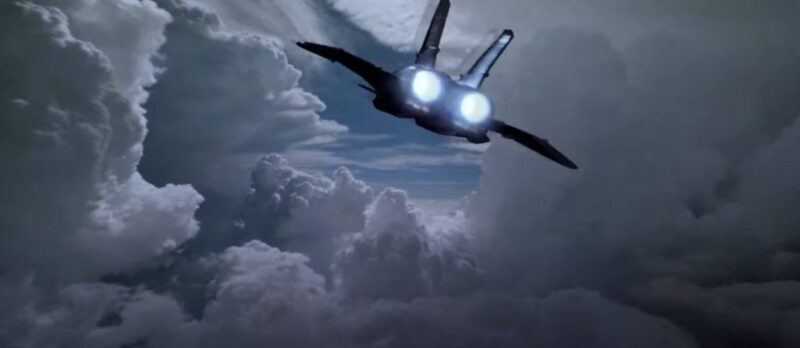
The bulk of Firefox’s aerial shots were achieved with motion-controlled cameras and miniatures. As Dykstra himself noted in a 1982 edition of Cinefantastique magazine,”Photographing a shiny aircraft is a theoretical taboo because a highly-reflective surface is a big problem in matte photography.”
Dykstra’s team therefore came up with a pioneering matting technique which involved coating miniatures with phosphorescent paint. When filmed under ultraviolet light, the model glowed, thus eliminating any pesky reflections from shiny surfaces and creating a solid outline which could be used in the final composite shot.
Apogee also came up with a system which allowed them to record the movement of a real-world aircraft. This could then be used to match up the movement of a miniature plane with its full-size counterpart.
As Apogee’s Mat Beck told CineFex, “The INS involves a system mounted inside an aircraft in which data regarding the plane’s altitude is fed through an interface box which then turns the aviation-type, synchro-altitude data into digital data, which an on-board Apple II computer can eat… Back at Apogee, we could then put the plates and INS data back together again, resulting in completely synchronised movement with our stage models.”
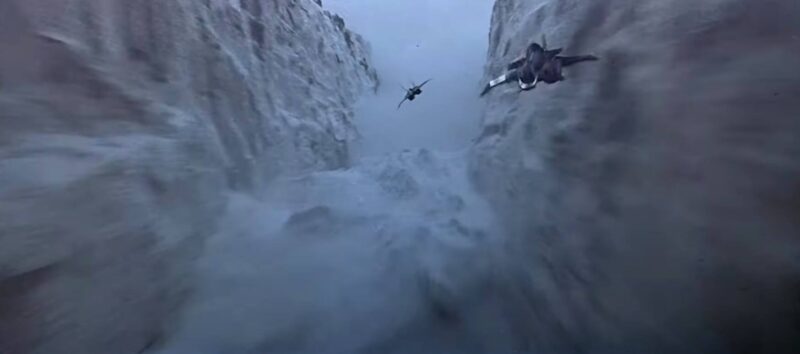
All this technical ingenuity came at a cost, however. The background plate footage and INS flight data was all captured from a Learjet flown by photographer and pilot Clay Lacy, which cost $1,200 an hour to keep in the air. All told, Firefox’s effects shots amounted to a considerable chunk of its $21m budget – and that cost made it one of the more expensive movies of 1982. It was behind Blade Runner ($30m) but well ahead of E.T. ($10m), The Wrath Of Khan ($12m) or The Thing ($15m).
Nor was Firefox a particularly big hit. Released in June 1982, it arrived when cinemas were positively swamped with other effects movies, and while it wasn’t an outright failure, nor did it do well enough to warrant further appearances from Major Mitchell Gant. Thomas had written a direct sequel to his hit novel with 1983’s Firefox Down, but it was never adapted into a movie.
The critical response to Firefox was mixed at the time, with some rightly picking fault with its lengthy 137-minute duration, and the length of time it takes Eastwood to finally steal the plane and take to the skies. In his new book Clint: The Man And The Movies, author Shawn Levy (not to be confused with the Free Guy filmmaker) argues that there’s “little magic in Firefox” and that Eastwood had “no feel for special effects.”
But while it might be true that Eastwood’s handling of Firefox’s thriller elements is somewhat pedestrian (not to mention downbeat), the sequences involving the aircraft itself are impressively done, especially given the filmmaking technology of the time. The sequence of the Firefox hurtling through snow-dappled mountains, achieved with a mixture of POV photography and miniature effects, is exhilarating – and the intercutting of Eastwood’s face, his visor reflecting the mountain ranges flickering past helps sell the illusion of supersonic flight.
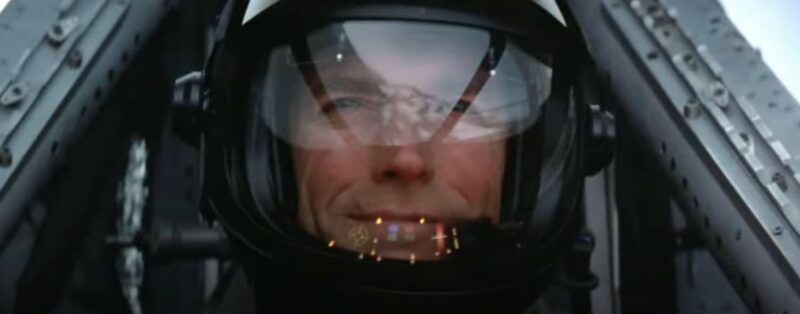
It’s possible that Eastwood himself may have felt a little out of his comfort making Firefox. “It was a challenge – more effects-driven than anything I’d done,” he said in 1982. “We had to create the whole thing – the jet, the effects, the environments. That was new for me. Usually I’m working with landscapes or cities. This was science fiction grounded in reality.”
Afterwards, Eastwood didn’t make anything as effects-heavy again for 18 years, with Space Cowboys in 2000. Even that film, about ageing pilots and astronauts charged with going into space to repair an ailing satellite, is more a drama than a high-speed action thriller.
Firefox is, therefore, a flawed yet fascinating diversion into a different filmmaking mode for Eastwood. It wasn’t Star Wars, exactly, but it was still one of those movies that regularly appeared on late night TV for decades afterwards. Then there’s the design of the Firefox craft itself. Taking its cues from real-world stealth planes like the SR-71 Blackbird and the Lockheed A-12, it’s as charismatic-looking and effortlessly cool as other fictional craft from the 1980s, whether it’s Blue Thunder’s experimental helicopter or Knight Rider’s talking Trans Am, KITT.
/**/