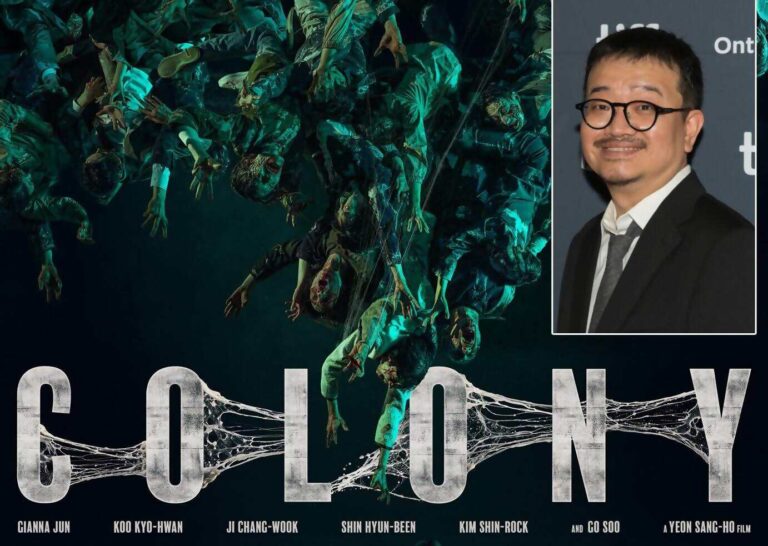
The maker of Train To Busan returns with a Colony, a new horror celebrating individuality in our chronically online, collective era. We talk to its director, Yeon Sang-ho: Ten years after Train To Busan first hit our screens with its infectious mix of apocalyptic horror, family drama and action, filmmaker Yeon Sang-ho has returned with ... Interview | “You have to protect the minority to survive” – Yeon Sang-ho on his new zombie movie, Colony
The maker of Train To Busan returns with a Colony, a new horror celebrating individuality in our chronically online, collective era. We talk to its director, Yeon Sang-ho:
Ten years after Train To Busan first hit our screens with its infectious mix of apocalyptic horror, family drama and action, filmmaker Yeon Sang-ho has returned with Colony, a poignant, grisly zombie tale that digs deeper into our age of hyper-connectedness.
With no direct link to Busan, the latest film from the South Korean director unfolds in a confined, Romero-esque setting, but taps into our modern fears of contagion in the post-COVID era.
Co-written with Choi Gyu-seok, Colony sees a biotech convention thrown into mayhem when terrorist Seo Young-cheol (Koo Kyo-hwan) unleashes a virus that creates voracious zombies. Trapped in a Seoul tower that winks at Die Hard’s Nakatomi Plaza, ostracised biotechnology professor Kwon Se-jeong (Gianna Jun) leads a group of survivors as authorities work to contain the outbreak from the outside.
“I am a really big fan of Romero’s Night Of The Living Dead because I think that at that time, zombie movies were able to catch the latent and biggest anxieties of that time,” Yeon tells us, adding that his film’s setting reflects “the real pandemic situation that we all experienced”.
“In this movie, you have a lot of references to films that I really like,” he continued.
“Of course, there are all the Romero’s movies, but there’s also Die Hard, partly because of the configuration, the setting of the building, the inside and the outside, and how people communicate. And regarding the story, there are also references to [The Poseidon Adventure] and Invasion Of The Body Snatchers.”
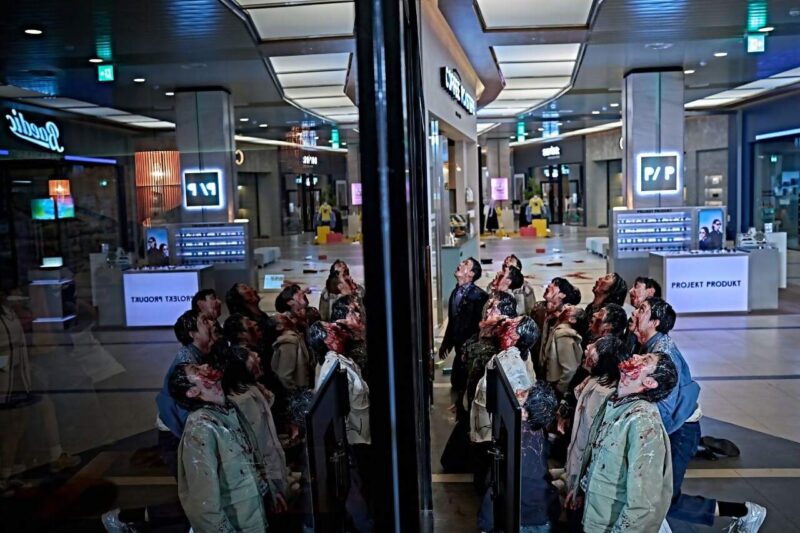
Colony’s tone and setting might seem familiar to fans of zombie flicks, but its undead make for a horde we’ve never quite seen before.
At a glance, these zombies may resemble those of Train To Busan – terrifyingly fast and prone to assemble in clusters of rotten flesh, but confused by darkness. But Colony’s infected have borrowed from the natural world the capacity to communicate with each other. The term describing this collective interaction is swarm intelligence, a concept that’s been applied to train AI.
“We all live in a very high-speed, exchange-of-information world, so there’s an ever-growing, rapid collectiveness,” Yeon says. “And, of course, our individuality becomes less and less important. There’s an erosion of individuality, so I wanted to represent that in a film, and that’s why Colony was made.”
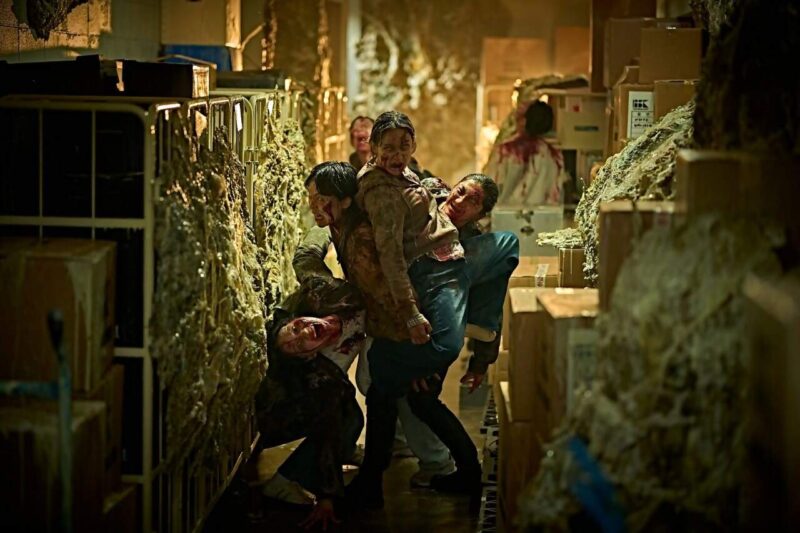
The zombies’ ability to evolve allows them to adapt to their surroundings at great speed. Yet, even this optimised operative system of walkers can be outsmarted by the one trait that’s profoundly, unmistakably human: unpredictability.
In Colony, we witness a clash between conflict and order, with the former represented by the survivors. The chaos of different voices poses an unexpected advantage against the hive mind, the film suggests, as the human gang also takes a page from biology when guarding their uniqueness.
“I learned that when you have a group or a horde of living organisms, sometimes when you find a weakness, the whole organism can be completely wiped out. So in order to survive, those organisms create their own mutation. They can still survive thanks to this mutation,” the filmmaker explains.
“So, for me, what was interesting was to compare this mutation to the minorities [in society]. You have to protect the voices of the minority in order to survive.
“I wanted to depict, on one hand, the collectiveness of the zombies, and, on the other hand, Professor Kwon Se-jeong, who is quite isolated and kind of an outcast.”

Alongside echoes of the COVID lockdowns and their oppressive climate of paranoia and suspicion, Colony also takes aim at AI’s single-mindedness.
“When you push the high-speed exchange of information to the extreme, you have AI. AI really represents that universality,” Yeon said, adding that the loss of distinctiveness in favour of mob mentality can be “dangerous”.
“I think I’ve always worked on the theme of humanity in all of my movies; I always had that in mind. And actually, the specificity of human beings, I think, is individuality.”
Touching more overtly on AI is Yeon’s next movie, Paradise Lost, premiering at Toronto International Film Festival (TIFF) in September.
Co-written with Ryu Yong-jae, the film adapts Oh Seong-eun’s novel Black Inferno and tells the story of a mother who resorts to an AI-generated version of her son after he mysteriously disappears.
When the now-adult son returns home, the protagonist can’t conceal her uneasiness at the friction between her grown-up kid and the AI programme she has consumed in his absence.
“Paradise Lost depicts the specificities, the characteristics of human beings, and our time,” Yeon says.
While AI is certainly a buzzy hook, the film is more interested in turning the spotlight to the bleakest nooks and crannies in the human psyche.
“I wanted to really go deeply into the darkness of the mind of human beings, what I would call the abyss of the human mind,” Yeon said.
“For me, this darkness is very specific to human beings, so, of course, AI is a theme in the movie, but the main focus was to go really deeply into the human mind for this.”
Colony is released in cinemas on 28th August. Paradise Lost will have its world premiere at Toronto International Film Festival in September.