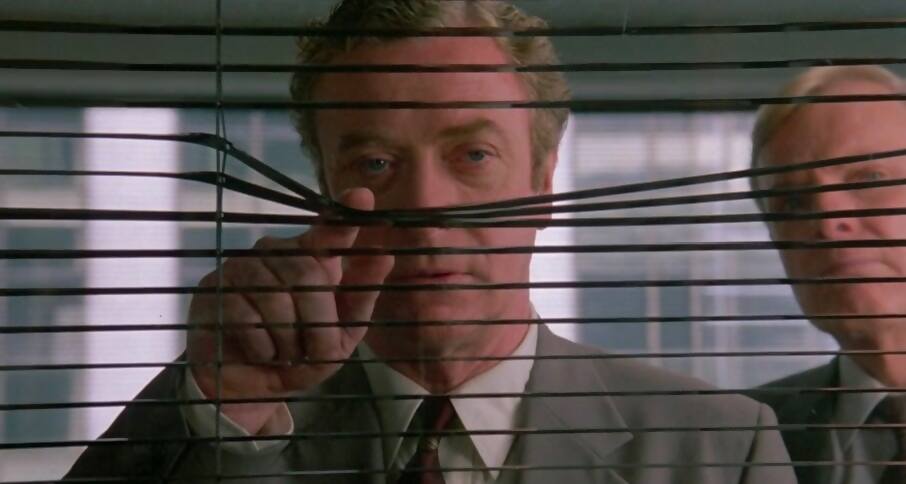
Does Michael Caine get away with murder in the 1990 thriller, A Shock To The System? Our latest entry in the series looks back. The 1990s were Caine’s last decade as a consistent leading man before he moved more permanently into supporting actor elder statesman territory. This decade features some of his most forgotten work, ... The 1990s films of Michael Caine: A Shock To The System (1990)
Does Michael Caine get away with murder in the 1990 thriller, A Shock To The System? Our latest entry in the series looks back.
The 1990s were Caine’s last decade as a consistent leading man before he moved more permanently into supporting actor elder statesman territory. This decade features some of his most forgotten work, but it also contains one of his most beloved and enduring roles as Scrooge in Muppets Christmas Carol, his second Best Supporting Actor Academy Award win for The Cider House Rules, a return to his iconic spy character Harry Palmer for two TV movies, the villain role opposite Steven Seagal in Seagal’s directorial debut and the role he was born to play, yes, Joseph Stalin. Join me as I delve into Caine’s 1990s to see what gems I can unearth and what’s perhaps best left hidden.
NB: Spoilers for A Shock To The System lay ahead.
Directed by: Jan Egleson (The Little Sister, Lemon Sky, The Blue Diner)
Tagline: He’s having the crime of his life. Killing is easy… getting away with it is murder.
Other featured geezers: Elizabeth McGovern as Stella Anderson, Peter Riegert as Robert Benham, Swoosie Kurtz as Leslie Marshall, Will Patton as Lt. Laker, John McMartin as George Brewster.
What’s it all about, Alfie?: A devilishly dark corporate satire. Caine is Graham Marshall, a middle-aged advertising executive, who resorts to murder after being passed over for the promotion that he believes he deserves. As his bloodlust appears to grow, and he gets away with more and more, where will it end for Graham? Prison or the corner office?
Caine-ness: Caine is first billed and the biggest star amongst the cast which, apart from Elizabeth McGovern who already had a few Hollywood hits and an Oscar nomination for her work in Ragtime (1981) in her back pocket, was comprised of primarily character actors.
A Shock To The System is centred on Caine’s unsavoury – but still charming thanks to Caine – character, Graham Marshall.
He’s the first person we see, searching around with a flashlight in his basement, and we hear his voiceover within the first few seconds; “It all began one night when the lights went out,” we hear him say, using his recognisable accent, over footage of a house, whose lights do indeed then go out.
Graham appears to be an everyday white-collar business guy. The kind who spouts sentences like, “Have we got the numbers back from the West Coast yet?” as soon as he walks into the office. He’s not even had time to sit down and already he’s been accosted with the “results of the great Kentucky gelatine wars.”


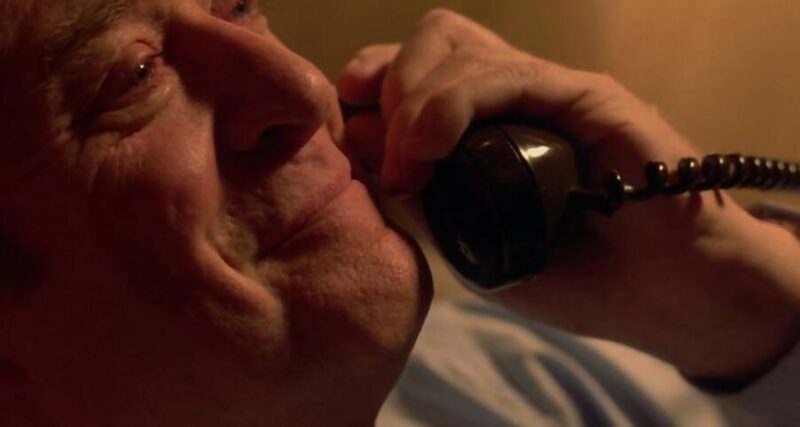
He’s seemingly normal and well liked at work – until he gets an electric shock from a dodgy light fitting, the titular shock to the system (and the title card comes up at this point to confirm this, in case you had any doubts), that propels him across his basement.
Whether he always had darkness in him, or the electric shock scrambled his brain, is unclear. But we see, as the movie progresses, that Caine is playing a massive wrong-un. A complete sociopath who, after committing a spot of accidental manslaughter when he pushes a homeless man in front of a subway train, develops an unremorseful taste for murder.
The first death was a total accident and, for a start, there’s a sense that Graham feels regret. “Had he really killed a man? He wanted to run away from himself as if he’d split into two pieces, him and the murderer,” Graham says in his voiceover. But then, after facing no repercussions, he doubles down on his crimes.
“He kept expecting a bolt of lightning to come out of the sky and strike him dead. But it never did. All he felt was good, clean, free.”
Graham says and Caine adds a nasty little growl when saying “free”, indicating Graham now fully embracing his dark side. You can tell Caine is having fun playing this unrepentant blighter.
Next up on Graham’s hit list is his annoying wife. He sets up an elaborate series of events that will lead her to electrocuting herself while he has the alibi of being away on a business trip.
“Oh my god, what a shock,” he says, and has to stop himself laughing, when the police ring to inform him of his wife’s death.
Other things that demonstrate how massively dodgy Graham is, to various extents, include when he’s at Stella’s place and she asks for music requests, he says, “anything with a saxophone”, which shows very odd taste. Also – which may be a tad worse – when he drugs her wine to knock her out in order to use her as an alibi. But worst of all is the fact that he keeps talking about himself in the third person. Only complete psychopaths would do that.

There’s a nasty edge to Caine in this, and we get more than our fill of shouty Caine. When he finds that a colleague’s desk has been added to his formerly private office, he confronts his new boss, Bob. He comes in shouting, but then manages to compose himself, with a barely contained bubbling anger underneath, but his composure makes him all the scarier as he seethes, “Let me tell you something Bobster. You don’t know the first fucking thing about power. I have more power in this hand than all of you fucking know.”
And if you didn’t think all of that makes him off-putting enough, Graham keeps using magic terms. “Abracadabra,” he says to himself in his car after his wife’s funeral, gesturing with his hands like a stage magician, convinced he has some innate power that helps him get away with his crimes.
After he’s had sex with Stella, while Bob’s sail boat is exploding elsewhere, she exclaims “that was magic”. He in return says “bibbidi-bobbidi-boo” and does a magician gesture with his hand. She doesn’t notice this, luckily for him, because if seeing that didn’t give her the ick then I’m not sure what could.
We eventually hear Graham’s backstory, what led him to crave money and status. Hs father was a London bus driver (an explanation for why he has his signature Caine accent) who, when growing up, used to take Graham over to Mayfair, where the rich people lived, and told him that there isn’t a heaven, and living in Mayfair is the closest he could get. Life there was sweet, whereas life where they came from was hard. Perhaps things would have turned out better if his dad had taken him to London Zoo or Chessington World of Adventures instead.
Caine is excellent in this, deftly juggling the tones, at times genuinely menacing and at others wryly amusing. It’s due to Caine’s charm that, as an audience, we’re never fully repulsed by Graham. There’s part of us that wants to him get away with it.
Caine-nections*: This is the second film in a row, after Jekyll And Hyde, where the character Caine plays commits, or nearly commits, manslaughter by pushing someone in front of public transport (he pushes a girl in front of a carriage in that one but she luckily survives).
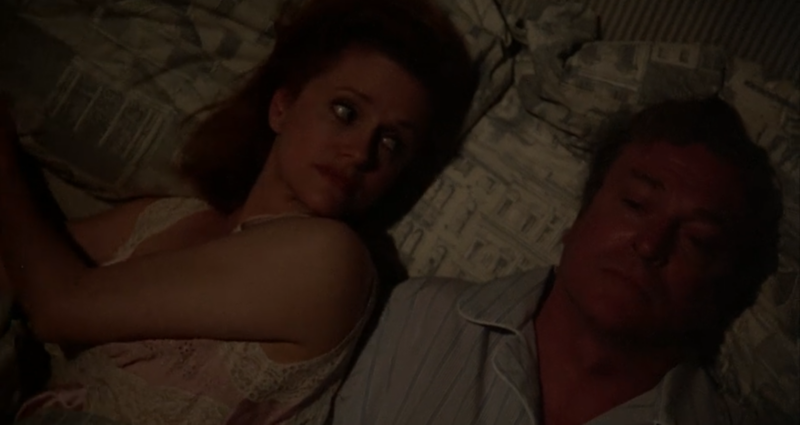
Best Non-Caine Actor: A young Elizabeth McGovern (now perhaps best known for Downton Abbey) is the second biggest name after Caine. As sadly seems to be a theme with many of the films I’ve been looking back at, it’s not a particularly interestingly role for the female lead, but McGovern is bright and chirpy and lights up the screen during her scenes. However, her romance with the much older Graham is not believable. McGovern and Caine have a fun, friendly chemistry, but I’m not sure I ever bought that she’d have the hots for Caine’s dad bod (no offence to Caine, he was still looking great but nevertheless…).
Peter Riegert, perhaps best known at that point for his roles in Animal House (1978) and Local Hero (1983), is Graham’s smarmy rival who boasts about having a boat and a hot young girlfriend called Tara “not the plantation”.
“Suppose if we were rival princes I could just have you killed,” he says with a smug laugh to Graham after he gets the promotion, not realising that he’s giving Graham a good idea.
The delightfully named Swoosie Kurts is Graham’s nagging wife. Just like Riegert, she’s the right level of annoying that you don’t entirely lose sympathy with Graham when he bumps her off. Their marriage seems like a nightmare, filled with petty bickering about stair machines. “Don’t use the quiet voice Graham, it’s just the same as yelling” she snaps at him during one of their many disagreements, causing him to then break out his signature Caine yelling.
In some ways, A Shock To The System feels like a bizarro episode of Columbo. Graham is the typical Columbo villain, a smug white-collar killer who thinks he’s untouchable. The Columbo character here is Will Patton’s dogged cop Lt Laker, but unlike Peter Falk, he fails to find any incriminating evidence that sticks.
The first scene with Laker, who pesters Graham with a bee in his bonnet about one little detail that doesn’t add up regarding his wife’s death, the single piece of electrical tape that wasn’t dusty, which a calm Graham casually dismisses with a flimsy excuse (he’d noticed the tape was loose and tied the new bit around recently, and he wishes he’d done a better job), could be taken directly from an episode of the iconic 70s “How Caught ‘em” series.
As could the scene where Laker casually wanders into Graham’s apartment out of the blue to ask further questions whilst Graham is watching a news report about Bob’s boat explosion.
Also, like Falk, Laker has a unique shabby visual trademark that could cause you to underestimate him; in Laker’s case it’s a really terrible haircut. But in Laker’s case, you’d be estimating him correctly as he’s not actually good enough to collar the crook.
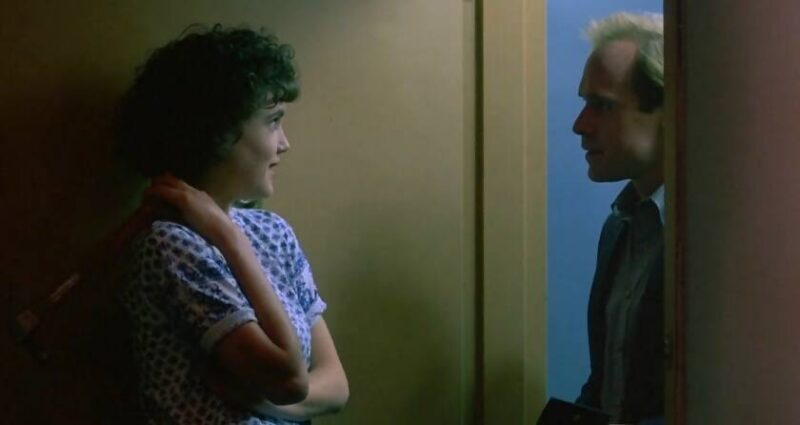
Trivia (Courtesy of IMDB): Samuel L Jackson appears briefly as a three-card monte dealer on the street, with one quick line of dialogue, whom Stella passes near the start of the film. One IMDb user didn’t find this helpful, but I did, as I completely missed him when I was first watching this.
The Sopranos’ Vincent Pastore can be seen shoving past Michael Caine at the beginning of the movie at Grand Central Station.
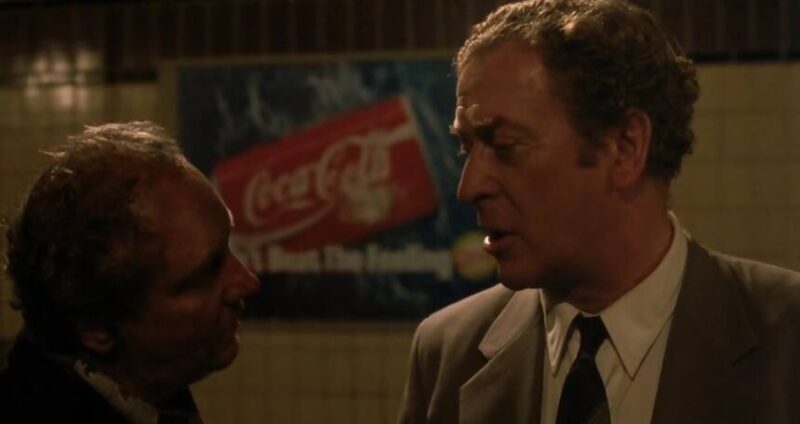
Most Unconventional Placement for a Coke Ad: It gets suprisingly prominent placing at the scene of Graham’s first murder, and then again when he’s threatening Stella with a potentially similar fate at the end. After a busy day of manslaughter, why not relax with a cool glass of Coca-Cola Classic!
Overall Thoughts: This is based on a 1984 novel of the same name by prolific British crime fiction writer Simon Brett, perhaps best known for his series of books about amateur sleuth Charles Paris. It’s not to be confused with the 2006 film of the same name which, according to Wikipedia, is a “gay-themed mystery film.”
This is arguably the highest profile work from American director Jan Egleson, even though it’s a relatively obscure entry in Caine’s filmography. This is a well executed, entertaining film, and so it’s a pity Egleson didn’t achieve a higher profile as he clearly was talented. Egleson doesn’t even have a Wikipedia page, and even the dog from The Artist has his own Wikipedia page (RIP Uggie).
Egleson’s earlier films were gritty indie dramas about troubled teens including 1988’s Lemon Sky in which star Kevin Bacon, playing “Alan”, met his wife Kyra Sedgwick. So, he may not have his own Wikipedia page but Egleson did help incubate a lasting Hollywood romance – Bacon and Sedgwick are still together at the time of writing.
On IMDb under “other works”, the concert video “Squibnocket” for James Taylor is listed, and IMDb also informs us that Egleson’s height is 5’7 and a half inches, which isn’t particularly useful to know, but I’ve told you now anyway just in case. More interestingly, he played “Pale Kid” in The Friends Of Eddie Coyle. He had range. Give him a Wikipedia page, Jimmy Wales!
After A Shock To The System, Egleson mostly worked in television, with his last credit being 2003’s TV movie Coyote Waits with the genuinely intriguing synopsis; “Two tribal cops uncover a plot involving a lost fortune, an historical artifact and a mythical coyote on a Navajo reservation.”
Having seemingly said everything he had to say with Coyote Waits, Egleson is now currently an Associate Professor of the Practice at the Boston University School of Film and Television, where he runs the Graduate Program in Cinema and Media Production. There is a nice illustration of him looking sad with a cup of coffee on his personal website.
Caine said in a 2002 interview with Venice Magazine that this was “a lovely little film, but it was too small for its own good, really. It got lost. It was the sort of film, were it made today, that would be great as a film for HBO, or something. But at the time, it just got lost in the system.”
The score is interesting, quite erratic, with lots of instruments chucked into the mix. The music is credited as being provided by Turtle String. If they were actual turtles that would somewhat explain the choices. Don’t get me wrong, I’m not saying those turtles aren’t talented – just not necessarily the most conventional thinkers musically.
There’s a seam of pitch-black humour running throughout. There aren’t many loud guffaws – it’s not that sort of comedy – but plenty of wry smirks, such as when Graham scatters his wife’s ashes and gets them blown back into his face.
There are some great dramatic moments, too. The scene where Graham’s wife blows the fuse and approaches the deadly lightbulb is incredibly tense. However, the tensest moment was unplanned, as it’s when a big horrible spider is crawling up Laker’s suit sleeve unbeknownst to him or Will Patton. It creeped me out.
The film kept me guessing as to how it would end, and I appreciated the appropriately dark and cynical denouement which differs from the novel, in which Graham gets caught, but here he gets the coveted corner office, finally reaching the top of his corporate world, and all his crimes go unpunished.
Overall Thoughts: A solid, dark comedy thriller with a delightfully devilish central performance from Caine.
Rating: 4/5 Shocks (to the system)
Where You Can Watch This: This is currently available to watch for free on Prime Video, or to rent or buy digitally from the usual places. It seems to be out of print on physical media, but DVDs are available on eBay for a reasonable price.
Up Next: Caine teams up with his old pal Roger Moore for a lot of silly business in Michael Winner’s comedy Bullseye! Will it hit the spot?