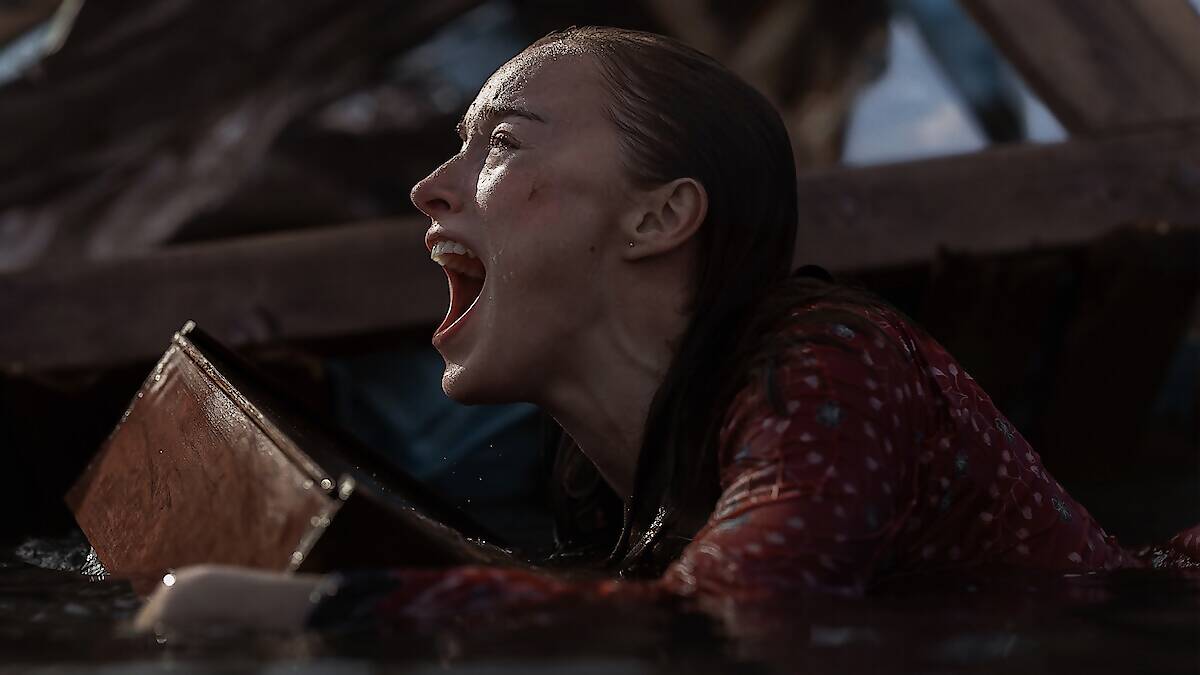
There are sharks in the kitchen as the ridiculously fun disaster film Thrash swims onto Netflix. “Bull sharks – hyenas of the ocean!” “This is the way the world would end in film after film,” author Tom Shone wrote in his book, Blockbuster. “Not with a bang, nor a whimper, but a wisecrack.” Shone was ... Thrash, now on Netflix, is the best sharks-in-the-kitchen thriller you’ll see in 2026
There are sharks in the kitchen as the ridiculously fun disaster film Thrash swims onto Netflix. “Bull sharks – hyenas of the ocean!”
“This is the way the world would end in film after film,” author Tom Shone wrote in his book, Blockbuster. “Not with a bang, nor a whimper, but a wisecrack.”
Shone was referring to Independence Day – director Roland Emmerich’s 1996 sci-fi disaster spectacle which, he said, “ushered the blockbuster into its late, decadent, self-parodic camp phase.”
I mention this because Thrash, a new disaster-survival flick just released on Netflix, looks and sounds uncannily like a film released in that late 90s era. It has a high concept (sharks attack a flooded American town!), plenty of equally improbable action, and dialogue that reminds us that the filmmakers are in on the joke (“Bull sharks, yes… the hyenas of the ocean”).
Produced by Sony Pictures, Thrash was originally conceived as a theatrical film for the summer; instead, it’s been quietly sent straight to streaming. Had it been released 30 years ago, director Tommy Wirkola’s shark film probably would have gotten its moment on the big screen.
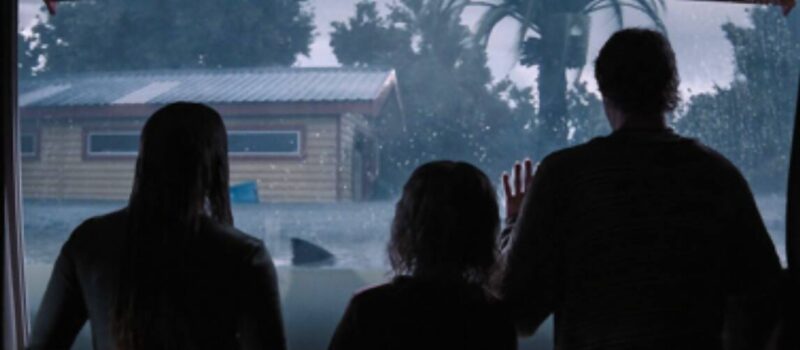
Like the cycle of disaster movies released in the 1970s, Thrash features an ensemble cast of characters thrown into a nightmare situation. The “Ted Bundy” of hurricanes has struck America’s east coast, all but drowning the small town of Annieville in several feet of water.
Among the survivors are the heavily-pregnant Lisa (Bridgerton’s Phoebe Dynevor), the agoraphobic Dakota (Whitney Peak) and a trio of kids living with a pair of foster parents so horrible, they could have been written by Roald Dahl. Overseeing the proceedings is Dr Dale Edwards (Djimon Hounsou), a marine biologist who rushes to the rescue as a huge shoal of hungry bull sharks descends on Annieville.
The whole film is disarmingly ridiculous. The sharks are attracted to the town by a juggernaut filled with gallons of pigs’ blood, which gets caught up in the flood water and breaks open like a squashed tomato. (The words “McKay’s Meats” are printed on the side of the truck – a nod to exec producer Adam McKay. We’re guessing he was impressed by the film’s vague environmental theme.)
As the waters rise and fleshy humans scramble for a dry spot, a newscaster says on a nearby television, “Write your phone number on your arm in permanent marker so you can be IDd when they find your body.”
Now, this might sound like The Asylum’s Sharknado cycle of zero-budget disaster films. The difference with Thrash is that it’s been shot and lit by filmmakers who genuinely know what they’re doing. Tommy Wirkola, the Dead Snow and Violent Night filmmaker who writes and directs here, stages some quite imaginative set-pieces. The visual effects, for the most part, are really good.
Of the three groups of survivors Wirkola keeps flipping between, the foster kids have the most exciting predicament. Teenager Ron (Stacy Clausen) and siblings Dee (Alyla Browne) and Will (Dante Ubaldi) are stuck in their awful guardians’ home as it’s consumed by the deluge. It doesn’t take long for the sharks to start sniffing around.
There’s a genuinely tense, well-framed moment where Dee stands on a kitchen worktop, stretching across to shut the back door, only for a shark to barge through the opening. There’s another where Ron has to swim into the basement to retrieve some beefsteaks and a box of dynamite.
(Stacy Clausen is a really good actor; his startled delivery of the line, “Mr Olsen – we were just talking about you” is a pitch-perfect comedy moment.)
Coming second in our ad-hoc ranking of Thrash’s plot strands comes Dakota, the chronically anxious niece of Hounsou’s Dr Dale. She helps rescue Lisa from her stricken Mini Cooper, and the pair then try to figure out how on earth they can deliver Lisa’s baby amid rising waters and gnashing sharks’ teeth.
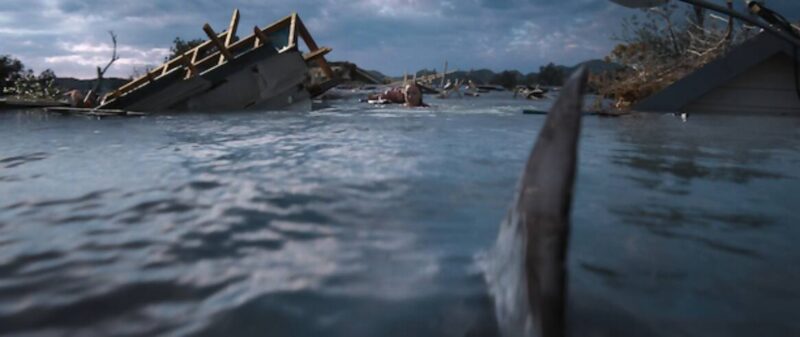
There’s a fascinating tension to this part of the film, because it seems as though Wirkola has written himself into a corner. Surely, we might think, there’s no possible way to stage a plausible outcome here.
Without spoiling things, there really isn’t a way to stage a plausible outcome for a woman about to give birth in shark-infested real estate, but Wirkola clearly has fun playing with the sheer absurdity of the situations he’s engineered.
Hounsou has less to do, having been mostly sidelined into exposition duty. But he also gets to ride around on a motor boat with a small group of secondary characters, one of whom is named Joe Sprinkle. That Hounsou seems so uncomfortable, like an actor wondering when he can find a minute to call his agent, only adds to the entertainment value.
Dr Dale’s motivation for becoming a marine biologist is also, frankly, wonderful, and has something to do with a childhood encounter with a hippopotamus. “I became really interested in this creature that put fear in the eyes of the river hippo,” he says, with all the solemnity he can muster (which isn’t much).
In 1975, we got Robert Shaw delivering his unforgettable USS Indianapolis speech. In 2026, we get Djimon Hounsou reflecting on the time he saw a shark bite a hippo. That’s progress.

Sony Pictures, evidently, didn’t have much faith in Thrash. Take out the credits, and its runtime is all of 72 minutes, which suggests that it might have been edited down to the bone in post-production. Its cinema release was delayed from August 2025 to July 2026, then it was flogged off to Netflix.
There have also been multiple title changes. It was filmed as Beneath The Storm, then changed to Shiver (the collective noun for sharks) and was also called The Rising for a while. It changed so often that Phoebe Dynevor joked earlier this month, “This movie is hilarious. I now just call it “the shark movie” with everyone in my life because it’s gone through so many titles.”
Sony’s loss, it turns out, has been Netflix’s gain. Thrash is currently number one in the streamer’s UK top 10. Not far behind it is Ben Wheatley’s shark-adjacent action thriller Meg 2: The Trench, which appears to suggest that there’s an audience sitting at home, hungry for wilfully silly shark disaster flicks.
In 2024, the similarly toothsome Under Paris (sharks up the Seine!) notched up 84 million views on Netflix in its first month alone. A sequel is currently in the works.
Elsewhere, Deep Blue Sea director Renny Harlin is returning to similar waters with Deep Water in May. British filmmaker Johannes Roberts is at the helm of his own shark-based mini-franchise, with the third film in the 47 Meters Down series, subtitled The Wreck, currently being directed by Patrick Lussier.
(Roberts is on board as co-writer and producer. “God bless the sharks,” he told us wistfully earlier this year.)
When Tom Shone wrote about self-parodic, camp blockbusters in his 2004 book, he wasn’t exactly celebrating the likes of Independence Day, Armageddon and Twister. But Thrash is a reminder of why these kinds of movies hold such an appeal. They may defy logic, they may be ridiculous, but the best self-aware disaster films create an alternate reality where seemingly anything can happen, no matter how outrageous it might be.
An unabashed B-movie, Thrash may also have invented a new twist on an old adage: when in doubt, just add sharks.
Thrash is available now on Netflix.