There was a rush to make a Total Recall videogame in time for Christmas 1990 – but chaos behind the scenes saw one version scrapped… Total Recall, released in the summer of 1990, told the tale of Douglas Quaid, a construction worker living in 2084. Quaid has been having recurring dreams of life on Mars, ... Total Recall | How a 1990 videogame tie-in was made in just one week
There was a rush to make a Total Recall videogame in time for Christmas 1990 – but chaos behind the scenes saw one version scrapped…
Total Recall, released in the summer of 1990, told the tale of Douglas Quaid, a construction worker living in 2084. Quaid has been having recurring dreams of life on Mars, meeting the same beautiful woman every time. Quaid wants to go to Mars, but his current salary would never cover the costs. Instead, he visits the company Rekall, which promises the next best thing: an implanted memory of a perfect Martian holiday tailored to his specifications.
During the implant procedure, however, something goes wrong. It transpires that Quaid has already been to Mars, but has had all memory of a previous life as a secret agent wiped. An action-packed and startlingly violent adventure ensues.
Directed by Paul (RoboCop) Verhoeven, the film was a loose adaptation of the short story We Can Remember It For You Wholesale by science fiction author Phillip K Dick. Another of his novels, Do Androids Dream of Electric Sheep? was famously adapted into the sci-fi classic, Blade Runner.
Before it appeared in cinemas, Total Recall had spent many years in development hell, with the story rights first being acquired by young producer and screenwriter Ronald Shusett in 1974. We aren’t here to explore that film story, but it’s interesting to note that David Cronenberg spent time developing a script. Also, it almost started production in the 1980s, with Patrick Swayze in the lead and Bruce Beresford directing.
It was Verhoeven who successfully shepherded the sci-fi thriller to the big screen, however, which resulted in a Total Recall tie-in videogame – a common occurrence for blockbuster movies in the 1980s and 1990s. And in the UK, at least, the Manchester-based studio Ocean Software was the most prolific maker of games based on films. For those of a certain age, that name alone will probably bring back memories of gaming in the late 20th century.

From the early 80s onwards, Ocean found success in making licensed games based on various film and TV titles: among its earlier such games were The NeverEnding Story, Rambo: First Blood Part II and Miami Vice. In 1988, it took a chance on RoboCop, acquiring the licence based on a reading of the script alone.
The resulting game was a huge success, becoming the best-selling home game of the 1980s. It was especially popular in the UK, where the ZX Spectrum version resided in the top ten gaming charts for 18 months.
This didn’t go unnoticed at Warner Bros, which offered Ocean the chance to make a game based on a little upcoming film called Batman in 1989. The game was another huge hit across multiple home computers.
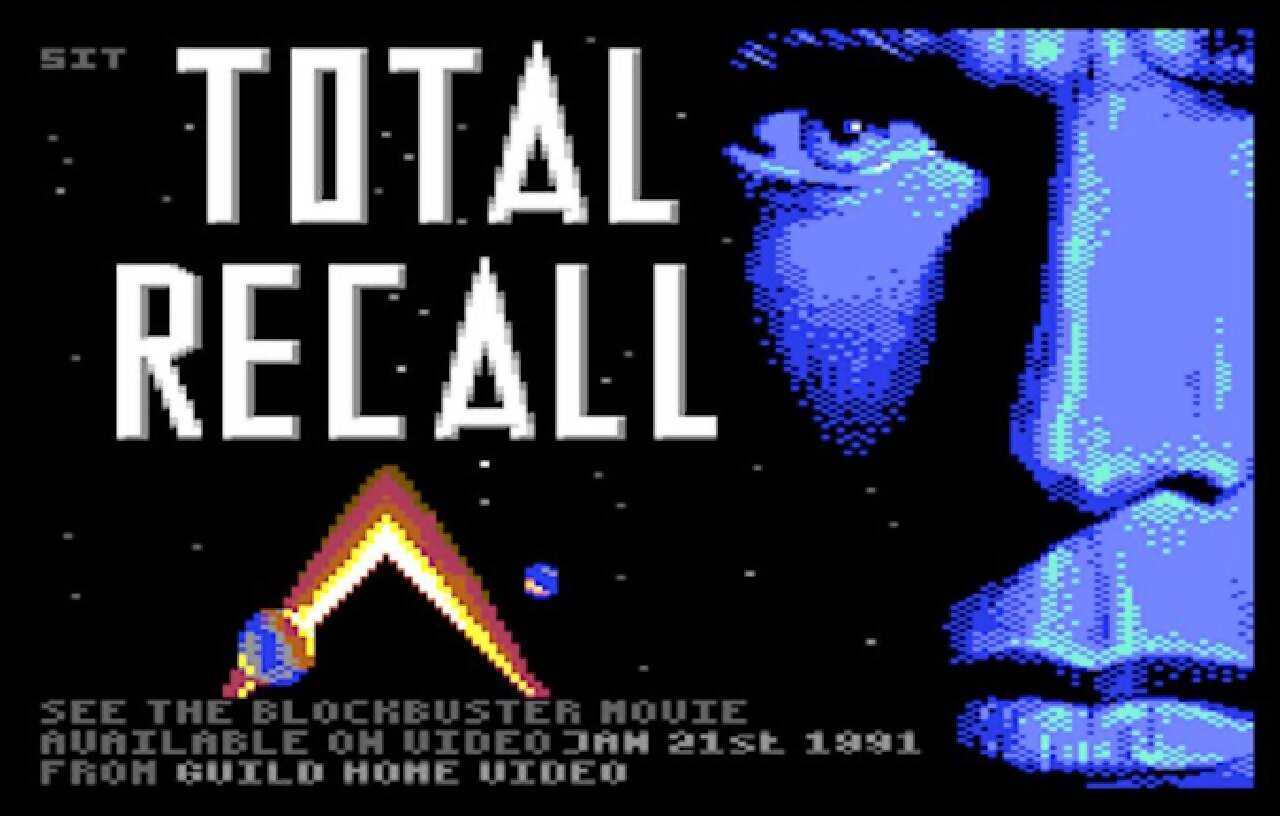
So it comes as no surprise that Ocean acquired the rights to Total Recall and aimed to get a game released for Christmas 1990, hoping to sell copies on the hype of the film due to be released that summer.
And that’s exactly what Ocean did. The Commodore Amiga and Atari ST versions of Total Recall were released just in time for parents to pick up the game for their children and place copies in their Christmas stockings. (Never mind that this was a game based on an incredibly bloody 18-rated film; again, such things were common in the 1980s and 90s.)


Suggested product
Issue #60 Magazine Bundle (3x Covers: A Scanner Darkly Magazine + 1991 + Roger Deakins)
£14.99
The 8-bit versions of the game for the ZX Spectrum, Commodore 64 and the Amstrad CPC 464, however, arrived too late to hit the shelves that Christmas. Years later, it transpired that there had been serious production problems behind the scenes.
Despite Ocean developing much of its software in-house, it decided to outsource the Total Recall licence to a new developer, Active Minds, headed up by Dave Colley and Alison Kelly. Not only was Active Minds working on Total Recall, but also Gazza II, a football game based on the licence of British athlete Paul Gascoigne.
Total Recall made one of its first public appearances when it was previewed in the October 1990 issue of the Commodore 64 magazine, Zzap! 64. According to the article, Active Minds had just moved into new offices, although what wasn’t mentioned was that it was located just a few minutes’ walk from Ocean’s headquarters.
Of Total Recall, Colley said, “We came up with a spec which Ocean liked the look of. There have been one or two changes as we’ve gone along, but mainly we’ve been left alone. It’s really great to have that sort of freedom.”
As it will turn out, perhaps too much freedom.
To help with the game’s development, Colley added, “We had a copy of the script from the start so we knew where we were going. Then we went to a special showing in London to check the backgrounds, though they weren’t all that imaginative anyway!”
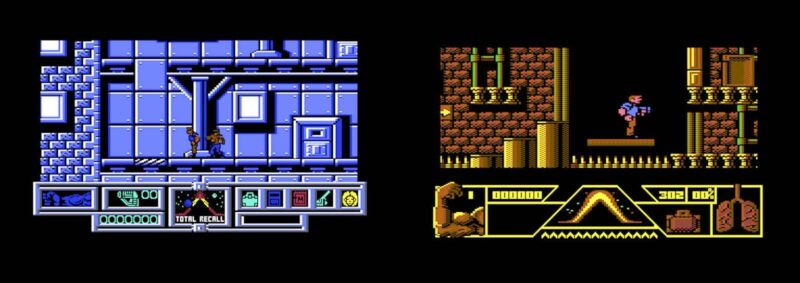
The article contains three screenshots, one from the Amiga game – which looks identical to the version later released – the others from the Commodore 64 version. With hindsight, we can see that this version bears no resemblance to what arrived in stores a few months later.
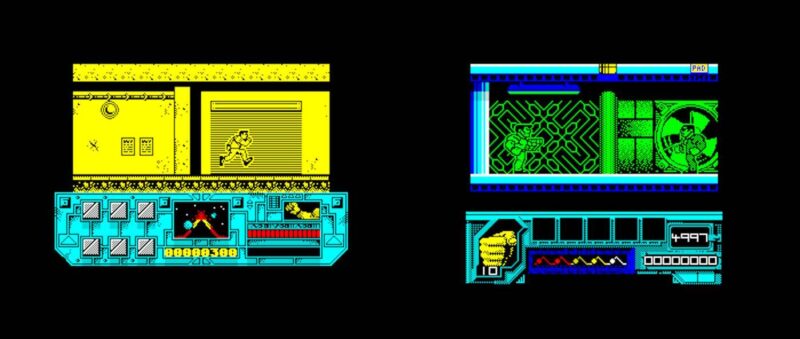
Meanwhile, in Spain, an independent magazine dedicated to the ZX Spectrum, Micro Hobby, included a cassette on its cover, just like every other 8-bit magazine of the time. But for the November 1990 issue, it included a rolling demo of Total Recall as developed by Active Minds.
A rolling demo was somewhat of a disappointment to gamers back then, as the software essentially played itself. You could only watch the game to get an idea of what the finished product might be like. This was the forerunner to watching videos of games, which was something that could only be done if a magazine decided to include a VHS tape on the cover – which, incredibly, did happen from time to time.
Turn to page 36 of the same Micro Hobby issue that gave away the rolling demo, and there’s a review of this version of Total Recall, which awards it 75%. Amusingly, the magazine gave the sound a score of 70% when the rolling demo is completely silent.
In other words, the magazine wrote a review without ever having played the game in question. It’s something Mark R Jones, who once worked at Ocean Software, pointed out in a 2017 YouTube video; for years, it was thought that this was the only version of the unreleased Total Recall available.
Dedicated fans have archived Spectrum software over time, so this rolling demo was easily available. One such person, Adrian Singh, presumably having watched the video, hacked the code and made the demo playable (albeit with bugs and graphical glitches etc). Jones made a follow-up video, now being able to play the demo level.
Meanwhile, the website Games That Weren’t has spent years documenting and archiving games that were never completed, released or just early prototypes.
After seeing the preview of Total Recall in Zzap! 64, they also realised that another, unreleased version of the game existed. Over the years, the graphical assets of the ZX Spectrum version previously mentioned have been recovered from a developer, along with a playable version of the original Commodore 64 developed by Active Minds.
The aforementioned graphics artist Simon Butler also contributed his version of the Total Recall story, and it’s well worth reading in his own words on the Games That Weren’t website.
According to Butler, Active Minds was run by people who had no previous games industry experience. Once Butler came aboard, he was stunned by the lack of content that had been created for Total Recall up to that point. Not only were the graphics at a level that Butler considered subpar, but the coding wasn’t up to scratch, either. Everyone seemed to be taking the boss for an easy ride. Butler also alleges that the lead graphics artist, when he bothered to show up for work, smoked a controlled substance in the office.
Butler informed those in charge about the reality of the situation. The smoking artist was fired, and the rest of the team were told to shape up or ship out: there was a deadline to meet. To hire a new team at such a late stage would be unworkable.
Word of the production issues was passed through to the project manager at Ocean Software, but as it transpired, the news never went any higher. Butler could see that Total Recall was at last beginning to take shape, but it wasn’t in a state where it would be ready for Christmas. So he went and informed the head of Active Minds, which led to a heated argument which saw Butler hand in his resignation.
Butler made the short walk to Ocean’s offices and told the head of development the entire story. He’d been blissfully unaware of what had been happening, as the project manager hadn’t been telling him the truth. Butler offered to help save the project by working with members of Ocean Software that he had collaborated with before, along with a few more reliable members of staff from the Active Minds team.
The Atari ST and Commodore Amiga versions were completed by Active Minds as planned. Butler and his team created a brand-new version of Total Recall for the Commodore 64 in just two weeks. The ZX Spectrum and Amstrad CPC versions took a week each.
The deadlines were met, and Ocean Software had another hit title on its hands for Christmas 1990. But only just.